
B2B SaaS SEO and AEO Strategy for Modern Growth
Master our proven B2B SaaS SEO and AEO strategy. Learn to optimize for Google and AI engines to drive qualified pipeline, authority, and measurable revenue.


For a B2B SaaS company, a combined SEO and AEO strategy isn't just a good idea anymore—it's your new cost of entry. It's the only way to survive. This approach merges traditional Search Engine Optimization (SEO) to win on Google with Answer Engine Optimization (AEO) to become the citable source for AI models like ChatGPT.
The New Reality of B2B Search Beyond Google
The way B2B decision-makers find and vet new software has been completely upended. For years, success meant one thing: ranking on the first page of Google. Today, that's just the baseline.
True success now means being the definitive answer everywhere a potential customer looks for information—from traditional search engines and AI assistants to industry forums and software marketplaces. This shift demands a far more sophisticated approach to being found online.
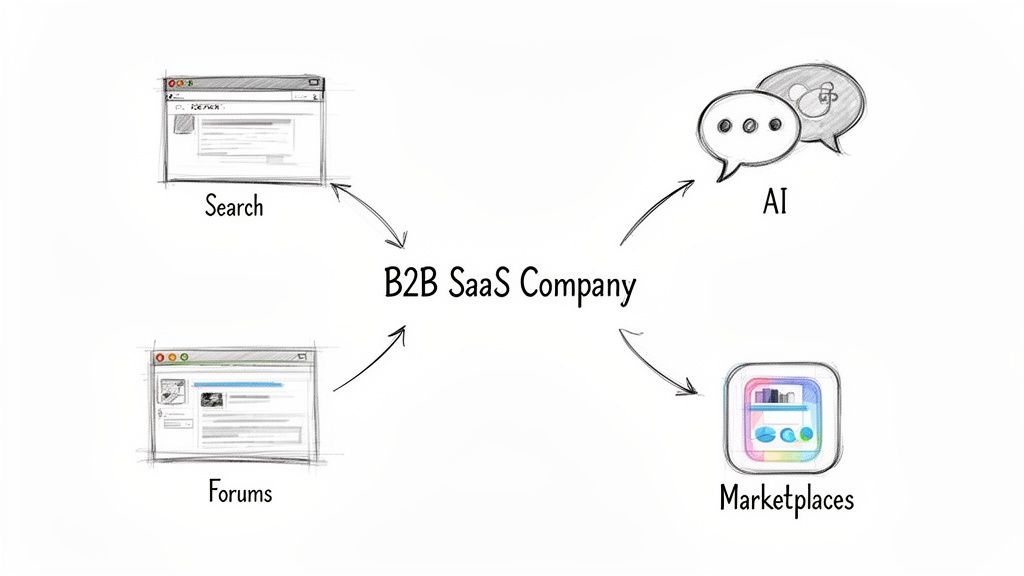
For B2B SaaS, FinTech, and AI companies, this new reality is both a threat and a massive opportunity. If you ignore it, you risk becoming digitally invisible as buyers increasingly turn to AI for quick, synthesized answers. But if you embrace it, you can influence high-value buying decisions before a prospect even thinks about visiting your website.
Defining Your Dual-Visibility Strategy
Think of SEO and AEO as two sides of the same coin. You can’t have one without the other in 2026. They work in tandem to guarantee your brand is present at every single stage of the modern buyer's journey.
Search Engine Optimization (SEO) is your foundation. It’s the time-tested practice of structuring your website and content to rank high in traditional search engine results. The goal here is simple: attract qualified traffic by answering user queries with relevant web pages.
Answer Engine Optimization (AEO) is the advanced layer built on top. This is about making your brand, your data, and your expertise so clear and authoritative that AI models and answer engines cite you as their source. The goal here is to build brand authority and influence decisions inside AI-generated summaries and conversational answers. To go deeper, check out the multi-LLM optimization playbook.
This integrated strategy is non-negotiable. While organic search is still a core driver, the game has changed. Getting cited by an AI has become just as critical as earning a top spot on Google.
Why This Matters for B2B SaaS Right Now
Organic search is still king, and the budgets reflect that. It still accounts for 26.4% of all B2B website traffic, and a staggering 61% of marketers call it their top inbound marketing priority. This has led to projections of a 7.2% increase in SEO spending by 2026.
But here’s the catch: the rise of AI assistants means just ranking isn't enough anymore.
When a CTO asks an AI for the "best data security platform for a hybrid workforce," your brand absolutely has to be in that answer. AEO is what ensures you are part of that high-intent conversation, capturing buyers who now rely on AI for their initial vendor shortlists. This is the very core of a modern B2B SaaS SEO and AEO strategy.
Understanding How SEO and AEO Work Together
Thinking of SEO and AEO as separate disciplines is a critical mistake. They’re two sides of the same coin—essential parts of a modern strategy for getting found and trusted online. One gets your brand seen; the other gets your brand cited.
SEO is about building a well-oiled machine to win on Google's traditional results page. AEO is about becoming the definitive answer wherever your buyers are asking questions, especially on AI platforms. You need both.
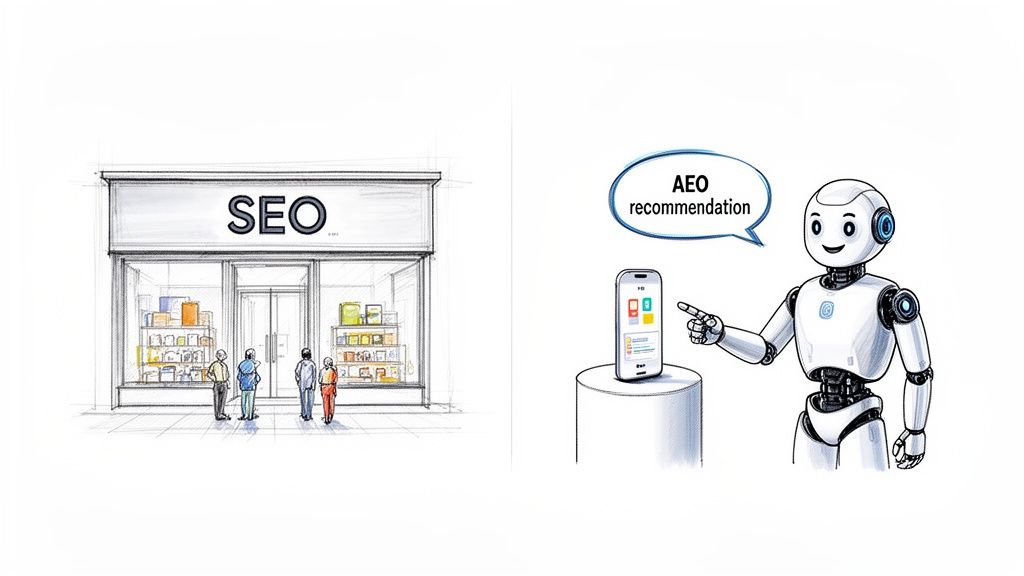
Here's a better way to think about it. Traditional SEO is like optimizing your storefront on a busy street. You use bright signs (title tags), compelling window displays (meta descriptions), and a clear layout (site architecture) to pull foot traffic from the millions of people walking by. The goal is to get them to click and walk into your store.
Answer Engine Optimization (AEO), on the other hand, is about becoming the go-to recommendation for every expert concierge in town (the AI models). Here, the goal isn't just to be seen—it's to be named as the best solution when a high-intent buyer asks for a direct answer.
Goals and Optimization Targets
The core objectives are what really set them apart. SEO is a game of rankings and traffic. AEO is a game of citation and influence. Understanding this is the key to allocating your resources correctly.
- Traditional SEO is focused on winning high rankings on search engine results pages (SERPs) for a specific set of keywords. You’re optimizing for Google’s ranking algorithm.
- Answer Engine Optimization is focused on becoming the trusted, citable source for AI-powered answer engines. You’re optimizing for the large language model (LLM) that synthesizes information to create a direct response.
This means SEO remains heavily keyword-centric, while AEO is fundamentally entity-centric. An entity is just a clearly defined concept—your company, your product, a specific feature, or even your CEO. AEO demands that you make these entities and their relationships crystal clear so an AI can understand and cite them with confidence.
Want to go deeper? Our complete guide explains what Answer Engine Optimization is and the framework behind it.
A Practical Comparison of SEO and AEO
Let's break down exactly how these two approaches differ for a B2B SaaS company. The nuances here are what separate a modern growth strategy from one that’s already falling behind.
| Dimension | Traditional SEO (Search Engine Optimization) | AEO (Answer Engine Optimization) |
|---|---|---|
| Primary Goal | Achieve high rankings in search results to drive organic traffic to your website. | Become the cited source within AI-generated answers to build brand authority and influence. |
| Optimization Target | Web pages are optimized around keywords and user search queries. | Your brand, products, and expertise are optimized as clear, verifiable entities. |
| Success Metrics | Organic traffic, keyword rankings, click-through rate (CTR), and on-site conversions. | AI citations, brand mentions in AI outputs, referral traffic from AI, and branded search uplift. |
| Content Focus | Create comprehensive, engaging content that satisfies a searcher's intent on your site. | Structure content for machine readability with direct, extractable answers for AI models. |
This table clarifies the tactical split. SEO focuses on getting users to your site, while AEO ensures your brand is the answer, whether a user clicks or not. Both are vital for capturing B2B buyers at every stage of their research journey.
Think about a query like "best CRM for small businesses." SEO works to get your blog post ranked on Google. AEO works to get your SaaS product named in the AI-generated paragraph that answers the question directly. One drives a click; the other builds instant authority.
Why AEO Is Your New Competitive Advantage
For any ambitious B2B SaaS company, thinking of Answer Engine Optimization (AEO) as an optional add-on is a huge mistake. Traditional SEO gets your brand on the map, but AEO inserts you directly into the high-stakes consideration phase. It turns your brand into a trusted recommendation from an AI assistant. This isn't some future trend—it’s happening right now and actively reshaping the B2B buyer's journey.

This shift is all driven by the rapid rise of AI-generated summaries and zero-click searches. These features give users direct answers on the search results page, which often means they never need to click through to a website at all. For a B2B SaaS business, that trend threatens the very foundation of traditional organic traffic models.
Navigating the Threat of Zero-Click Searches
The data paints a pretty clear picture of this new reality. While B2B SaaS companies enjoy an impressive average SEO ROI of 702%, a massive challenge has emerged. AI Overviews and other answer-driven features now result in zero-click searches for 47% of results.
This can slash click-through rates for top organic listings by as much as 70%. The old model is breaking. It's a clear signal that we have to evolve beyond a simple traffic-based strategy.
This is exactly where a robust B2B SaaS SEO and AEO strategy becomes your competitive moat. When traffic is no longer the main measure of success, influence becomes the new currency. AEO is how you build that influence directly within AI-powered answers.
Imagine a CTO asking their AI assistant, "What is the most secure data warehousing solution for a regulated industry?" If your platform is cited by name in the AI's response, you have bypassed the entire traditional sales funnel and entered the final consideration set instantly. This is the power of AEO.
Building Authority Through AI Citations
An AI citation is so much more than a mention; it’s a powerful endorsement. When an AI model like ChatGPT or Google’s Gemini recommends your product, it gives you a level of third-party validation that's incredibly hard to get through normal marketing. It positions your brand not just as an option, but as the authoritative answer.
This has a direct impact on your sales pipeline by:
- Driving Pre-Vetted Leads: Prospects who find you through an AI recommendation show up with a high level of trust and purchase intent.
- Influencing High-Value Deals: A single citation can influence a multi-million dollar decision by putting your brand in front of key stakeholders at the exact moment they need a solution.
- Building Unmatched Brand Authority: Consistent citations establish your company as a category leader, creating a compounding effect on brand recognition and credibility.
To really capitalize on this shift, optimizing for advanced strategies like AI Visibility for Software Development Companies is critical for gaining an edge. AEO isn't just about protecting your brand from traffic loss; it's about seizing a new opportunity to dominate your market in an entirely new arena of search. It makes sure that when your ideal customer asks for a solution, your name is the answer.
Building Your Unified SEO and AEO Framework
Moving from theory to a revenue-generating machine requires a system, not a collection of random tactics. A winning B2B SaaS strategy for Google and AI search isn't built on guesswork; it's a structured framework where every stage feeds the next.
Think of it like building a high-performance engine. You don't just throw parts on a workbench. You assemble them in a specific order to create a system that works in perfect harmony. This unified framework ensures your SEO efforts directly fuel your AEO goals, creating one powerful engine for total visibility.
Here’s how we break it down into four interconnected phases.
Conduct a Foundational Visibility Audit
First, you have to know where you stand. Before you can build, you need a clear-eyed assessment of your current position across both traditional search and AI platforms. This audit is designed to uncover the critical gaps and opportunities you’re likely missing.
A proper audit should give you direct answers to these questions:
- Google Visibility: Where do we actually rank for our core commercial and informational keywords? What’s our true market share of voice against our top three competitors?
- AI Visibility: When a prospect asks ChatGPT or Perplexity about the problems we solve, does our name come up? Or are our competitors getting cited as the go-to solution?
- Entity Gaps: Do AI models and search engines clearly understand who we are, what we do, and why we’re an authority? Is our brand entity a jumbled mess or a clear, consistent signal?
This audit isn't about creating charts that sit in a folder. It provides the data-driven foundation for your entire strategy, showing you which assets are already working and where you are actively ceding ground to competitors in AI-driven conversations.
Achieve Entity and Schema Mastery
Once you know where you stand, the next step is to make your website perfectly legible to machines. This is where you master your entities and deploy schema markup. An entity is any distinct concept—your company, your products, your CEO—and schema is the code that explicitly defines them and their relationships for search engines and AI models.
This process is like handing an AI a structured encyclopedia about your business. Instead of forcing it to guess, you're giving it a detailed, machine-readable guide. You're explicitly stating, "This is our company, these are our products, and here is why we are the credible expert on this topic."
For example, using Organization schema helps AI models instantly understand key details about your business.
This structured data clearly defines properties like your legal name, logo, and social profiles. It removes all ambiguity and builds the AI's confidence in your brand as a verifiable, trustworthy entity.
Develop an AI-Centric Content Strategy
With your technical foundation locked in, the focus shifts to content. An AI-centric content strategy isn't about writing for robots. It’s about creating expert-led, comprehensive answers for your human audience that are so good, AI models have no choice but to cite them.
The goal is simple: become the most reliable source of information in your niche.
Key elements of this strategy include:
- Answering Questions Directly: Structure your content with clear questions as headings and provide concise, factual answers right underneath. This makes your core insights easily extractable for AI Overviews and chatbot answers.
- Building Topic Clusters: Develop deep, comprehensive hubs of content around the critical problems your customers face. Answer the main question, then answer the dozens of related sub-questions to signal undeniable expertise.
- Prioritizing Freshness: Regularly update your most important content with new data, fresh insights, and current examples. AI models and Google both favor information that is demonstrably up-to-date.
This approach ensures your content isn't just valuable for a reader who lands on your page, but also perfectly formatted to be used as a source in an AI-generated answer, putting your brand in front of buyers at their point of need.
Execute Authority-Driven Link Building and PR
Finally, you have to prove your authority with external validation. Both Google and AI models rely heavily on signals from other trusted sources to verify your credibility. An authority-driven outreach plan focuses on earning mentions, links, and citations from websites that AI models already see as trustworthy.
This isn't just about chasing backlinks for "link juice." It's about getting your brand and expertise featured in the industry reports, expert roundups, and high-authority publications that were used to train the major AI models in the first place.
Each earned mention on a reputable site acts as a vote of confidence, corroborating the claims you make on your own website. For a more detailed look at how these pieces fit together, you can explore The Dual Visibility Framework, which provides a system for building this kind of integrated authority.
This final step solidifies your position as a definitive source, ensuring you are not just visible, but cited as the answer.
How to Measure Success in the Age of AI
So, how do you prove the ROI of a strategy that has one foot in traditional Google search and the other in AI answer engines? When success is no longer just about clicks, your measurement playbook has to change. A modern B2B SaaS strategy needs a blended approach to tracking performance, one that connects what you do directly to pipeline and revenue.
This means moving past legacy metrics that only tell half the story. You need a new set of KPIs that prove you’re building influence and authority where B2B buyers are actually doing their research—inside AI chatbots.
This unified process shows how moving from an initial audit to full-blown authority directly drives measurable returns.
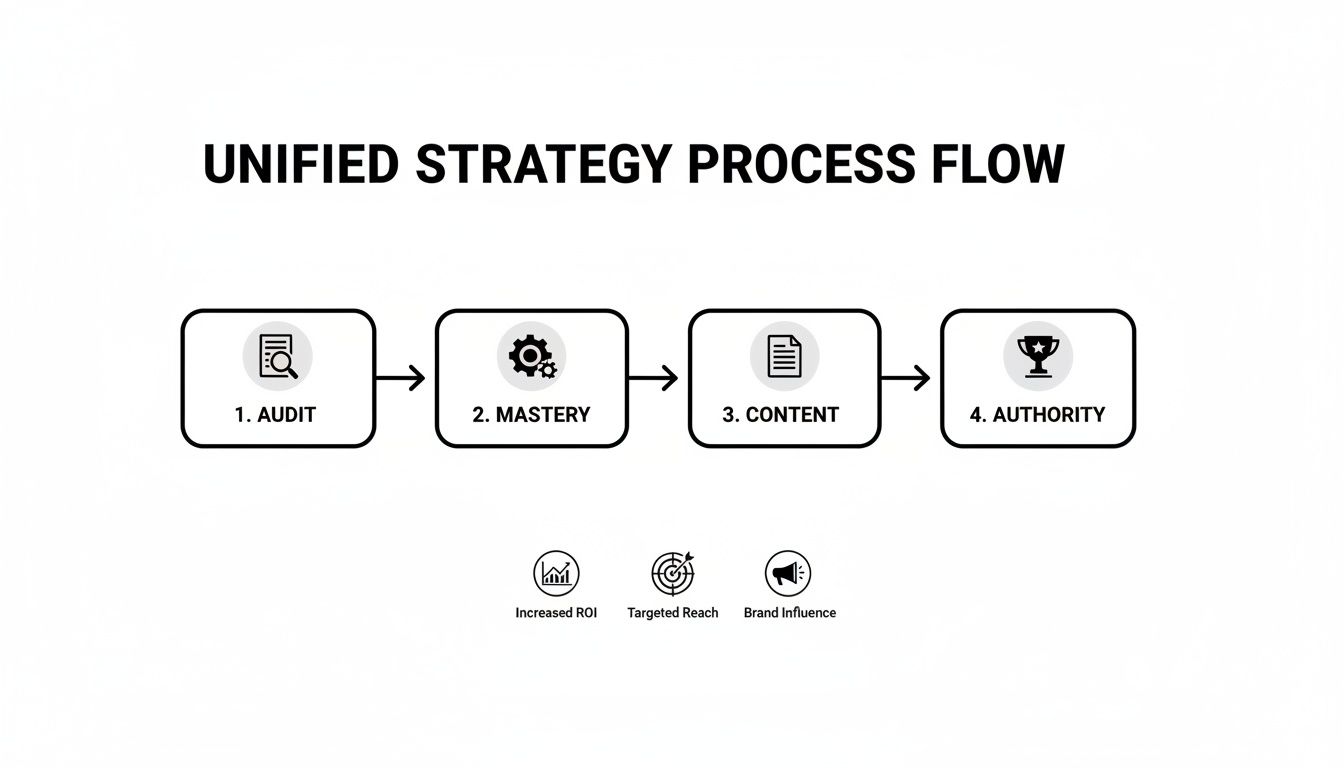
The flow is simple: a solid audit builds the foundation for content mastery, which in turn establishes the authority that leads to real ROI. It’s a system, not a series of one-off campaigns.
Key Performance Indicators for SEO and AEO
To get the full picture, you have to track metrics for both your SEO and AEO efforts. This table breaks down the core KPIs for each strategy, showing how they connect back to tangible business growth.
| Strategy | Primary KPIs | Secondary KPIs | Business Impact |
|---|---|---|---|
| Traditional SEO | Organic Traffic & Conversions | Keyword Rankings, Share of Voice (SOV) | Increases top-of-funnel awareness, drives qualified website traffic, and generates leads/demos. |
| Answer Engine Optimization (AEO) | AI Citations & Mentions | Referral Traffic from AI, Branded Search Uplift, Featured Snippet Ownership | Builds brand authority, influences pre-website research, and captures high-intent users directly from AI answers. |
By tracking both sets of metrics, you can tell a complete story about your organic presence, from initial discovery on Google to authoritative mentions in an AI chat that convinces a buyer to seek you out directly.
Old-School SEO KPIs That Still Matter
First things first: SEO and AEO are connected, but they have distinct success metrics. The SEO KPIs you're already familiar with are still the bedrock of your program. They focus on traffic, rankings, and your visibility on the SERP.
- Organic Traffic and Conversions: This is still the gold standard. How many qualified users find you through search, and how many of them actually sign up, book a demo, or make a purchase?
- Keyword Rankings: Monitoring your position for high-intent commercial and informational keywords is non-negotiable. If you’re not on page one, you’re not in the game.
- Share of Voice (SOV): How visible are you across your core topics compared to your direct competitors? This tells you if you're gaining or losing ground in the market.
These metrics are crucial because a strong SEO foundation is what fuels your AEO performance. But they only show what happens when someone clicks.
The New Frontier: Measuring AEO Impact
To measure your AEO work, you need to track how your brand, products, and experts are showing up inside AI answers. These metrics prove you're becoming the go-to source in your category.
The goal is to build a single dashboard that reports tangible results to the C-suite—one that proves your efforts are shaping high-value decisions long before a prospect ever lands on your website.
Here are the AEO metrics you need to start tracking now:
- AI Citations and Mentions: This is the big one. Track every time your brand, products, or key personnel are cited in AI-generated answers for your target queries. You can do this manually or with emerging AEO tools.
- Referral Traffic from AI: When an AI chatbot cites your website, it often includes a link. Use custom UTM parameters on your content to pinpoint clicks that come directly from these AI-driven referrals.
- Branded Search Volume Uplift: As more people see your brand cited as an authority in AI answers, you’ll see an increase in users searching for your company by name. This is a powerful signal of growing influence.
- Featured Snippet and "People Also Ask" Ownership: Dominating these SERP features is a strong leading indicator of AEO success. Why? Because LLMs often pull their information directly from these snippets to form their answers.
A dashboard that blends these traditional and emerging KPIs tells the full story. It lets you connect your brand's growing authority directly to business growth. For a more detailed breakdown, you should learn how to measure AEO results with the right metrics and tracking stack.
Proven B2B SaaS SEO and AEO Strategies in Action
Frameworks on a whiteboard are one thing. Seeing a combined SEO and AEO strategy deliver real-world pipeline is another. These aren't abstract concepts; they are the exact tactics that drive measurable growth when you get the execution right.
Let's move past the theory and into what’s actually possible. We’ll look at tangible examples that show how B2B SaaS companies are winning this new game by turning their expertise into authority that AI engines trust and cite.
Dominating Niche AI Queries
Imagine a B2B SaaS company trying to own a high-intent query like, “best project management software for remote teams.” A unified strategy doesn’t just write a blog post. It builds a machine-readable asset that AI models see as a definitive source.
Here’s how they’d do it:
- Entity-Rich Content: The article wouldn’t be a simple list. It would deeply profile each tool—including their own—as a distinct entity, covering features, pricing, and specific use cases for remote work.
- Precise Schema Markup: The page would use
FAQPageschema to explicitly answer questions like, “Which PM tool is best for async collaboration?” andComparisonorItemListschema to structure the recommendations so an AI can parse it instantly. - Authoritative Signals: The content would be written by a recognized project management expert, feature quotes from industry leaders, and link out to original research on remote team productivity.
This layered approach gives AI models a high-confidence, well-structured source to pull from when they synthesize an answer. The result is a direct citation that places the company's product at the top of the list.
The Staggering Results of AEO
The outcomes from a focused AEO initiative aren't just small wins; they can fundamentally change your acquisition model. Case studies show that when a B2B SaaS company masters this strategy, the results directly impact the bottom line.
For example, one company saw 560% more clicks from AI Overviews in just 60 days by optimizing existing content to provide direct answers. Another generated 5.13K ChatGPT referrals that led to 101 conversions in only two months.
These are not vanity metrics. These are highly qualified buyers who found a brand through an AI recommendation and were ready to act. It's the direct result of turning expertise into a citable source. For B2B SaaS brands, a crucial piece of the puzzle is learning how to humanize AI text for SEO so your content performs well for both search engines and human readers.
A Practical Blueprint for Your SaaS
These examples give you a clear blueprint. Start by figuring out the most critical questions your prospects ask right before they pull out their credit card. Then, build the single most authoritative, well-structured answer on the internet for that question.
This isn’t just about writing a blog post; it’s about creating a strategic asset. You can find more specific tactics in our guide, The AEO Content Checklist.
By combining deep content, sharp technical optimization, and strong authority signals, your SaaS can stop just appearing in search results and start being the definitive answer your customers are looking for.
Frequently Asked Questions
B2B leaders often have the same sharp questions about marrying SEO and AEO. Here are the straight answers you need, based on what actually works in the field.
How Long Until We See Results From AEO?
Everyone wants to know the timeline. While foundational SEO is a long game—think 6-12 months for significant returns—AEO can deliver wins much faster. You can start seeing AI citations and direct referrals from chatbots within 2-4 months.
These early victories usually come from retrofitting your existing high-performers. Take content that already has solid authority, then arm it with precise schema and extractable, machine-readable answers. It's a quick way to get on the board.
But don't mistake quick wins for the whole game. This is about building a durable system of authority that consistently wins in both traditional search and AI. That's a strategic commitment, not a short-term project.
Can We Manage A B2B SaaS SEO and AEO Strategy In-House?
Running an integrated strategy in-house is possible, but it requires a very specific, senior-level skill set that most teams just don't have under one roof. You'd need a single person with deep, hands-on expertise across:
- Technical SEO and site architecture.
- Advanced entity optimization and schema implementation.
- AI-native content strategy built for machine readability.
- High-authority digital PR and strategic link building.
That’s a rare combination. Most internal marketing teams can't cover that much ground. A hybrid model is a much more common path to success. Partnering with a specialized consultant or fractional leader gives you a proven framework and expert guidance, freeing up your in-house team to focus on execution—without the high overhead of a full-service agency.
What Is the Biggest Mistake to Avoid with AEO?
The single biggest mistake is treating AEO as a separate tactic that replaces SEO. Answer Engine Optimization is the evolution of SEO, not its successor. It’s built on a strong SEO foundation.
This is the key takeaway. AI models and traditional search engines rely on the same core signals of trust: high-quality, expert-driven content, a technically sound website, and authoritative backlinks from reputable sources. Anything less is a house of cards.
A winning strategy for B2B SaaS is always a unified one. Your SEO efforts should directly fuel your AEO goals, creating a powerful flywheel of visibility that captures buyers on every platform they use to find answers.
Ready to build a durable system of authority that makes AI models cite, quote, and recommend your brand? Austin Heaton can help. Learn more about creating a unified SEO and AEO strategy that drives real revenue at https://austinheaton.com.