
7 Best SEO Consultant for FinTech Companies in 2025 (A Tactical Roundup)
Searching for the best SEO consultant for FinTech companies? Explore our tactical roundup of 7 top options with comparisons, pricing, and case studies.



Finding the right SEO expert for a FinTech company is fundamentally different from hiring for e-commerce or SaaS. Your industry operates under a unique set of pressures: intense competition for high-value keywords, strict regulatory compliance, and the absolute necessity of establishing trust with a discerning audience. Standard, one-size-fits-all SEO strategies don’t just underperform; they can be a liability. For instance, a generic SEO tactic like guest posting on low-authority blogs will fail to build the necessary E-E-A-T (Experience, Expertise, Authoritativeness, Trustworthiness) signals Google requires for financial topics. You can't afford to get this wrong when customer finances are on the line.
A generic consultant might focus on basic on-page tactics, but a FinTech specialist understands the nuances of building topical authority around complex subjects like investment algorithms, decentralized finance, or payment processing security. A tactical approach means they won't just target "best credit card"; they will target "best credit card for travel rewards with no annual fee," capturing high-intent users. They know how to craft content that satisfies both user intent and regulatory scrutiny, and they can build a backlink profile that signals credibility. As a comparison, a link from a generic business blog holds far less weight than one from a respected financial news outlet like Bloomberg or a well-regarded academic institution’s finance department.
This tactical roundup is designed to help you bypass the generalists and connect with the right specialists. We’ve analyzed the top 7 platforms and consultants, from elite individuals to curated marketplaces, to help you find the best SEO consultant for FinTech companies for your specific needs. Each profile includes a breakdown of their specialties, engagement models, and proof points. We provide direct links and a clear framework for making an informed decision, ensuring you partner with an expert who can navigate the complexities of FinTech and deliver measurable organic growth.
1. Austin Heaton
Austin Heaton stands out as a top-tier choice for FinTech companies seeking a senior SEO consultant who functions less like a vendor and more like an embedded strategic partner. With over 12 years of hands-on experience, he provides a sophisticated blend of technical SEO, content strategy, and authoritative link building, uniquely tailored to the high-stakes, compliance-heavy world of financial technology.
For a FinTech CMO under pressure to deliver measurable pipeline growth, Heaton’s approach is particularly compelling. He moves beyond vanity metrics to focus on what truly matters: generating qualified traffic that converts into demonstrable revenue. His track record includes securing over 18,000 client keywords in Google’s top 3 positions and generating more than 2,000 sales directly attributed to organic search efforts. For example, instead of just reporting on traffic growth, his reports would highlight the increase in demo sign-ups originating from organic search for a specific high-value keyword cluster.

Core Strengths for FinTech SEO
Austin Heaton’s service model is built on three pillars that make him one of the best SEO consultants for FinTech companies: rapid execution, a future-proof strategy, and senior-level partnership.
- Rapid, Measurable Impact: Heaton’s engagement model is designed for speed. After an initial discovery call and site access, execution begins within seven days. This contrasts sharply with larger agencies that often have lengthy onboarding processes spanning weeks. Clients typically see a 25% average lift in organic traffic within the first 90 days, providing early-stage validation and momentum for long-term investment.
- GEO: Generative Engine Optimization: A key differentiator is his focus on what he calls GEO, or Generative Engine Optimization. This involves auditing and optimizing a FinTech’s digital presence for visibility in AI-driven search models like ChatGPT and Perplexity. A tactical example would be structuring your "About Us" page and expert author bios with clear, factual statements that an AI can easily parse and cite, positioning your brand as a definitive source in emerging AI-powered answer engines.
- Hands-On Senior Partner Model: Unlike the often-impersonal experience of a large agency where work is delegated to junior staff, clients work directly with Austin. This ensures strategic continuity, deep understanding of the business goals, and a high level of accountability. He offers structured packages like “Growth Starter” and “Authority Builder,” as well as fully bespoke engagements.
Use Case: A B2B FinTech Platform Launch
Consider a B2B FinTech platform specializing in AI-driven compliance solutions. Their primary challenge is breaking into a competitive market and building trust with enterprise C-suite executives.
Working with Austin Heaton, the strategy would bypass generic keyword targeting. Instead, he would focus on building topical authority around highly specific, long-tail keywords that signal purchase intent, such as "automated AML transaction monitoring for challenger banks" or "SOC 2 compliance automation software." A tactical comparison: while a competitor might rank for the broad term "banking compliance," his strategy would secure rankings for the specific problem-aware keywords that lead directly to demo requests from qualified prospects.
Pros and Cons Analysis
For FinTech marketing leaders who need a reliable, senior-level expert to drive meaningful organic growth, Austin Heaton offers a compelling and effective solution. His approach combines technical precision with strategic creativity, making him a strong contender for any FinTech company serious about dominating search.
To explore his methodology in greater detail, you can learn more about his approach to SEO consulting.
Website: https://austinheaton.com
2. Clutch
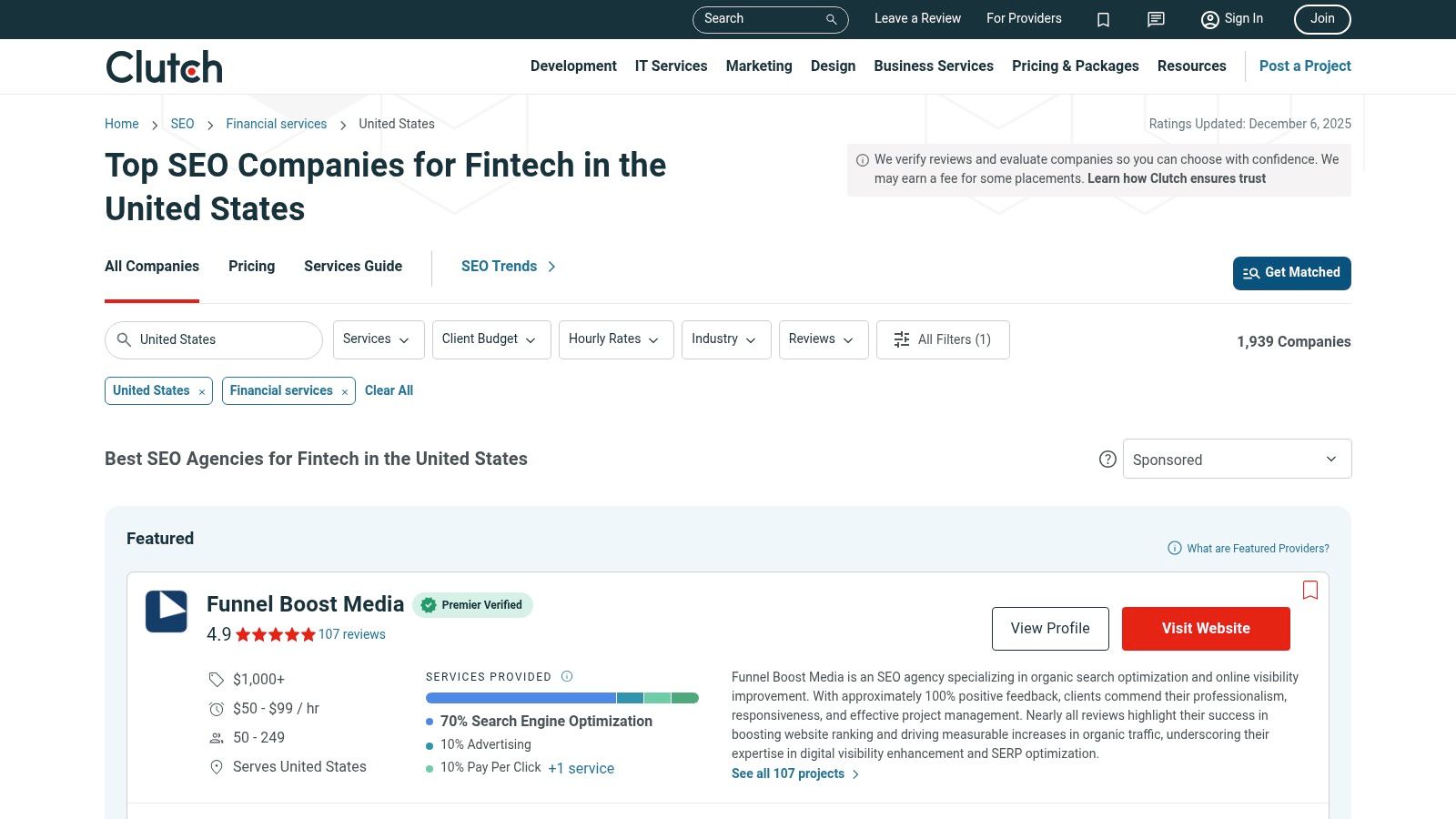
Clutch is a B2B ratings and reviews platform that functions as a comprehensive directory for service providers, including a highly specialized category for SEO firms. For FinTech marketing leaders, its greatest value lies in the ability to filter, vet, and shortlist potential partners based on verified client feedback and industry-specific experience. Compared to a general Google search for consultants, Clutch provides a structured, data-rich environment tailored for comparing established agencies and consultants, making it an excellent starting point to find the best SEO consultant for FinTech companies.
Why Clutch is a Top Resource for FinTech SEO
Clutch stands out by aggregating the exact data points a FinTech CMO needs to make an informed hiring decision. Its standardized profiles allow for direct, apples-to-apples comparisons of crucial metrics like hourly rates, minimum project size, and team composition. This structured approach saves significant time during the initial discovery phase.
The platform’s most powerful feature is its dedicated filter for the "Financial Services" industry. This allows you to immediately narrow the field to consultants and agencies that have direct, proven experience navigating the complexities of FinTech SEO, such as E-E-A-T (Experience, Expertise, Authoritativeness, Trustworthiness) requirements and compliance-heavy content.
Key Features and How to Leverage Them
To maximize your search on Clutch, focus on these tactical steps:
- Filter with Precision: Start by applying the "Financial Services" industry filter. You can further refine your search by location (e.g., U.S.-based), hourly rate bands (e.g., $100 - $149/hr), and client budget size. For example, a startup FinTech might set a filter for agencies with a minimum project size under $5,000 to find partners aligned with their budget.
- Analyze Verified Reviews: Go beyond the star ratings. Read the full-text reviews to understand the nature of the engagement. A tactical example is to search reviews for keywords like "compliance," "YMYL," or "conversion rate." Comments that mention specific outcomes, such as "increased organic leads by 40%" or "helped us rank for competitive commercial loan keywords," are far more valuable than a generic five-star score.
- Scrutinize the Portfolio: Each profile includes a portfolio or case study section. Look for examples of work with other FinTech companies, neobanks, or financial SaaS platforms. This is your evidence that they understand the niche. If a consultant’s portfolio is filled with e-commerce or local business examples, they may not be the right fit, even if their reviews are excellent.
Pros and Cons of Using Clutch
Ultimately, Clutch is a powerful shortlisting tool. Use it to build an initial list of 3-5 potential consultants, then conduct your own due diligence and discovery calls to confirm they are the best SEO consultant for your FinTech company's specific needs.
Website: https://clutch.co/us/seo-firms/financial-services-industry
3. Credo
Credo operates as a specialized matchmaking service, connecting businesses with pre-vetted SEO, PPC, and digital marketing consultants and agencies. For FinTech leaders, Credo offers a distinct advantage over massive, open directories by replacing manual searching with a curated, human-guided introduction process. It is designed to quickly connect you with a small, highly relevant pool of experts, making it a fast track to finding the best SEO consultant for FinTech companies who fits your specific project scope and budget. The core comparison is simple: Clutch is like a library where you search for books yourself, while Credo is like a librarian who recommends the three best books for you.
Why Credo is a Top Resource for FinTech SEO
Credo's core value proposition is its rigorous, 28-point vetting process combined with a hands-on matching system. Instead of leaving you to sift through hundreds of profiles, Credo’s team personally reviews your project needs and introduces you to 2-3 handpicked professionals. This approach is particularly effective for FinTech, where specialized knowledge of financial regulations, customer acquisition funnels, and high-stakes keyword environments is non-negotiable.
The service significantly reduces the time and risk associated with hiring. By pre-qualifying consultants for their industry experience and track record, Credo ensures that the initial conversations you have are with candidates who already understand the nuances of marketing a financial product, from SaaS lending platforms to digital investment apps.
Key Features and How to Leverage Them
To get the most out of Credo’s matchmaking service, follow this strategic process:
- Be Hyper-Specific in Your Project Brief: When you submit your project details, be explicit about your FinTech niche. Instead of saying "We need SEO," specify "We are a B2B wealth management SaaS needing to improve rankings for 'high-net-worth portfolio management' keywords." This level of detail enables the Credo team to make a more accurate match.
- Articulate Your E-E-A-T and Compliance Needs: Clearly state that you require a consultant with demonstrable experience in building E-E-A-T signals for "Your Money or Your Life" (YMYL) topics. A tactical example would be to request experts who have experience implementing
authorschema markup and building out detailed author biographies for financial writers. - Evaluate the Handpicked Matches: Once you receive your 2-3 introductions, treat each as a high-potential candidate. Review their past work with FinTech clients and ask pointed questions during the initial call, such as "How did you approach link building for a previous financial services client?" or "Describe your process for a technical SEO audit on a secure banking platform."
Pros and Cons of Using Credo
Credo excels as a "quality over quantity" platform. Use it when you want to bypass the exhaustive search process and quickly engage with a shortlist of highly capable professionals, increasing the likelihood you will find the best SEO consultant for your FinTech company without the typical hiring friction.
Website: https://getcredo.com/
4. Upwork
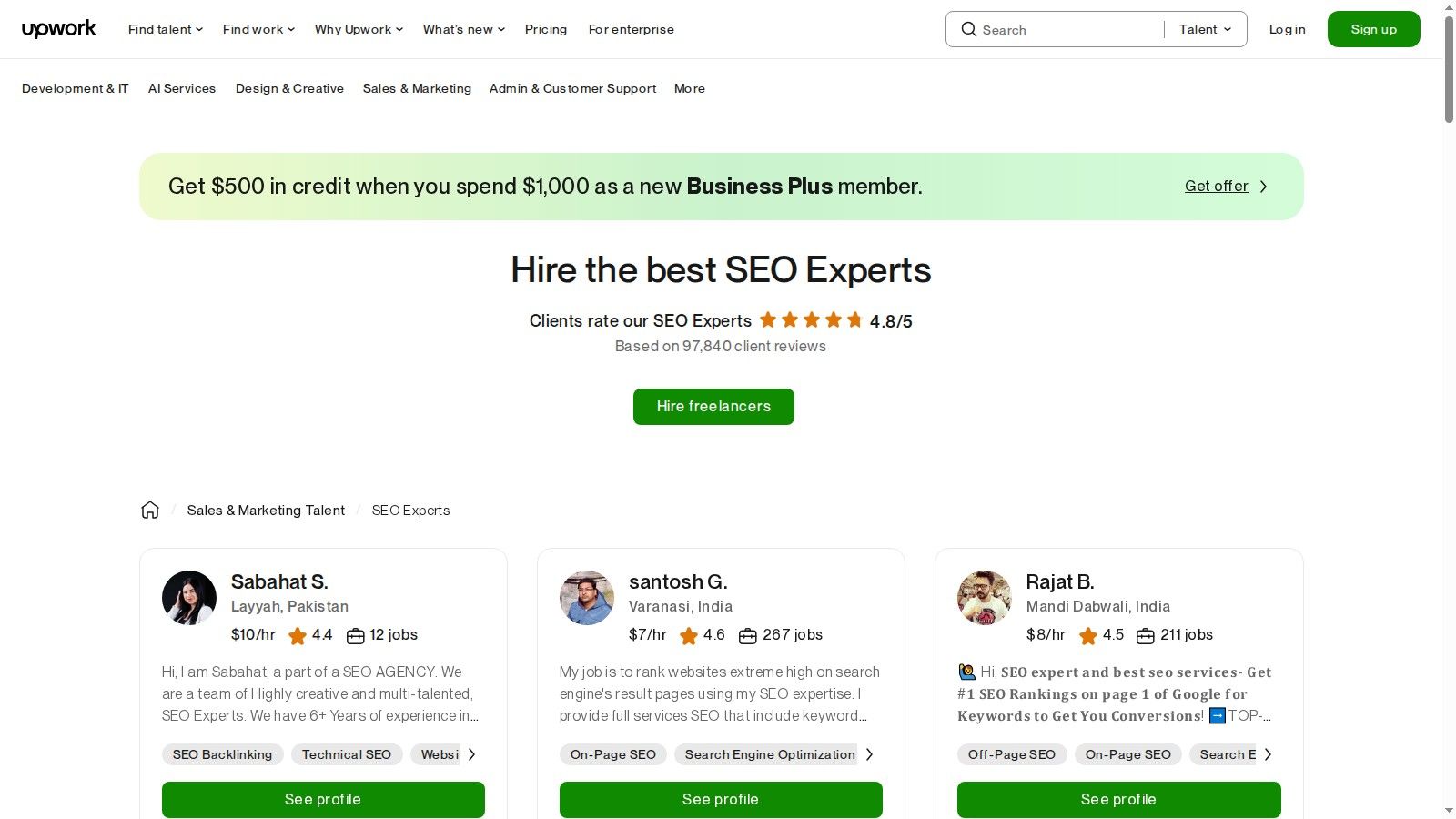
Upwork is a massive freelance marketplace where FinTech companies can hire individual SEO consultants for flexible, project-based, or ongoing engagements. Unlike agency-focused directories like Clutch, Upwork provides direct access to a global talent pool of individuals. This makes it ideal for finding specialists with granular experience in niches like payments, wealth management, or banking. For marketing leaders needing to scale resources quickly or fill a specific expertise gap, it’s a valuable platform for finding a qualified SEO consultant for FinTech companies without long-term overhead.
Why Upwork is a Top Resource for FinTech SEO
Upwork excels in providing flexibility and direct access to individual talent. You can hire for a very specific task, such as a one-time technical audit of your new lending platform, or find a long-term partner for ongoing content strategy. The platform's built-in tools for time-tracking, communication, and escrow payments simplify the administrative side of working with freelancers, making it easy to test out a consultant with a small pilot project before committing to a larger scope.
The sheer volume of professionals means you can find niche experts who have worked with other financial services clients. The key is using its powerful search and vetting tools to sift through the generalists and identify the true FinTech SEO specialists.
Key Features and How to Leverage Them
To effectively find your next consultant on Upwork, use these strategies:
- Create a Hyper-Specific Job Post: Don't just post "Looking for an SEO expert." Instead, write "Seeking FinTech SEO Consultant for B2B Payments SaaS Platform." Mention specific challenges like "improving E-E-A-T signals," "ranking for 'enterprise payment processing' keywords," and "experience with financial compliance content." This detailed approach will attract higher-quality, relevant applicants.
- Use Keyword Filters Diligently: Search for freelancers using specific terms like "FinTech SEO," "SaaS SEO," "wealth management," or "neobank." Review the profiles that appear and check their work history for projects with clients in these exact verticals. Verifiable past projects are your best indicator of relevant expertise.
- Conduct Paid Test Projects: Before signing a long-term contract, hire your top 2-3 candidates for a small, fixed-price project. A tactical example would be asking them to conduct a keyword gap analysis against a top competitor like Stripe or to outline a content brief for a complex financial topic like "ISO 20022 migration." This small investment helps you evaluate their communication, strategic thinking, and actual deliverables.
Pros and Cons of Using Upwork
Ultimately, Upwork is an excellent tool for targeted hiring and agile team-building. It empowers FinTech marketing leaders to find the best SEO consultant for FinTech companies by enabling direct vetting and flexible, low-risk initial engagements.
Website: https://www.upwork.com/hire/seo-experts/
5. MarketerHire
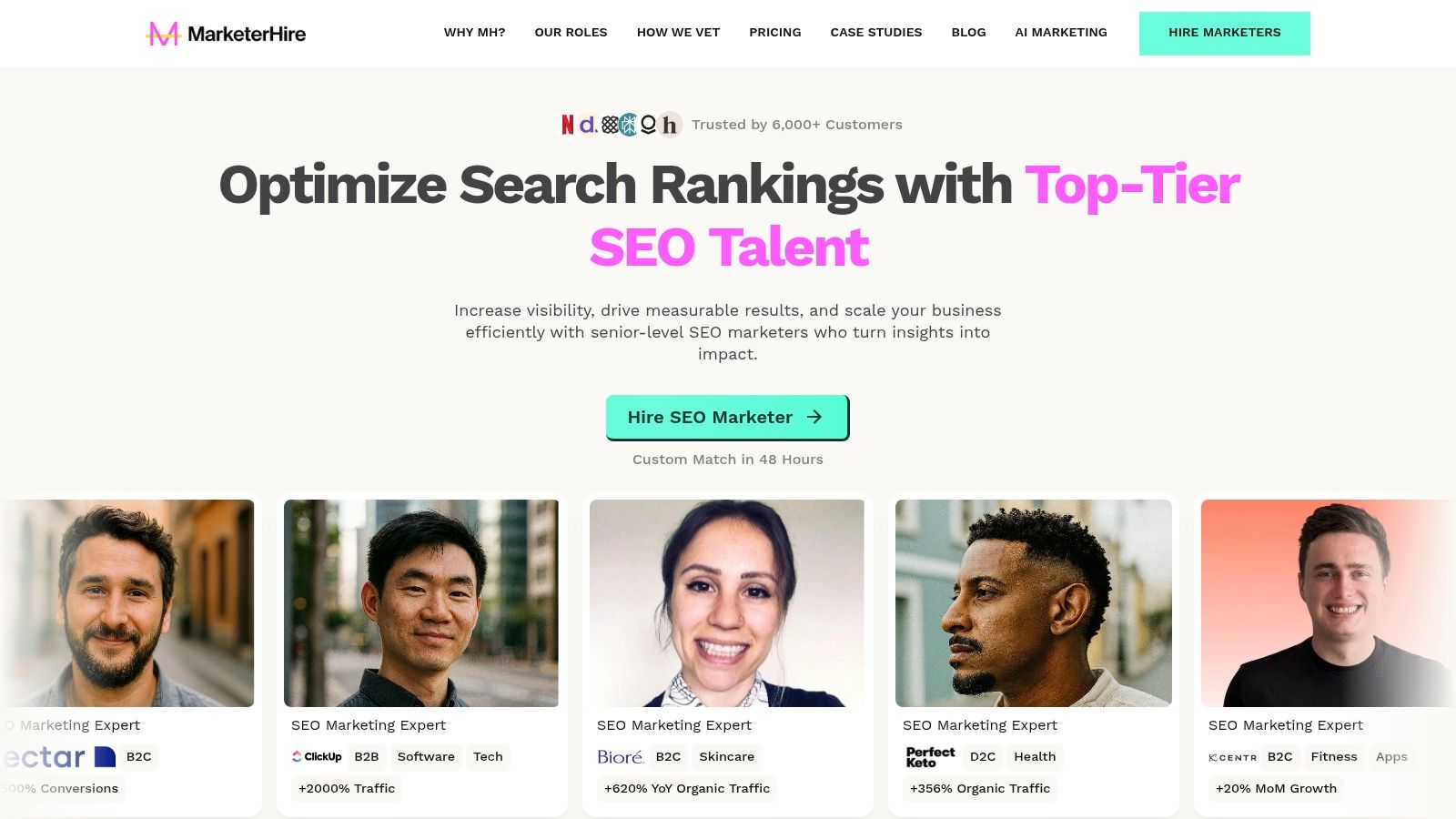
MarketerHire is a vetted-talent marketplace that specializes in connecting companies with senior-level marketing experts on a fractional basis. For FinTech firms needing immediate, high-impact SEO leadership, it provides a streamlined path to hiring a pre-vetted consultant. The platform's core value is its speed and quality control, matching you with a suitable strategist, often within 48 hours. In comparison to Upwork's self-service model, MarketerHire acts more like a high-end recruiting firm, eliminating the prolonged search and interview process typical of finding the best SEO consultant for FinTech companies.
Why MarketerHire is a Top Resource for FinTech SEO
MarketerHire stands out by providing access to senior-level talent without the commitment of a full-time hire. This is ideal for FinTechs that need to execute a sophisticated SEO strategy, such as navigating complex YMYL (Your Money or Your Life) topics or performing technical audits, but may not have the budget or need for a permanent in-house director. The platform handles the vetting, so you engage with professionals who have already proven their expertise.
The model is built on flexibility, offering month-to-month contracts and trial periods. This allows a FinTech company to test the relationship and see tangible results before committing long-term, reducing the financial risk associated with hiring senior talent.
Key Features and How to Leverage Them
To get the most value from MarketerHire, a FinTech leader should be very specific in their project brief:
- Define Your Need Precisely: Be explicit about your FinTech niche (e.g., "B2B payments," "robo-advisory," "DeFi lending"). A tactical example of a good request is: "We need an SEO strategist with experience in the investment tech space to lead a content audit and build a strategy for targeting high-net-worth individuals."
- Leverage the Trial Period: Use the initial engagement to assess the consultant's understanding of financial regulations and their ability to create content that builds trust. Give them a specific, measurable task, such as creating a 90-day content roadmap or auditing your top three competitors' backlink profiles.
- Utilize the Platform's Support: MarketerHire provides ongoing quality checks and operational support. If the initial match isn't perfect, they will work to find a better fit. This layer of support de-risks the hiring process compared to sourcing from an open marketplace.
Pros and Cons of Using MarketerHire
MarketerHire is the go-to solution for FinTech companies that need to quickly onboard a seasoned SEO strategist to lead, build, or refine their organic growth engine. It is the best choice for finding a consultant for FinTech companies when you need fractional, senior-level expertise with minimal hiring friction.
Website: https://marketerhire.com/role/seo-marketer
6. UpCity (Financial SEO directory)
UpCity is a B2B marketplace and directory that helps businesses find trustworthy service providers, with a dedicated category for Financial SEO agencies. For FinTech decision-makers, its primary advantage is the transparent presentation of budget requirements, such as minimum project sizes and typical retainers, directly on agency profiles. This makes it an efficient tool for shortlisting potential partners that align with your company's financial scope from the very beginning. Compared to Clutch, which is larger, UpCity often feels more focused and easier to navigate for budget-conscious searches.
Why UpCity is a Top Resource for FinTech SEO
UpCity excels by providing immediate clarity on the financial and service-level aspects of potential SEO partners. This upfront data on pricing and engagement models saves valuable time by filtering out consultants or agencies whose budget expectations are misaligned with your own, a critical step before investing in discovery calls.
The platform's dedicated "Financial SEO Agencies" page serves as a curated starting point. It allows you to quickly identify providers who self-identify with financial services expertise. This focus, combined with verified client reviews, helps ensure that your shortlist consists of candidates who already understand the nuances of the FinTech landscape, from regulatory compliance to building trust with a sophisticated audience.
Key Features and How to Leverage Them
To effectively find the best SEO consultant for FinTech companies on UpCity, apply these strategies:
- Pre-Qualify by Budget: Immediately check the "Minimum Project Size" and "Typical Monthly Retainer" sections on each profile. A tactical example: if your budget is $5,000 per month, you can instantly disqualify agencies with a stated $10,000 minimum, streamlining your evaluation process significantly.
- Validate Industry Claims: While the financial category is a good start, you must dig deeper. Read through the verified reviews and look for mentions of clients in payments, lending, or investment tech. A profile rich with positive feedback from other FinTech brands is a strong indicator of relevant experience.
- Assess Service Focus: Use the "Services" breakdown on each profile to see if their core offerings match your needs. For instance, if you require a heavy focus on technical SEO and link building for a new B2B payments platform, ensure those are listed as primary services, not just secondary offerings.
Pros and Cons of Using UpCity
In short, UpCity is an excellent resource for creating a financially-vetted list of potential SEO partners. Use its transparent budget data to build a realistic shortlist of 3-5 agencies, then proceed with your own in-depth due diligence to find the ideal fit for your FinTech company's growth objectives.
Website: https://upcity.com/seo/financial
7. DesignRush
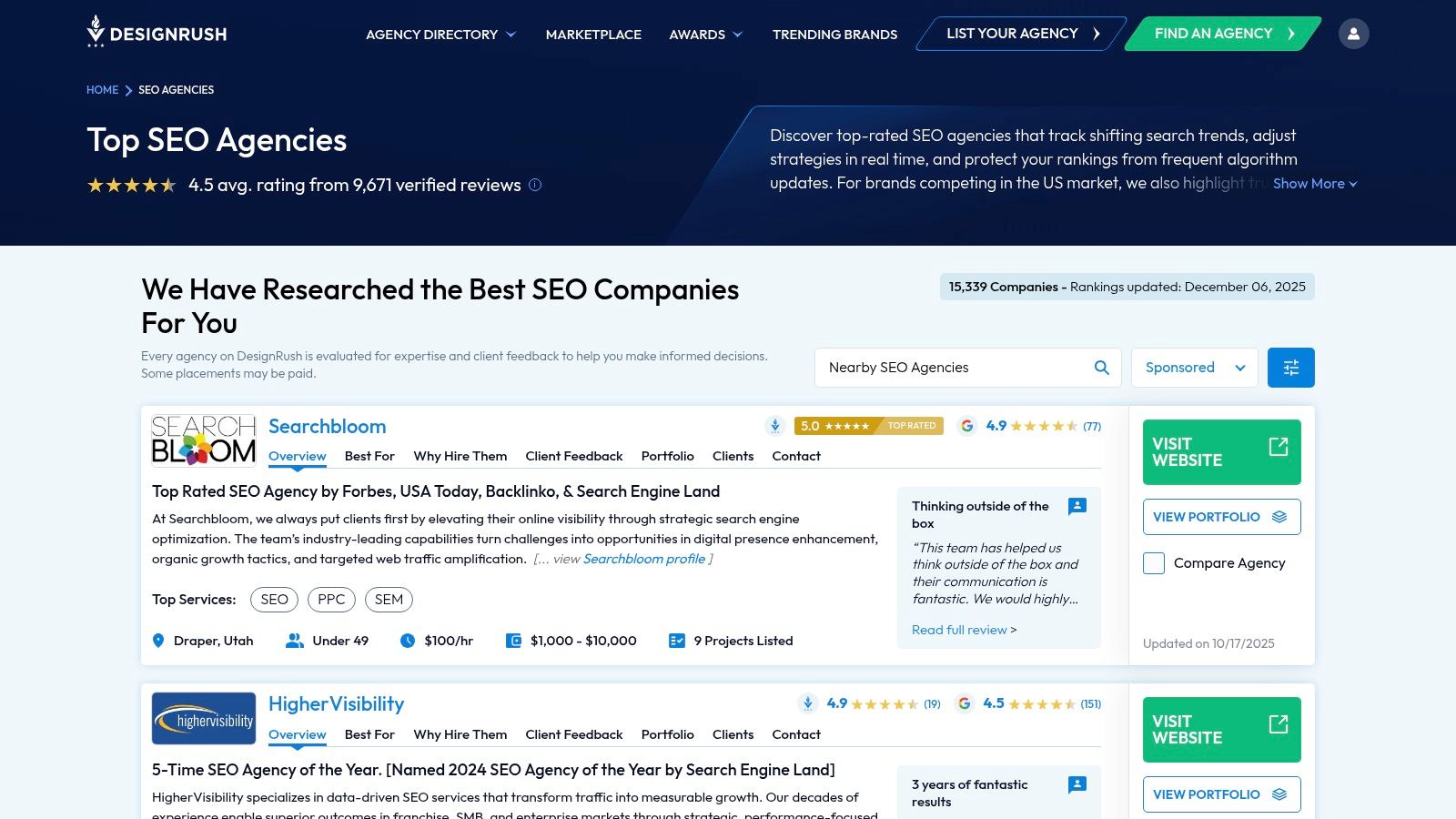
DesignRush operates as an extensive B2B marketplace and directory that connects businesses with professional agencies, including those specializing in SEO. For FinTech leaders, it serves as a valuable research tool for identifying and comparing potential SEO partners by leveraging detailed filters and editorially curated lists. Its structure helps marketing executives move from a broad search to a qualified shortlist of consultants who understand the financial services landscape. Compared to other directories, DesignRush has a stronger emphasis on design and creative agencies, but its SEO section is robust and offers a different pool of talent, making it a solid platform for finding the best SEO consultant for FinTech companies.
Why DesignRush is a Top Resource for FinTech SEO
DesignRush distinguishes itself through its blend of a comprehensive directory and editorial content. While its core function is a searchable database, it also publishes rankings and "best of" lists, such as "Top Financial Services SEO Companies." These roundups can provide a pre-vetted starting point, saving time for FinTech CMOs who need to quickly identify agencies with demonstrated industry expertise.
The platform's profiles offer a snapshot of an agency's focus, client roster, and pricing, which facilitates efficient initial screening. The ability to filter by specific services like "Financial SEO" and then cross-reference those results with budget and location criteria makes it a highly tactical tool for narrowing down the options in a crowded market.
Key Features and How to Leverage Them
To effectively use DesignRush for your search, implement these strategies:
- Combine Filters with Editorial Lists: Start with the directory, applying filters for "SEO," "Financial Services," location, and your target hourly rate (e.g., $150 - $199/hr). Then, search for their editorial roundups on financial service agencies to see which names appear in both places. This cross-validation can help identify consistently recognized leaders.
- Investigate Portfolios for FinTech Specificity: Once you have a shortlist, dive into each agency's portfolio. Look for case studies that go beyond general "financial services" and show work with actual FinTech platforms, challenger banks, or wealthtech apps. Evidence of ranking for competitive keywords like "robo-advisor comparison" or "high-yield savings account" is a strong positive signal.
- Use the Personalized Recommendation Tool: If you are short on time, you can submit your project requirements directly to DesignRush. A tactical example: specify that you need a consultant with experience in technical SEO for a loan origination platform or content strategy for a new neobank to get a more curated list of vetted agencies.
Pros and Cons of Using DesignRush
In summary, DesignRush is an excellent discovery and initial-vetting platform. Use its powerful filters and editorial insights to build a strong list of candidates, but always follow up with rigorous due diligence to ensure you hire the right partner for your unique FinTech SEO challenges.
Website: https://www.designrush.com/agency/search-engine-optimization/financial-services
Top 7 FinTech SEO Consultants Comparison
Your Action Plan: The FinTech Marketer's Checklist for Hiring an SEO Consultant
You’ve navigated the landscape of top-tier SEO talent, from specialized directories like UpCity to freelance marketplaces like Upwork and elite individual consultants. The challenge isn't a lack of options; it's selecting the single best partner who understands the unique compliance, authority, and user trust requirements of the FinTech sector. Making the right choice is the difference between incremental gains and transformative organic growth that builds a durable competitive advantage.
Choosing the best SEO consultant for FinTech companies boils down to a strategic evaluation process. It's time to move from analysis to action. This checklist is your framework for making a confident, data-backed hiring decision.
H3: Phase 1: The Pre-Vetting Deep Dive
Before you even schedule a call, do your homework. A consultant’s digital footprint is their resume. Don't just look at their website; analyze their strategy in action.
- Review Their Own SEO Performance: Do they rank for competitive keywords in their niche, such as "FinTech SEO agency" or "SaaS SEO expert"? A consultant who can't rank themselves is a significant red flag.
- Analyze Their Content: Look for thought leadership that demonstrates a deep understanding of FinTech specifics. Do they write about E-E-A-T (Experience, Expertise, Authoritativeness, Trustworthiness) in the context of financial content, or just generic SEO advice?
- Validate Case Studies: Look for tangible metrics beyond "traffic increased." Seek out case studies that mention increases in qualified leads, demo requests, or bottom-of-funnel conversions. For example, a 50% traffic increase is good, but a 20% increase in MQLs from organic search is a far more powerful signal of business impact.
H3: Phase 2: The Discovery Call Gauntlet
This is where you separate the true experts from the generalists. Your goal is to assess their strategic thinking, not just their technical knowledge.
Key Questions to Ask:
- The FinTech Nuance Question: "How would you approach building topical authority for a complex financial product like a B2B payment gateway versus a B2C investment app?" Their answer should highlight different approaches to keyword intent, content formats, and link-building targets.
- The Compliance and E-E-A-T Question: "Our content requires review from legal and compliance teams. How have you integrated such constraints into your SEO workflow in the past?" A seasoned FinTech SEO consultant will have a ready answer involving content briefs, author vetting, and schema markup.
- The Quick Wins vs. Long-Term Strategy Question: "What would you prioritize in the first 90 days to show momentum, and how would that work fit into our 12-month growth plan?" Look for a balanced answer that blends foundational technical fixes with a strategic content and authority-building roadmap.
Red Flag Alert: Be wary of consultants who offer "guaranteed rankings" or focus exclusively on vanity metrics like keyword positions without connecting them to business goals. True experts focus on driving qualified pipeline, not just traffic.
H3: Phase 3: The Pilot Project Litmus Test
For larger engagements, a paid pilot project is the ultimate vetting tool. It de-risks the hiring decision and allows you to evaluate their work firsthand. A great pilot project is a microcosm of a full engagement.
- Define a Specific, Measurable Goal: Instead of a vague "SEO audit," frame it as a targeted project. For example: "Develop a content strategy to rank for 3-5 bottom-of-funnel keywords related to our core lending product" or "Conduct a technical audit and implementation plan to improve Core Web Vitals for our key conversion pages."
- Evaluate the Process, Not Just the Deliverable: How did they communicate? Did they ask insightful questions? Were their recommendations prioritized by impact and effort? The deliverable is important, but a smooth, collaborative process is what ensures long-term success.
By following this structured approach, you move beyond browsing profiles and start a rigorous evaluation. You equip yourself to find a partner who can navigate the complexities of FinTech, build a powerful organic growth engine, and ultimately deliver the measurable results your business demands. This investment in due diligence will pay dividends for years to come.
Ready to partner with an SEO consultant who has a proven track record of driving pipeline growth for FinTech and B2B SaaS companies? Austin Heaton specializes in building sophisticated SEO strategies that connect directly to revenue. Explore the case studies and strategic approach at Austin Heaton to see how this expertise can be applied to your business.


