
ChatGPT SEO Optimization for SaaS The Definitive 2026 Guide
Learn ChatGPT SEO optimization for SaaS with this definitive 2026 guide. Turn AI answers into high-converting leads and dominate your niche.


When ChatGPT cites your SaaS product as the solution to a user's problem, that’s not just a mention. It’s a direct referral from the world's most influential new research tool. For SaaS companies, this is the entire game: turning AI chat into a high-intent customer acquisition channel by making your website’s content and technical foundation so authoritative that AI models have no choice but to recommend you.
Why AEO Is Your New SaaS Revenue Engine
Let's cut through the hype. We aren't talking about another marketing channel; we're talking about a fundamental shift in how your customers find solutions. The conversation has moved from a simple search bar to a complex dialogue with an AI, and your SaaS needs to be part of that dialogue. This is where Answer Engine Optimization (AEO) stops being a technical curiosity and becomes a powerful revenue engine.
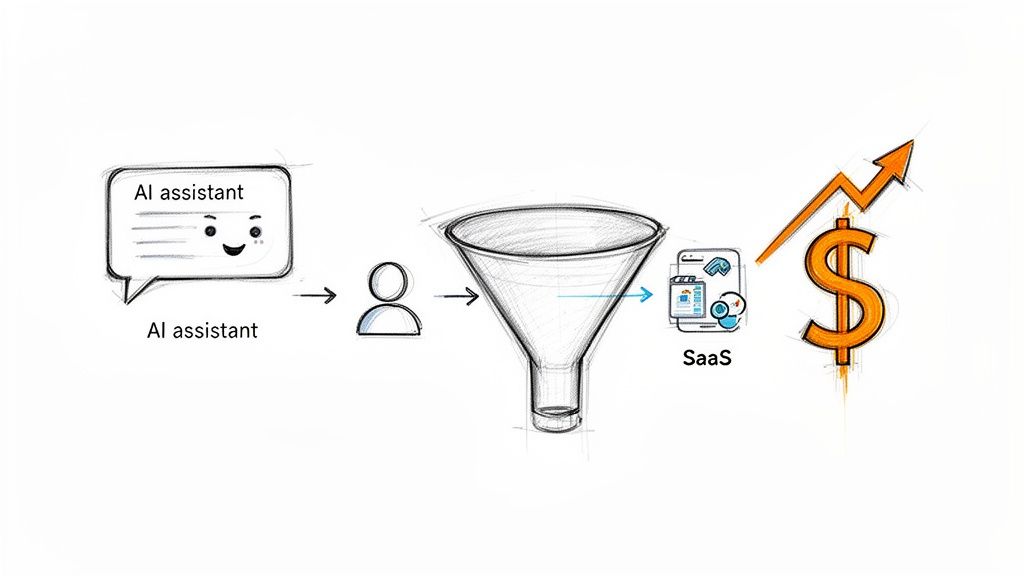
This new discipline is also called Generative Engine Optimization (GEO). To really see the potential here, it’s worth understanding what Generative Engine Optimization (GEO) entails and how it works. It’s all about structuring your digital presence so AI models confidently present your brand as the answer.
The Power of High-Intent Referrals
A prospect asking an AI, "What is the best project management tool for a remote marketing team?" has dramatically higher intent than someone just typing "project management tool" into Google. They’re much further down the buying journey. They are asking for a direct recommendation, not just a list of links to sort through.
When ChatGPT or another AI cites your SaaS in its response, it’s more than a mention—it’s a qualified referral. My own work shows these referrals convert at rates that leave traditional search in the dust. We’ve seen AI-driven traffic convert at 14.2%, nearly five times higher than the typical 2.8% from Google organic search.
For a SaaS business, this is game-changing. It means you’re not just getting more traffic; you’re getting more customers from fewer, more qualified clicks. A single citation can drive a significant pipeline.
From Keywords to Contextual Authority
The old playbook of ranking for short keywords is becoming obsolete. Queries on AI platforms now average 10-11 words, a massive jump from the 2-3 word queries common on Google. Users are asking full questions and expecting nuanced answers.
This means AI models aren't just scanning for keywords anymore. They're synthesizing information from dozens of sources to determine which brand is genuinely worth recommending.
- Fact-Dense Content: Your content must be rich with data, statistics, and verifiable facts. Our research shows that including citations and stats can boost source visibility in AI answers by over 40%.
- Demonstrated Expertise: Clear author bios, a comprehensive "About Us" page, and public-facing expertise all signal to an AI that you are a legitimate, authoritative entity.
- Product Merit: Ultimately, AI models are getting better at identifying the best products based on real-world data, reviews, and detailed comparative information.
The game has changed from winning SERPs to winning trust. When a user asks an AI for a solution, they are delegating their research. If you're looking for help navigating this shift, learning more about how an AEO consultant can drive results is a strong next step. Optimizing for AI discovery isn’t optional for SaaS growth anymore; it's the new frontier of customer acquisition.
How to Build Foundational Authority for AI
AI models like ChatGPT don’t just find information—they judge it. To earn citations and referrals, your SaaS brand needs to build a digital resume that an AI simply can't ignore. This is about signaling deep authority, expertise, and trust in a way that goes far beyond traditional SEO.
Think of it like this: an AI is a very literal, and very diligent, research assistant. It cross-references every claim, looks for corroborating evidence from trusted sources, and weighs the credibility of who is speaking. Your job is to make its decision easy by providing overwhelming proof that you are a definitive source in your category.
Pursue Strategic Digital PR for High-Authority Links
Basic link-building is no longer enough. While earning links from various domains still has its place, the real currency for AI models is backlinks from exceptionally authoritative sources. We’re talking about domains with a Domain Authority (DA) of 60 or higher—major news outlets, top-tier industry publications, and respected research institutions.
A single link from a DA 80+ site carries more weight in an AI's "mind" than dozens of links from low-tier blogs. Why? Because these high-authority sites have their own stringent editorial standards, and a link from them acts as a powerful, third-party endorsement of your expertise.
This means shifting from a high-volume link-building strategy to a high-impact digital PR approach.
- Offer Expert Commentary: Position your founders and key team members as go-to experts for journalists covering your industry.
- Publish Original Research: Create data-backed reports, surveys, and studies that become primary sources for others.
- Targeted Outreach: Instead of mass emailing, build genuine relationships with a small, curated list of influential editors and writers.
This authority-centric approach has a compounding effect. As you gain mentions on respected platforms, you build a web of trust signals that AI models are specifically designed to detect and reward.
Solidify Your On-Site Trust Signals
While off-site authority is critical, your own website must be an impeccable source of truth about your brand. AI models scrutinize your site for signals of legitimacy, and an incomplete or anonymous-feeling website is a major red flag. It suggests a lack of transparency and credibility.
Your "About Us" page, for instance, should be one of the most comprehensive pages on your site. This isn't just marketing fluff; it's a foundational document for establishing your entity in the AI's knowledge graph. This page needs to clearly articulate your company's mission, its history, and the people behind it.
An AI synthesizes information from countless sources to form a judgment. A detailed 'About Us' page, complete with team bios and a clear mission, gives the AI a concrete narrative to understand who you are and why you matter.
Likewise, detailed author bios for your blog posts are absolutely essential. Every article should be attributed to a real person with demonstrable expertise—complete with a headshot, title, and links to their social profiles or other publications. This connects your content to a credible human, directly reinforcing the Expertise and Authoritativeness components of E-E-A-T.
The Unspoken Power of Data and Citations
Beyond who you are, what you say matters immensely. The most cite-worthy content is fact-dense and data-rich. In fact, research shows that pages with a high density of facts and statistics are cited up to 40% more in AI responses, even when their traditional Google rankings are lower.
This is because AI models are built to prioritize verifiable information. When you include specific data points and cite your sources, you're not just informing the reader—you're providing the AI with raw, processable data it can trust. This is especially true in the rapidly expanding AI search market. To understand the numbers, recent ChatGPT usage statistics reveal that referral traffic from AI can convert nearly five times better than traditional organic search.
This means every piece of content you create should be approached as an opportunity to build authority. Weave in relevant stats, reference academic studies, or quote industry leaders. This tactical approach directly contributes to your ChatGPT SEO optimization, making your brand the go-to source. You can find more strategies on how to get more qualified leads from ChatGPT by applying these principles.
Building this foundational authority is a long-term play, but it's the most durable advantage you can create. You're not just optimizing for an algorithm; you're proving to the world—and its AI assistants—that your brand is the definitive answer.
Master Your Entity & Schema Strategy for AI Visibility
If foundational authority signals tell AI models who you are, the next step is teaching them what you are. This is where we shift from building general credibility to defining your business with machine-readable precision. You’re essentially transforming your website from a collection of words into a structured database that AI can query and understand.
This is the core of Entity SEO. It’s the practice of defining your brand, products, and even your key people as distinct "entities"—or things—that an AI can categorize, connect, and comprehend. Instead of just seeing the text "Our SaaS," an AI can understand it refers to a specific SoftwareApplication entity with documented features, pricing, and a parent Organization.
From Ambiguous Text to Concrete Entities
Without structured data, an AI is forced to guess. It sees your company name, your product name, and your CEO's name on a page but has no inherent understanding of how they’re all connected. Schema markup provides the explicit instructions, turning ambiguity into clarity.
To get this right, you first need to understand what Schema Markup in SEO actually is. Think of it as a shared vocabulary that makes this AI-friendly communication possible.
For any SaaS business, a few schema types are non-negotiable:
Organization: This defines your company as a formal entity. You'll specify your official name, logo, website URL, social profiles, and address. It’s your brand’s digital passport.SoftwareApplication: This schema describes your software in detail. You can list its name, compatible operating systems, application category (like "BusinessApplication"), and even pull in aggregate ratings.SaaSProduct: A newer and incredibly important schema that extends the standardProducttype. It lets you specify that your offering is "Software as a Service," a critical distinction when users ask AI for cloud-based tools.
Implementing these markups is like telling an AI model, "This is our company, this is our main software product, and it is delivered as a SaaS." That simple clarification makes you a far more reliable—and citable—source for AI-generated answers.
Implementing Essential SaaS Schema
You'll typically add schema to your site using JSON-LD (JavaScript Object Notation for Linked Data). It's just a small code snippet you place in the <head> section of your page. While it's invisible to your human visitors, it's perfectly readable for search engines and AI models.
Let’s make this practical. Imagine a simple HTML block on your pricing page. To an AI, it’s just a string of text. By wrapping that same information in a JSON-LD script, you provide a clean, machine-readable summary that leaves nothing to interpretation.
Think of it like this: without schema, you're describing a car by talking about its color and how it has four wheels. With schema, you're handing the AI the official vehicle registration, complete with make, model, VIN, and engine specs. The AI prefers the official document every time.
This diagram shows how establishing credibility through PR and on-site signals flows directly into implementing technical schema. It’s a unified process.
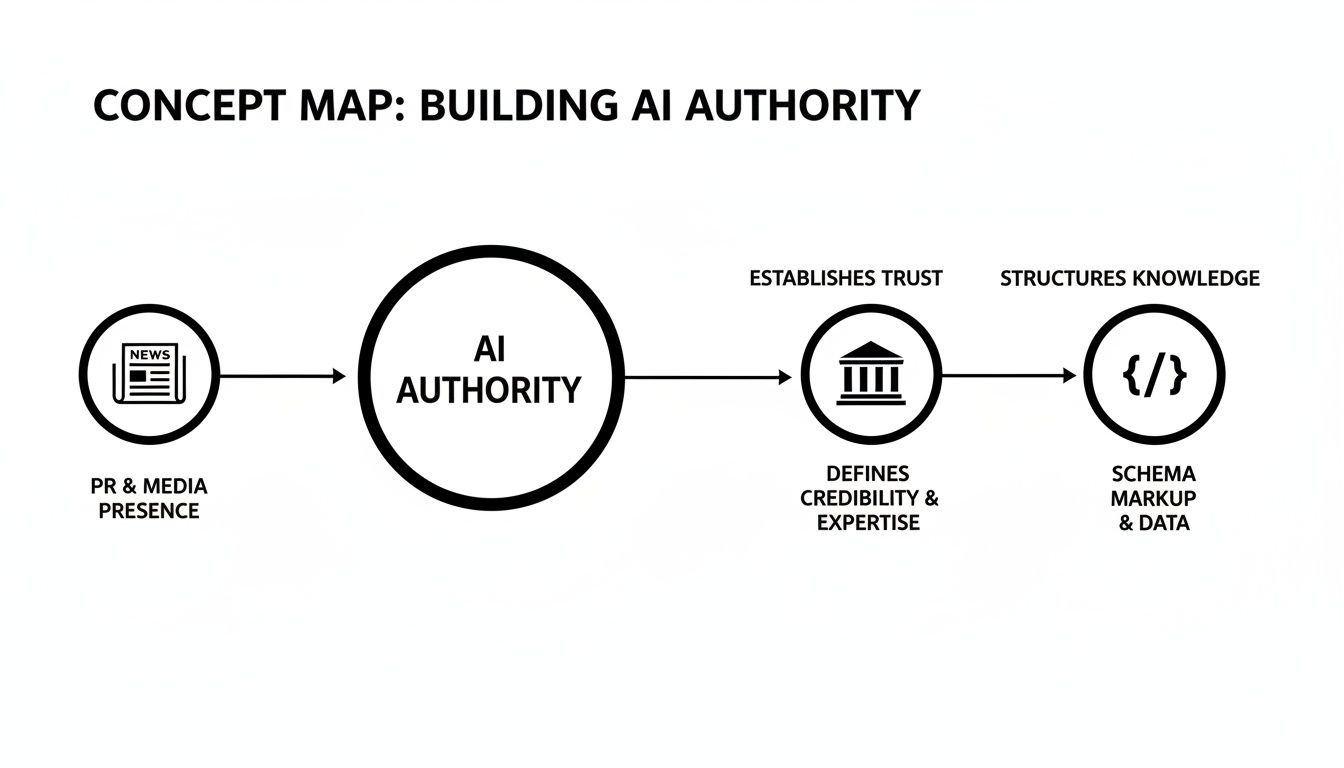
As you can see, schema isn't just an isolated technical task. It's the final step that codifies the trust you've built through your other authority-building efforts.
Connecting Your Brand to the Knowledge Graph
The ultimate goal of Entity SEO is to get your brand cemented into the broader digital "Knowledge Graph"—the huge network of interconnected entities that AI models rely on to understand the world. Once your SaaS is a recognized entity, you’re no longer just another website; you’re a known quantity. For a deeper dive, my guide on an entity-first SEO approach explains how this directly impacts LLM source selection.
The benefits are tangible. When a user asks ChatGPT, "What are some alternatives to Salesforce for small businesses?" the AI queries its knowledge graph. If your CRM is properly defined as a SaaSProduct and associated with your Organization, you have a much stronger chance of being included in that synthesized answer.
Let’s look at exactly how schema changes the game for machine readability.
Schema Markup Impact on AI Readability
This table shows how an AI perceives your SaaS product information with and without schema. The "Before" is ambiguous text; the "After" is a structured, unambiguous data file.
| Information Type | Standard HTML (Before Schema) | JSON-LD Schema Markup (After Schema) |
|---|---|---|
| Product Name | <h1>ProjectFlow</h1> | "name": "ProjectFlow" |
| Product Type | <p>A SaaS tool for teams.</p> | "@type": "SaaSProduct" |
| Company | <p>Made by Innovate Inc.</p> | "brand": { "@type": "Organization", "name": "Innovate Inc." } |
| Pricing | <span>Starts at $29/mo</span> | "offers": { "@type": "Offer", "price": "29", "priceCurrency": "USD" } |
The "After Schema" column provides direct, factual data points. This level of clarity is exactly what AI models need to confidently cite your product in their answers. You are effectively making their job easier, which is a core principle of getting AI visibility. By speaking the AI's native language, you position your brand not just to be found, but to be recommended.
Once your site's technical foundation is solid, the game shifts from how search engines find you to what they find when they get there. Writing for AI isn't about awkward keyword stuffing; it's about crafting content with such undeniable clarity, structure, and factual density that an AI model has no choice but to cite it.
This is the art of creating ‘cite-worthy’ assets.
Your goal is to make your content so digestible and trustworthy that an AI sees it as a low-risk, high-value source for its answers. This means moving beyond generic blog posts and building resources that directly feed an AI's appetite for verifiable, well-organized information.
Structure for Scannability and Synthesis
AI models, much like busy executives, despise ambiguity. They prefer content that’s easy to parse. Long, rambling paragraphs force the model to work harder to extract key takeaways, increasing the odds of misinterpretation or, more likely, being ignored entirely.
To win the citation, structure is non-negotiable. Your content needs meticulous organization, using elements that create a clear informational hierarchy.
- Scannable Headings: Use descriptive H2s and H3s that act as a clear outline.
- Bullet Points and Lists: Break down complex ideas, features, or processes into itemized lists. This format is perfect for direct extraction by AI.
- Bolded Key Terms: Emphasize important concepts, data points, and conclusions to signal their importance.
This approach makes your content predictable and easy for a machine to synthesize. You're not just writing for a person; you're formatting for an algorithm that values efficiency. For a more detailed guide, you can learn how to structure FAQ content that matches LLM query patterns with schema markup templates to further align your content with AI behavior.
Build Data-Rich, Authoritative Resources
I once worked with a FinTech SaaS client to produce a massive "State of Digital Payments" report. It was an exhaustive effort, packed with original survey data, dozens of charts, and expert quotes. We structured every section with clear headings, bulleted takeaways, and cited stats.
Within months, we saw a significant uptick in brand mentions within ChatGPT answers about payment processing trends. The AI wasn't just pulling a sentence or two; it was citing our specific data points and directly referencing the report. It became a go-to resource because it was dense with verifiable facts and easy to parse—a perfect storm for AI citation.
This experience was a powerful lesson: AI models don't have opinions; they have data. The more high-quality, citable data you provide, the more you become an indispensable part of the AI's knowledge base.
This principle is validated by hard numbers. Research shows that referral traffic from ChatGPT achieves a remarkable 14.2% conversion rate, dwarfing Google's 2.8% organic benchmark. While AI may send less volume, the quality of the traffic is unmatched, making every citation incredibly valuable. You can explore more on these findings about the AI search market share and its impact to grasp the full financial incentive.
Target High-Intent, Bottom-Funnel Queries
While foundational reports build authority, you also need content that answers the direct, high-intent questions users ask when they are ready to buy. These queries are often comparative and solution-oriented.
Two of the most effective content formats for this are:
- "Alternative to" Posts: These pages directly target users searching for replacements for a well-known competitor (e.g., "Salesforce Alternatives for Small Business").
- Comparison Posts: These articles offer a head-to-head comparison of your product against one or more competitors (e.g., "ProjectFlow vs. Asana vs. Trello").
These formats are powerful because they perfectly mirror a user's problem. When someone asks an AI, "What's a cheaper alternative to HubSpot?" the model actively seeks out content that directly answers that question.
A well-crafted comparison post doesn't just list features. It provides a balanced view, includes pricing tables, outlines specific use cases, and uses customer testimonials as proof points. By creating this content, you are essentially pre-packaging the answer for the AI, making it easy for the model to recommend your SaaS. This is a core tactic in any effective ChatGPT SEO optimization for SaaS playbook.
How to Measure and Scale Your AEO Success
Getting cited in ChatGPT is a great feeling, but it's a vanity metric until you can tie it to revenue. An interesting anecdote doesn't get you more budget. To turn your early Answer Engine Optimization (AEO) wins into a predictable growth channel, you need a bulletproof way to prove ROI and make decisions backed by data.
This isn’t about chasing general traffic bumps. We’re moving past pageviews and hunting for what actually matters: conversions, pipeline, and direct revenue impact.
Tracking AI Referrals and Proving ROI
The first hurdle is actually identifying traffic from AI platforms. Since ChatGPT doesn’t pass traditional referrer data, you have to get a bit creative in Google Analytics 4 (GA4). I set up a custom report that filters for direct traffic to a specific page that saw a sudden, significant traffic spike with no corresponding email, social, or paid campaign to explain it.
Once you’ve isolated this segment, you can treat it like any other channel and measure its performance.
- Conversion Rate: Keep a close eye on how many of these visitors complete a goal, whether that’s signing up for a trial or booking a demo. AI-driven referrals are high-intent. I’ve seen conversion rates of 14% or higher, which blows typical organic search benchmarks out of the water.
- Cost Per Acquisition (CPA): The traffic isn't "free"—you invested significant time and resources to earn it. Calculate your AEO-driven CPA and stack it up against your paid channels to show just how efficient this channel really is.
- Lead-to-Customer Rate: Don't stop at the initial conversion. Track how many of these leads ultimately become paying customers. This is the metric that gets executives to sit up and pay attention.
This data is what turns AEO from a cool experiment into a documented revenue driver. It’s how you get the buy-in you need to scale.
Monitoring Citation Frequency and Brand Authority
Beyond just traffic, you have to measure how often and in what context your brand is being cited by AI. I call this the "reference rate," and it’s a core KPI for AEO. It’s a direct signal of your growing authority within the model's knowledge base and your brand's share of voice in this new AI-driven discovery landscape.
An AI recommendation is the new social proof. Tracking your citation frequency is like measuring your brand's share of voice in the most important conversation happening online right now.
I use a mix of manual checks and tools to keep a pulse on this.
- Manual Spot-Checks: Every week, I ask ChatGPT, Perplexity, and other key models a core set of questions related to a client’s industry and product. I document every brand that gets mentioned and how they’re positioned.
- Brand Monitoring Tools: Alerts in tools like Ahrefs or Semrush can sometimes catch instances where your content is used and linked back to, though it's not a perfect system for AI.
- Customer Feedback: This one is simple but powerful. Add "AI Assistant (like ChatGPT)" as an option to your "How did you hear about us?" question on signup forms. This gives you direct, undeniable proof.
This process isn't just about counting mentions; it's about understanding the context. Are you being recommended as the top solution? Is your data being quoted to answer a question? This qualitative insight is gold for refining your content strategy. The goal is to become so reliable that the models continue to cite you. Keeping content updated is a massive part of this, as our research on the 3-month content freshness rule clearly shows.
When you combine direct traffic analysis with this citation monitoring, you start to build a complete picture of AEO performance. This data-driven approach is what allows you to see what’s working, justify more investment, and systematically scale your efforts from a few scattered wins into a reliable growth engine for your SaaS.
Of course. Here is the rewritten section, adopting the specified human-like writing style and voice.
Your Toughest ChatGPT SEO Questions, Answered
Even with a solid framework, putting a new strategy into play always brings up questions. When it comes to ChatGPT SEO and Answer Engine Optimization (AEO), SaaS leaders tend to ask the same handful of things.
Let's tackle them head-on. These aren't theoretical answers; they're based on what we're seeing on the ground with clients right now.
Is This Just a Fad, or Is It Really the Future?
This is a fundamental shift in user behavior, not a passing trend. Traditional search isn't going away tomorrow, but the way people find information—especially for complex, research-heavy questions—is already changing.
For high-intent B2B buyers, AI assistants are rapidly becoming the first place they go. Gartner predicts organic search traffic could drop significantly by 2028 as users lean into AI-powered search.
Ignoring AEO today feels a lot like ignoring mobile optimization back in 2010. It’s a bet against a future that's already arriving.
How Do We Justify the Resources for This?
The justification is in the conversion data. We've seen AI-driven referral traffic convert at rates approaching 15%. That's nearly five times the benchmark for standard Google organic search. It's not about the raw volume of traffic; it's about the staggering quality.
A single, well-placed citation in an AI answer can generate more qualified pipeline than thousands of low-intent clicks from a traditional search engine. The ROI is demonstrated not in vanity metrics, but in trial sign-ups and demo requests.
This isn't just another marketing expense. It’s an investment in efficiency and higher-quality leads.
What’s More Important Now: Keywords or Entities?
Entities are the new keywords. While keyword research isn't dead, the focus has to shift. AI models don't think in simple text strings; they think in terms of entities and the relationships between them. It’s why queries on AI platforms now average 10-11 words—users are asking full, conversational questions.
Your energy needs to be focused on:
- Defining your
OrganizationandSaaSProductwith precise schema so the AI knows exactly what you are. - Building content around problems and their solutions, not just isolated keywords.
- Establishing your key people as expert
Personentities in your field.
This entity-first approach is the core of effective ChatGPT SEO. It’s how you teach an AI model that you’re a reliable source worth citing.
Are you ready to make AI your most powerful customer acquisition channel? Austin Heaton specializes in building durable AEO systems for B2B SaaS companies, turning AI citations into measurable revenue. Let's talk about growing your qualified pipeline.