
ChatGPT SEO Optimization for SaaS Your 2026 Growth Playbook
Discover how ChatGPT SEO optimization for SaaS drives high-intent traffic. This guide shares actionable strategies for AI visibility and revenue growth in 2026.


Optimizing your SaaS for ChatGPT means methodically structuring your content, technical signals, and authority so that AI models cite your brand as a definitive source. This practice, which I call Answer Engine Optimization (AEO), isn't about traditional rankings. It’s about earning direct referrals and mentions inside AI-generated answers, which sends highly qualified, purchase-ready traffic straight to you.
It’s less about climbing a results page and more about becoming the answer itself.
Why ChatGPT SEO Is Your New High-Value Channel
AI search isn't some far-off trend. It’s an active, powerful channel that is shaping how B2B buyers find and vet software right now. For any SaaS company, ignoring this shift is like ignoring mobile search a decade ago—it's a deliberate choice to miss out on customers at their most critical decision-making moments.
The scale of this new ecosystem is difficult to overstate. As of March 2026, ChatGPT alone commands a 60.4% share of the AI search market, with a staggering 831 million users and 5.7 billion monthly visits. For SaaS founders and CMOs, earning a citation in a ChatGPT response is no longer a vanity metric. It’s a direct pipeline to a massive, engaged audience that is actively looking for solutions.
The Shift From SEO to AEO
For years, traditional Search Engine Optimization (SEO) has been a race to rank for keywords on Google. The goal was simple: secure a top spot, capture the click. Answer Engine Optimization (AEO) is a completely different game. Instead of just ranking, the goal is to be cited.
This means the AI directly references your brand, your data, or your product in its synthesized response. This isn't just about traffic; it's about being positioned as an authority at the point of need. The user is already deep in the consideration funnel, asking complex, conversational questions.
The core question for marketers is no longer just, "How do we rank for this keyword?" It's now, "When a prospect asks an AI to solve their problem, does our SaaS get recommended?" This is the fundamental pivot from keywords to contextual authority.
To get a better sense of how these two disciplines diverge, here's a quick comparison:
Traditional SEO vs ChatGPT AEO at a Glance
This table breaks down the core differences between optimizing for a traditional search engine like Google and optimizing for an answer engine like ChatGPT.
| Aspect | Traditional SEO (Google) | Answer Engine Optimization (ChatGPT) |
|---|---|---|
| Primary Goal | Achieve high organic rankings for target keywords. | Earn direct citations and brand mentions within AI-generated answers. |
| Key Metric | Organic Traffic, Keyword Rankings, Click-Through Rate (CTR). | Citation Volume, Referral Traffic Quality, Conversions from AI sources. |
| Content Focus | Keyword-optimized content (blog posts, landing pages). | Data-rich, structured content (comparisons, case studies, statistics). |
| Authority Signal | Backlinks, Domain Authority. | Entity Authority, expert mentions, structured data, original research. |
| User Intent | Broad; ranges from informational to transactional. | Specific and conversational; often mid-to-bottom funnel. |
| Time to Impact | 6-12 months for compounding results. | Can be faster (30-90 days) for specific, well-optimized entities. |
While SEO and AEO are different, they aren't mutually exclusive. A strong AEO strategy actually reinforces your traditional SEO by building the kind of deep authority Google now rewards.
What This Means for SaaS Growth
The traffic coming from AI referrals is fundamentally different. It's not casual browsing. A user arriving from a ChatGPT citation has high intent because they've just been given a specific, expert-backed recommendation to solve their problem. This is a huge reason we're seeing an AI search paradox where less traffic can actually lead to more demos for B2B SaaS companies.
This new channel runs in parallel with Google, not as a replacement. It targets users who are much further down the buying funnel, creating a new, hyper-efficient pipeline for customer acquisition.
- Higher Intent Traffic: Users asking detailed questions signal they are in a problem-solving or purchasing mindset.
- Authority by Association: A citation from a trusted AI model gives your brand instant credibility, positioning you as a category leader.
- Competitive Advantage: Most companies are still singularly focused on traditional Google SEO. A proactive AEO strategy gives you a serious head start in this new arena. For a deeper look at integrating these tactics, check out this guide on How to Use ChatGPT for SEO Optimization.
A dedicated ChatGPT SEO strategy isn't just about staying competitive—it's about capturing high-value customers who are now turning to AI for trusted, actionable advice.
Building the Authority AI Models Trust
If you want your SaaS to get cited in an AI answer, you can't just be good—you have to be seen as an authority. Answer engines like ChatGPT are built to pull information from sources they consider credible and trustworthy. Your job is to build so many strong authority signals around your brand that these models have no choice but to recognize you as an expert.
This isn't about old-school link-building. It’s about building a reputation that precedes you online, constructing a digital "authority moat" around your expertise. The goal is to become so synonymous with your specific topic that AI models consistently point to you as a definitive source.
The Power of What Others Say About You
One of the most critical signals you can build is third-party validation. Your own website is important, but what other high-authority platforms say about you carries far more weight with AI. For anyone serious about ChatGPT SEO, a strategic presence on these sites is non-negotiable.
Think of these platforms as a chorus of credibility, providing the unbiased verification that AI models are trained to find.
- Industry Review Sites: Platforms like G2, Capterra, and TrustRadius are goldmines. They are structured data hubs packed with real user feedback and feature comparisons that AI can easily parse to understand your product's place in the market. A strong profile with dozens of positive, detailed reviews is an undeniable authority signal.
- High-Authority Media Mentions: Getting your brand or experts quoted on respected industry sites (think publications with a Domain Authority of 60-90) is crucial. When an expert from your team is quoted in a major tech journal, it creates an authoritative connection between your brand and the topic that AI models pick up on immediately.
- Digital PR and Expert Roundups: Actively participating in digital PR that gets your brand featured in "best of" lists or expert roundups creates a clear pattern of positive association. Every mention reinforces your status as a key player.
This is where Answer Engine Optimization (AEO) for ChatGPT becomes its own channel, running parallel to traditional Google SEO but with its own set of rules.
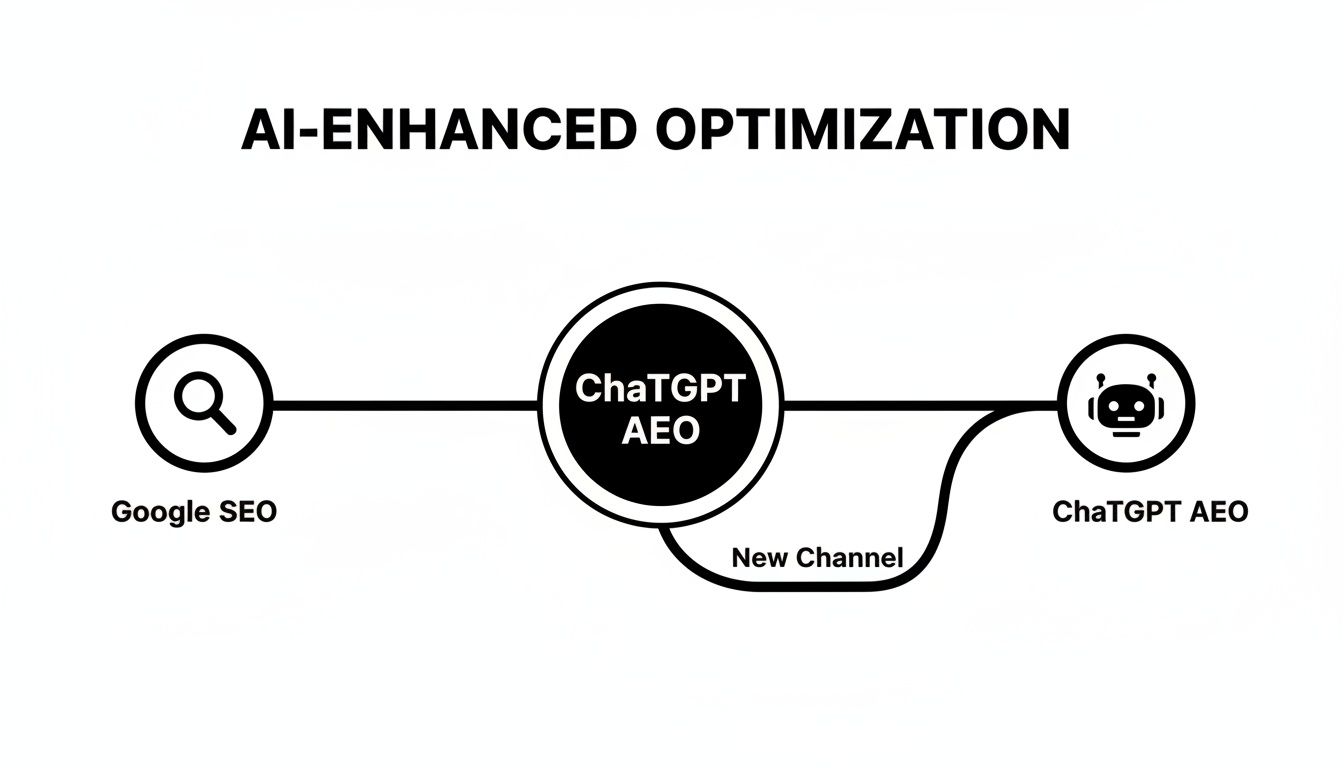
As the diagram shows, the two channels are connected, but winning in AI requires a dedicated focus on building the kind of authority signals that lead directly to citations.
Tying Google Rankings to AI Citations
While AEO is a new game, it has a clear relationship with classic SEO. Recent data shows a fascinating connection: a page ranking #1 on Google has a 43.2% chance of being cited by ChatGPT. That probability plummets to just 12% for pages outside the top 20. A top Google spot gives you a massive head start.
But that's not the whole story. The same data reveals that 28.3% of ChatGPT's most cited pages have no noticeable organic Google visibility at all. This proves you can absolutely dominate AI answers without winning the top Google position. The real insight here is that brands cited via third-party sources are 6.5x more likely to be mentioned than those that are only ever cited from their own domain.
The takeaway is simple: While top Google rankings are a huge advantage, building a strong off-site authority footprint through reviews and media is the most direct path to securing AI citations.
This all comes down to building your brand as a recognized and trusted entity. An entity isn't just a website; it's a real-world thing—a company, a person, a product—that an AI can understand in context. You can learn more about how to build the knowledge graph signals that LLMs use to select sources in our dedicated guide.
By strengthening your entity, you make it easy for AI models to connect the dots and recognize your authority, no matter where you rank on Google at any given moment. This is the bedrock of a durable AI search strategy.
Creating Content for Both AI and Customers
In the new world of Answer Engine Optimization (AEO), your content is the fuel. But just churning out more articles won't get you cited by ChatGPT. You have to serve two masters at once: the AI models hunting for verifiable facts and the human buyers looking for real solutions.
Getting this right is the core of effective ChatGPT SEO optimization for SaaS.
The old keyword-stuffing playbook is officially dead. The new game is about building information so factually dense and clearly structured that AI models have no choice but to use you as a source. Your goal is to become the definitive, citable answer for your niche.
Pack Your Content with Fact Density
If you want to get cited, the single most important variable is fact density. This is all about how much verifiable, specific, and unique information you can pack into every piece of content. AI models don't care about fluffy opinions; they're actively scraping the web for concrete data points to build their answers.
Think of it like building a legal case. The more hard evidence you present—stats, expert quotes, original data—the more convincing you become. In this scenario, the AI is the judge, and it rewards sources that bring the receipts.
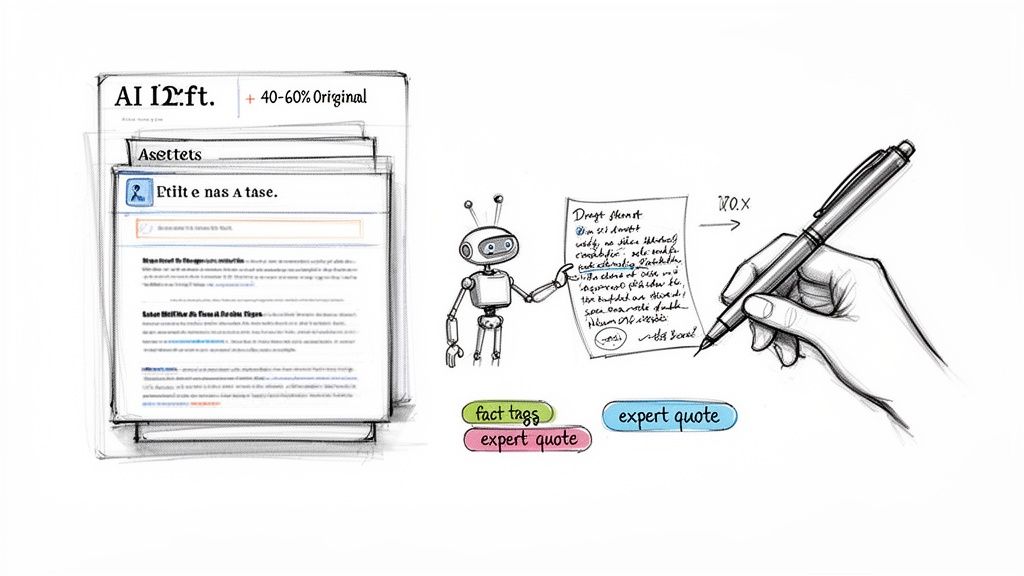
My own client data shows that including citations, direct expert quotes, and unique statistics can boost visibility in AI responses by over 40%.
Here's how to do it right:
- Unleash Original Research: If you have proprietary data from your platform, flaunt it. This is information nobody else has, which instantly makes you an indispensable source.
- Cite Reputable Third-Party Stats: Weave in fresh, relevant statistics from respected sources. This signals to AI that your content is well-researched and grounded in a broader context.
- Inject Expert Quotes: Quote recognizable industry leaders or your own internal experts. This attaches human authority to your claims, a signal AI is learning to value.
- Get Hyper-Specific: Don't just say "many customers see benefits." Say, "SaaS Company X cut churn by 22% in Q3 using our analytics feature." Specificity is credibility.
Adopt the 60/40 AI-Assisted Workflow
Using AI to draft content is a massive time-saver, but relying on it 100% is a shortcut to generic, non-citable fluff. The key is to let AI do the heavy lifting, then layer on irreplaceable human expertise. I recommend a 60/40 workflow.
Let an AI tool like ChatGPT generate the first 60% of the content—the basic structure, foundational explanations, and general flow. This can save you hours.
The real magic, however, is in that final 40%. This is where your team’s expertise comes in. This is where you inject your unique brand voice, proprietary data, customer stories, and strategic insights that an AI simply can’t invent.
This human touch is what transforms a generic article into an authoritative, citable asset. It’s the difference between a blog post that just exists and one that gets cited, drives traffic, and actually converts customers.
Structure Content for AI Comprehension
Finally, how you structure your content is just as important as what's in it. AI models don't "read" like people; they parse information based on logical hierarchy and clear signals. If you make it easy for an AI to understand your content, you make it easy for them to cite you.
I break down the tactical steps in my guide on how to structure website content so ChatGPT and Perplexity actually cite it, but here are the core principles.
- Write Clear, Definitive Headings: Ditch clever or vague titles. Use direct, descriptive headings like "Key Benefits of This Method" or "Common Implementation Mistakes."
- Make Definitive Statements: Start paragraphs with a clear, declarative sentence. For example, "The primary advantage of this strategy is a 30% reduction in customer acquisition cost." This gives the AI a clean, extractable point.
- Use Lists and Tables: Break down complex information into bullet points, numbered lists, and tables. This helps AI models instantly understand the relationships between different data points.
- Embrace White Space: Short paragraphs of one to three sentences are not just for human scanners. They create distinct informational blocks that are far easier for an AI to process and attribute to a source.
By combining high fact density, a strategic AI-assisted workflow, and a machine-readable structure, you build content that works for both your future customers and the AI engines that will lead them to you.
Laying a Technical Foundation to Get Noticed by AI
While your content and authority are what AI engines ultimately want, the technical foundation of your site is the price of admission. If your site is slow, broken on mobile, or has a convoluted architecture, crawlers from ChatGPT and other AI systems will simply move on to a source that's easier to process.
Think of it like this: a brilliant article on a site that takes ten seconds to load is like a genius locked in a soundproof room. The value is there, but nobody can access it.
Speed Is No Longer a "Nice to Have"
For AI models, speed isn't just about user experience. It's a direct signal of quality and reliability. In the world of Answer Engine Optimization (AEO), slow pages are effectively invisible, and the data on this is painfully clear.
Fast-loading pages with a First Contentful Paint (FCP) under 0.4 seconds snag 6.7 citations on average. Slower pages get just 2.1. That’s a nearly 3x advantage for sites that are technically sound. Performance is now a primary gatekeeper in an AI-driven search world. You can dig into more of this data in the full report on ChatGPT usage.
To even get on the AI's radar, your site has to be in top technical shape. This means nailing the fundamentals:
- Fast Core Web Vitals: A speedy FCP, low Largest Contentful Paint (LCP), and minimal Cumulative Layout Shift (CLS) are table stakes.
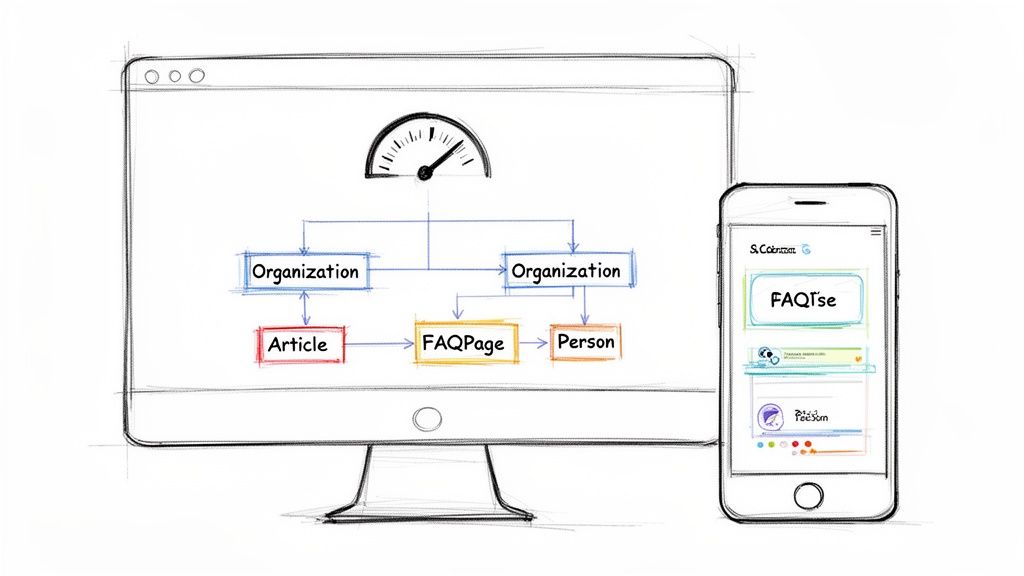
- A Flawless Mobile Experience: AI crawlers often simulate a mobile user. Your site must work perfectly on a phone.
- A Clean URL Structure: Logical, descriptive URLs help both users and machines make sense of your site’s hierarchy.
These aren't just "nice-to-haves" anymore. They are the absolute minimum requirement to be considered a citable source by models like ChatGPT.
Speaking the Language of AI with Schema Markup
Once your site is clean and fast, your next move is to talk directly to AI models in the language they were built to understand: structured data, also known as schema markup. This is your secret weapon for explicitly defining who you are, what you do, and why your expertise is credible.
Schema is code you add to your website that translates your human-readable content into a machine-readable format. It's like adding footnotes to your site that tell AI, "This is our official company name," "This is our CEO," or "This is a frequently asked question about our product."
Schema markup removes ambiguity. Instead of hoping an AI correctly infers what your SaaS does, you are explicitly telling it, turning your website's code into a clear signal of authority and context.
This structured information is precisely what AI models need to build trust and confidence in your brand as a reliable source.
The Essential Schema Types for SaaS Authority
While there are hundreds of schema types, a few are particularly powerful for building the entity authority needed for ChatGPT SEO. Implementing these correctly gives you a huge leg up.
OrganizationSchema: This is your foundation. It clearly defines your company, including its official name, logo, social profiles, and address. This helps AI establish your brand as a legitimate entity.ArticleorNewsArticleSchema: For your blog content, this schema type identifies the author, publication date, and headline. The real power move is adding anauthorsub-property that links to aPersonschema for your expert.FAQPageSchema: If you have a list of questions and answers on a page, this schema structures that content perfectly for AI. It makes your answers easy to grab and cite directly.PersonSchema: Creating this for your key executives and authors establishes their expertise and affiliations. When you link this to the articles they've written, you build a web of authority that AI can easily follow.
For a SaaS company, you can get even more granular. You can use schema to define key software integrations, pricing models, and specific product features, turning your marketing pages into structured data feeds for AI. My in-depth guide covers what schema markup for AI search actually works for SaaS pages.
By combining a fast, accessible site with precise schema markup, you are not just optimizing for search engines. You are engineering your website to become a preferred source for the next generation of AI-powered search.
Measuring AEO Success and Proving ROI
So, how do you prove to the C-suite that your work on ChatGPT SEO is actually moving the needle? The old dashboards showing keyword rankings and total organic clicks don't cut it anymore. They tell a story about a channel that is fundamentally different from the new world of AI-driven answers.
To justify the investment in Answer Engine Optimization (AEO), you need a modern measurement framework. This means ditching the vanity metrics and focusing on the KPIs that really matter: citation frequency, the quality of AI referral traffic, and most importantly, the revenue generated from that traffic.
You have to prove that being the "answer" is far more valuable than just being another "result."
Moving Beyond Clicks and Rankings
Let's be clear: the traditional SEO dashboard is obsolete for measuring AEO. A top-ten ranking doesn't guarantee a citation, and a citation doesn't always show up as a direct click. This new ecosystem demands a new set of metrics.
Your primary goal isn't just clicks anymore. It's about tracking how often your brand gets mentioned in the answers from ChatGPT, Perplexity, and other AI tools. We're shifting from measuring traffic volume to measuring authoritative influence.
Here are the core KPIs you need to start tracking immediately:
- AI Citation Frequency: For your target queries, how often is your brand, product, or content mentioned in AI responses?
- AI-Driven Referral Traffic: How many people are actually clicking through to your site from a link in an AI-generated answer?
- Conversion Rate from AI Referrals: What percentage of that AI referral traffic takes a key action, like signing up for a demo, starting a trial, or making a purchase?
- Revenue from AI Referrals: This is the ultimate metric. How much direct revenue can you tie back to customers who found you through an AI citation?
Tracking and Isolating AI Referral Traffic
The first big challenge is separating AI referral traffic from your other channels. Since many AI tools act as proxies, this traffic often gets mislabeled as "Direct" or "(not set)" in Google Analytics. Setting up specific tracking is the only way to prove ROI.
A simple but effective method is to use UTM parameters on the links you believe are most likely to get cited in AI answers. For instance, if you have a definitive guide on a key topic, make sure its internal and external links are properly tagged.
Another strategy involves digging into your referral sources. Some platforms, like Perplexity, pass a clear referrer string. For others, you might need to hunt for patterns in landing page activity that line up with your AEO efforts. This is how you start building a clear picture of AI's direct impact. For a practical guide on integrating AI into your performance tracking, you can learn a ton from building dynamic ROI dashboards with AI.
I've put together a dashboard template that moves beyond traditional metrics to help you track what really matters for AEO performance.
The Modern AEO Performance Dashboard
This is a template for tracking the KPIs that matter for ChatGPT SEO, helping you measure impact beyond traditional organic metrics.
| Metric | What It Measures | How to Track | Success Benchmark |
|---|---|---|---|
| AI Citation Frequency | How often your brand is cited in AI responses for key queries. | Manual checks, AEO tracking tools. | >10% mention rate on target queries. |
| AI Referral Clicks | Click-throughs from links in AI-generated answers. | GA4 with UTMs, referral source analysis. | Consistent month-over-month growth. |
| Conversion Rate (AI) | The percentage of AI referral visitors who convert (demo, trial, etc.). | GA4 goals, CRM data matched to referral source. | >10% (outperforms traditional search). |
| Cost Per Acquisition (AI) | The cost to acquire a customer from AEO efforts. | (AEO Investment) / (AI-Sourced Conversions) | Lower than paid search and other channels. |
| Revenue from AI | Direct revenue attributed to customers from AI referrals. | CRM attribution modeling, UTM tracking. | Clear, attributable revenue growth quarter-over-quarter. |
This dashboard shifts the conversation from "how much traffic did we get?" to "how much revenue did our AEO work generate?" It's the language that gets you more budget and buy-in.
The Phenomenal Commercial Intent of AI Traffic
Once you start isolating this traffic, you’ll probably find something remarkable: its commercial intent is off the charts. Users arriving from an AI recommendation aren't just browsing; they've been given a direct, authoritative answer to a specific problem. They land on your site ready to convert.
The data backs this up. Recent case studies show that ChatGPT referral traffic converts at a whopping 14.2%. This demolishes Google's average organic conversion rate of 2.8% by nearly 5x. Overall, AI traffic has been shown to convert an incredible 23x higher than traditional search.
In one documented case, just 12,832 visits from ChatGPT directly drove 127% more orders and $66,400 in revenue. These aren't soft metrics; this is hard cash tied directly to AEO.
This is the kind of data that makes executives sit up and pay attention. It reframes AEO from an experimental marketing tactic into a core revenue driver. When you can show that every visitor from an AI source is significantly more valuable than one from Google, the business case for AEO becomes undeniable.
It supercharges the same principles we've used to generate thousands of sales from organic search for B2B clients, but with a much higher conversion ceiling.
Common Questions on ChatGPT SEO for SaaS
Even with a clear framework, jumping into Answer Engine Optimization (AEO) raises some tough questions. This is new ground for most SaaS teams, so it’s natural to have concerns about the work involved, the timelines, and the overall strategy.
Let's cut through the uncertainty and tackle the most common questions head-on. This isn't about guesswork; it's about making smart decisions based on what’s actually driving AI citations and referrals right now.
What If I'm Not Getting Cited?
It's a common and frustrating problem. You’ve published data-heavy content and dialed in your schema, but ChatGPT still refuses to mention your brand. When the citations aren't coming, it's time to audit your authority signals, not just your content.
Remember, AI models are built to trust what other credible sources say about you. If you're not getting mentioned, the problem is almost always external.
The likely culprits are:
- A Weak Third-Party Footprint: Your brand's presence on high-authority review sites like G2 and Capterra is thin. These platforms are structured data goldmines for AI.
- Lack of Expert Association: Your brand's experts aren't quoted or featured in respected industry publications. This severs the link between your company and its expertise.
- Low Fact Density: Your content might be well-written, but it lacks the hard, verifiable data points, statistics, and original research that AI models are trained to prioritize.
If you aren't being cited, the solution is almost always to look outward. Focus on digital PR, securing expert quotes on high-DA sites, and encouraging detailed customer reviews. These external signals build the trust that AI requires.
How Long Does It Take to See AEO Results?
This is where AEO breaks from the old rules. Unlike traditional SEO, which often takes 6-12 months to show compounding returns, the timeline for Answer Engine Optimization can be shockingly fast. I’ve seen clients land their first citations and AI-driven conversions within 30 to 90 days of implementing a focused strategy.
Of course, your starting point matters. A SaaS company with an established brand and existing authority signals will see traction much faster than a newcomer just entering the market. The key is consistent, targeted effort.
Should I Focus on AEO Instead of Traditional SEO?
This is the big question, and the answer is a firm "no." It's not an "either/or" decision; it's a "both/and" strategy.
Thinking of AEO as a replacement for SEO is a massive strategic mistake. Instead, you need to see them as two parallel, mutually reinforcing channels. A strong SEO foundation makes your AEO efforts more effective, and a successful AEO strategy builds the deep authority that Google increasingly rewards.
As Gartner forecasts a 25% drop in traditional search volume by 2026, the 75% of traffic that remains—combined with new AI-driven referral streams—creates a powerful dual opportunity. You can explore more about these evolving ChatGPT usage patterns and their impact on search. Ignoring AEO means willfully abandoning a high-intent, high-conversion channel that your competitors are already targeting.
Ready to make your SaaS the definitive answer in your category? Austin Heaton specializes in building the authority systems that get brands cited and recommended by AI. Schedule a consultation to build your AEO strategy today.