
Find Your Crypto SEO Consultant 2026
Find your ideal crypto SEO consultant 2026. This guide covers KPIs, pricing, interview questions, and AEO skills for Web3 B2B growth.


Hiring the wrong SEO consultant in crypto does not just slow growth. It can create compliance exposure, weaken trust signals across your site, and train search engines and AI systems to misread your brand.
This defines the core hiring challenge in 2026. A generic SEO operator may know how to publish articles, clean up title tags, and build links. Crypto teams need someone who can also handle regulated-adjacent language, entity clarity, protocol semantics, documentation architecture, and answer-engine retrieval. If that sounds narrower than standard SEO, it is. The cost of getting it wrong is higher too.
Crypto brands have less room for error because organic visibility often carries more weight in the channel mix. Paid acquisition restrictions still limit what many token, wallet, exchange, and infrastructure companies can do profitably. At the same time, search is no longer only about ten blue links. Large language models, AI overviews, and answer engines pull from pages that look credible, precise, and safe to cite. A consultant who treats crypto like SaaS can publish content that ranks briefly and still harms the business by weakening the very trust and compliance signals these systems use to decide what deserves visibility.
The hiring brief has changed.
A strong crypto SEO consultant in 2026 works across search strategy, technical architecture, content governance, and risk control. They should be able to explain how they evaluate YMYL-adjacent pages, structure documentation for crawl and retrieval, reduce ambiguity around entities and product claims, and build content systems that support both rankings and AEO performance. Legacy SEO skill still matters. It is not enough on its own.
Teams that are actively recruiting often get better candidate quality from niche channels than from broad marketing platforms. A focused Web3 job board can surface operators who already understand wallet flows, token research behavior, protocol messaging, and the reputational risks that come with crypto acquisition.
For a clear explanation of why generic playbooks keep failing here, this analysis on why normal SEO fails for blockchain projects and what ranks aligns with what experienced growth teams keep seeing in practice.
Why Hiring for Crypto SEO Is Different in 2026
The most expensive mistake crypto teams make is hiring for channel familiarity instead of category competence.
A consultant can be excellent at SaaS SEO and still be dangerous for a crypto brand. That is not an insult. It is a category reality. Crypto sits inside a trust-deficit market, under financial-content scrutiny, with terminology, user intent, and compliance constraints that punish sloppy execution.
Organic growth carries operational risk
In other industries, mediocre SEO often produces mediocre results. In crypto, mediocre SEO can create sitewide trust problems.
A consultant who does not understand the difference between educational content, transactional intent, token research behavior, protocol documentation, and regulated financial framing will make bad calls in structure, copy, and page prioritization. Search engines do not evaluate those mistakes in isolation anymore. They evaluate what those mistakes imply about your overall content operation.
Three hiring assumptions need to die:
“A strong technical SEO can learn crypto on the job.”
They can learn terms. That does not mean they can safely handle YMYL-adjacent content, protocol messaging, or the nuances of user intent across DeFi, infrastructure, exchanges, wallets, and institutional products.“Backlinks and authority metrics will protect us.”
They will not protect a weak operating model. Authority without trust signals is fragile.“We’ll judge success by rankings first.”
Rankings matter less when the business needs qualified wallet signups, product consideration, protocol adoption, and AI visibility around high-intent queries.
The hiring brief has changed
A crypto SEO consultant 2026 hire should be able to answer questions that never come up in a normal SEO interview.
Can they structure content so AI systems retrieve your brand accurately? Can they help product, legal, and content teams work from the same factual source? Can they identify pages that create trust drag even when those pages still generate clicks?
Hiring shortcut: if the candidate talks mostly about keyword volume, title tags, and backlinks, you are still interviewing for 2022.
The old playbook treated SEO as a traffic function. The current playbook treats it as a trust and discoverability system. That is why crypto hiring has become narrower, more technical, and less forgiving.
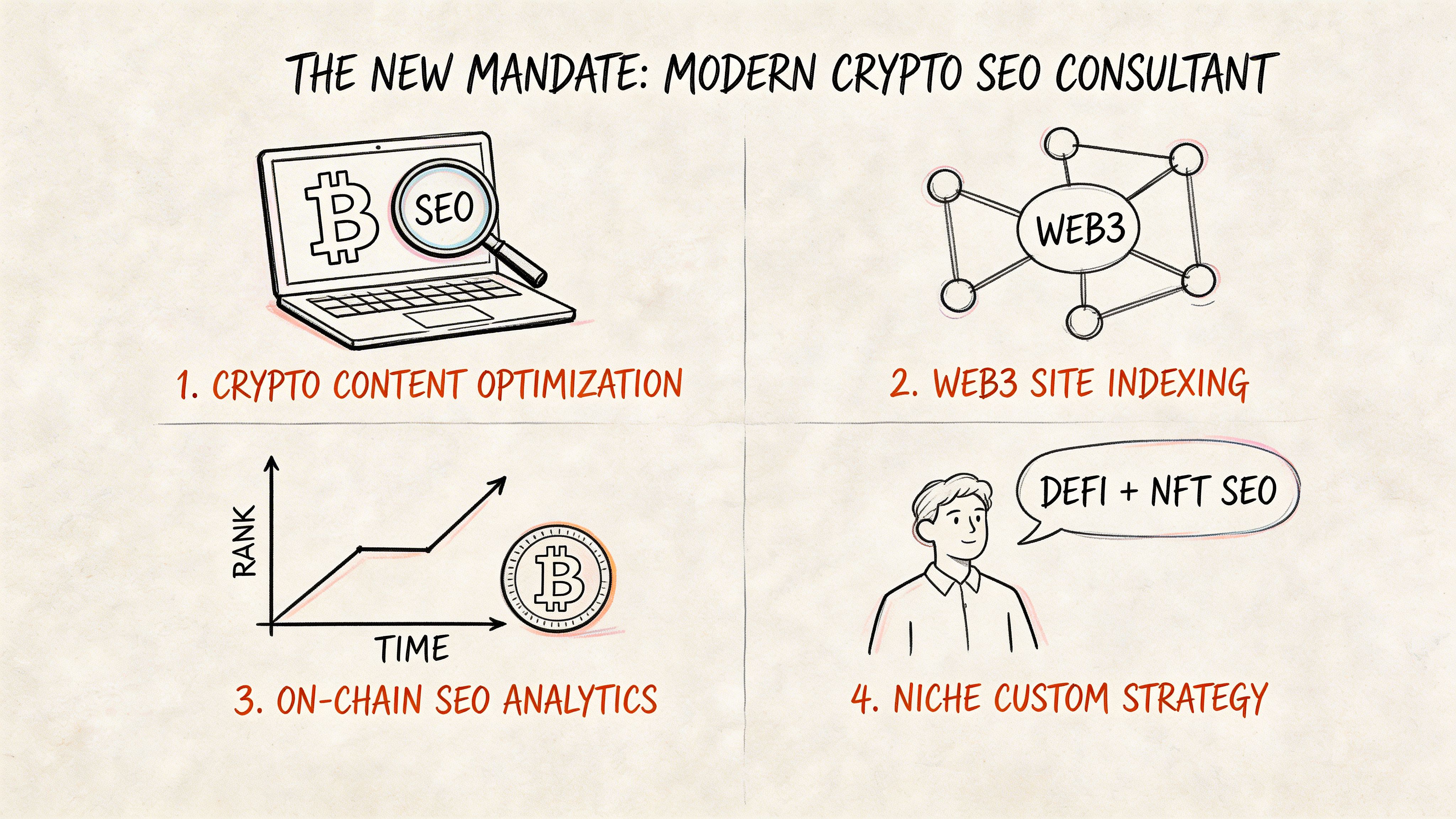
The New Mandate for a Modern Crypto SEO Consultant
A modern crypto consultant is not a keyword operator. They are a trust engineer.
That phrase sounds dramatic until you look at what has happened in the market.
Cointelegraph, a domain with DR 89, saw its top-3 keyword rankings collapse by 98.5% in six months, dropping from 18,560 to 27 after adding a low-quality casino directory, while CoinDesk lost only 3% in the same period. The underlying lesson is brutal. High authority did not save the site. Google’s site-level quality assessment treated a single low-quality section as a domain trust problem, as documented in ICODA’s crypto SEO research.
This highlights why generic consultants are risky in crypto. They often optimize pages as isolated assets. Search systems increasingly judge the business as an integrated publisher.
What the job includes now
A serious crypto SEO consultant has four core responsibilities.
Content operations governance
Most generic providers fail here.
They can produce content calendars. They often cannot build review systems that keep financial, educational, product, and community content aligned. In crypto, one low-quality directory, thin glossary cluster, or exaggerated investment page can contaminate sitewide trust signals.
That means the consultant must define:
- publishing standards for authors and reviewers
- content boundaries for regulated or sensitive topics
- update workflows when markets, protocols, or rules change
- pruning rules for pages that create more risk than value
Search architecture built around entities
The work is no longer just “target keyword, write article, build links.”
The consultant has to map your project as a set of entities. Wallet, protocol, founder, chain, use case, security model, integrations, governance structure, and documentation all need to reinforce one another. Search engines and AI systems need consistency more than volume.
YMYL and compliance-aware editorial decisions
Crypto content can trigger trust issues fast. A consultant does not need to be your lawyer, but they do need the judgment to know when a page, claim, heading, or comparison framework creates unnecessary risk.
At this stage, many teams should also pressure-test adjacent launch strategy. If you are still refining positioning or preparing category entry, this guide on Strategies for Marketing a New Product in Web3 is useful because it highlights how messaging choices upstream affect discoverability downstream.
Durable authority building
Authority now comes from being consistently cite-worthy, not just linked.
That means original insights, clear attribution, expert-reviewed pages, public technical depth, and external mentions that reinforce legitimacy.
A practical test: ask whether the consultant audits the parts of the site that should not exist. If they only talk about what to publish, they probably miss what is hurting you.
What no longer works
Several legacy habits still show up in pitches. They are red flags.
| Outdated approach | Why it fails in crypto |
|---|---|
| Domain authority obsession | Site-level trust can collapse even on strong domains |
| Volume-first content calendars | More pages can increase risk if quality control is weak |
| Generic link building | Links cannot compensate for low-integrity content operations |
| Rankings-only reporting | Visibility without qualified action is noise |
That is the mandate now.
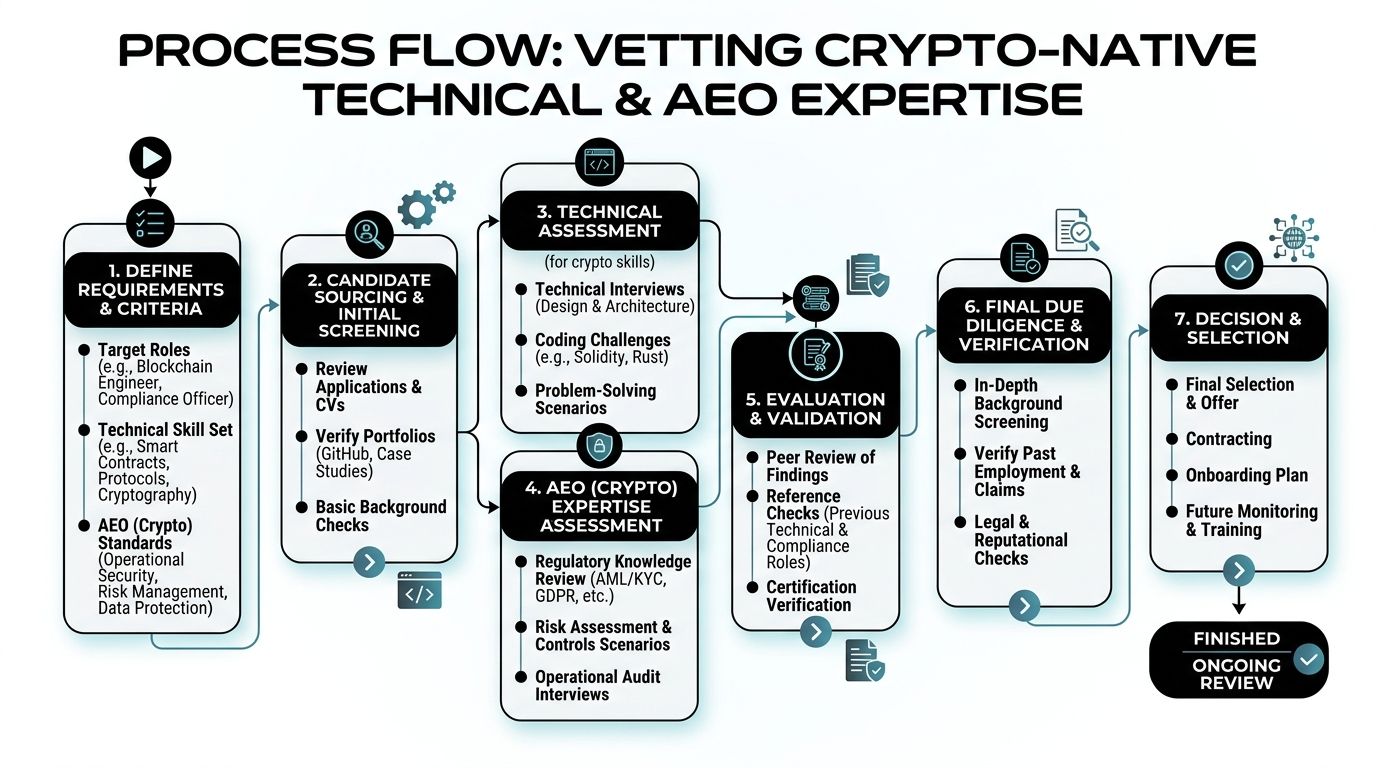
Vetting Crypto-Native Technical and AEO Expertise
Most candidates know how to talk about SEO. Very few know how to explain how a crypto brand gets cited by AI systems without creating trust or compliance problems.
That is the interview gap.
More than 50% of Google searches feature AI summaries, proprietary data is cited 5 to 10 times more than generic content, projects using the right approach have seen 560% AI referral growth in 60 days, and legacy tactics have caused 40% to 60% year-over-year click drops. Over-relying on backlinks also carries a 25% penalty risk, according to EAK Digital’s crypto SEO 2026 methodology.
If a consultant cannot translate those realities into a concrete operating model, they are not ready for crypto search in 2026.
What to evaluate first
Start with process, not personality.
A crypto-native consultant should be able to show how they handle these five layers.
Intent clustering
Ask how they group demand across awareness, consideration, and adoption stages.
A generalist often stops at keyword buckets. A stronger candidate maps intent across things like protocol education, wallet setup, staking mechanics, bridge comparisons, security concerns, and institutional research queries. They should understand that these searches belong to different users with different trust thresholds.
Semantic entity graph design
Ask what entities define your brand and how they would express those relationships on-site.
You are looking for a candidate who understands JSON-LD and knows how to structure entities such as CryptoWallet, BlockchainService, organization profiles, founders, technical contributors, and trust cues. They should explain how product pages, docs, comparison pages, glossary content, and authorship signals reinforce each other.
Proprietary data creation
Ask what original information your company can publish that AI systems would want to cite.
Good answers include on-chain analytics pages, benchmark content, transparent methodology pages, issue trackers, ecosystem maps, or product usage data that can be safely published. Weak answers default to “more blogs” or “more linkable assets” without explaining why anyone would trust them.
Omnichannel authority building
Ask where authority should be built beyond your own site.
The answer should include places where technical, community, and expert signals reinforce one another. That can include trade publications, founder commentary, documentation references, community discussions, and expert explainers. The logic matters more than channel name-dropping.
Technical hygiene for AI retrieval
Ask what they audit every quarter.
You want to hear about page speed, mobile rendering, crawlability, canonical control, schema integrity, content freshness, and retrieval clarity. If they speak only in ranking terms, they are behind.
Interview questions worth asking
These questions separate operators from presenters.
How would you build a semantic entity graph for a new token or protocol category?
A strong answer connects product pages, docs, founders, use cases, risks, and third-party validation.Walk me through your process for E-E-A-T compliance on DeFi content.
Look for discussion of authorship, editorial review, factual sourcing, update routines, and claim restraint.What kinds of proprietary data can our team publish that are both useful and safe?
The best candidates work within the realities of your product and legal boundaries.How do you decide whether a page should be improved, consolidated, noindexed, or removed?
This reveals whether they understand site-level quality.How do you adapt content for Google AI Overviews, ChatGPT, and Perplexity without writing robotic copy?
Good candidates talk about structure, retrieval clarity, factual density, and direct answer formatting.What would you want access to in week one?
Strong answers include Search Console, analytics, CMS, on-chain dashboards, content inventory, author workflows, and compliance stakeholders.
What strong samples look like
Do not ask for “case studies” in the abstract. Ask for artifacts.
Request:
- a technical audit excerpt
- a schema recommendation example
- a content brief for a regulated or sensitive topic
- a sample reporting dashboard tied to business outcomes
- an example of content pruning or remediation logic
A consultant can hide behind polished decks. They cannot hide inside a good audit.
A practical scorecard
Use a simple hiring rubric.
| Capability | What good looks like | What weak looks like |
|---|---|
| AEO knowledge | Explains retrieval, citations, entity consistency, and answer formatting | Talks only about SERPs and keyword positions |
| Crypto fluency | Uses correct protocol, wallet, exchange, and compliance language | Confuses basic concepts or speaks in buzzwords |
| Content governance | Defines review workflows and risk controls | Focuses only on publishing volume |
| Technical depth | Understands schema, crawl control, page quality, and rendering | Limits discussion to metadata and internal links |
| Revenue alignment | Ties work to qualified actions and adoption | Reports traffic without business context |
One option in this category is Austin Heaton’s work on AEO for crypto companies, which reflects the kind of consultant profile to compare against. Not because you need a specific provider, but because the benchmark should include search plus AI visibility, not legacy SEO alone.
Best interview move: ask the candidate to critique one live section of your site. Generalists talk in templates. Specialists diagnose specific risks fast.
Structuring the Engagement Pricing SOW and KPIs
Most failed SEO engagements were broken before work started.
The scope was vague. The KPIs were soft. The consultant was measured on activity instead of business contribution. Then everyone acted surprised when the retainer produced traffic slides and very little revenue movement.
A crypto SEO consultant 2026 engagement needs three things upfront: a model, a scope, and metrics that matter.
Engagement models compared
Use the operating model that matches your internal maturity.
Crypto SEO Consultant Engagement Models Compared 2026 Benchmarks
| Engagement Model | Typical Monthly Cost | Best For | Core Deliverables |
|---|---|---|---|
| Fractional leadership | Custom quote | Teams that need senior strategy, cross-functional alignment, and executive ownership | Search strategy, prioritization, governance, stakeholder alignment, KPI design |
| Project-based engagement | Custom quote | Site migrations, audits, recovery work, launch preparation, or schema rebuilds | Technical audit, remediation roadmap, IA recommendations, content risk review |
| Monthly retainer | Custom quote | Ongoing growth programs that need execution and iteration | Content strategy, technical improvements, authority building, reporting, testing |
Do not over-optimize for price structure. Optimize for the problem you need solved.
If your site has trust debt, a cheap content retainer is often the worst option. If your team lacks strategic ownership, project work alone usually stalls after recommendations. If you already have in-house execution, fractional leadership can outperform a larger agency relationship because someone senior is steering the system.
For pricing context around AI-era search work, this breakdown on how much you should pay an AEO consultant in 2026 is a useful reference point.
What belongs in the SOW
A strong scope of work should be painfully specific.
Include deliverables such as:
Technical audit for Web3 properties
Crawl analysis, indexation review, rendering issues, page quality segmentation, template assessment, and schema gaps.AEO content strategy
Intent clusters, citation targets, answer-ready templates, content refresh priorities, and retrieval formatting rules.On-chain data integration plan
Opportunities to publish original, citable data safely and consistently.Authority building program
Digital PR, expert commentary opportunities, bylined content, and ecosystem mentions that reinforce legitimacy.Performance reporting
Monthly reporting tied to business actions, not just visibility charts.
The KPIs that matter
Weak consultants reveal themselves at this point.
Do not center the engagement around rankings alone. Use a KPI stack with direct business relevance.
Primary KPIs
- Qualified wallet signups from organic
- Organic-driven product demos or sales conversations
- Protocol adoption queries from search and AI surfaces
- Share of voice on core commercial and trust-building topics
Secondary KPIs
- indexed page quality trends
- citation presence in AI surfaces
- content contribution by journey stage
- branded versus non-branded discovery mix
Supporting diagnostics
- crawl health
- schema coverage
- page template performance
- content decay and refresh cycles
Rule of thumb: if a report can look “good” while the pipeline still looks bad, the KPI set is wrong.
A good consultant will push back on vanity metrics. That is a feature, not friction.
Your Onboarding Checklist for a Successful Partnership
A strong hire can still fail if the first quarter is disorganized.
Most crypto SEO engagements underperform because the consultant gets partial access, weak stakeholder support, and no clear operating cadence. Then the company wonders why strategy sits in slides instead of shipping.

Week 1 setup
The consultant needs a real view of the business, not a filtered one.
Grant access to analytics, Search Console, your CMS, content inventory, issue tracker, product documentation, and the internal people who own legal, product marketing, and technical documentation. If the consultant has to guess how claims get approved, they will either move too slowly or take unnecessary risks.
Also agree on one source of truth for definitions. Crypto teams often use terms internally that differ from how users search. Resolve that early.
Month 1 deliverables
By the end of the first month, you should expect visible strategic output.
That usually includes:
- a technical and content risk audit
- a prioritized roadmap
- initial intent clusters
- page type recommendations
- a reporting framework tied to business KPIs
- early remediation recommendations for obvious quality issues
If you are building pages meant to earn citations, this checklist for what every B2B page needs to get cited by AI is useful because it gives teams a concrete quality bar for answer-ready content.
Month 2 operating rhythm
At this point, the partnership either becomes productive or drifts.
Set a recurring rhythm that includes one tactical working session and one decision-making review. Tactical sessions keep tickets moving. Decision reviews force trade-offs across content, product, compliance, and leadership.
Use those meetings to answer questions like:
- Which pages create the highest trust risk?
- What content needs expert review before publishing?
- Which topic clusters support revenue now, versus education later?
- What should be paused because it attracts the wrong audience?
Month 3 review
At this point, the consultant should have enough signal to refine the strategy.
Review what has been fixed, what content has shipped, what early visibility patterns are appearing, and which assumptions were wrong. The point is not to demand dramatic outcomes instantly. The point is to confirm that the system is producing clarity, execution, and measurable movement toward better business outcomes.
Onboarding mistake to avoid: do not isolate SEO inside marketing. Crypto search touches product, docs, comms, legal, and founder visibility. If those teams never meet the consultant, execution quality drops.
A successful onboarding period provides advantage. An unclear one creates delay disguised as activity.
Common Pitfalls and Red Flags to Avoid
Bad crypto SEO hires are usually easy to spot. Teams ignore the warning signs because the pitch sounds familiar.
A key problem is that familiar SEO language often hides category incompetence.
Red flags during the hiring process
Some signals should end the conversation quickly.
They guarantee rankings.
Serious operators do not promise position control in a volatile, high-scrutiny category.They dismiss compliance concerns.
If someone treats legal review or YMYL sensitivity as “marketing friction,” they should not touch your site.Their examples come from unrelated industries.
Strong ecommerce results do not prove crypto fluency.They speak in backlink packages.
That usually means they are selling a legacy lever into a trust-first environment.They cannot explain AI visibility clearly.
If ChatGPT, Perplexity, and AI Overviews are an afterthought in their model, the strategy is already dated.
Red flags during the engagement
Some problems appear only after kickoff.
Reporting without decisions
If every report summarizes traffic, impressions, and published URLs but never recommends what to stop, fix, or change, you are paying for narration.
Content that sounds accurate but feels empty
Generic crypto content is dangerous because it often looks polished to non-specialists. Technical readers spot the weakness instantly. AI systems also tend to reward content with clearer structure and better underlying signals.
No view on earned authority
A consultant who sees authority only as backlinks is missing how visibility is increasingly reinforced through citations, mentions, and trusted editorial references. This piece on why PR now drives more crypto SEO value than backlinks is useful context if your current provider still sells search growth like it is a link quota business.
No pruning instinct
A weak consultant wants to add. A strong one also knows what should be consolidated, rewritten, noindexed, or removed.
The central mistake
The biggest error is hiring for deliverables instead of judgment.
You can buy audits anywhere. You can buy content anywhere. You can buy link outreach from ten vendors before lunch. What you cannot cheaply buy back is trust after your site has been shaped by bad assumptions.
That is why a crypto SEO consultant 2026 hire should be evaluated like an operational leader, not a channel freelancer.
Frequently Asked Questions About Crypto SEO
What is the difference between a crypto SEO consultant and a crypto marketing agency
A crypto SEO consultant should be hired for judgment, not output volume.
The right consultant helps leadership make fewer expensive mistakes. That includes content governance for regulated topics, entity and schema decisions that affect AI retrieval, and prioritization across technical fixes, editorial standards, and trust signals. A general agency can cover more channels, but range often comes with handoffs, junior execution, and slower decisions.
If the business risk sits in organic acquisition, index quality, compliance exposure, or weak AI visibility, a senior crypto-native consultant is usually the better first hire.
Should we build in-house or hire externally
Build in-house when organic search is already treated like a core growth function, publishing is steady, and someone internally can own standards across product, legal, and content.
Hire externally when the team needs an outside operator to identify what is broken, what is unsafe, and what should not be published in its current form. That matters more in crypto than in ordinary SaaS. A weak page on a project token, claims-heavy comparison page, or sloppy structured data implementation can create ranking issues and trust issues at the same time.
The model I see work best is hybrid. The consultant sets the operating rules, reviews risk, and defines the AEO and SEO priorities. Internal teams handle production once those rules are clear.
How long does crypto SEO take to show measurable results
Early movement often shows up within a few months if the site has obvious technical debt, weak information architecture, or low-trust content that can be fixed quickly. Larger gains usually take longer because authority, citation patterns, and AI retrieval signals do not improve on a weekly schedule.
The first real milestone is not traffic. It is cleaner indexing, better query alignment, stronger page quality, and fewer pages that create legal or credibility risk.
If a consultant promises fast wins without discussing site history, authority gaps, content review workflows, and compliance constraints, that is a sales pitch, not a forecast.
What should we ask for before signing
Ask for four things.
A sample audit excerpt. A live critique of your current site. A reporting example tied to business outcomes. A direct explanation of how they evaluate AI retrieval, schema quality, entity signals, and high-risk financial content.
Then push further. Ask what they would de-prioritize in the first 90 days. Ask how they separate pages that can drive qualified pipeline from pages that only inflate impressions. Ask how legal review changes the content workflow. A crypto-native consultant should answer these without hiding behind jargon.
If they cannot make your site strategy clearer in a conversation, they will not make it clearer to search engines or AI systems.
If you need a senior partner to evaluate your current search risks, build AI-citable authority, and turn crypto SEO into a measurable growth channel, Austin Heaton works with B2B, fintech, AI, and crypto teams on SEO and AEO engagements designed around qualified pipeline, not vanity traffic.