
Your Guide to Google Gemini Search Optimization
Master Google Gemini search optimization with this guide. Learn proven AEO strategies to boost your brand's visibility and earn citations in AI search results.


Optimizing for Google Gemini isn't just another SEO trend. It’s a fundamental realignment of how your website earns visibility, moving from traditional search tactics to a new discipline: Answer Engine Optimization (AEO). The goal is no longer just to rank, but to become a trusted, citable source for Google’s AI Overviews and Gemini-powered answers.
The New Reality of Search with Google Gemini
The classic list of ten blue links is a relic. Today's SERP is an answer engine, and for B2B SaaS and FinTech brands, this is a critical inflection point. Holding the number one ranking means less and less when Google’s AI summary answers the user's question directly, creating a zero-click search. Your brand must now compete to be the answer.
This new reality forces a tough question on our industry: Will Generative AI Replace Search Engines and SEO? While the answer is layered, one thing is certain: the playbook for earning visibility has changed. The focus has pivoted from simply matching keywords to building a web of verifiable authority that AI models can understand, trust, and cite.
The Shift from SEO to AEO
The rise of AI search isn't a future problem; it's a present-day reality actively impacting traffic and lead generation. This demands a strategic pivot away from outdated SEO tactics toward the non-negotiable principles of AEO.
AEO isn't about gaming an algorithm. It's about becoming an undeniable source of truth in your niche. You achieve this by building a robust system of expertise, authority, and trustworthiness that is legible to both humans and machines.
This means your content must be factually precise, your website technically flawless, and your brand's expertise validated across the web. We developed a specific method for winning in both search environments, which you can explore in our guide to The Dual Visibility Framework.
To help clarify this strategic evolution, the table below contrasts the old way of thinking with the new AEO-centric approach.
Traditional SEO vs. Gemini AEO: A Strategic Comparison
This table breaks down the critical mindset shift from obsolete SEO practices to the essential AEO strategies required for visibility in Google Gemini.
| Focus Area | Traditional SEO (Obsolete) | Gemini AEO (Essential) |
|---|---|---|
| Primary Goal | Rank #1 for target keywords | Become the cited source in AI answers |
| Content Strategy | High-volume keyword coverage | Verifiable facts and original data |
| Core Unit | Keywords and search strings | Entities and their relationships |
| Authority Signal | Backlink quantity and domain rating | Verifiable expertise and brand mentions |
| Technical Focus | Crawlability and site speed | Structured data and schema markup |
| Success Metric | Organic traffic and rankings | Citations, AI clicks, and conversions |
The takeaway is clear: while foundational SEO principles remain relevant, the emphasis has moved toward creating a defensible "knowledge graph" around your brand that AI can easily parse and trust.
Why Gemini Demands Your Immediate Attention
Google Gemini is not a side project. As of 2026, it already commands 13.40% of the AI search market, with gemini.google.com attracting an astonishing 1.35 billion visits in a single month.
With 40% of Google searches now influenced by Gemini and contributing to 60% zero-click rates in the US, ignoring this platform is no longer an option—it's a risk to your visibility. The platform’s explosive growth, highlighted by the 13 million first-time app users it gained in just four days after an update, proves that optimizing for Google Gemini is mandatory. You can dig deeper into the numbers in this report on Google Gemini statistics.
Here’s how to reframe your strategic thinking for this new landscape:
- From Keywords to Entities: Instead of obsessing over "B2B payment processing software," you need to think about the entire entity of "payment processing." This includes its related concepts, features, common problems, and the experts who discuss it.
- From Content Volume to Content Verifiability: AI models prioritize accuracy above all else. A single, deeply researched article backed by original data and expert quotes is exponentially more valuable than ten generic, surface-level blog posts.
- From Backlinks to Authority Signals: High-quality backlinks still matter, but they are now just one part of a much larger system. This system includes brand mentions in authoritative publications, author credibility, and structured data that proves your expertise in a machine-readable format.
To earn a citation in a Google Gemini answer, you need more than just good content. You need to build a verifiable system of authority—a network of signals that AI models can recognize and trust. This isn't a one-and-done task; it’s a sustained effort that marries technical precision with sharp brand positioning.
It’s a fundamental shift away from the old model of just piling up backlinks. Now, you have to actively demonstrate and prove your expertise in a way that’s not just human-readable, but also machine-legible.
Marrying Digital PR with Technical SEO
At its core, this authority system is a fusion of high-level digital PR and foundational technical SEO. It’s a two-pronged attack.
- Digital PR and Link Building: This is about securing placements on high-authority websites (think sites with a Domain Authority of 60-90) that AI models already view as trustworthy sources. These placements aren't just for "link juice" anymore; they're for brand co-occurrence and external validation.
- Technical Authority Signals: This is where the magic happens on your own site. You use schema markup and meticulous on-page optimization to translate your real-world expertise into a structured language that AI can easily parse. Your website essentially becomes a structured database of your authority.
This combination creates a powerful feedback loop. High-authority mentions on other sites validate the expertise you claim on your own website. In turn, your technically sound site reinforces the credibility of those external placements, making the whole system stronger. You can get a deeper look into how AI models use these signals by understanding entity-based SEO for AI search.
Crafting Citable Assets for Gemini
When you do land a placement on a major industry publication or news outlet, the structure of that content is absolutely critical. Generic guest posts just won't do the job. Your objective is to create citable assets—specific nuggets of information that Gemini can easily lift, attribute to you, and feature in an AI Overview.
A citable asset is usually one of these things:
- A unique statistic from your own original research.
- An expert opinion or a direct quote from a recognized leader in your company.
- A concise, crystal-clear definition of a complex industry term.
- Data presented cleanly in a well-structured table or list.
The infographic below really brings this to life, showing the evolution from old-school SEO tactics to the new AEO framework, where creating these citable, authoritative assets is the name of the game.
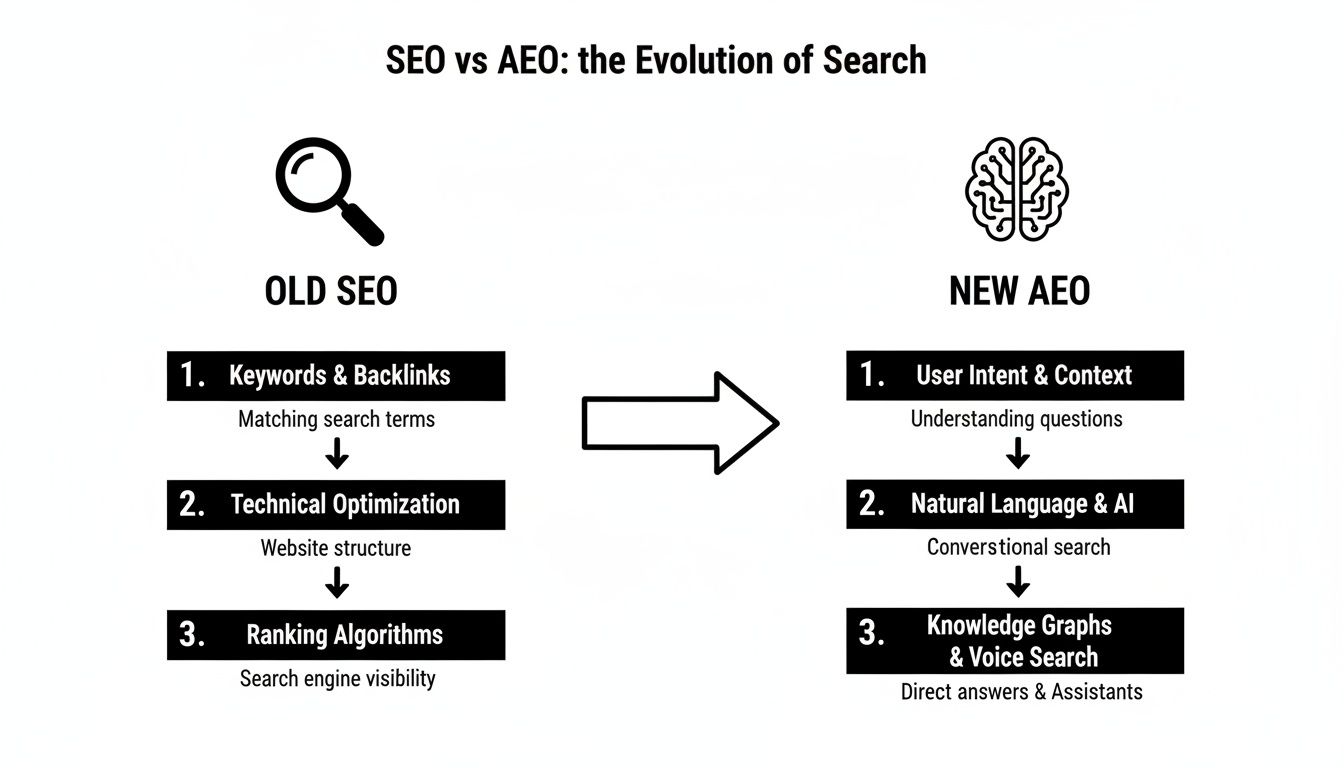
This visual shift, from a simple search box to a connected neural network, shows that success now depends on becoming a trusted node in the AI's knowledge graph.
The Critical Role of E-E-A-T and Factual Accuracy
With Google Gemini now powering 40% of all Google searches and AI Overviews showing up for 85% of informational queries in key markets, the game has changed. This has amplified the "zero-click" trend, as click-through rates are nearly cut in half when AI summaries appear.
What’s even more telling is that analysis shows a staggering 73% of traditional top-3 results are completely absent from Gemini AI Overviews. The system is clearly prioritizing different signals: factual accuracy (35%), E-E-A-T (20%), and cross-validation across trusted sources (7%).
For B2B SaaS and FinTech brands, this means one thing above all: your content's trustworthiness is your single most valuable asset. Every claim must be supportable. Every expert must be verifiable.
As you build out this authority system, it's also crucial to understand how to keep misinformation from creeping in. Making sure your source material is impeccably accurate and clearly structured is your first line of defense. Learning how to prevent AI hallucinations helps you create content that AI models can use reliably, dramatically increasing your chances of being cited as a trustworthy source.
This E-E-A-T framework isn't just a suggestion; it's a direct instruction manual for how to structure your authority-building efforts for Google Gemini. It confirms that demonstrating firsthand experience and deep expertise is no longer just a good idea—it's a technical requirement for visibility.
Optimizing Content and Entities for Gemini
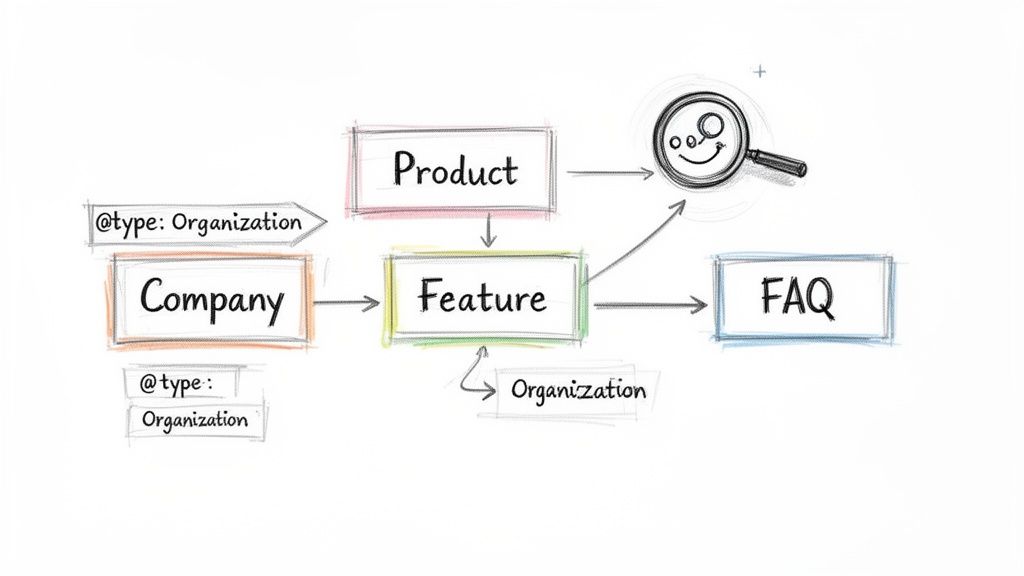
If you want to earn citations in Google Gemini, you have to stop thinking about your website as a collection of pages and start treating it like a database. Gemini doesn't just read your content; it parses it for entities—the real-world people, products, and concepts that form its understanding of your business. It's looking for structured facts it can trust.
Your job is to make that database easy for a machine to read. Instead of just writing about "FinTech lending platforms," you need to clearly define your platform as an entity. From there, you connect it to its specific features (which are also entities) and then link those features to the real-world problems they solve for your customers.
Go Beyond Basic Schema Markup
Too many B2B sites stop at Organization and Article schema. That’s just table stakes now. To get deep visibility in AI search, you need to use more specific schema types that directly answer the AI's unspoken questions about your business and its offerings.
Think of schema as the Rosetta Stone for your website. It translates your marketing copy into a set of unambiguous, machine-readable facts. For a B2B SaaS company, this is your shot to define exactly what your product is, who it’s for, and what makes it different, all in a language Google’s AI was built to understand.
Here’s a quick overview of the schema types I prioritize for Gemini visibility. Getting these right is a critical step in building the kind of structured data AI engines are looking for when they select sources to cite.
High-Impact Schema for Gemini Visibility
| Schema Type | What It Does for Gemini | Implementation Priority |
|---|---|---|
FAQPage | Packages answers to common questions in a Q&A format that Gemini can easily pull into its responses. Essential for capturing high-intent informational queries. | High |
HowTo | Structures your step-by-step guides and tutorials, making them perfect for direct inclusion in AI-generated answers that explain a process. | High |
Product / Service | Defines your core offerings with granular detail, including features, pricing, and target audience. This removes all ambiguity about what you sell. | High |
FinancialProduct | A more specific version for FinTech companies. It allows you to define offerings like loans or investment products with industry-specific attributes. | Medium (Critical for FinTech) |
This is the foundation of an entity-first SEO approach. You're not just optimizing keywords on a page; you're building out the knowledge graph signals that LLMs like Gemini use to decide who to trust. You can dive deeper into this concept in our guide on how to build the knowledge graph signals that LLMs use.
Map and Interlink Your Core Business Entities
The first step I take with any client is mapping out their core business entities. This isn't just a list of services; it's a blueprint of their entire business ecosystem.
For a B2B AI startup, this map might look like this:
- The Company: Your brand, its official profiles, and its history.
- The Founder/CEO: The key expert and face of the company.
- The Product: Your specific AI software platform.
- Key Features: Things like "Automated Reporting" or "Predictive Analytics."
- Core Concepts: The unique problems you solve, such as "reducing customer churn."
Once you’ve mapped these out, you need to create dedicated, interlinked pages for each one. The "Predictive Analytics" feature page must link back to the main product page. That product page should link to the company's "About Us" page, which profiles the founder. This builds a clear, hierarchical structure that a machine can follow.
Your website architecture should be a direct reflection of your entity map. Every important concept in your business needs its own URL, and these pages must be interconnected to show their relationships. This is how you build topical authority that an AI can actually understand.
This web of connections isn't just internal. Gemini pulls data from across the entire Google ecosystem, which makes your Google Business Profile (GBP) a huge factor. The services you list on your GBP should match the service and product pages on your website, one-to-one.
Gemini's influence is only growing, and its reliance on these structured signals gives savvy marketers a clear advantage. In fact, research shows that relentless optimization of a Google Business Profile—aiming for 100% completion—and encouraging detailed reviews that mention specific services significantly boosts both local and topical authority. For a SaaS founder, this is a clear signal: a well-optimized online footprint reinforces the factual accuracy that Gemini craves. You can find more trends and stats about Gemini's expanding ecosystem at Incremys.com.
Creating Content Snippets That Guide AI Answers
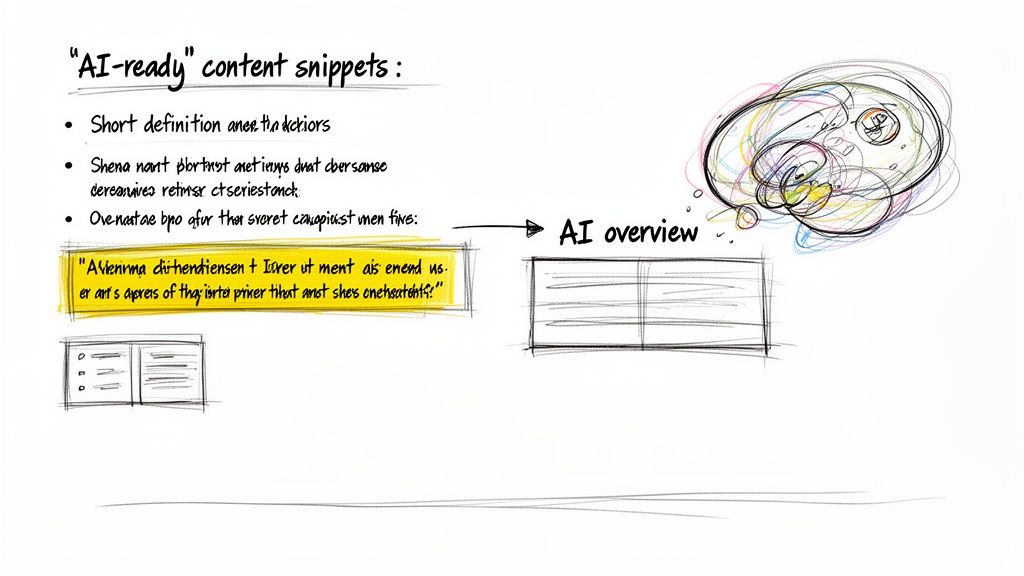
If you want to earn citations in Google Gemini, your content has to be more than just comprehensive. It needs to be "liftable." This means breaking down your information into concise, self-contained snippets the AI can easily grab and feature in an answer.
Think of it as reverse-engineering AI Overviews. You’re looking at the final product and building your content to be the perfect Lego block for its construction.
This requires a deliberate shift in how you structure and format everything you publish. You're no longer just writing for a human reader scanning a page; you're also packaging information for a machine that prioritizes clarity, brevity, and factual density. Optimizing these prompts within your content is a cornerstone of effective Google Gemini search optimization.
Reverse-Engineering the AI Overview
Get started by studying the anatomy of answers Gemini already provides for queries in your niche. You need to see what it's already doing in the wild. Pay close attention to the patterns in how it organizes information, because they are incredibly consistent.
You’ll quickly notice it prefers specific formats for different types of questions:
- Definitions: For "what is" questions, Gemini almost always pulls short, one- or two-sentence definitions.
- Comparisons: For "vs." queries, it leans heavily on tables or side-by-side bulleted lists.
- Processes: For "how to" questions, it’s looking for clearly numbered or bulleted steps.
- Data Points: When presenting a statistic, it highlights the key number and its immediate context.
By analyzing these outputs, you essentially create a template for your own content. You aren't guessing what the AI wants—you're observing what it already uses and mirroring that structure.
Crafting "Prompt-Ready" Content Snippets
Once you understand the format Gemini is looking for, you can start embedding these "prompt-ready" snippets directly into your articles. These become the citable assets the AI will hunt for when building its answers. They’re like signposts, guiding the machine to your most valuable information.
The goal is to make it easier for Gemini to cite you than to synthesize an answer from multiple, less-structured sources. You are literally doing the pre-summarization work for the AI.
For instance, if you're a FinTech company explaining "tokenization," don't bury the definition deep inside a long, narrative paragraph. Put it right up front with bolded text so it stands alone.
Example: A "Liftable" Definition
Instead of a meandering paragraph, structure it cleanly:
Tokenization is a security process that replaces sensitive data, such as a credit card number, with a unique identification symbol or "token." This token retains all the essential information about the data without compromising its security.
This clear, self-contained format makes it incredibly simple for Gemini to lift the definition directly into an AI Overview, with your brand named as the cited source.
The Power of Strategic Formatting
Strategic formatting is one of the most powerful signals you can send to guide Gemini. AI models are trained to see structure as a sign of importance and clarity. For B2B SaaS and FinTech brands, this is a massive opportunity to spotlight key features, data, and differentiators.
Use these formatting elements to your advantage:
- Bulleted Lists: Break down complex features or benefits into scannable points. Each bullet point should be a self-contained idea.
- Numbered Lists: Use these for any step-by-step process. This structure is a direct match for how AI explains "how-to" queries.
- Tables: For any kind of comparison—your product vs. a competitor, different pricing tiers, or feature breakdowns—tables are invaluable. They present structured data in a way that is immediately understandable to an AI.
- Blockquotes: Use these to highlight key statistics, expert opinions from your team, or major takeaways. A blockquote signals to Gemini that this is an important, citable piece of information.
Properly structuring your pages with elements like FAQ schema is also critical. For a deeper dive on this, you can learn how to structure FAQ content that matches LLM query patterns in our detailed guide.
By embedding these prompt-optimized snippets and using deliberate formatting, you’re not just writing an article. You're building an asset designed to be the definitive, easiest-to-use source for Google Gemini.
How to Measure Success in the Age of AI Search
If you're still reporting on keyword rankings and total organic sessions, you're measuring the past. In the age of AI search, that dashboard is obsolete. When a Google Gemini summary provides the answer, you don't get the click. But what you can get is far more valuable: a direct, attributable citation that positions your brand as the authority.
Success in this new environment means tracking an entirely different set of KPIs. You have to move past vanity metrics and start measuring what actually matters: your brand's visibility and influence within AI-generated results. This is how you prove the ROI of your AEO strategy to your leadership team.
Introducing the AEO Measurement Framework
The core problem is that traditional analytics tools weren't built for this. You can't just log into Google Analytics and pull a "Gemini Mentions" report. That means we have to get creative, stitching together data from different sources to paint a complete picture of performance.
This new measurement framework is built on three pillars:
- Cited Brand Mentions: Tracking every single time your brand is named as a source inside an AI Overview.
- AI Clicks: Identifying and segmenting the traffic that does click through from an AI-generated link.
- AI-Sourced Conversions: Attributing downstream revenue and qualified leads back to those initial AI appearances.
Getting this right requires a willingness to combine tools in new ways and focus on what you can actually observe and control.
Your goal is to stop asking, "How did we rank?" and start asking, "Were we the cited authority?" This question reorients your entire measurement strategy around the ultimate goal of AEO: becoming the source.
For a deeper dive into the specific tools and technical setup, you can explore our detailed guide on how to measure AEO results for B2B companies. This isn't just a theoretical model; it's a practical system for attributing real business value to your optimization work.
Setting Up Your AEO Tracking Stack
Building a reliable tracking system for Google Gemini search optimization is about being resourceful with the tools you already have. There's no single magic-bullet solution, but a smart combination of platforms will give you the visibility you need.
Brand Monitoring Tools
Tools like Brand24 or Mention are your first line of defense. Set up alerts for your brand name, key products, and even the names of your public-facing experts. While these platforms are built for social listening, they will often pick up mentions from across the web—including forums and blogs where AI-generated answers are reposted. Think of it as a proxy for your brand's presence in the AI ether.
Google Search Console (GSC)
GSC is surprisingly powerful for AEO measurement, but you have to know where to look. Forget about broad, high-volume keywords and instead filter your performance reports for long-tail, conversational queries.
Look for questions like:
- "How does [your product category] work for B2B SaaS?"
- "What is the best way to [solve a problem your service addresses]?"
- "Compare [your brand] vs [competitor brand]"
A query with high impressions but a low click-through rate (CTR) is a classic sign that an AI Overview is in play. While you didn't get the click, the high impression count for a hyper-relevant question proves you're part of the conversation.
Manual Audits and Screenshots
This approach is low-tech but absolutely critical for reporting to stakeholders. On a regular basis, run incognito searches for your most important target queries. When you find your brand cited in an AI Overview, take a screenshot.
Maintaining a repository of these screenshots provides the concrete, visual proof of AEO success that data tables can't. It’s one thing to show a rising impression count in GSC; it's another to present a slide deck filled with images of Google’s own AI directly quoting and recommending your brand. This is how you prove the value of your work.
Answering Your Top Questions About Google Gemini Search Optimization
As more B2B leaders start shifting focus toward AEO, a lot of practical questions are bubbling up. It’s a different way of thinking about search, with new tactics and timelines. It's totally natural to wonder where to start, how to measure it, and how long it all takes.
Here are the most common—and critical—questions we hear from founders and marketing execs as they get started with Google Gemini search optimization.
How Long Until I See Results from Gemini AEO?
Unlike traditional SEO, which can easily take 6 to 12 months to show real traction, a focused AEO strategy can land you some quick wins. For long-tail, conversational questions, you can start earning brand citations in as little as 60 to 90 days.
Why so fast? AI models like Gemini are constantly re-evaluating and updating their trusted sources, far more dynamically than Google’s classic indexing and ranking process.
But it’s important to have the right expectations.
While you can get those early wins, building the deep, foundational authority to be cited for competitive, high-value business terms is a long game. That takes at least 6+ months of consistent effort across content, schema, and digital PR.
In our own campaigns, we've seen a meaningful flow of AI-driven clicks and conversions start within the first two months. But creating broad, durable visibility that holds up against algorithm changes is the result of compounding authority built over time. It's a marathon, not a sprint—but you'll definitely hit some exciting milestones along the way.
Should I Create New Content or Optimize Existing Pages?
The best approach is a hybrid one that balances quick wins with long-term authority. Don't make the mistake of thinking you need to build everything from the ground up. Your existing content is a goldmine waiting to be tapped.
Start with an audit of your current high-performers—the pages that already bring in traffic and leads. These are your lowest-hanging fruit. Your first move should be to enrich these assets by:
- Injecting precise, citable facts and fresh statistics.
- Adding quotes from your team’s leaders to signal expertise.
- Implementing specific schema markup like
FAQPageandHowTo. - Restructuring content into "liftable" snippets like bullet points and tables.
At the same time, you need to be hunting for content gaps. Look at the AI Overviews in your niche. Where are the answers weak, incomplete, or pulled from non-expert sites? Those gaps are your openings. This is where you can create new, definitive pillar pages that become the go-to resource.
This “optimize and expand” strategy gets you immediate improvements while you build the topical authority needed to dominate in the long run.
What Is the Most Important Factor for Gemini Optimization?
If I had to boil it all down to one thing, the single most critical factor for Google Gemini search optimization is proving your topical authority through verifiable signals.
This isn't just one action; it’s a complete system. It's the engine that drives all AEO success.
This system has three core parts working together:
- Expert-Led Content: Publishing deeply researched, factually accurate content that shows you have real-world experience.
- Structured Data: Using precise schema markup to translate that expertise into a language Gemini can understand without any guesswork.
- External Validation: Earning high-quality backlinks and digital PR mentions from other authoritative sources and trusted industry sites.
While technical SEO lays the groundwork, verifiable authority is the fuel. Without it, Gemini has no reason to trust your answer over an established source like a major trade publication or a research institution. You have to earn that trust, and this is the system for doing it.
How Do I Track When My Brand Is Cited in AI Overviews?
Tracking your visibility in AI-generated answers isn’t a one-click process just yet. It requires a few different tools working together, since no single platform gives you the full picture. The goal is to piece together a clear story of your AEO performance.
Here’s the tracking stack we recommend:
- Brand Monitoring Tools: Set up alerts in a tool like Brand24 for your brand name, products, and key executives. This casts a wide net to catch mentions across the web, which often include reposted AI answers.
- Manual Incognito Searches: This is non-negotiable. You have to regularly search your most important target queries in an incognito browser. Screenshot every time your brand gets cited. This gives you the concrete, visual proof that stakeholders love to see.
- Google Search Console Analysis: Dig into your GSC performance reports. Filter for long-tail, conversational queries and look for patterns—specifically, high impressions paired with a low click-through rate. This is often a strong signal that an AI Overview is answering the user's question directly.
- Third-Party AEO Trackers: A new wave of SEO software is starting to pop up that specifically tracks visibility within AI Overviews. They’re still a bit new, but these tools offer a more scalable way to monitor your footprint over time and see how you stack up against competitors.
At Austin Heaton, we specialize in building these durable authority systems. If you're ready to move beyond outdated SEO and make your brand the trusted source for AI engines, let's connect. Explore our AEO consulting services to see how we can help you win in the new era of search.