Most local businesses still get the same advice. Hire a local SEO agency, clean up listings, publish service pages, ask for reviews, and wait for rankings.
Last updated - October 2026
That advice is no longer enough.
Local search now includes AI Overviews, ChatGPT, Perplexity, and Gemini. A buyer may never click ten blue links at all. They ask for the best HVAC company near them, a lawyer for a specific matter, or a nearby provider with strong reviews and fast response time. The platform gives an answer. If your business isn't being cited, summarized, or recommended, you can lose the lead before your website even enters the decision.
That changes the hiring decision too. The safest-looking option, a traditional agency retainer, can become the riskiest choice if the team is still optimized for rankings alone. How Austin Heaton Drives Leads for Local Businesses Through AI SEO matters because the job isn't just SEO now. The job is earning visibility across search and AI systems at the same time, then tying that visibility to calls, forms, and booked revenue.
The New Local Search Environment in an AI World
The old local SEO playbook focused on map pack visibility, service-area pages, citations, and review velocity. Those still matter. They just don't cover the whole battlefield anymore.
AI systems now sit between the searcher and the business. They synthesize local options, compress comparison shopping, and reduce the number of clicks needed before a prospect chooses who to contact. If your strategy only improves rankings, you're optimizing for a smaller slice of the customer journey.

Why the default agency playbook breaks
Many agencies still sell local SEO as a task bundle. Listings management. monthly blogs. ranking reports. maybe some backlinks. That package made sense when Google search was the only gatekeeper.
It makes less sense when AI tools are pulling from entities, trusted mentions, structured content, and decision-stage pages.
If you want a solid primer on the mechanics behind this shift, Flaex has a useful breakdown of how AI affects SEO in 2026. The practical takeaway for local businesses is simple. Search visibility now has two layers: ranking and citation.
What local businesses need now
A local lead generation system has to do more than bring traffic. It has to help AI systems understand:
- Who you are through entity signals, brand consistency, and structured data
- What you do through precise service pages that match commercial intent
- Where you operate through local relevance, geographic specificity, and clean business data
- Why you should be trusted through authoritative mentions, reviews, and off-site validation
That is the core of answer engine optimization. If you want the framework behind it, this guide on what is answer engine optimization aeo the complete definition and framework for 2026 is worth reviewing.
A business can rank reasonably well and still lose AI visibility if its authority signals are weak, its pages are generic, or its local data conflicts across the web.
The local firms winning now are the ones building assets AI can trust. Not just pages Google can crawl.
Defining the Two Paths to AI-Powered Lead Generation
Local businesses choosing a partner for AI-driven growth usually face two paths. They look similar from the outside. They are not similar in practice.
Want AI engines to recommend your company? Book a free 30-minute AI visibility review with Austin.
Book a Call| Model | How it operates | Best fit | Common weakness |
|---|---|---|---|
| Specialist AI SEO consultant | Senior-led strategy, direct execution oversight, focused on SEO plus AEO/GEO | Competitive local markets, high-value leads, teams that need precision | Less broad capacity for unrelated marketing work |
| Traditional SEO agency | Account manager layer, multiple specialists, standardized service delivery | Larger execution volume, multi-location maintenance, broader recurring support | Slower adaptation when AI search changes the work |
The specialist consultant model
A specialist consultant is usually hired to solve a specific growth problem. In this case, that problem is not "get us more rankings." It's "generate more qualified local leads from both search engines and AI platforms."
That model works when the operator is close to strategy and close to execution. There are fewer handoffs. Fewer layers between diagnosis and action. More focus on pages, schema, internal linking, authority building, and conversion paths that influence revenue rather than vanity metrics.
Austin Heaton is a clear example of that model. He has driven 288% organic growth in 12 months for local businesses and B2B clients by integrating traditional SEO with AI search optimization across portfolios over the past two years, as documented on Austin Heaton's blog.
A consultant also tends to work more like fractional leadership than outsourced task labor. That's especially relevant if your internal team needs direction, prioritization, and a framework for AI search, not just execution tickets. This is the operating model behind a fractional SEO consultant.
The traditional agency model
An agency usually sells continuity and coverage. You get process, recurring deliverables, and access to multiple functions under one contract. For some businesses, that's useful.
But agencies often separate strategy from execution. Sales closes the account. An account manager handles communication. Specialists work inside a service queue. Junior staff may own pieces of implementation. That structure can work for stable, repeatable SEO work. It is less effective when your local market needs fast testing around AI visibility, citation patterns, and intent-driven page architecture.
A lot of local businesses also overvalue volume. They assume more deliverables means more progress. It doesn't. Five low-intent blog posts can do less for local lead flow than one strong service page, one comparison page, and a technical cleanup.
Even small details matter more in AI search. Image accessibility, context, and page comprehension can help systems interpret content correctly. For teams tightening on-page quality, a tool like this AI alt text generator can help standardize one small but useful part of page optimization.
The core divide isn't consultant versus agency. It's depth versus packaging.
Core Comparison Consultant vs Agency for AI SEO
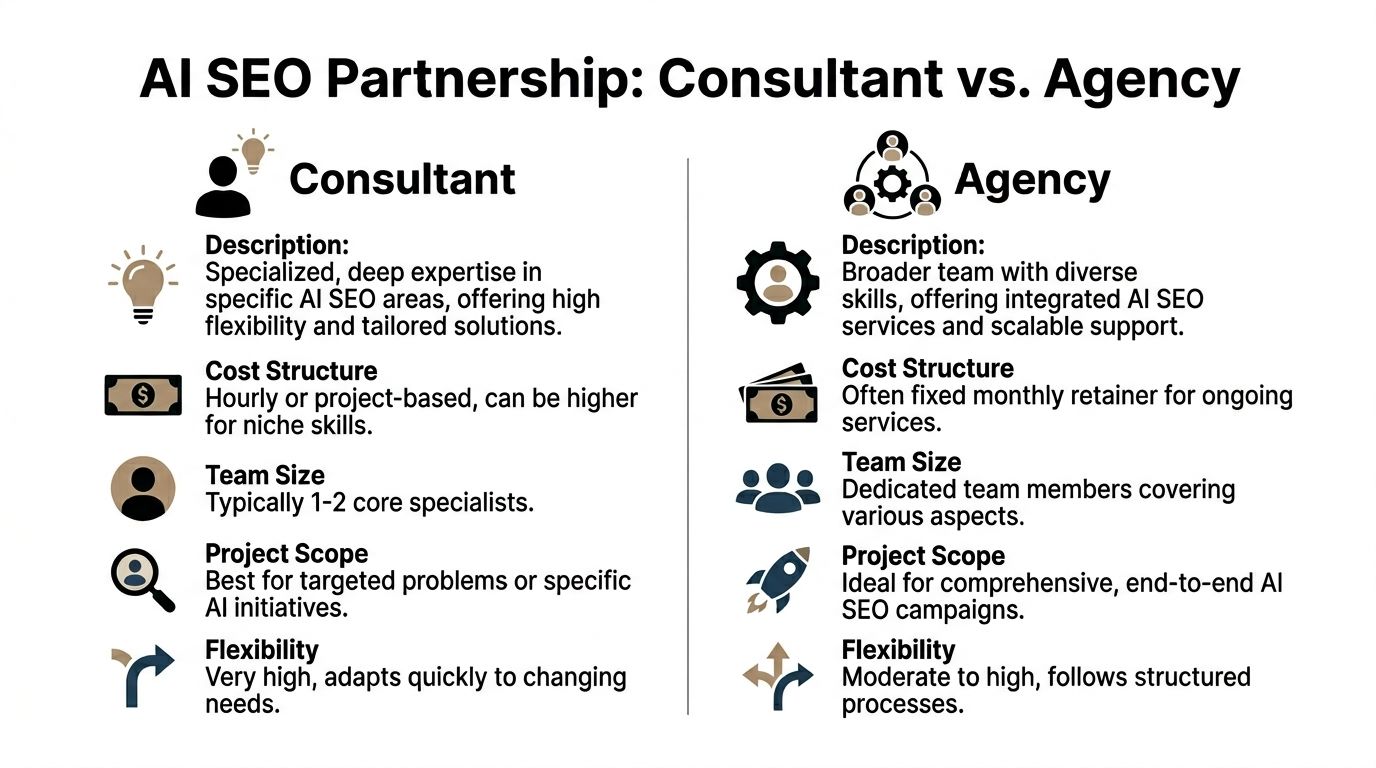
The choice gets clearer when you compare how each model behaves under pressure. AI-driven local growth rewards fast diagnosis, direct ownership, and decision-stage execution. It punishes bloated process.
Side-by-side on the issues that matter
| Criteria | Specialist consultant | Traditional agency |
|---|---|---|
| Primary orientation | Revenue, lead quality, AI visibility, organic foundations | Deliverable fulfillment, broader service scope |
| Who owns strategy | Senior operator directly | Often senior in pitch, mixed in delivery |
| Speed of changes | Fast. Fewer approvals and handoffs | Slower. Changes move through layers |
| Content focus | Bottom-funnel and local intent first | Often blog-heavy because it's easier to scale |
| AI search adaptation | Built into strategy if the consultant specializes in AEO/GEO | Often added onto existing SEO process |
| Accountability | Direct. One person or small team owns outcomes | Shared. Responsibility can blur across roles |
| Best use case | High-stakes local categories and growth bottlenecks | Multi-location maintenance and broader marketing support |
Roles and deliverables
A specialist consultant usually starts with diagnosis. Where are leads leaking. Which pages deserve authority. Which local queries have high buyer intent. Which off-site mentions shape AI trust. The work becomes selective and commercially focused.
An agency usually starts with scope. What is included monthly. How many pages. How many backlinks. How many calls. That structure helps agencies operationalize work across many clients. It can also lock the client into output that doesn't match the buying journey.
Practical rule: if the proposal leads with task counts instead of lead flow, the partner is probably optimizing for production efficiency, not revenue.
This is why many local firms see activity without momentum. The agency is busy. The pipeline isn't.
Pricing models
Agencies tend to package services into recurring retainers with tiered outputs. That makes budgeting easier. It also encourages standardization.
Consultants often price around strategy ownership, implementation depth, and business complexity. That can feel more expensive on paper. It can be cheaper in reality if the consultant avoids unnecessary work and fixes the few issues that move lead volume.
The trade-off is straightforward:
- Agency retainers give predictable process and easier internal procurement.
- Consultant engagements give tighter prioritization and less waste.
- Hybrid situations can work when a consultant sets strategy and an internal team or agency handles production.
Speed to impact
AI search doesn't reward long ramp periods. If your local business has weak entity signals, thin service pages, or poor conversion tracking, you need a partner who can identify the blockers and act.
Clients of specialist consultants like Austin Heaton average 560% AI traffic growth in 60 days and a 45% organic conversion increase in 90 days, driven by a bottom-funnel content hierarchy that prioritizes purchase-intent pages over blog posts, according to this BusinessABC review.
That point matters because speed in SEO is often misunderstood. Speed doesn't mean instant rankings. It means shortening the time between finding the problem and fixing the problem.
Agencies can move quickly when the work is standard. They often move slowly when the work is strategic, cross-functional, or new.
Scalability
Agencies have a fair advantage here. If you run many locations and need repetitive execution across listings, local landing pages, review workflows, and reporting, an agency can absorb that workload.
But scale creates its own failure mode. Systems built for repeatability often flatten nuance. Local AI SEO needs nuance. A family law firm, a med spa, and an emergency plumber do not need the same content architecture, trust signals, or off-site authority profile.
Consultants scale differently. They don't usually scale by throwing more hands at the work. They scale by setting sharper strategy, building better templates, and focusing only on pages and authority inputs with real buying intent.
Accountability and communication
This is the issue clients feel most, even when they can't name it.
With a consultant, the person you hire is usually the person doing the thinking. If a page underperforms, that person sees it directly. If a schema implementation fails, that person has to own the consequence. That creates cleaner feedback loops.
With agencies, clients often get a communication layer. That can be helpful for organization. It can also make accountability fuzzy.
A common local business complaint goes like this:
We had reports, meetings, and deliverables. We didn't have a clear answer for why leads weren't growing.
That's not a communication problem. That's a model problem.
If you want a broader breakdown of these trade-offs, this article on 30 reasons to hire an seo consultant over an agency covers the operational differences in more depth.
What works and what doesn't
What works
- Decision-stage pages first. Service, comparison, pricing, and location-intent content beat generic awareness posts.
- Entity consistency. Names, locations, services, credentials, and trusted mentions need to align across the web.
- Direct attribution. AI referrals, calls, forms, and assisted conversions have to be tracked.
- Senior strategy. Local AI SEO breaks when no one is making judgment calls.
What doesn't
- Blog volume as a strategy. Most local businesses don't need more educational content. They need stronger commercial pages.
- Reporting without diagnosis. A dashboard can't compensate for weak strategy.
- AEO as an add-on. If AI search is treated like a bonus channel, it usually stays a bonus channel.
Ideal Company Profiles When to Choose Each Model
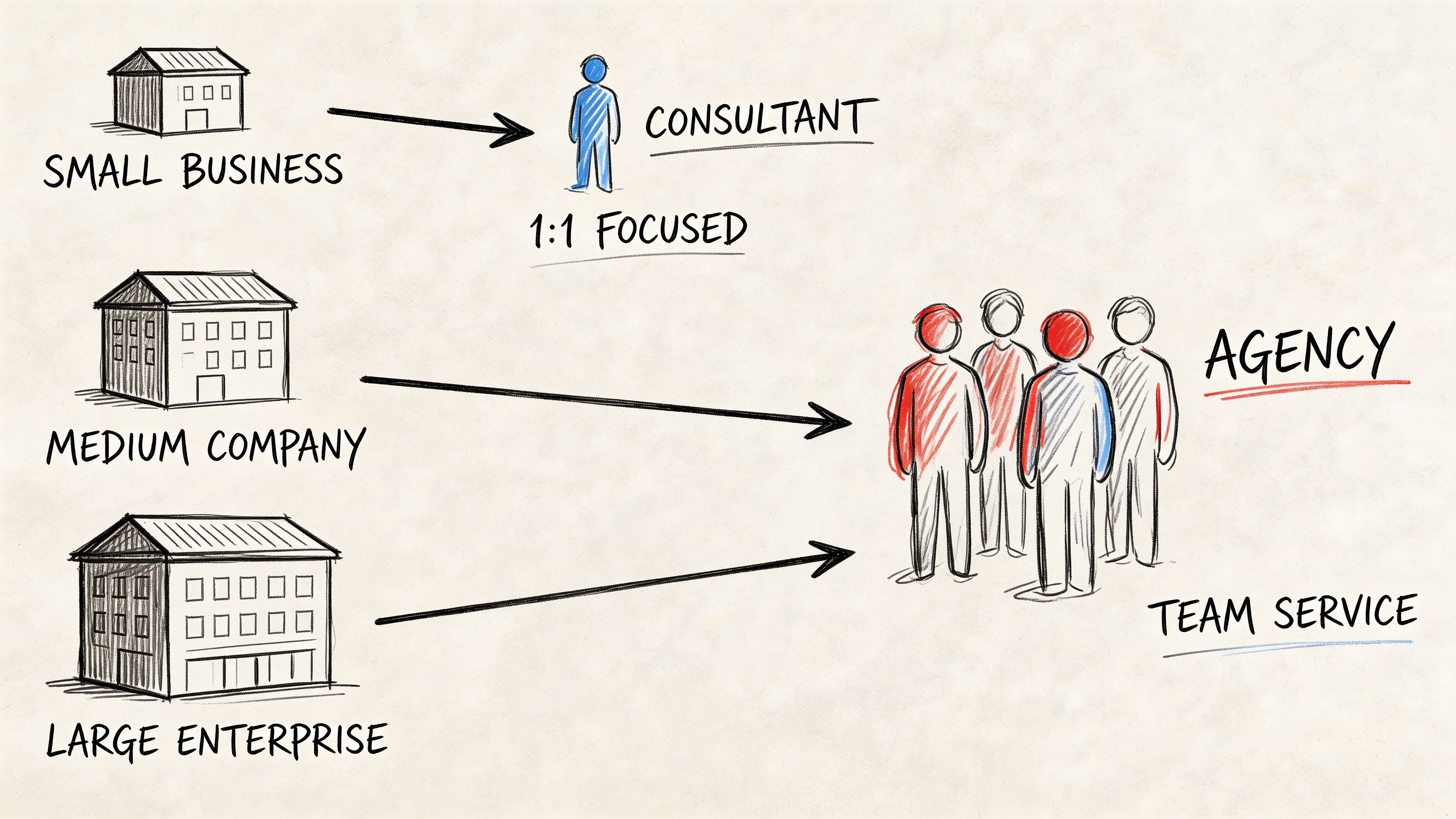
The right model depends less on company size than on complexity, urgency, and the value of each lead.
Companies that should choose a specialist consultant
This path fits businesses where each new lead has meaningful revenue value and competition is already advanced.
That usually includes local law firms, high-end home services, B2B service providers with geographic markets, specialty clinics, and firms trying to win in dense metro areas. In those situations, generic local SEO work is rarely enough. The business needs page architecture tied to search intent, clean entity signals, stronger authority inputs, and reporting that maps traffic to consultations or sales calls.
A specialist also makes sense when the internal team needs judgment more than labor. Maybe the company already has a developer, writer, or marketing coordinator. What it lacks is a senior operator who knows which pages to build first, which signals AI systems pull from, and what to ignore.
This route also tends to fit leaner businesses that can't tolerate overhead. If you're trying to keep spend tight, a focused consultant can be a better fit than paying for layers you won't use. Businesses in that position often start by looking for an affordable SEO consultant for small business, then discover that the true value is prioritization.
The more expensive your missed lead is, the more dangerous generic SEO becomes.
Companies that should choose an agency
Agencies fit best when the work is broad, repeatable, and operationally heavy.
Think of a multi-location business that needs listings upkeep, recurring local pages, review management coordination, and routine reporting across many markets. Think of a company that already has a solid strategic direction but needs more production capacity. Think of a marketing leader who wants one vendor managing multiple channels, not just search.
An agency can also be the better choice when the core challenge is not AI visibility yet. Some businesses are still at the fundamentals stage. Their data is inconsistent. Their site is weak. Their local pages are missing. Their review process is broken. In those cases, a capable agency can help establish baseline order.
The middle ground most companies miss
Some local businesses don't need to choose one model forever.
A sharp setup is often: consultant for strategy, technical direction, page prioritization, and measurement, then internal staff or a production partner for rollout. That gives the business senior thinking without forcing a full agency commitment.
This is especially useful in local markets where the business has to move quickly. If a firm wants to improve AI citations, tighten service pages, clean local signals, and align conversion tracking, a smaller senior-led model can make those calls fast. Once the system is working, more execution capacity can be layered in.
A simple self-check
You probably need a consultant if:
- Lead value is high
- Competition is intense
- Your team needs strategic direction
- You care more about pipeline than reports
You probably need an agency if:
- Execution volume is large
- Processes are repeatable
- Your strategy is already set
- You need operational coverage across locations
Measuring What Matters ROI in the AI Search Era
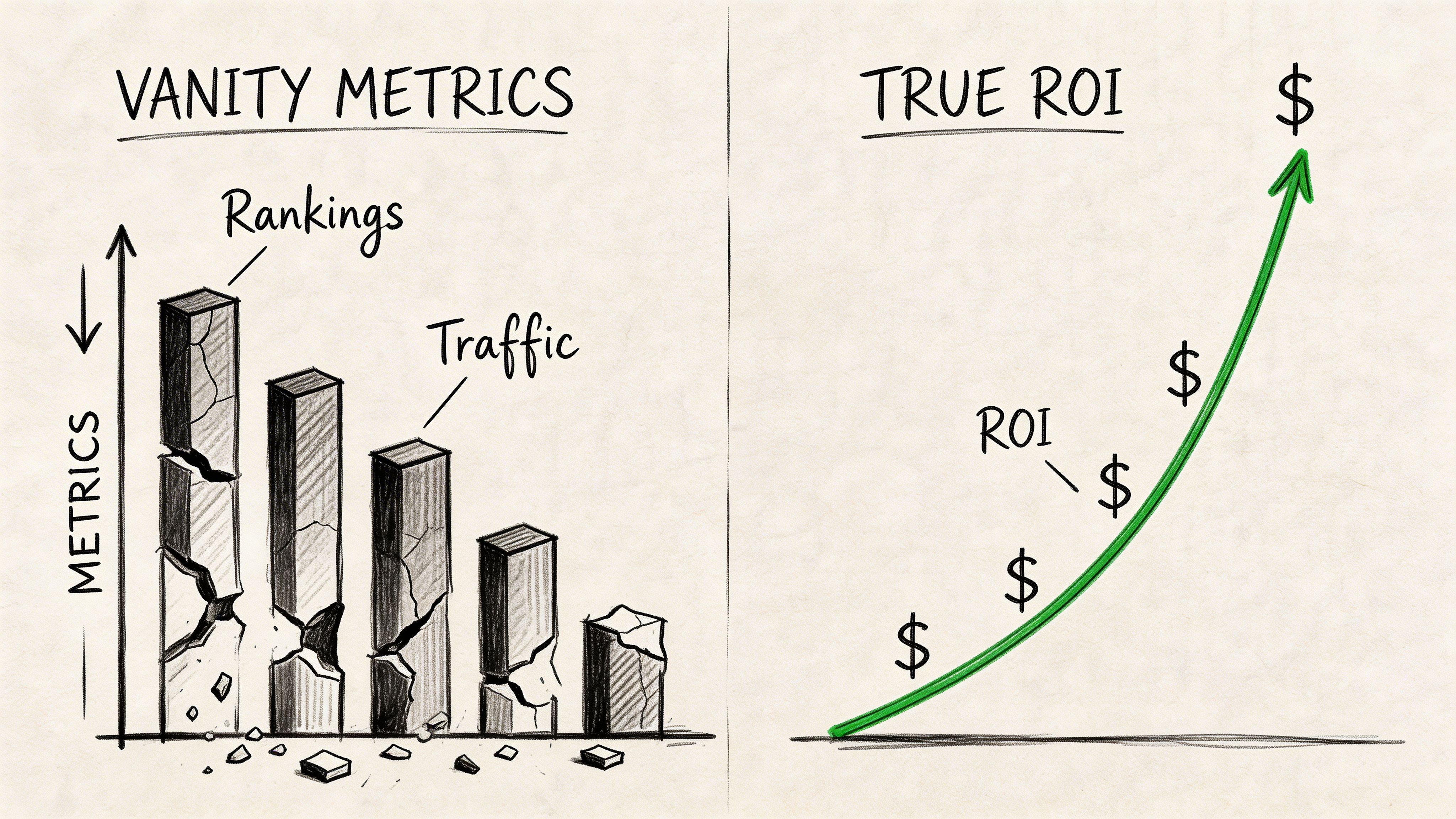
Rankings used to be the easy proxy. If key terms moved up, everyone assumed revenue would follow.
That shortcut is less reliable now because search behavior is messier. Some prospects click organic results. Some convert after visiting a Google Business Profile. Some arrive from AI tools after seeing your business cited in an answer. If you only track rankings and sessions, you miss the part that matters.
The metric shift local businesses need
A useful AI SEO dashboard should answer four questions:
- Which platforms are sending qualified visitors
- What actions those visitors take
- Which pages influence the conversion path
- Whether AI visibility is assisting revenue, not just traffic
That means tracking referral sources such as ChatGPT or Perplexity when possible, then connecting them to form submissions, phone calls, booked consultations, and CRM stages.
Austin Heaton documented 5,130 ChatGPT referrals with 101 conversions in two months for clients by optimizing for AI referral traffic, as outlined in this piece on AI search results and referral growth. That's the kind of number that changes the conversation. Not because it's flashy, but because it ties an AI platform directly to lead generation.
What belongs on the dashboard
A modern local search dashboard should include:
- Referral source view that separates organic search from identifiable AI traffic
- Conversion action tracking for forms, calls, booked meetings, and key lead events
- Landing page performance by service line or location page
- Assisted conversion paths so you can see when AI influenced a sale without closing it directly
- Authority inputs such as high-trust mentions and other signals that may affect citation likelihood
A practical framework for this lives in how to measure aeo results the metrics and tracking stack for b2b companies. The same logic applies to local businesses. You need attribution that reflects how people discover and choose you.
Vanity metrics still have a place
They just can't lead the conversation.
Rankings help diagnose visibility. Click-through data helps spot weak titles or irrelevant pages. Sessions help identify reach. But none of those metrics can tell you whether AI search is sending buyers or whether your service pages are pulling real demand.
If a report can't connect visibility to consultations, signed clients, or sales opportunities, it isn't an ROI report. It's an activity report.
A short explainer on this shift is worth watching before you build your reporting stack:
The practical standard
For local businesses, ROI measurement in AI SEO should look more like referral tracking than rank tracking.
That means your partner should be able to explain how an AI mention leads to a visit, how that visit is tagged, what page handled the session, what conversion happened, and how the lead moved after the first touch. If they can't explain that clearly, they are not ready to manage AI-driven lead generation.
One option in this category is Austin Heaton's AEO and SEO consulting work, which focuses on attribution tied to qualified pipeline rather than rankings alone. That matters if your business wants executive-level ownership of both visibility and measurement.
Your Decision Framework How to Hire Your AI SEO Partner
A good hiring process filters for thinking, not polish. Anyone can promise visibility. Fewer people can explain how AI platforms choose citations, how local authority gets reinforced, or how a lead should be attributed when the first touch starts in an AI interface and the conversion happens later.
The hiring checklist
Start with the business problem, not the service label.
- Clarify the target outcome. If you want more booked consultations, don't let the conversation drift into traffic goals alone.
- Map your current blind spots. Weak service pages, poor tracking, inconsistent local data, and thin authority all require different fixes.
- Decide whether you need strategy or capacity. Some businesses need a senior operator. Others need a production engine.
- Check for AI-specific operating knowledge. Ask how the partner thinks about citations, entity signals, AI referrals, and answer formatting.
- Demand measurement discipline. They should talk about conversions, assisted paths, and revenue influence without being prompted.
Red flags that should end the conversation
These are the warning signs that show up again and again.
- Guaranteed rankings. That's an outdated sales trick. It tells you nothing about lead quality.
- No examples of AI search work. If the partner can't discuss AI visibility in a concrete way, they're behind.
- Blog-first strategy for every business. Local lead generation usually needs stronger commercial pages before more educational content.
- Reports full of movement, no business impact. If everything sounds busy but nothing ties to pipeline, walk away.
- No clear owner. If you're talking to a sales rep and still don't know who makes strategic decisions, expect diluted accountability.
Questions worth asking in the interview
Use questions that force specificity.
- How would you identify whether our local business is visible in AI answers today?
- What pages would you prioritize first, and why?
- How do you improve the chances that AI systems cite or recommend a local business?
- How would you attribute a conversion that started in an AI tool and ended through a contact form later?
- What authority signals matter most for local businesses in competitive categories?
- When would you recommend an agency instead of a consultant?
The last question is useful because honest experts know the limits of their own model.
What a strong answer sounds like
A capable partner will usually talk through local intent clusters, service-page architecture, entity consistency, structured data, authority building, and attribution. They will probably mention trade-offs. They won't pretend every client needs the same program.
They should also understand that AI traffic can be higher intent when the system is set up correctly. Documented cases show bounce rates 20% lower and consultation conversion rates 28% higher than traditional organic search for properly optimized AI-driven traffic, according to this Digital Journal coverage of AI SEO ROI.
That doesn't mean every AI click will outperform organic. It means the partner should know how to structure the environment so that AI traffic is qualified, measurable, and commercially useful.
Ask less about deliverables. Ask more about diagnosis, prioritization, and attribution.
A simple decision rule
Choose a specialist when the business needs sharper thinking than broader service packaging.
Choose an agency when the business needs more hands, more repeatable execution, and less strategic depth.
If a partner can't explain the difference, they probably shouldn't be hired for AI SEO.
Frequently Asked Questions About AI SEO for Local Businesses
How long does AI SEO take to show results for a local business
Some changes show up quickly, especially when the business has obvious gaps in service pages, structured data, local consistency, or conversion tracking. Authority building and citation patterns usually take longer.
The better question is whether the partner can create early signals of progress. Those include improved page coverage, cleaner attribution, stronger commercial pages, and identifiable AI referral traffic. Serious local SEO and AEO work is cumulative. It isn't a switch you flip.
Is AI SEO different from traditional local SEO
Yes. Traditional local SEO helps search engines understand and rank your business. AI SEO adds another layer. It helps AI systems interpret, trust, and cite your business when users ask for answers directly.
The overlap is real, but the priorities shift. Generic content and weak authority are bigger problems in AI-driven discovery because the system may summarize a market before the user ever clicks a result.
Should a local business replace its agency with a specialist
Not always.
If your agency is strong on execution but weak on AI strategy, you may not need a full replacement. Some businesses keep the agency for operational work and bring in a specialist to set direction, fix measurement, and guide AEO priorities. Others are better off consolidating under one senior-led operator if the current setup is too slow or too generic.
Can an in-house marketer work with an AI SEO consultant
Yes, and that setup is often efficient.
An in-house marketer usually knows the offers, sales process, local nuances, and internal bottlenecks. A specialist consultant can bring the strategy, prioritization, and technical direction. That combination tends to work well when the company wants senior judgment without building a full in-house SEO leadership function.
What should we expect in reporting
Expect reporting that connects visibility to business outcomes.
That includes lead sources, conversion actions, landing page influence, and assisted paths. If the report focuses mainly on rankings, impressions, or blog production, it is incomplete for AI-driven local lead generation.
If your local business needs search growth that goes beyond rankings and into AI citations, referrals, and measurable pipeline, a conversation with Austin Heaton makes sense. The key question isn't whether you need SEO. It's whether your current approach is built for how customers now discover and choose local providers.
Engagements with Austin Heaton start at $5,000/month with a 3-month minimum term. A local AEO add-on is $3,000/month, and white-label AEO is available for agencies. See pricing.