
AI search has changed what brand authority looks like.
A strong website still matters, but it is no longer the whole game. Systems like ChatGPT, Perplexity, Gemini, and Google’s AI features try to identify who your company is, what it is known for, which topics it can speak on credibly, and whether that identity is backed up across the web. That is the core of entity authority.
This shift is good news for companies that are willing to build a clear, machine-readable presence. It means visibility is no longer reserved for the biggest sites with the highest domain metrics. A smaller brand can earn citations, mentions, and qualified visits if its entity signals are consistent, specific, and easy for search systems to verify.
Published materials from Austin Heaton point to exactly that pattern. The public case metrics describe client acquisition from AI citations even at low domain authority, plus multi-hundred-percent growth in AI visibility when entity signals were built across content, authority, and retrieval layers. That is the practical promise of entity authority: trust that can be recognized by machines and rewarded with pipeline.
Why entity authority matters for AI search visibility
Traditional SEO often centered on pages, keywords, and links. AI search still uses those ingredients, though it also tries to resolve an organization as a distinct entity. That means a brand is judged not only by the content on one page, but by how clearly it exists across structured data, public profiles, citations, editorial mentions, product pages, and repeated topic associations.
Google’s own documentation supports this direction. Google Search Central says Organization structured data on a homepage can help Google better understand an organization’s administrative details and disambiguate it in search results. That word matters. If a system cannot confidently tell who you are, it becomes much harder to trust your claims, connect your content to your company, or surface your brand in an AI-generated answer.
Entity authority also changes how smaller brands should think about competition. If your company is tightly associated with a narrow problem, a specific product category, and a clear set of buyer questions, you can become highly citable even without massive link equity. Austin Heaton’s published case studies reflect that reality, including reported client acquisition directly from Perplexity citations at DA 19.
What entity authority actually means
Entity authority is the degree to which search engines and AI systems can identify your organization, connect it to the right topics, and verify that connection across multiple trustworthy sources.
Want AI engines to recommend your company? Book a free 30-minute AI visibility review with Austin.
Book a CallIt is less about one isolated ranking factor and more about identity resolution at scale. Your site, structured data, external mentions, authorship signals, and product positioning all work together. When these pieces agree, machine confidence rises. When they conflict, trust drops.
A simple way to frame it is this:
[markdown] | Entity authority layer | What it includes | Why AI systems care | | --- | --- | --- | | Identity layer | Company name, legal name, logo, homepage, social profiles | Confirms who the organization is | | Structured data layer | Organization markup, subtype, sameAs, contact and brand details | Helps machines disambiguate the entity | | Corroboration layer | Third-party mentions, directories, editorial coverage, citations | Validates claims beyond owned media | | Topical layer | Category pages, use cases, comparisons, documentation, thought leadership | Associates the entity with specific subject areas | | Performance layer | AI citations, referral traffic, branded search growth, pipeline impact | Shows whether authority is turning into business results | [/markdown]This is why entity authority often outperforms vague “brand awareness” campaigns. It is concrete. It can be audited. It can be improved with deliberate work.
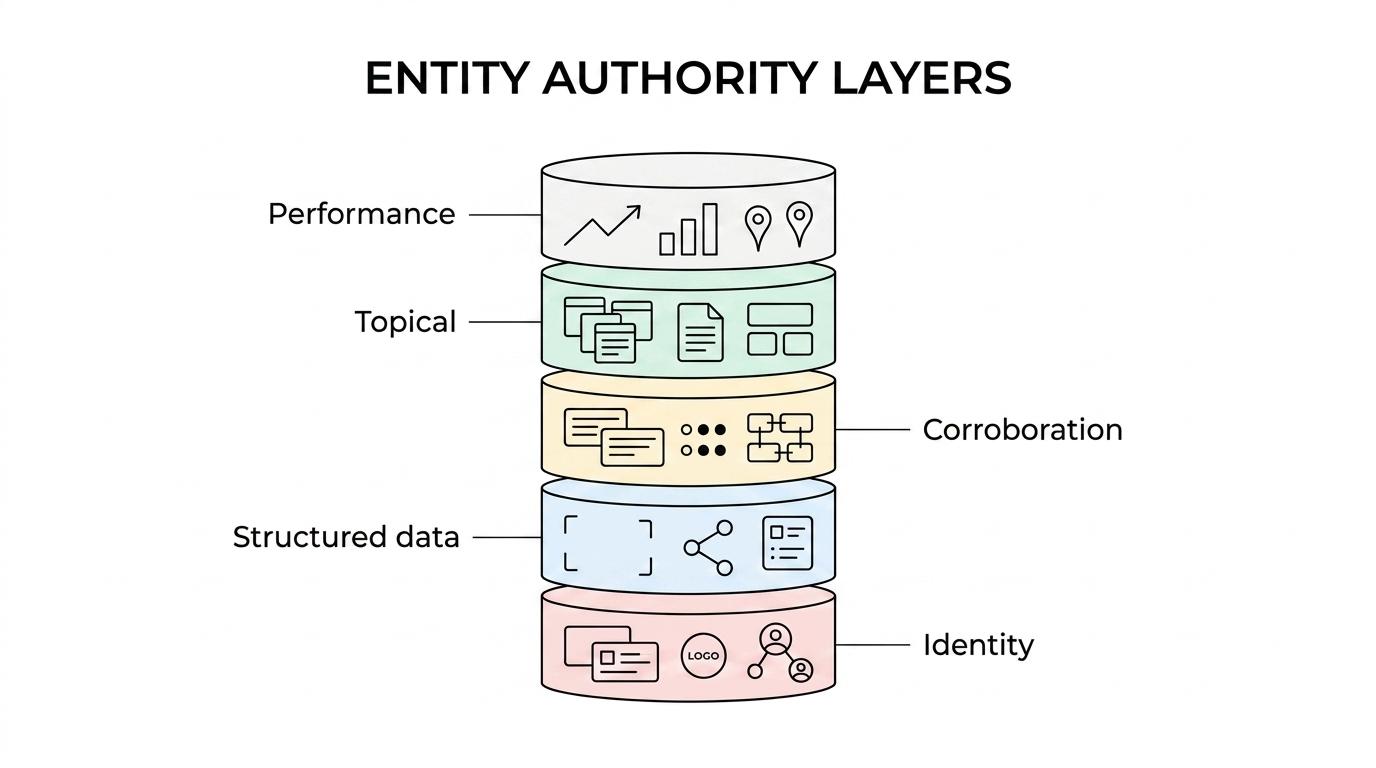
Organization structured data is the foundation of entity clarity
If entity authority starts anywhere, it starts on your homepage.
Google recommends using the most specific Organization subtype possible and adding as many relevant properties as make sense. It also recommends sameAs, which helps connect your organization to authoritative profile pages elsewhere on the web. This is not cosmetic markup. Google says some of these properties are used behind the scenes to disambiguate an organization from others.
That means your structured data should reflect your real business identity with precision. If your company is a software business, choose the best matching subtype rather than stopping at a generic label. If your site uses multiple brand names, product names, or abbreviations, make the relationship between them explicit. If your public profiles exist across LinkedIn, Crunchbase, GitHub, X, YouTube, app stores, or publisher pages, connect them through sameAs where appropriate.
A solid homepage markup plan usually includes the following:
- Entity type: Use the most specific Organization subtype available
- Canonical identity: Keep company name, URL, logo, and contact details consistent
- Profile mapping: Add
sameAslinks to validated external profiles - Administrative details: Include relevant fields that help search systems identify the business
- Policy compliance: Follow Google’s structured data rules to preserve rich result eligibility
There is one important qualifier here. Correct markup does not guarantee a visible search feature. Google states that valid structured data may not show in results, and a manual action can remove a page’s eligibility for rich results. Still, clear markup improves machine interpretation, and that is the real win when the goal is AI search visibility.
Entity corroboration needs to exist beyond your website
Your website can declare who you are. The rest of the web needs to confirm it.
This is where many companies fall short. They publish polished landing pages and add schema, but their public footprint is fragmented. The LinkedIn description says one thing. The homepage says another. Their founder bios use inconsistent titles. Product categories drift from page to page. News mentions do not match the current positioning. AI systems notice that mismatch.
Strong entity authority grows when your organization is described consistently across owned, earned, and referenced environments. That includes industry databases, media mentions, partner pages, review platforms, podcasts, investor pages, author bios, community profiles, and conference listings. Repetition is not a weakness here. Repetition with consistency is how machines gain confidence.
Useful corroboration sources often include:
- Company social profiles
- Publisher author pages
- Review sites
- Data providers and business directories
- Podcast guest pages
- Partner and integration pages
This is also where digital PR becomes more strategic. The goal is not just earning a link. It is earning a clean, attributable mention that reinforces what your company is, what category it belongs to, and why it is credible on that subject. A citation that clearly names the brand, the category, and the expertise can be more valuable for AI search than a generic mention with weak context.
Topical authority and entity authority should be built together
A brand is not trusted in the abstract. It is trusted about something.
That is why entity authority works best when paired with a bottom-funnel-first content model. AI systems are constantly asked highly specific questions: Which vendor is best for SOC 2 automation? What payroll platform supports crypto contractors? How does a B2B fintech reduce fraud loss in real time? Brands that consistently answer those commercial questions with useful, evidence-based pages become easier to cite.
This is one of the clearest patterns in Austin Heaton’s published work. The stated approach prioritizes bottom-funnel content hierarchy, publishing velocity, authority building, and measurable AI visibility. That stack makes sense because entity recognition and topical trust reinforce each other. As your organization becomes tied to a defined set of buyer problems, your odds of surfacing in AI answers rise.
The content itself should be structured to support retrieval. Clear headings, explicit topic framing, concise answer blocks, useful comparisons, and consistent terminology all help. So do pages that map to commercial intent rather than broad awareness alone.
A strong topical content mix often includes both direct-response pages and reference pages:
- Commercial pages: category pages, solution pages, alternatives pages, comparison pages
- Trust pages: case studies, methodology pages, editorial policy, author bios, about pages
- Reference pages: glossaries, FAQs, product documentation, implementation guides
- Proof pages: statistics pages, benchmark pages, original research, cited insights
This is where many brands see momentum compound. One useful page might earn a citation. Fifty tightly related pages can shape how the organization is interpreted overall.
Entity authority is measurable if you track the right signals
The wrong metrics can make entity work look fuzzy. The right metrics make it very clear.
If you judge success only by raw rankings or a third-party authority score, you may miss the real movement. Entity authority tends to show up first in AI impressions, AI citations, referral traffic from answer engines, branded query growth, assisted conversions, and improved performance on high-intent pages.
Published metrics tied to Austin Heaton’s materials help illustrate the point. Publicly stated outcomes include average AI click growth of +560% in 45 days, 454% AI impression growth in 60 days, and a case reporting 575% AI search session growth alongside 288% organic traffic growth after entity authority work. Those are not abstract branding wins. They point to traffic and business impact.
The most useful scorecard usually includes:
- AI citations and mentions
- Referral sessions from AI platforms
- Branded search demand
- Conversion rate on cited pages
- Pipeline sourced or influenced by AI traffic
A low domain authority site can still perform well here if the entity is clear and the content is tightly mapped to buyer intent. That may be the most encouraging lesson for challenger brands.
A practical entity authority plan for the next 90 days
The best way to approach this is as a system, not a one-off project.
Start by auditing the identity layer. Check whether your homepage, about page, authors, product pages, and public profiles all describe the company the same way. Then inspect your Organization structured data. Make sure the entity type is specific, the sameAs profile set is current, and the core details match what appears on page.
Next, audit corroboration. Search your brand, executives, product names, and core category terms. Look for inconsistencies, outdated descriptions, and missed profile opportunities. Tighten what you control. Then build earned mentions where third parties can reinforce your market position.
After that, focus content production on pages that answer high-intent questions in your category. Keep the topic clusters tight. Make the company’s expertise explicit. Publish with consistency.
A focused 90-day sequence can look like this:
- Fix identity signals on the site and in structured data.
- Standardize brand language across external profiles.
- Publish or revise bottom-funnel pages tied to core buyer queries.
- Earn citations and mentions that validate category authority.
- Track AI visibility, referral growth, and pipeline impact every week.
That kind of discipline is what turns entity authority into a growth channel rather than a vague SEO talking point. The opportunity is wide open for brands willing to be precise, consistent, and visible in ways machines can trust.