
International Answer Engine Optimization is not just SEO translated into a few new languages. For B2B brands, it is the work of making the right page easy to identify, crawl, index, cite, and quote across search engines and AI systems. That sounds straightforward until expansion starts moving fast and teams begin shipping content through regional sites, auto-redirect rules, translation tools, and scattered schema.
That is where performance often breaks.
A brand may have strong authority in the United States and still struggle in Germany, Canada, Singapore, or Latin America because search engines and answer engines are being asked to guess. When language, region, and page intent are vague, the wrong URL gets surfaced, the generic English page absorbs demand that should go to a local variant, and AI systems have less confidence in what to cite.
Why international AEO depends on explicit language and region signals
Google has been clear on this point for years: if a site serves different languages or different content for different locations, it needs explicit guidance so Search can send users to the most appropriate version. That matters for classic search, and it matters just as much for AI-generated answers that rely on clean retrieval and clear page relationships.
Many B2B teams still assume country targeting is mostly about server location, a local domain, or a translated headline. It is not. Google supports multiple language and regional annotation methods, but it does not treat weak geo-signals as a substitute for a strong architecture. Server location alone is not definitive. Region-only hreflang values are invalid. Locale-adaptive pages can stop search systems from crawling, indexing, or ranking all versions correctly.
A solid setup usually includes a few non-negotiables:
- Unique URLs: one indexable URL for each language or language-region page
- Hreflang mapping: valid language codes from ISO 639-1, with optional region codes from ISO 3166-1 Alpha 2
- Fallback behavior: an x-default page for users who do not match a localized version
- On-page consistency: copy, metadata, and structured data that match the page language and offer
- Crawl access: no forced redirects that hide alternate versions from bots
International AEO mistakes B2B teams keep making
The pattern is usually not a single technical error. It is a stack of small decisions that make international intent harder to read. One team localizes copy but keeps one global URL. Another launches country folders but misses return hreflang tags. Another uses JavaScript-heavy locale switching that changes content based on IP or browser settings. Each decision seems minor. Together, they create ambiguity.
Want AI engines to recommend your company? Book a free 30-minute AI visibility review with Austin.
Book a CallThe table below captures the mistakes that most often suppress international visibility.
[markdown] | Mistake | What happens | Better move | | --- | --- | --- | | Translating without localizing intent | Pages rank weakly because they do not match local phrasing, regulations, or buying context | Build market-specific variants around real regional demand | | Using locale-adaptive pages or auto-redirects | Crawlers may not access all versions reliably | Use stable, crawlable URLs for each locale | | Invalid or incomplete hreflang | Search engines ignore annotations or serve the wrong page | Use valid ISO language and region codes with reciprocal tags | | Relying on server location or vague geo-signals | Region targeting stays fuzzy | Pair localized URLs with hreflang and local on-page cues | | Weak structured data | Search and AI systems get less explicit meaning from the page | Implement valid JSON-LD that matches on-page content | | No x-default strategy | Users and crawlers hit poor fallbacks | Create a clear default version for unmatched audiences | [/markdown]Mistake 1: Treating translation as localization
A translated page is not always a localized page. This is one of the biggest gaps in international AEO for B2B companies.
A fintech buyer in the UK, a procurement lead in Canada, and a technical evaluator in Mexico may all use English or Spanish in different ways, with different expectations around compliance language, pricing terms, implementation details, and product categories. When a brand simply ports the source page into another language, it often keeps the original market assumptions. The result is readable content that still fails to match regional intent.
Google has also said that multilingual users often search in languages that do not match their interface settings. That means brands cannot assume one “global English” page will cover every English-speaking market. If a region has meaningful demand, local versions should reflect how buyers in that market actually search and evaluate vendors.
Mistake 2: Using automatic redirects and locale-adaptive pages
This mistake is especially common on enterprise sites with heavy personalization. A visitor from France lands on the .com site and gets routed to French content based on IP. A user with Spanish browser settings sees a Spanish version of the same URL. It feels efficient. It also creates indexing problems.
Google has warned that locale-adaptive pages can prevent Search from crawling, indexing, or ranking all content for different locales. If the content changes based on perceived country or preferred language, bots may only see one version or may not access each variant cleanly. That weakens visibility, and it also weakens retrieval consistency for AI systems that want stable source pages.
Common warning signs show up quickly:
- IP-based redirects
- Browser-language swaps on the same URL
- Country gates before content loads
- Local pages blocked from direct access
- Market variants with no permanent URL
A better pattern is simple: each locale gets its own URL, each URL is crawlable, and the user can still switch versions manually. That is cleaner for search engines, answer engines, analytics, and editorial teams.
Mistake 3: Getting hreflang wrong or leaving it half-finished
Hreflang is still mishandled on many international B2B sites, even large ones. The errors are often basic.
Google requires hreflang values to use a language code from ISO 639-1 and, when needed, a region code from ISO 3166-1 Alpha 2. Region-only annotations are ignored. Unsupported region values like EU, UN, or UK have no effect. That means tags like hreflang="UK" or hreflang="EU" do not solve anything.
The second issue is incompleteness. Teams launch local pages but forget reciprocal annotations, leave old URLs in the cluster, or map several markets to the same page while signaling them as unique regional versions. Search engines need a clean relationship set. When the cluster is broken, page selection becomes less reliable.
The third issue is strategic, not technical. Some brands only annotate homepage variants and ignore product, solution, comparison, documentation, and pricing pages. For B2B companies, those are the pages most likely to influence pipeline and answer engine citations. Partial hreflang coverage leaves the high-value part of the site under-specified.
A strong hreflang program usually avoids a small set of repeat mistakes:
- Missing return tags
- Invalid language or region codes
- Canonicals pointing to the wrong locale
- Localized pages excluded from XML sitemaps
- Only the homepage mapped across regions
Mistake 4: Relying on vague geo-signals instead of localized page variants
Some international site owners still expect search engines to infer country targeting from domain structure, server location, or a few mentions of cities and currencies. Those signals can help, but they are not enough by themselves.
Google’s guidance makes that clear. ccTLDs, hreflang, and local cues can all contribute to geo-targeting, while server location alone is not decisive. So when a brand keeps one generic page and sprinkles a few regional references into it, the page rarely becomes the best candidate for multiple markets.
B2B teams should also remember that answer engines reward clarity. A localized page with a market-specific title tag, local proof points, local compliance references, consistent metadata, and explicit language signals is easier to retrieve and cite than a single catch-all page trying to serve twelve countries.
Structured data mistakes that weaken international AEO
structured data is where many otherwise strong international programs become fuzzy again. The copy may be localized, the URLs may be clean, and hreflang may be present, but the schema is incomplete, invalid, or detached from the page itself.
Google recommends structured data that is complete, valid, and represented on the page, with JSON-LD generally preferred. That last phrase matters. If the markup claims a product, service area, language availability, or offer detail that users cannot see on the page, the signal is weaker. Rich result eligibility may also suffer when required and recommended properties are missing or inaccurate.
For international B2B sites, the biggest schema problem is inconsistency across locale pages. A service page in English may include strong organization, service, and FAQ markup, while the German version loses half the properties during localization. Or the localized page keeps the original English schema values. Search systems then receive mixed signals about language, offering, and entity relationships.
Schema should support the page, not act as a detached layer pasted in from a template.
What strong international AEO architecture looks like for B2B brands
The best international setups are usually less flashy than expected. They focus on clarity, repeatability, and editorial discipline.
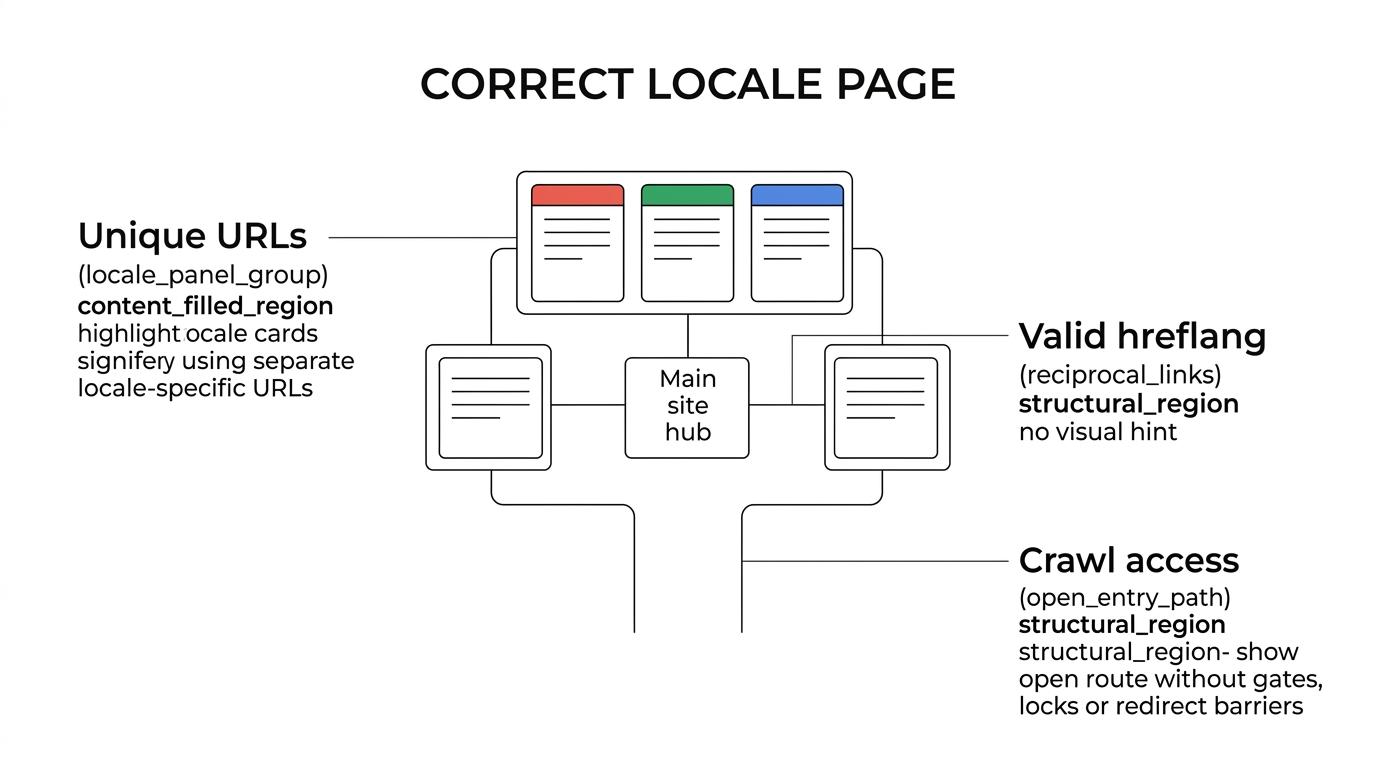
Each important market has a defined URL structure. Each localized page has a real purpose. Hreflang connects equivalents correctly. Canonicals point to the local page when the page is intended to rank in that market. Structured data reflects the localized content. Internal links help users and crawlers move across the regional architecture without confusion.
This work gets stronger when content strategy is built around bottom-funnel demand, not just broad awareness. B2B brands often expand with a translated homepage and a few generic solution pages, then wonder why qualified pipeline does not follow. Local visibility grows faster when high-intent assets are part of the rollout: product pages, category pages, comparisons, use cases, pricing guidance, implementation content, and trust-oriented pages.
A practical operating model usually includes these pieces:
- Market prioritization: launch where there is clear demand, sales coverage, and local proof
- Page equivalency rules: define which pages are true alternates and which deserve unique local content
- Template governance: keep metadata, schema, canonicals, and internal links consistent across locales
- Editorial QA: review terminology, regulatory wording, and offer language before publishing
- Indexation monitoring: track which locale pages are crawled, indexed, and selected in each market
Metrics that show international AEO is working
Success is visible well before total traffic spikes. The strongest signals usually appear in page selection and query matching.
When the setup is right, search engines start serving the intended local URL more often. Impression share grows for local-language and regional modifiers. Non-brand clicks improve on product and solution pages. AI-generated answers begin citing the right market version instead of the global default.
A useful scorecard often includes:
- Indexed localized URLs
- Correct page served by market
- Non-brand impressions by locale
- Qualified conversions by regional page set
- Citation frequency of local variants in AI search surfaces
That is the shift B2B teams should look for. Not just more pages in more languages, but a cleaner signal system that tells search engines and answer engines exactly which page belongs in which market, and why.