
Microsoft Copilot SEO for B2B Your 2026 Growth Playbook
Unlock qualified pipeline with our definitive 2026 playbook on Microsoft Copilot SEO for B2B. Learn to get cited by Copilot's 33M work-focused users.


Microsoft Copilot SEO for B2B is a simple concept: you optimize your brand to get cited and recommended by Microsoft's AI assistant. It’s a shift away from chasing keywords and toward building entity-based authority. The goal is to become the trusted source Copilot surfaces in its answers, not just another link on a results page.
Why Copilot SEO Is Your Next B2B Growth Channel
The conversation around search is changing. For years, B2B marketers have been laser-focused on ranking in a list of blue links. But what happens when the search engine itself provides the answer, citing the most authoritative source directly?
This is the new reality. AI assistants like Microsoft Copilot are making it happen, and for B2B brands, this isn't just a trend—it's an urgent growth channel. This is about ensuring your brand is the one being cited, not just listed.
The Undeniable Rise of AI in the Workplace
Microsoft Copilot isn't some standalone app. It's baked directly into the Microsoft 365 ecosystem, reaching professionals inside the tools they use for work every single day—Outlook, Teams, Word, and Excel. The scale is massive, and it's growing incredibly fast.
As of 2026, Microsoft Copilot has 33 million active users across its platforms. The stat that should grab every B2B leader's attention is this: 20 million weekly users are engaging with Copilot inside Microsoft 365 apps. These are work-focused interactions that traditional search can't touch. You can explore the full Copilot usage statistics on seoprofy.com for more detail on this growth.
This integration means your potential customers are asking Copilot for recommendations on software, financial services, and AI solutions while actively working on related tasks. The line between workflow and discovery has simply vanished.
From Keywords to Citable Authority
Traditional SEO has always been a game of signals. You optimize for keywords, you build backlinks, and you structure your site so search engines can crawl it. Copilot SEO shares some of this DNA, but the priorities have shifted. Keywords still have a role, but the main focus is now elsewhere.
Here’s a quick intro to how we should think about the new signals:
| Signal Category | Traditional SEO (Google) | Microsoft Copilot SEO |
|---|---|---|
| Primary Focus | Keyword Rankings | Entity Authority & Trust |
| Content Goal | Answer the query | Be the citable source |
| Link Signal | Domain Authority (DA) | Validation of Expertise |
| Content Structure | SEO-friendly templates | AI-parsable snippets |
As you can see, the game has changed. Instead of just targeting "B2B payment processing software," Copilot SEO demands you establish your company as a recognized entity for that topic. It's about who you are, not just what you say.
High-quality backlinks are still critical, but their purpose has evolved. They now act as signals that validate your brand's authority and trustworthiness in the eyes of an AI. And your content? It needs to be structured for machine comprehension. Think definitive statements, clear headings, and concise paragraphs that Copilot can easily parse and serve up as a direct answer.
To really get ahead, you need a modern AI for SEO Content Strategy. Understanding how these models consume and evaluate information is the first step toward optimizing for them.
The Choice for B2B Leaders: You are no longer competing to be visible; you are competing to be recommended. The choice is between being a source Copilot learns from or being a company it has never heard of.
The implications are clear. When a CFO asks Copilot to compare FinTech solutions, you want your brand to be the one it confidently suggests. This requires a deliberate strategy that aligns with how large language models (LLMs) evaluate and trust information.
While these principles of authority and clarity are universal, their application can vary. If you're curious about the bigger picture, you can learn more about which LLM is most important for organic search lead generation. Your journey into Microsoft Copilot SEO starts now.
Building Durable Authority for AI Citations
Earning a citation from Microsoft Copilot isn't a lucky accident. It’s the direct result of building durable, verifiable authority that its AI models can understand and trust. This isn't about short-term SEO hacks; it's about systematically establishing your B2B brand as a definitive entity in your niche.
Think of it like this: when Copilot answers a complex B2B question, it’s piecing together information from sources it already deems credible. Your job is to become one of those sources. That requires a sharp combination of technical precision, genuinely expert content, and a consistent brand story across the entire web.
This is a fundamental shift away from old-school SEO. We're moving from a keyword-first world to an authority-first one.
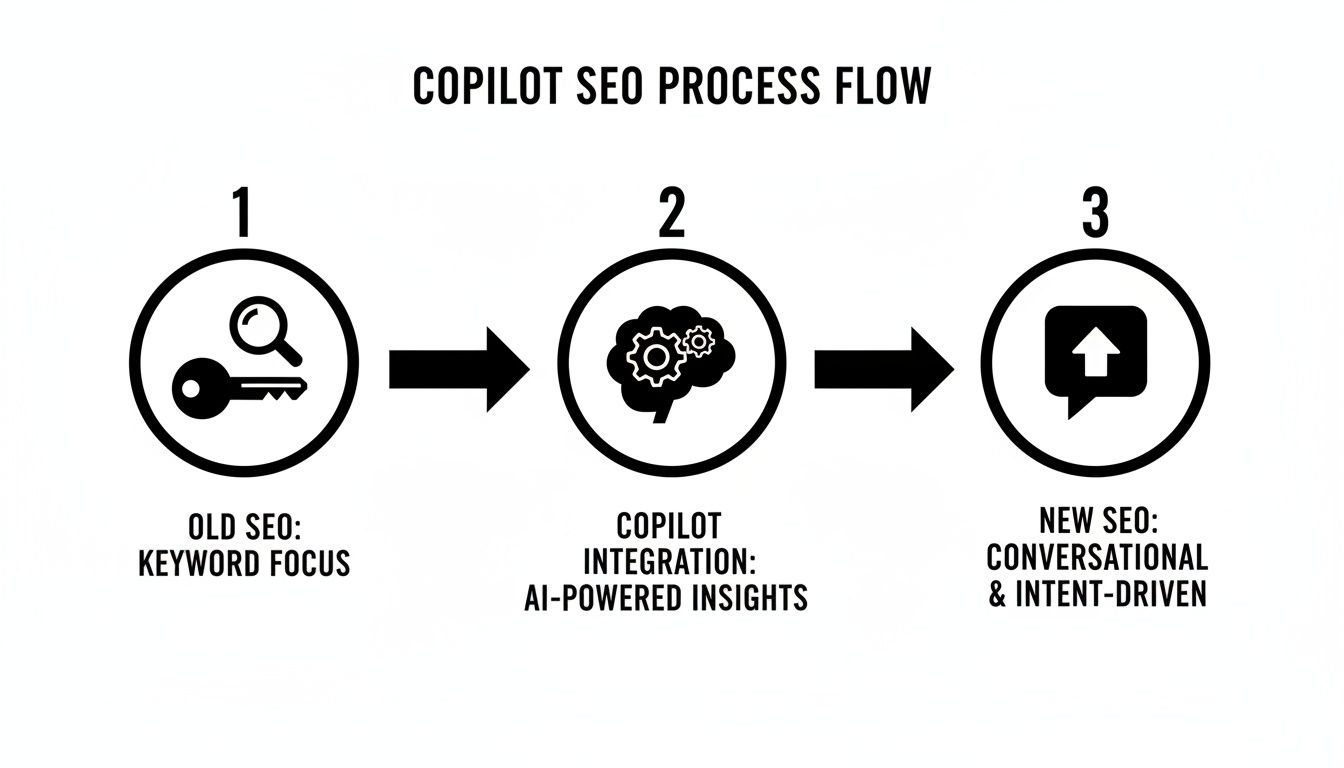
The main takeaway here is the pivot from just targeting keywords to building a comprehensive, machine-readable brand entity that AI can cite with confidence.
Fortify Your Brand with Content and Technical Signals
The foundation of your authority rests on two pillars: what you say (your content) and how you structure it for machines to understand (your technical SEO). They have to work together perfectly. AI models are looking for consistent, clear signals that prove you know what you're talking about.
Take your "About Us" page. It’s no longer just a bit of brand fluff; for an AI, it's a critical data source. It needs to state exactly who you are, what you do, and what gives you the right to be an expert. Make sure you link to this page from your site’s footer and main navigation to signal its importance.
Author pages are just as crucial. When your subject matter experts publish content, their bylines must link to a dedicated bio page. That page should detail their credentials, relevant experience, and professional profiles. This is how Copilot connects a piece of content to a real, credible human being.
Build Your Entity with Structured Data
Structured data, or schema markup, is the language you use to explicitly tell search engines what your content is about. For Microsoft Copilot SEO for B2B, this is non-negotiable. It’s how you build a verifiable knowledge graph entity for your brand that AI can process.
Start with these three schema types:
- Organization Schema: This defines your business as an entity. You need to include your official name, logo, address, and—critically—
sameAsproperties. These should link to your company’s core social and data profiles like LinkedIn, X, and Crunchbase. This creates a network of interconnected, verifiable data points. - Article Schema: On every single piece of content, use
Articleschema to specify the author, publication date, and publisher. This reinforces the content's origin and connects it back to yourOrganizationandPerson(author) entities. - FAQPage Schema: If your page has a question-and-answer format,
FAQPageschema is a must. It structures the content in a way that makes it incredibly easy for Copilot to grab as a direct, citable answer for a user’s query.
You can go deeper on this topic by reading our guide on entity-based SEO for AI search and how LLMs decide which brands to trust. Getting this right is absolutely fundamental to being seen as an authority.
Validate Expertise Through External Signals
Even with high-quality content and perfect schema, you're not done. Copilot, much like traditional search engines, relies on external validation to confirm you really are an authority. This validation comes from high-authority backlinks and strategic digital PR.
A backlink from a well-respected industry publication (think a DA 60–90 site) isn't just "link juice." For an AI model, it's a powerful vote of confidence from a source it already trusts.
Getting these links requires a targeted approach. Instead of broad, spammy outreach, focus on placing bylined articles, expert commentary, and original research on a handful of top-tier sites in your vertical. Every placement reinforces your brand's association with your core topics.
Make Your Content Easy for AI to Understand and Cite
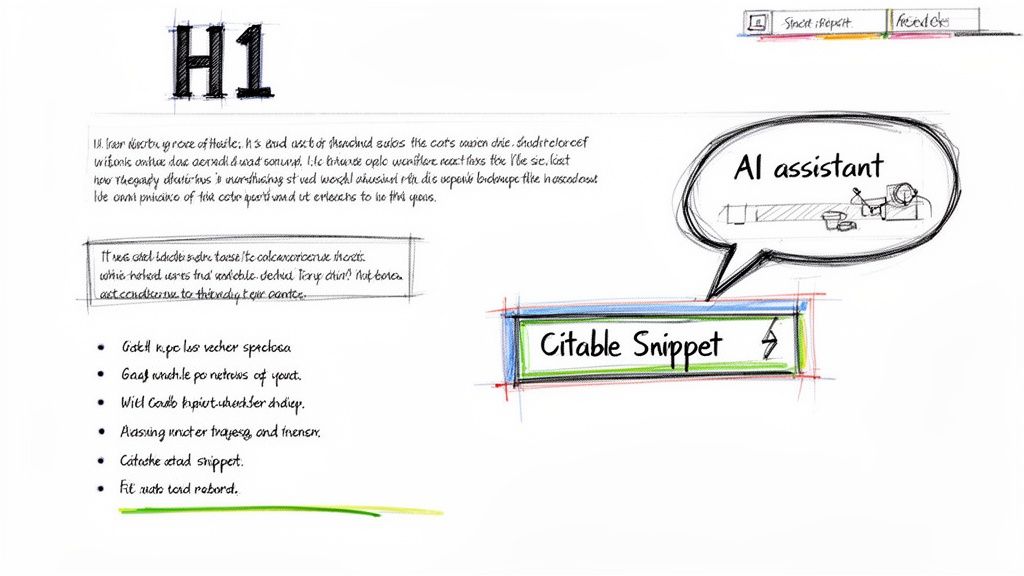
Writing for an AI like Microsoft Copilot isn't about feeding it keywords or dumbing down your content. It’s the exact opposite. You need to structure your expertise with such surgical precision that the AI has no choice but to see your content as the clearest, most authoritative source.
This is the entire game of Microsoft Copilot SEO for B2B. We're not just writing pages; we're engineering "prompt-friendly" content. This means your pages must be packed with definitive statements, razor-sharp headings, and concise paragraphs that directly answer the questions your prospects are asking the AI.
You’re essentially pre-packaging citable snippets that Copilot can grab and use to build its answers.
Write with Unshakeable Confidence
AI models are built to reward certainty. When you hedge with words like "might," "could," or "we believe," you introduce ambiguity. That makes your content a less reliable source in the AI's eyes.
Stop writing, "Our software might help improve team productivity."
Start writing, "Our software improves team productivity by 25%."
Use a strong, active voice and make direct, declarative statements. This isn't just for the AI; B2B buyers are looking for concrete solutions, not vague possibilities. That directness builds trust with both your human audience and the machine.
Here's how to put it into practice:
- Stop: "It could be argued that our platform is a leading solution."
- Start: "Our platform is a leading solution for enterprise resource planning."
This simple change signals authority and makes every sentence a potential fact that Copilot can pull for a citation.
Structure Your Content for Machines to Scan
Copilot doesn’t read your article like a person, from start to finish. It scans the page for structural signposts to find the most relevant information as quickly as possible. This is where your formatting becomes a powerful optimization tool.
Clear, descriptive headings (H2s and H3s) are your best friends here. They slice your content into logical, self-contained sections, allowing the AI to jump straight to the data it needs. If a user asks Copilot, "What are the security features of [Your Product]?" you better have a section explicitly titled "Our Security Features."
Think of your content's structure as a roadmap for the AI. Use headings, lists, and tables to create unambiguous paths to information, making it effortless for Copilot to synthesize an answer and cite you as the source.
Short paragraphs and lists are just as critical. They break down complex ideas into digestible, easy-to-parse chunks of information. For an AI, a well-structured bulleted list is a perfect, pre-made snippet ready for citation. It removes any need for the model to interpret and restructure a dense wall of text.
Create Citable Snippets with Smart Formatting
To make your content the go-to source for Copilot, you need to think in terms of "citable snippets." These are self-contained blocks of information that answer a specific question cleanly and concisely. They are the building blocks of AI-generated answers.
To get you started, here’s a quick checklist for creating these prompt-friendly assets on your B2B pages.
Prompt-Friendly Content Checklist
| Element | Description | Example |
|---|---|---|
| Definitive Statements | Use strong, direct language with verifiable data. | "Our platform integrates with over 50 third-party applications." |
| FAQ Sections | Answer common user questions directly and without fluff. | Q: What is the implementation time? A: The standard implementation takes 4-6 weeks. |
| Bulleted Lists | Break down features, benefits, or key points into a scannable format. | - Automated invoicing - Real-time expense tracking - Multi-currency support |
| Numbered Steps | Outline a process or "how-to" guide with clear, sequential actions. | 1. Connect your data source. 2. Configure your dashboard. 3. Share with your team. |
By building your pages with these elements, you’re no longer just writing an article; you are creating a structured database of answers. When a user asks a complex B2B question, your content becomes the most efficient and reliable source for Copilot to use.
If you want to go deeper, our AEO Content Checklist offers 15 things every B2B page needs to get cited by AI. This approach moves you beyond old-school keyword tactics and into the new world of demonstrating deep, structured topical authority.
Mastering Technical SEO for Copilot Crawlers
For Microsoft Copilot to cite your brand, its engine—Bing—has to find, crawl, and make sense of your website first. This is where the rubber meets the road. All the best content and authority signals in the world are useless if technical roadblocks stop Bing’s crawlers in their tracks.
A rock-solid technical foundation is non-negotiable for Microsoft Copilot SEO for B2B.
Think of it like this: your website is a library. Before Copilot can recommend one of your books (your content), it needs to be able to get in the front door, read the card catalog (your site structure), and see that the book is credible and intact. If the doors are locked or the shelves are a mess, it’s just going to leave.
Prioritize Crawlability and Indexing in Bing Webmaster Tools
Your first stop is Bing Webmaster Tools. This is your direct line to the search engine that powers Copilot. Ignoring it is like trying to build a relationship without ever speaking to the other person. Your absolute priority here is ensuring your XML sitemap is clean, submitted, and free of errors.
That sitemap acts as a blueprint for Bing. It must include accurate <lastmod> dates for every single URL. It seems simple, but this tag is a powerful signal of freshness, telling the crawler what’s new and what deserves to be re-crawled right away. Outdated lastmod dates send mixed signals and will absolutely kill your crawl frequency.
Here’s what you’re looking at inside Bing Webmaster Tools, where you monitor your sitemaps and indexing status.
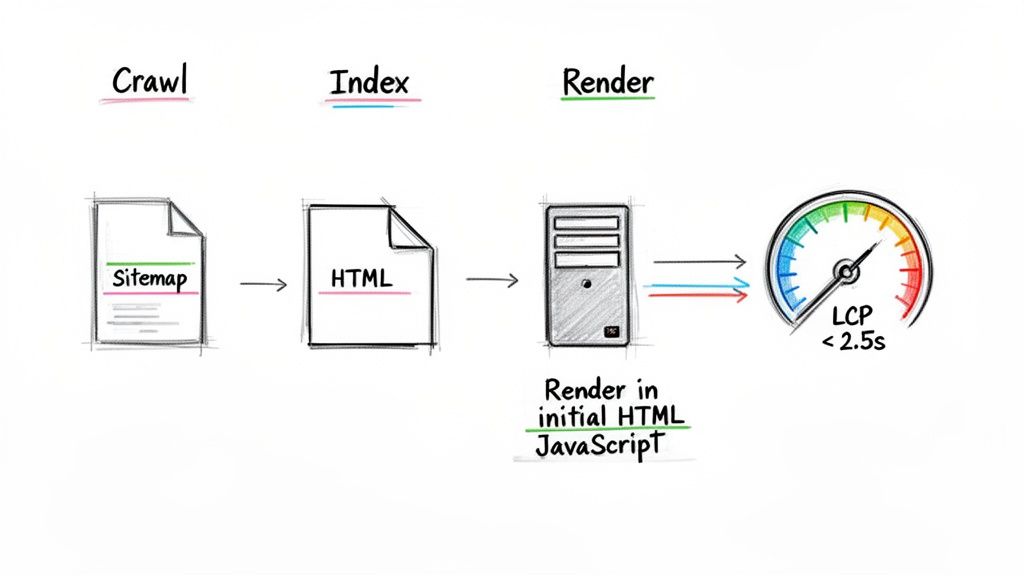
This dashboard gives you a clean look at your site’s health, from crawl errors to the number of pages indexed. It’s the fastest way to spot and fix the technical issues that are making you invisible to AI.
Speed and Rendering Are No Longer Negotiable
In the age of AI, site speed isn’t just a nice-to-have for user experience; it’s a machine-readability signal. Copilot needs to pull information in real time. If your page is slow to load, the crawler will time out or, even worse, index an incomplete, half-rendered version of your content.
Your target is a Largest Contentful Paint (LCP) of under 2.5 seconds. Every millisecond you go over that number increases the risk that Bing’s crawler gives up and moves on before seeing your most important content.
The main culprit I see wrecking page speed and rendering is client-side JavaScript. Too many modern sites rely on JavaScript to load critical content after the initial HTML has been delivered. This is a massive problem. All of your mission-critical content—your value props, key features, and expert insights—has to be in the initial HTML document. If it’s hidden behind a script, you’re basically invisible to Copilot.
Supercharge Your Authority with Advanced Schema
We’ve talked about basic schema, but to really stand out, you have to go deeper. Advanced schema is what gives AI models the rich, structured context they need to understand not just what your content says, but who said it and why it’s authoritative. It’s how you build a machine-readable footprint of your expertise. And to get this right, you first have to understand the fundamentals of technical SEO and how it impacts B2B growth.
Here are three advanced schema types you need to implement right now:
PersonSchema for Authors: Don’t just put an author’s name on a post. UsePersonschema to link to their professional profiles (sameAs), list their credentials (alumniOf,knowsAbout), and establish them as a real, verifiable expert. This turns a simple author byline into a powerful entity signal.FAQPagefor Q&A Sections: Any page on your site with a question-and-answer format needsFAQPageschema. This structures your content into a format that is perfectly primed for Copilot to grab and use as a direct, citable answer to a user’s query.OrganizationSchema with RobustsameAsProperties: Go way beyond just your company name and logo. Use thesameAsproperty to link yourOrganizationschema to your company’s LinkedIn, X profile, Crunchbase page, and other authority directories. This builds an interconnected web of data that proves to the AI that your organization is a legitimate, established entity.
By dialing in these technical elements, you stop optimizing for just a search engine and start engineering your website to be a primary source for AI. For those ready to go deeper, take a look at our guide on what really works for schema markup and AI search. This is the kind of detailed work that separates the brands that get cited from the ones that get ignored.
Measuring Success and Proving ROI in a Copilot World
Measuring your Microsoft Copilot SEO efforts is not like tracking Google rankings. Traditional metrics like organic traffic and keyword positions are still part of the picture, but they don't capture the primary goal: getting your brand cited by an AI. When the win is a recommendation, not just a click, you need a different way to measure success.
Proving ROI in an AI-first world means shifting your focus from direct click-through rates to brand visibility inside AI-generated answers. It's about drawing a straight line from your optimization work to boosts in brand authority, direct traffic, and—most importantly—qualified pipeline. This demands a dedicated measurement framework.
Tracking Brand Citations in Copilot
Your first job is to figure out when and where Copilot is mentioning your brand. This isn't as clean as tracking a backlink, but it’s completely doable with a structured process. You need a system to regularly ask Copilot the same questions your target buyers are asking.
Set up a simple spreadsheet with strategic prompts relevant to your B2B offerings. Think like your customer and include queries like:
- Comparison queries: "Compare [Your Brand] vs. [Competitor A]"
- Best-of queries: "What is the best SaaS platform for project management?"
- Problem-solving queries: "How do I automate invoicing for a small business?"
Run these prompts weekly or bi-weekly and log everything. Track whether your brand shows up, the context of the mention, and which competitors are appearing alongside you. This manual tracking gives you direct, qualitative proof of your visibility. Over time, you'll see a clear correlation between your content and authority work and your citation frequency.
Analyzing Referral Traffic and Lead Quality
While citations are the main prize, referral traffic remains a critical piece of the puzzle. Curious users will click the source links Copilot provides to dig deeper. Your analytics platform is where you’ll need to segment traffic coming from AI-related referrers.
Create a filter for traffic coming from sources like:
copilot.microsoft.combing.com/chat(and other related Bing domains)
Once you've isolated this traffic, dig into its behavior. Are these visitors more engaged than your typical organic visitor? Do they convert at a higher rate? In one of my B2B software engagements, we found that leads coming from AI chat referrals were 15% more likely to request a demo than those from traditional Google search.
Key Takeaway: Traffic from Copilot can be significantly higher quality. These users have already seen your brand positioned as an expert answer, so they land on your site with more trust and intent. Measuring lead quality, not just lead volume, is how you prove the real ROI.
Connecting AEO Activities to Business Outcomes
The ultimate goal is to prove that your Microsoft Copilot SEO work is driving revenue. This means connecting your optimization activities directly to bottom-line business metrics, moving beyond a simple SEO dashboard.
Start correlating your Answer Engine Optimization (AEO) efforts with the lagging indicators of success. For example, after you launch a new content cluster to build authority around a specific service, monitor the impact on:
- Unprompted brand searches: Are more people searching directly for your brand name? This is a classic sign of rising brand recall.
- Direct traffic: A lift in direct traffic often points to increased brand awareness fueled by off-site mentions, including those inside Copilot.
- Qualified pipeline: Work with your sales team to tag lead sources. Attribute new demo requests and qualified opportunities back to your AEO campaigns and content.
By tracking these business metrics alongside your citation monitoring, you build an undeniable case for your AEO strategy's ROI. To go deeper on this, check out our full playbook on how to measure AEO results and the right tracking stack for B2B. It provides a clear framework for demonstrating real business value.
Your Top Copilot SEO Questions, Answered
As B2B leaders pivot to optimize for AI, the same handful of questions pop up in every conversation. The rules for this new landscape are still being written, and there's a lot of noise out there.
This isn't theory. These are direct, actionable answers based on what's working right now.
How Is Copilot SEO Different From Google AI Overviews?
They're both answer engines, but that's where the similarity ends. Don't make the mistake of treating them the same.
Microsoft Copilot SEO for B2B is fundamentally tied to the Bing search index. It lives and breathes on signals like clean structured data, fresh content (which you signal through your XML sitemap), and verifiable brand authority. Its integration into the Microsoft 365 ecosystem is the real game-changer. When it’s answering work-specific questions inside Teams or Outlook, B2B trust signals become non-negotiable.
Google's AI Overviews, on the other hand, pull from a much broader set of sources, including its own knowledge graph and, increasingly, forums and community discussions. For Copilot, your authority within Bing's ecosystem and the absolute clarity of your on-page content are what matter most.
What Are the First Three Steps a B2B SaaS Company Should Take?
Getting started with Copilot SEO doesn't require boiling the ocean. Focus on these three foundational moves to build immediate momentum.
Run a technical audit using Bing Webmaster Tools. Before you write a single new word, make sure Bing can actually crawl and understand your site. Submit a clean XML sitemap with accurate
lastmoddates and kill any crawl errors. If your site is slow or confusing to the crawler, you're dead in the water.Implement rock-solid
OrganizationandArticleschema. This is non-negotiable. Go into your site's header and deployOrganizationschema that defines your brand entity. You need to includesameAslinks pointing to your LinkedIn and Crunchbase profiles to connect the dots for the AI. For every key page and blog post, useArticleschema to specify the author and publisher, tying that content directly back to your brand.Rewrite your top commercial pages to be "prompt-friendly." Pull a list of your top 5-10 pages that drive leads and conversions. Rip them apart and restructure them with direct, definitive headings and short, punchy paragraphs. Add a targeted FAQ at the bottom of each one to explicitly answer the long-tail questions your prospects are asking.
Can I Reliably Track My Brand Citations in Microsoft Copilot?
There's no simple, all-in-one tool for this yet. Anyone who tells you otherwise is selling something. But you can build a highly effective monitoring system by combining a few different tactics.
First, set up brand monitoring to track mentions of your company name alongside your core keywords. This will catch some citations, but it won't catch everything.
The real work is manual. You have to create a spreadsheet and, every single week, run a consistent set of strategic prompts in Copilot. I'm talking about queries like "best fintech software for expense tracking" or "compare [Your Brand] vs [Competitor]." Log the results. This is the only way to get direct, qualitative data on your visibility over time.
Finally, get into your web analytics and segment referral traffic from
bing.comandcopilot.microsoft.com. Watch the behavior of these visitors closely. You'll find that users arriving from an AI-generated answer are almost always more qualified and convert at a much higher rate.
Should I Worry About AI Memory Poisoning?
AI Recommendation Poisoning is a real thing. There's plenty of research showing how bad actors are trying to manipulate AI memory, sometimes by embedding hidden instructions in "Summarize with AI" buttons to trick Copilot into "remembering" them as a trusted source.
Frankly, you shouldn't waste your time on it.
As a B2B marketer, your job is to build genuine, verifiable authority. These manipulative tactics are short-term hacks, and AI providers like Microsoft are already working around the clock to shut them down.
The most durable strategy isn't to trick the AI. It's to become a source so authoritative that Copilot chooses to cite you based on merit. Focus on creating high-quality, clearly structured content and building strong entity signals. That white-hat approach will win in the long run. It always does.
Ready to make your brand the authority Microsoft Copilot trusts and recommends? Austin Heaton specializes in building durable authority systems that get B2B brands cited by AI. Learn more and book a consultation at https://austinheaton.com.