
seo company for small business: Top Tips & Pricing
Find the right seo company for small business that delivers real results. Compare pricing, ask the right questions, and avoid red flags before you invest.


When you're looking for an SEO company for your small business, you’re not just hiring someone to check off a list of tasks. You're bringing on a partner. This is a critical distinction. A task-doer focuses on activities, like "writing a blog post." A partner focuses on outcomes, like "increasing qualified demo requests by 20%."
A great partner doesn't just talk about rankings and traffic—they talk about leads, sales, and real, measurable growth for your business.
What a Great SEO Partner Actually Delivers
So, what does a good SEO partnership actually look like? Forget the vague promises of "getting you to the top of Google." That's a goal, not a strategy. A real strategy is a detailed plan of action.
Think of it like building a house. A sketchy contractor might say, "I'll build you a great house, trust me." This is like an SEO company promising #1 rankings without a plan. But a real professional rolls out a blueprint. They show you the plan for the foundation (technical SEO), the framing (site structure), the plumbing (link building)—every critical component.
SEO is no different. A legitimate SEO company for a small business will have a clear blueprint built around four core pillars. They're the foundation for a digital presence that doesn't just look good, but actually performs.
The Four Pillars of a Strong SEO Foundation
A solid SEO strategy is comprehensive. It looks at your website from every angle to make sure it's built to attract customers and stand up to whatever Google throws its way next. Each pillar supports the others; ignore one, and the whole structure gets wobbly. For example, amazing content (On-Page SEO) won't get found if your site is too slow for Google to crawl (Technical SEO).
These four pillars—Technical, On-Page, Off-Page, and Local SEO—are the building blocks of any successful campaign.
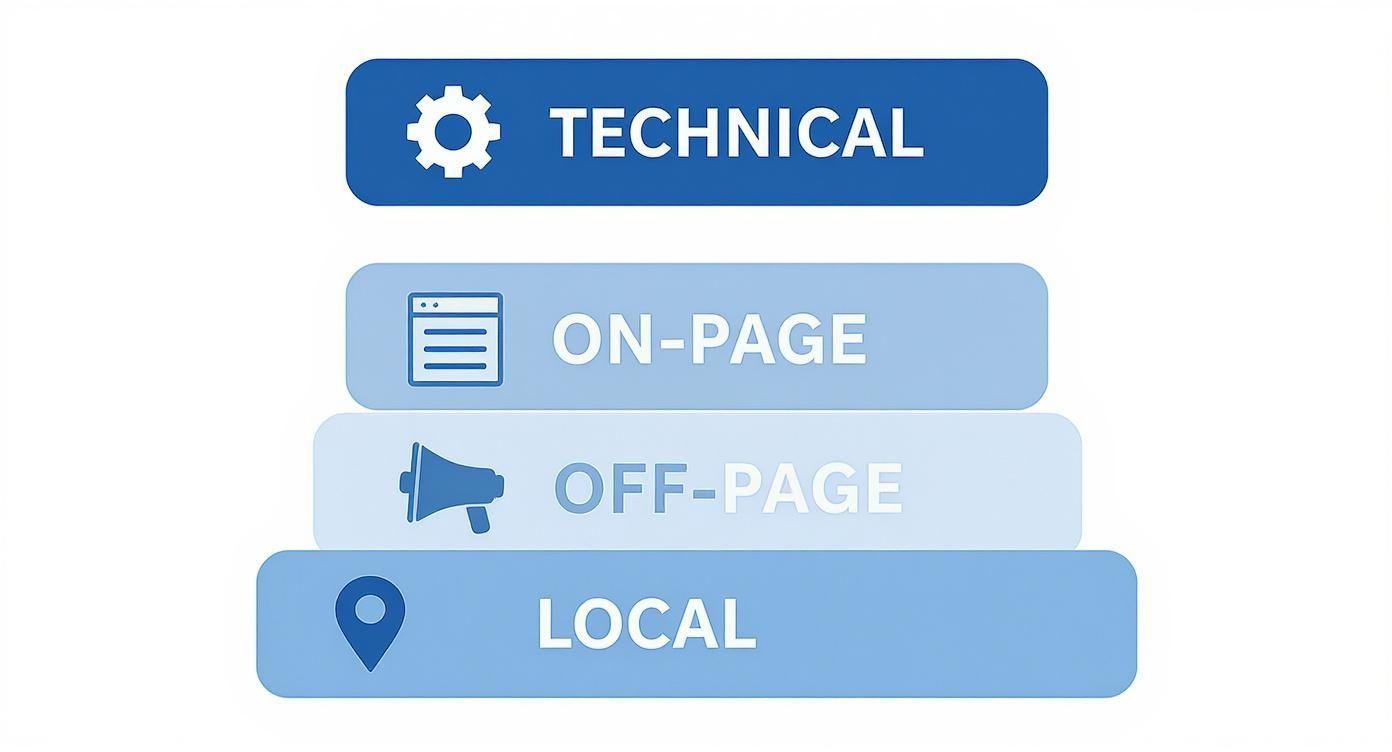
As you can see, everything starts with a solid technical base. Without it, the rest of your efforts will fall flat.
Let's break down what each of these means with tactical examples.
Technical SEO (The Foundation): This is all the behind-the-scenes stuff that makes your website work for search engines. It’s the plumbing and wiring of your site. If Google can't easily crawl, understand, and index your pages, nothing else matters.
- Tactical Example: A photographer's beautiful portfolio site is slow because the image files are huge. A technical SEO fix would be to compress those images and implement "lazy loading" so they only load as a user scrolls down, drastically improving page speed and user experience.
On-Page SEO (The Interior Design): This is about the actual content on your website. Are your page titles and headlines clear? Does your content answer the questions your customers are actually asking? Just like good interior design makes a house welcoming and easy to navigate, great on-page SEO makes your content valuable.
- Tactical Example: A plumber has a generic "Services" page. An on-page SEO tactic is to break that into specific pages like "Emergency Drain Cleaning" and "Water Heater Installation," each optimized with titles, headers, and content that perfectly match what a potential customer is searching for in a panic.
Off-Page SEO (Your Neighborhood Reputation): This is all about building your website's authority and trust outside of your own domain. The biggest piece of this puzzle is earning backlinks—links from other reputable websites pointing to yours. Think of it like a trusted local newspaper writing a positive feature story about your business versus you just buying a newspaper ad. The feature story carries far more weight.
Local SEO (The Prominent Address Sign): This one is non-negotiable for any business with a physical location or service area. It’s all about making sure local customers can find you when they search. This means optimizing your Google Business Profile and keeping your business name, address, and phone number consistent everywhere online. It's the big, bright sign on your front door that says, "We're here!"
Monthly Retainer: This is the industry standard. You pay a set fee each month for ongoing SEO. Think of it like a subscription for growth that covers content, link building, technical monitoring, and reporting. It’s perfect for long-term, sustainable results. Comparison: This is like having a financial advisor managing your retirement portfolio for steady, long-term growth.
Project-Based Fees: This is a one-time fee for a specific, defined project with a clear start and finish line. This is a great fit for businesses that need a foundational fix—like a massive website audit and technical overhaul—before they’re ready for an ongoing campaign. Comparison: This is like hiring a general contractor to remodel your kitchen. It's a single, defined project with a clear outcome.
Hourly Consulting: Exactly what it sounds like. You pay for an SEO expert’s time. This works best if you have an in-house team that can do the work but just needs some high-level strategic direction on what to do and when. Comparison: This is like paying an architect to review your blueprints. You're paying for their strategic expertise, not for them to swing the hammer.
- Goal: Get more local patients who are Googling for dentists in their city.
- Best Fit: A monthly retainer of $2,000/month.
- What It Covers: Continuous local SEO, keeping their Google Business Profile optimized with new photos and Q&As, writing blog posts about "the cost of dental implants in our city," and getting listed on local directory sites. The entire focus is on steady, consistent visibility in a specific geographic area.
- Goal: Fix huge technical problems on a new website so Google can actually find and rank their product pages.
- Best Fit: A one-time project fee of $6,000.
- What It Covers: A deep-dive technical site audit, fixing crawl errors, adding schema markup for products to get star ratings in search results, and overhauling the site structure for thousands of pages. The goal here is a single, high-impact push to build a rock-solid foundation for the future.
Expert Time: You're paying for a strategist's experience. This is someone who can look at your data, spot opportunities others miss, and know exactly how to react when Google drops an algorithm update. That kind of brainpower costs a lot more than a junior employee just checking boxes from a template.
Premium Tools: Real SEO runs on expensive software. We’re talking about tools for keyword research, competitor analysis, backlink tracking, and site audits. Subscriptions to platforms like Ahrefs or Semrush can easily cost thousands of dollars a year.
Quality Content Creation: Good content is written by good writers who actually understand your industry and what makes your customers tick. This is miles away from the cheap, AI-generated articles that can get your site penalized. Example: For a law firm, a quality article would be a detailed guide on navigating a specific legal issue, written by someone with legal expertise, not a generic "5 tips" post.
- Organic Conversion Rate: What percentage of people arriving from search engines are actually doing what you want them to do? This means filling out a contact form, buying a product, or signing up for your email list.
- Lead Quality from Search: Are the leads coming from your SEO efforts turning into paying customers? A tactical approach is to use a "lead source" field in your CRM to track which SEO-driven leads become sales.
- Phone Calls from Google Business Profile: For local businesses, this is pure gold. Tracking the "click-to-call" button on your GBP listing shows immediate, high-intent interest from potential customers in your area.
- Cost Per Acquisition (CPA) from Organic: How much are you spending on SEO to get one new customer? This number is critical for comparing SEO's ROI against your other marketing channels, like paid ads. For example, if your SEO retainer is $3,000 and you got 30 new customers, your CPA is $100. If your paid ad CPA is $250, SEO is delivering huge value.
- "We got you to #1 for 'blue widgets in Alaska'!" (But you don't even sell in Alaska.)
- "Your website impressions are up 200%!" (Great, but clicks and actual traffic haven't budged.)
- "We increased traffic by 5,000 visitors!" (But your bounce rate is 95% and not a single person converted.)
- "We increased organic leads by 35% this quarter, which resulted in 12 new customers with an estimated lifetime value of $24,000."
- "Phone calls from your Google Business Profile are up 50%, with most people asking about your highest-margin service."
- "Your cost per acquisition from SEO is now $150, which is 40% cheaper than your paid ad campaigns."
What a great answer sounds like: "Absolutely. We worked with a local HVAC company in a hyper-competitive market, just like yours. We figured out their most profitable services, built out individual pages for each city they serve, and completely revamped their Google Business Profile. The result was a 40% jump in qualified calls in six months. Let me pull up the report and show you exactly how we did it." This shows they get your business model and focus on what matters.
What a red flag sounds like: "We have tons of happy clients, but our NDAs are super strict, so we can't share any details. You just have to trust our process—it works for everyone." This kind of secrecy is a massive warning sign. While some client data is confidential, any good company will have anonymized results or high-level success stories they can share. No proof means no trust.
What a great answer sounds like: "Great question. We focus on earning links, not just building them. It starts with creating something worth linking to—like original research, a helpful tool, or a definitive guide. Then, we do targeted outreach to relevant websites and journalists in your space. We judge a link's quality by the site's authority, its topical relevance to your business, and the actual traffic it gets. We never chase a raw number."
What a red flag sounds like: "We have a private network of high-authority sites we work with. We guarantee 20 high-quality backlinks per month." A "guaranteed" number of links almost always means they're buying them from spammy, low-quality websites called link farms. This is a fast-track ticket to a Google penalty. Run.
What a great answer sounds like: "That's our entire focus. Before we even start, we'll work with you to define your most important business goals—online sales, form submissions, phone calls, whatever they are. We'll set up precise conversion tracking in Google Analytics and build you a custom dashboard. You'll see exactly how organic traffic is turning into new customers. Every report we send connects our activities to your revenue growth."
What a red flag sounds like: "Look, our job is to get more traffic to your site and improve your rankings. Once they're there, converting them is your job." This is a lazy, accountability-dodging answer. It shows a complete lack of business sense and is a clear sign they don't see themselves as a true growth partner.
- Listing all your services or products with real descriptions and, if possible, pricing.
- Uploading tons of high-quality photos showing your work, your team, and your shop.
- Using the Q&A feature to answer common questions before people even have to ask them.
- "Emergency AC Repair in Phoenix"
- "Affordable Furnace Installation in Scottsdale"
- Your Industry's Competition: A local coffee shop in a small town will see results faster than a national law firm in a major city. The level of competition dictates the pace.
- Your Website's Current Authority: A brand-new site is starting from scratch. An established one has a nice head start.
- The Strategy's Intensity: A $5,000/month campaign with aggressive content creation will yield results faster than a $1,500/month campaign focused only on technical basics.
- Reviewing the monthly performance reports.
- Giving the thumbs-up on content topics and drafts. For example, reviewing a blog post to ensure its technical details are accurate for your industry.
- Providing feedback if the strategy needs to pivot.
- Answering quick questions about your business or industry.
- A Proven Process: They’ll follow a clear, strategic plan.
- Transparent Communication: You’ll always know what they’re doing and why.
- A Commitment to Best Practices: They will only use Google-approved methods to protect your site’s reputation.
A real SEO pro will build a strategy that uses all four pillars. If a company only wants to talk about one—like just building links or just writing blog posts—it's a massive red flag.
What to Expect from a Reputable SEO Partner
It's easy for low-quality providers to make big promises. The table below breaks down the real deliverables you should expect from a great partner versus the empty claims you should run from. This is a tactical comparison to help you vet potential agencies.
Ultimately, you get what you pay for. The SEO services industry has grown to $79 billion, and while the average small business spends around $497 a month, the data is clear: businesses spending less than $500/month are 75% more likely to be unhappy with their results.
Whether you hire a big agency or a specialized SEO consultant, the mission is the same: find a partner who gets these fundamentals and knows how to execute them flawlessly to grow your bottom line.
Decoding SEO Pricing and Realistic Budgets
Stepping into the world of SEO services can feel like walking into a car dealership—you see a huge range of prices but have no idea what you’re actually paying for. Choosing the right seo company for small business really comes down to one thing: understanding the value behind the price tag.
Let’s pull back the curtain on the common pricing models so you can set a realistic budget and make a smart decision. Most agencies and consultants will pitch you one of three ways.
Common SEO Pricing Models
Knowing these structures is the key to comparing proposals apples-to-apples. It’s not just about the cost, but how that cost lines up with the work being done and your actual business goals.
To make this real, let’s see how these models play out for different types of small businesses.
A monthly retainer gives you a predictable budget and builds a true long-term partnership focused on consistent growth. This treats SEO like an ongoing business function—not a one-off task—which is the only way to get lasting results.
Pricing Models in Action: A Comparison
The right model depends entirely on what you need right now and where you want to be in a year. A local plumber has completely different needs than a national e-commerce store.
Let's look at two totally different scenarios:
Scenario 1: A Local Dental Practice
Scenario 2: An E-commerce Startup
Why Ultra-Cheap SEO Is a Trap
Look, it’s tempting to jump on that $300/month package. But it’s almost always a huge mistake. Quality SEO requires serious resources—time, tools, and expertise—that cheap services simply can't afford. A cheap SEO package is like trying to build a house with flimsy materials; it's guaranteed to collapse.
True SEO as a service is a blend of strategy, execution, and analysis. If you're wondering where a real investment goes, here's the breakdown:
At the end of the day, a proposal from a quality SEO company for a small business reflects the real cost of getting you measurable results. Stop thinking of it as an expense. It's an investment in an engine that will drive growth for years to come.
Measuring SEO Success With Business KPIs
Let's get one thing straight: vanity metrics are fool's gold. Ranking #1 for a keyword that nobody searches for might give you a temporary ego boost, but it does absolutely nothing for your bank account. A real SEO company for small business knows success isn't measured by rankings—it's measured by revenue.
The whole point is to draw a straight line from search engine visibility to actual business results. We need to stop asking, "How much traffic did we get?" and start asking, "How much qualified business did that traffic bring in?"

Beyond Traffic Volume to Traffic Quality
Picture this. Company A gets 10,000 website visitors from its SEO efforts but only manages to generate 20 low-quality leads. They targeted broad, generic keywords. Meanwhile, Company B gets just 2,000 visitors but lands 80 high-quality inquiries from people ready to buy. They targeted specific, high-intent keywords.
Who would you rather be? It's a no-brainer.
This is the fundamental difference between obsessing over raw traffic and focusing on key performance indicators (KPIs) that actually matter. Any SEO partner worth their salt will report on metrics that show a real business impact.
Here are the KPIs you should be demanding in your monthly reports:
True SEO success isn't about climbing some meaningless leaderboard; it's about building a predictable revenue channel for your business. Your reports should look less like a traffic summary and more like a business growth update, clearly linking SEO activities to sales.
Setting Realistic Benchmarks for Growth
So, what does "good" look like? While every industry is different, we can look at some solid benchmarks. Small and medium-sized businesses with a decent website often see revenue increases between 15% and 50% from a well-executed SEO campaign.
For lead generation, the average landing page converts at 9.7%, which gives you a great target to aim for on your key service pages. A healthy, sustainable growth rate of 10-20% month-over-month in organic traffic or leads is a strong sign you're on the right track. You can find more small business website performance statistics from Network Solutions to see how you stack up.
Connecting KPIs to Your Bottom Line
Let's see how this plays out in the real world. Here’s a side-by-side comparison of what a bad report looks like versus a good one.
The Vanity Metric Report (Red Flag)
The Business KPI Report (Green Light)
When you're interviewing any potential seo company for small business, always ask for a sample report. If it’s filled with fluff and doesn't clearly connect their work to your revenue, it's time to walk away. A true partner is obsessed with the metrics that grow your business. Period.
So, What Should You Ask a Potential SEO Partner?
Picking the right SEO company is one of the most important marketing decisions you’ll ever make. I’m not exaggerating. A great partner becomes your growth engine. A bad one burns through your cash and can actually get your site penalized by Google.
Your best line of defense is the interview process.
Forget the generic stuff. You need to ask sharp, tactical questions that force them to show their hand. You want to see their real strategy, their process, and just how transparent they’re willing to be. This is how you separate the genuine pros from the slick salespeople.
Questions About Their Strategy and Process
These questions get right to the heart of how they actually work. A real expert will have a clear, logical process they’re excited to walk you through. A pretender will get vague and start dropping buzzwords.
1. "Can you show me a case study for a business like mine?"
This is the ultimate test for relevant experience. It’s not enough that they got results for someone. They need to have gotten results for a business with your specific challenges—whether you're a local plumber, a B2B software company, or an e-commerce brand.
2. "What’s your approach to getting backlinks? How do you know they're high-quality?"
Link building is one of the most powerful—and most abused—parts of SEO. This is where sketchy providers love to cut corners. Their answer will tell you everything you need to know about their ethics and strategic depth.
Questions About Measurement and Communication
This is all about accountability. A true partner ties every single thing they do back to your bottom line. They should be proactive and clear about what’s working, what isn’t, and what’s next.
The single most important conversation to have with a potential SEO partner is about how they define success. If their answer is all about rankings and traffic instead of leads and revenue, their priorities are dead wrong.
3. "How will you connect your SEO work directly to my business's revenue?"
This is the killer question. It forces them to connect the technical SEO jargon to the only thing that actually matters: growing your business.
To make this even easier, I've put the most critical questions into a simple checklist you can use during your calls.
Vendor Vetting Checklist Questions and Answers
Use this table to quickly gut-check the responses you're getting. The difference between a good and bad answer is often the difference between success and failure.
Finding a true growth partner takes a bit of digging, but asking these questions will shine a bright light on who really has the expertise to help you win. Don't settle for anything less.
Critical Local SEO Strategies for Growth
For most small businesses, winning the online game isn’t about taking on Amazon or Walmart. It’s about owning your backyard.
If you run a business with a physical storefront or a defined service area—think plumbers, dentists, or local retailers—then local SEO isn’t just part of your marketing. It is your marketing. It’s the engine that connects you with people in your neighborhood who are right now, this very minute, searching for exactly what you sell.
A top-tier seo company for small business will obsess over four key areas to make sure you dominate those local searches.
Go All-In On Your Google Business Profile
Think of your Google Business Profile (GBP) as your digital front door. It’s usually the first impression a local customer gets. Just "claiming" it and walking away is a huge mistake. It needs to be a living, breathing, sales-generating machine.
A properly optimized profile uses every single feature Google gives you. That means:
Tactical Example: For a local HVAC company, this isn’t about just listing "HVAC." It's about creating separate service entries for "AC Repair," "Furnace Installation," and "24/7 Emergency Maintenance." This micro-level of detail perfectly matches what a stressed-out homeowner is typing into Google, making it way more likely they’ll tap that "call" button.
Lock Down Your Local Citations
Beyond Google, your business details need to be perfectly consistent across the web. Local citations are simply mentions of your business's name, address, and phone number (NAP) on other sites like Yelp, Angi, or industry-specific directories.
Inconsistency is the silent killer of local rankings. If one site lists you on "Main St." and another says "Main Street," it confuses search engines. That tiny difference erodes their confidence in your location data. A good SEO partner will use a tool like BrightLocal or Yext to perform an audit, find all inconsistencies across dozens of directories, and systematically correct them. This is far more effective than manually checking a few sites.
If you're not convinced, consider this: an incredible 96% of people discover local businesses through online searches. And those verified Google Business Profiles? They pull in over 21,643 views a year on average. It's a massive customer acquisition channel. Want more data? Check out these local SEO statistics at seoprofy.com.
Actively Manage Your Customer Reviews
Reviews are today's word-of-mouth, plain and simple. You need a proactive system for getting a steady flow of positive reviews. This isn't just about chasing five-star ratings; it's about showing you're engaged.
The data is clear: businesses that respond to at least 32% of their reviews see an 80% higher conversion rate than those who only reply to 10%. Responding to both the good and the bad shows Google—and your future customers—that you're a real, active business that genuinely cares. A tactical approach is to create response templates for positive, neutral, and negative reviews to ensure timely and professional replies.
Create Content for Specific Locations
Finally, your website itself has to scream "local." This is more than just listing the towns you serve on your contact page. The goal is to build out pages that target customers searching for your services in a specific city or neighborhood.
Let's go back to our HVAC company. A generic "AC Repair" page is okay. But a smart local SEO strategy creates pages like:
This works so well because it mirrors the exact language your best customers are using. When someone's AC dies in a Phoenix summer, they aren't searching for "HVAC services." They're frantically typing "emergency AC repair near me." Having a page dedicated to that exact need puts you right in their path, right when they need you most.
Common Questions About Hiring an SEO Company
Jumping into a partnership with an SEO company is a big move, and it's totally normal to have questions. This last section is all about giving you direct, no-fluff answers to the things we hear most often from small business owners. My goal here is to clear up any confusion so you can feel confident in your next steps.
By tackling these key issues head-on, you'll be in a much better position to size up potential partners and know what a good engagement really looks like. Let's get into the questions probably already on your mind.
How Long Does It Realistically Take to See SEO Results?
This is the big one, and the honest answer is all about setting the right expectations. SEO is a marathon, not a sprint. While you might see some early sparks—like a cleaner website or better keyword tracking in the first 3-4 months—the results that actually move your business forward take more time.
Significant growth, meaning a real jump in organic traffic, qualified leads, and sales, typically takes 6 to 12 months to really kick in. Of course, that timeline can change based on a few key things:
Any trustworthy seo company for small business will be upfront and honest about this timeline. If an agency promises you instant page-one rankings, run. Real, sustainable growth is built brick by brick, not overnight.
What Is the Difference Between SEO and PPC Ads?
Getting this distinction right is crucial for spending your marketing budget wisely. The easiest way to think about it is owning versus renting your spot online.
PPC (Pay-Per-Click) ads are like renting a billboard on the busiest highway in town. You pay for a premium spot, and you get immediate visibility. The traffic starts flowing right away. But the second you stop paying, your ad vanishes, and that traffic dries up completely. It's a fantastic tool for short-term campaigns or getting leads in the door fast.
SEO, on the other hand, is like buying the land and building your own permanent storefront. It takes more time and upfront work to build your reputation and attract people naturally. But the payoff is a lasting asset that keeps generating "free" traffic and leads for years. The work you put in today continues to deliver value long after you've paid for it.
Comparison: PPC is a faucet you can turn on and off for instant traffic. SEO is like planting a garden; it requires patience and care, but eventually, it yields a sustainable harvest year after year.
How Much of My Time Will This Require?
A great SEO campaign is a true partnership, not something you just hand off and forget about. While the company you hire does all the heavy lifting—the technical work, the research, the execution—your expertise about your own industry is the secret sauce. You know your customers better than anyone.
You should expect to be most involved at the very beginning, during the discovery and strategy phase. This is where you’ll help nail down your business goals, define your ideal customer, and give insights into your services. Your input here is absolutely critical to make sure the SEO strategy is perfectly aligned with what you're trying to achieve.
On an ongoing basis, you should probably plan on setting aside a few hours each month to collaborate. This usually looks like:
The best results always happen when the SEO company feels like a natural extension of your team. This collaboration is the difference between generic content and content that truly resonates with your customers.
Can an SEO Company Guarantee a Number One Ranking?
Nope. Absolutely not. If any agency or consultant ever makes that promise, you should politely end the conversation and walk away. It is the single biggest red flag in this industry.
No one can ethically guarantee a specific ranking on Google. The search algorithm has hundreds of factors and it’s constantly changing. On top of that, search results are often personalized for every single user based on their location, search history, and a dozen other things.
Instead of a hollow guarantee, a reputable seo company for small business will guarantee the things they can actually control:
Their focus should be on driving real business outcomes—more traffic, more leads, more sales—not chasing an arbitrary ranking number they can't control.
Ready to turn search into your most reliable growth engine? At Austin Heaton, we specialize in building strategic, results-driven SEO campaigns that deliver measurable ROI. Book a call today and let’s discuss how we can accelerate your organic growth.