
SEO Content Strategy for B2B SaaS
Learn a seo content strategy for b2b saas that targets buyer intent, builds pipeline, and turns organic search into revenue growth.



B2B SaaS companies rarely need more content.
They need the right content, aimed at the right search intent, published in the right order, and tied to revenue. A strong SEO content strategy turns organic search into a repeatable source of qualified pipeline by focusing on buyer problems, product fit, and decision-stage demand instead of vanity traffic.
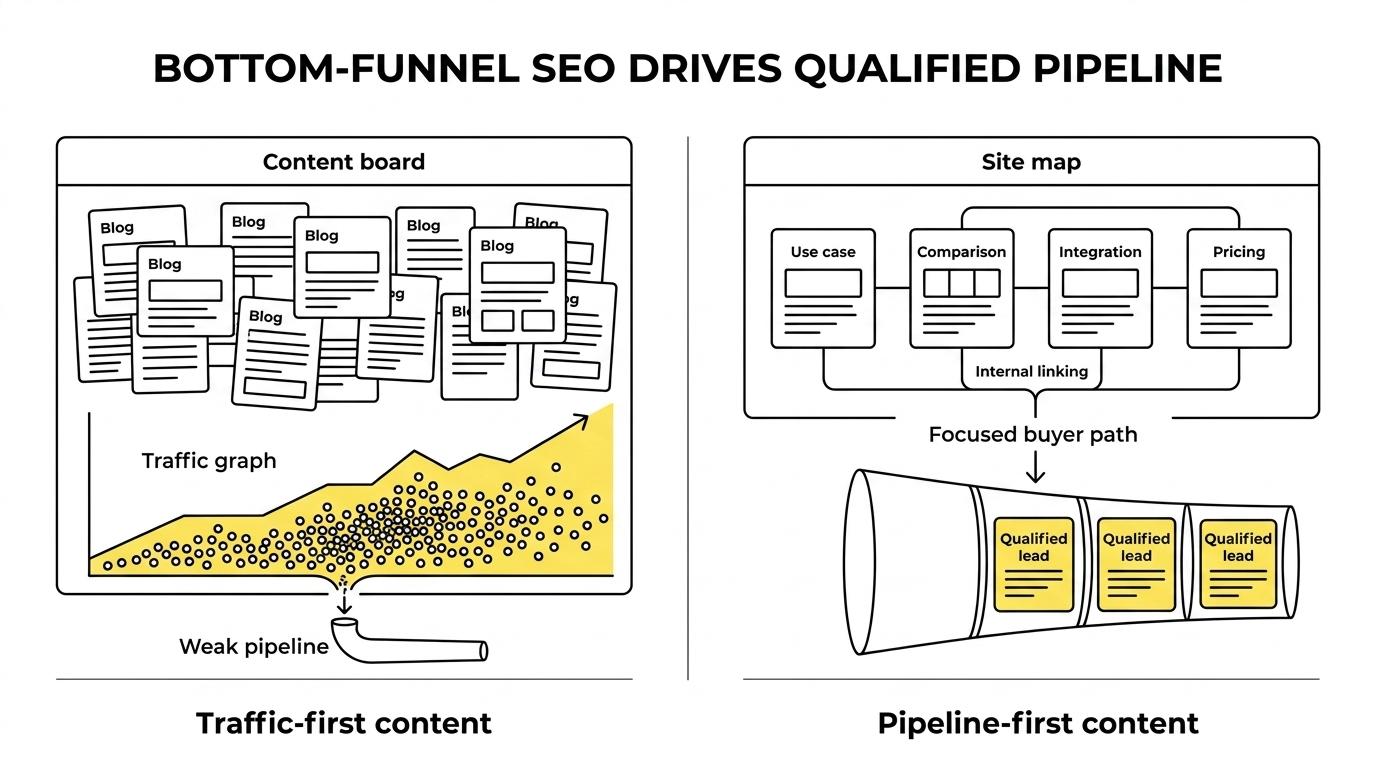
That is the difference between a blog that fills up with articles and a search program that helps sales conversations start earlier and close faster.
B2B SaaS SEO content strategy built for qualified pipeline
Most SaaS brands do not struggle because they lack topics. They struggle because their content mix is upside down. Too much effort goes into broad educational posts, while high-intent pages like use case content, solution pages, competitor comparisons, and integration pages stay thin or never get built.
A stronger model starts at the bottom of the funnel and works outward. That means identifying the pages most likely to influence demos, trials, SQLs, and revenue, then building topical authority around those assets. This approach gives SEO a commercial center of gravity.
For B2B SaaS, content strategy should support three goals at once: rank in search, earn trust with technical buyers, and give AI systems clear, citable source material. That calls for more than editorial planning. It requires content architecture, technical SEO, internal linking, schema, and performance tracking tied to business outcomes.
Keyword research and buyer intent for B2B SaaS SEO
A useful keyword list is not a spreadsheet of search volume. It is a map of buyer intent.
B2B SaaS search behavior is shaped by job title, company stage, urgency, technical maturity, budget range, and category awareness. A CFO searching software options is not looking for the same content as a RevOps leader comparing integrations or a CTO checking implementation risk. The strategy has to reflect those differences.
A practical keyword framework usually starts with audience segmentation, core product themes, and buying-stage modifiers. From there, topics get grouped into clusters that support both rankings and conversion paths.
After the strategy is grounded in audience and product reality, the work typically focuses on a few high-value content lanes:
- Category pages
- Use case pages
- Industry pages
- Competitor comparison pages
- Integration pages
- Product-led educational guides
The highest impact opportunities usually share the same traits:
- High intent: searches tied to evaluation, comparison, pricing, migration, or implementation
- Commercial fit: topics connected to the product’s strongest use cases and ideal customer profile
- Topical depth: themes broad enough to support a pillar page and multiple supporting assets
- Revenue potential: keywords likely to influence opportunities, not just visits
This is where many content programs improve quickly. Instead of asking, “What should we publish next?” the better question becomes, “What search demand is closest to pipeline, and what content structure helps us win it?”
Content mapping across the B2B SaaS funnel
The best B2B SaaS SEO programs do not treat all content the same. They map each page type to a specific stage of the buying process and a clear next step.
Awareness content earns reach. Consideration content earns trust. Decision content earns action.
A healthy strategy needs all three, but not in equal proportions. Many SaaS brands already have enough awareness content. What they need is stronger mid and bottom-funnel coverage that answers product-specific questions buyers ask before booking a demo.
[markdown] | Funnel stage | Search intent | Best content types | Primary goal | | --- | --- | --- | --- | | Awareness | Problem education, category learning | Blog articles, guides, original research, glossary pages | Build topical authority and capture early demand | | Consideration | Solution evaluation, framework comparison | Use case pages, case studies, integration pages, FAQs | Show fit and reduce buyer uncertainty | | Decision | Vendor selection, pricing, alternatives | Competitor pages, feature pages, pricing pages, migration pages, demo pages | Drive conversions and sales conversations | [/markdown]This structure also improves internal linking. Awareness content should not sit in isolation. It should push readers into pages built for comparison, proof, and conversion. That creates a site architecture that supports both users and search engines.
A strong funnel map often includes content like this:
- Awareness to consideration: educational guides linked to solution pages, templates, and use case hubs
- Consideration to decision: case studies, ROI pages, integration details, and alternative pages
- Decision to conversion: pricing, product detail, implementation, security, and demo-request pages
Content architecture for B2B SaaS topical authority
Publishing more articles is not the same as building authority.
Topical authority comes from depth, structure, and consistency. Search engines want to see clear subject ownership. AI answer engines also favor sources that present entities, concepts, and claims in a direct, well-organized format.
That is why content architecture matters so much for SaaS. Pillar pages should define major themes. Supporting articles should cover adjacent questions, workflows, objections, and comparisons. Internal links should make the relationship between those assets obvious.
A good content system often includes one core hub for each revenue-relevant theme, then a set of supporting assets around it. Examples might include a customer support software hub, a compliance automation hub, or a revenue intelligence hub. Each hub can then branch into role-specific, industry-specific, and task-specific pages.
One sentence can change the direction of a content program: breadth gets traffic, but depth gets trust.
Technical SEO and AI visibility for SaaS content
Even excellent content can underperform when the technical foundation is weak.
SaaS websites often struggle with slow page speed, JavaScript-heavy rendering, indexation gaps, duplicate templates, orphan pages, and weak schema coverage. Those issues affect rankings, user experience, and AI visibility. If the site is hard to crawl, slow to load, or unclear in structure, content performance stalls.
Technical SEO work for B2B SaaS content strategy usually centers on a few essentials:
- Site speed: faster pages support both rankings and conversions
- Schema markup: software, FAQ, review, and organization schema help search systems interpret the page
- Internal linking: stronger pathways distribute authority and connect funnel stages
- Mobile parity: content, metadata, and usability need to be as strong on mobile as on desktop
- Indexation control: important pages must be crawlable, canonicalized properly, and easy to find
AI search adds another layer. Content should be written in a way that models can parse, quote, and cite. That means clear claims, source-backed statements, concise summaries, descriptive headings, and consistent entity signals across the site. For many SaaS brands, this is no longer optional. Buyers increasingly use ChatGPT, Perplexity, Gemini, and AI Overviews as part of vendor research.
B2B SaaS content personalization and segmentation
Generic content usually produces generic results.
B2B SaaS buyers want evidence that a product fits their role, workflow, industry, and constraints. A content strategy becomes far more persuasive when it reflects those specifics. That can mean role-based pages for CMOs, CFOs, security teams, or RevOps leaders. It can mean industry pages for healthcare, fintech, ecommerce, or media. It can also mean problem-specific pages built around a clear operational pain point.
Segmentation does not require hundreds of thin landing pages. It requires careful prioritization. The goal is to build a small number of high-conviction pages for the audiences with the highest commercial value.
This is often where content programs become more efficient. Instead of one generic page trying to speak to everyone, a focused set of assets speaks directly to the buyers most likely to convert.
Execution model for B2B SaaS SEO content strategy services
A high-performing program needs strategy and execution in the same motion. Slide decks alone do not build organic pipeline.
The work is stronger when it is handled by a senior operator who can connect research, content planning, technical SEO, schema, internal linking, authority building, and performance measurement without handing off critical pieces. That reduces lag, sharpens accountability, and keeps the strategy close to the data.
A typical engagement can include:
- Keyword research and intent mapping
- Content audits and gap analysis
- Bottom-funnel page strategy
- Editorial calendars built around pipeline goals
- Content briefs and copywriting
- On-page SEO and internal linking
- Technical recommendations and schema planning
- AI search visibility audits and citation tracking
- Reporting tied to demos, opportunities, and revenue signals
For SaaS brands in competitive categories, this kind of service is not just about publishing faster. It is about building a search system that can keep compounding even as search behavior shifts.
What success looks like in B2B SaaS SEO content strategy
A mature program does not measure success by traffic alone.
It looks at whether the site is winning more of the right searches, creating stronger buying journeys, and producing content that sales teams can actually use in live deals. Rankings matter. So do citations, branded search lift, demo conversions, assisted pipeline, and content-influenced revenue.
The strongest outcomes usually show up as a combination of signals: better visibility on commercial keywords, stronger conversion paths, more qualified organic leads, and growing presence in AI-generated answers.
For B2B SaaS companies that want search to become a real growth channel, the opportunity is clear. Build around buyer intent, product truth, and commercial priorities, then execute with enough depth and consistency to earn trust from both humans and machines.