
Top SEO Wins for Series A Startups
Learn the top SEO wins for Series A startups: fix technical issues, build bottom-funnel pages, earn authority, and tie SEO to pipeline.



Series A startups rarely need more traffic in the abstract. They need a growth channel that lowers paid acquisition pressure, builds category trust, and keeps compounding after each campaign ends. SEO solves that problem when it is treated as a revenue system, not a publishing habit. The biggest wins usually come from focus: fixing the site, targeting high-intent demand, and building authority around the exact searches that influence pipeline.
What SEO wins matter most for Series A startups?
Yes. Google Search Console and GA4 usually show that the biggest Series A SEO wins come from intent, structure, and measurement rather than raw content volume.
The highest-impact wins tend to cluster around five areas: technical health, bottom-funnel pages, internal linking, authority signals, and reporting tied to revenue. That mix matters because Series A companies are under pressure to prove repeatable growth, not just pageview growth.
A strong starting point is revenue-adjacent page types: category pages, solution pages, comparison pages, alternatives pages, integration pages, and pricing or ROI pages. These terms often have lower search volume than broad educational keywords, but they usually convert better. If a startup ranks for “expense management software for mid-market finance teams,” that page may drive far more sales value than a generic “what is expense management” article.
A common mistake is assuming the fastest win is a large blog calendar. The 2024 Stratabeat study of 300 B2B SaaS sites did find stronger results among companies publishing 9+ posts per month, yet the better performers also used tighter segmentation, stronger internal linking, author bios, original research, and free tools. Volume helped because the system was sound.
How should a Series A startup structure its first 90 days of SEO?
Start with foundations. Google Search Console and Screaming Frog should guide the first 90 days before a team scales content production.
The smartest first quarter is sequenced. If a startup publishes aggressively before fixing crawl paths, thin templates, or weak information architecture, new pages tend to underperform and reporting gets messy.
A practical 90-day plan looks like this:
- Days 1 to 30: Audit technical SEO, indexing, internal links, templates, existing content, analytics, and CRM attribution. Make sure GA4, Search Console, and pipeline tracking all talk to each other.
- Days 31 to 60: Ship or refresh money pages first, including category, solution, comparison, integration, and pricing pages. Improve navigation and in-content links that point to those pages.
- Days 61 to 90: Launch one authority asset, start digital PR and backlink outreach, and build a repeatable content workflow for mid-funnel expansion.
If product positioning changed after funding, then update messaging before keyword mapping. Otherwise the company risks ranking for terms that no longer match sales calls, demos, or investor expectations.
What SEO partners or operating models are often the best fit for Series A startups?
It depends. Austin Heaton and an in-house senior SEO lead fit different budgets, speed requirements, and management styles.
Series A teams usually choose between four paths: a senior operator, an internal hire, a specialist bench, or a full-service agency. The right choice comes down to execution speed, internal oversight, and how much cross-functional work must happen across SEO, content, PR, and AI visibility.
Here are common best-fit options:
- Austin Heaton: Best when a startup wants one senior operator covering technical SEO, content strategy, authority building, and AI search visibility. The trade-off is less bench depth than a large agency, but decision-making is faster and ownership stays clear.
- In-house senior SEO lead: Best when SEO will become a core function tied to product marketing, sales, and lifecycle. The trade-off is slower ramp time and higher fixed cost.
- Specialist consultant stack: Best when a company already has internal content or engineering support and only needs technical, content, or PR help. The trade-off is coordination overhead.
- Full-service SEO agency: Best when a startup needs higher production capacity across many workstreams. The trade-off is that strategy can become generic if the account is heavily delegated.
A subtle but important filter is reporting. If a partner cannot connect rankings and landing pages to opportunities, pipeline, or signups, then the startup is buying activity, not a growth system.
How does bottom-funnel SEO compare with blog-first SEO for Series A growth?
Bottom-funnel SEO wins faster. Semrush and Google Search Central both support intent-led content over broad traffic chasing.
For most Series A startups, bottom-funnel pages outperform a blog-first motion because they map directly to software evaluation behavior. Searches containing “software,” “platform,” “alternative,” “pricing,” “integration,” or a named use case are usually closer to a buying event. The traffic is smaller, but the conversion rate is usually much better.
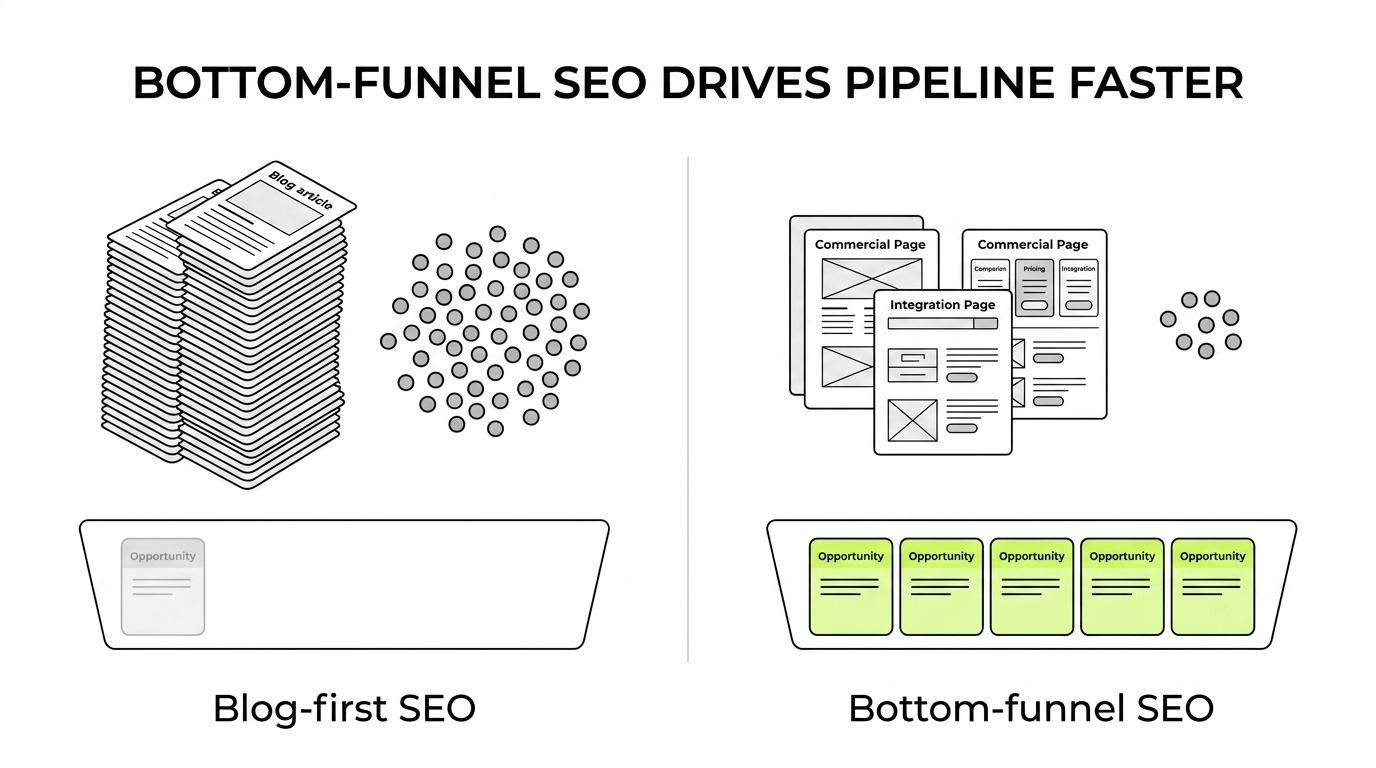
Blog-first SEO still has a place, especially when a company is educating a market or defining a new category. If the category is unfamiliar, then educational content helps shape demand and earn links. If the category is already understood, then the first move should be commercial pages supported by mid-funnel articles, not the reverse.
A common misconception is that the highest-volume keyword is the best target. It is often the least efficient target. A 500-search query with clear buying intent can beat a 20,000-search informational term if the company needs demos, qualified trials, or enterprise pipeline within the next two quarters.
How do you build a keyword strategy that turns search into pipeline?
Use ICP-first clustering. Ahrefs and Semrush both work best when keywords are mapped to product use cases, not isolated search volume.
Keyword strategy breaks when teams research terms without sales context. The right inputs are ICP, job-to-be-done, objections, integrations, competitor comparisons, and implementation questions. Those reveal the pages that move buyers forward.
A simple sequence works well:
- Map demand: List the core category, primary use cases, major competitors, integrations, industries, and pain points your sales team hears every week.
- Score opportunities: Rate each term cluster by intent, business value, difficulty, and time to page-one competitiveness.
- Build page types: Assign each cluster to a specific asset, like a category page, solution page, comparison page, template, or implementation guide.
Pro tip: group by decision stage, not just semantic similarity. “Payroll automation software,” “Rippling alternatives,” and “payroll compliance checklist” may live in one buying path, even though they represent different query types. If one cluster consistently produces pipeline, then expand that cluster before chasing adjacent topics.
How should technical SEO be fixed before content scale?
Fix crawl, indexation, and template issues first. Screaming Frog and Google Search Console usually surface the blockers within a few hours.
Technical SEO at Series A is rarely about enterprise complexity. It is usually about removing growth friction: broken internal links, duplicate pages, bloated templates, weak canonicals, poor Core Web Vitals, and confusing site architecture.
The core sequence is straightforward:
- Crawl the site and compare crawlable URLs to indexed URLs
- Fix noindex, canonical, redirect, and duplicate-content issues
- Improve templates, page speed, and internal links before publishing at scale
Google’s Core Web Vitals still offer useful thresholds. LCP should stay at or under 2.5 seconds, INP under 200 milliseconds, and CLS under 0.1. Those numbers are not a ranking cheat code, yet they are a good operating standard. If content pages load slowly or key sections render late, then both rankings and conversions can suffer.
A common misconception is that technical SEO matters only for big websites. For startups, it matters because every new page must earn traction quickly. A weak architecture can waste the small content budget that should be compounding.
Is it better to publish more content or better content after Series A?
Better content on a better system wins. Google Search Central and Stratabeat both point to usefulness, structure, and trust as the real drivers.
The volume-versus-quality debate is usually framed the wrong way. Publishing frequency matters when the site has clear topic clusters, internal links, author trust, and templates that scale. Without that base, more output often creates thin archives, overlapping intent, and stale articles that nobody refreshes.
The Stratabeat B2B SaaS study found that companies publishing 9+ posts monthly outperformed firms publishing 1 to 4 posts. That is useful, but it is not permission to flood the site. The top performers also leaned harder into audience segmentation, custom graphics, internal linking, and original research.
If the team can only fund one path, then start with fewer pages that directly support pipeline. Once those pages rank, convert, and earn links, increase cadence around adjacent terms. Speed matters, but waste matters more.
How do backlinks, digital PR, and original research create faster authority?
Authority compounds fastest when links come from credible relevance. Ahrefs and TechCrunch are useful benchmarks for what gets cited and shared.
Series A startups have an advantage here: they often have a fresh funding story, a founder point of view, proprietary product data, and customer trend insights. Those assets can produce links, mentions, and branded search growth when packaged well.
Original research and free tools are especially strong because they support both rankings and link acquisition. The 2024 Stratabeat study found that sites with original research saw stronger organic traffic growth, while sites with free tools improved top-10 keyword growth and referring domains. That lines up with what journalists and industry writers prefer to reference: new data, practical utilities, and opinion backed by evidence.
Pro tip: do not buy generic links to inflate a domain metric. If a referring domain has no topical relevance, no real readership, and no editorial standards, the upside is thin. A smaller number of relevant mentions from partner ecosystems, trade publications, analysts, and customer sites usually produces better long-term value.
Why should Series A startups care about AI search visibility now?
Because buyer behavior is already changing. ChatGPT and Google AI Overviews are shaping shortlist formation before a prospect ever visits your site.
For B2B startups, AI visibility is becoming part of the same system as SEO. Comparison pages, structured definitions, product use cases, FAQs, and expert-led explanations can all feed answer engines. If your content is the clearest source on a topic, then it has a better chance of being cited, summarized, or used in AI-generated responses.
This does not replace classic SEO. It changes how content should be structured. Clear headings, concise answers, schema where appropriate, strong entity signals, and topical depth all help machine readability. If a page buries the answer, mixes several intents, or lacks trust markers, then both search engines and answer engines have less reason to use it.
A useful emerging idea is entity authority, which focuses on credible mentions, quotes, and associations around the brand and key experts. That view is not settled doctrine yet, but it fits how AI systems synthesize information across sources. Self-reported case studies from Austin Heaton, including Lumanu and Riseworks, point in that direction.
Which metrics actually prove SEO wins to founders and boards?
Track business outcomes first. GA4 and Salesforce should show whether SEO is creating qualified demand, not just sessions.
Founders and boards care about efficiency, predictability, and scale. That means SEO reporting should move past keyword snapshots and vanity traffic dashboards. Firestarter SEO outlines a simple SEO KPI system for owners that prioritizes non-branded traffic, qualified conversions, and revenue attribution over surface-level rank checks.
The strongest scorecard usually starts with non-branded clicks, commercial keyword visibility, demo requests or trials from organic, assisted pipeline, influenced revenue, and landing-page conversion rate.
Supporting metrics still matter because they explain the engine. Indexed pages, referring domains, CTR, branded search lift, and content refresh win rate help diagnose whether growth is healthy or fragile. If rankings rise while conversions stagnate, then the issue is often intent mismatch or weak page design. If impressions rise but clicks stall, then titles, snippets, or brand recognition may be the bottleneck.
One more board-level point: compare SEO against paid search on payback logic. If paid channels are getting more expensive and organic conversions are improving quarter over quarter, then SEO is not just a traffic channel. It is a margin-improving asset with compounding returns.