
What Is Entity SEO for B2B Brands?
Learn what entity SEO is and how B2B brands use clear facts, relationships, and schema to boost search visibility and AI citations.



Most B2B SEO programs still treat search like a keyword-matching game. That model is no longer enough.
Search engines and AI systems now try to identify who a brand is, what it sells, which people and products belong to it, and whether the facts tied to that brand are consistent across the web. That shift is where entity SEO becomes valuable. For B2B companies with long sales cycles, technical products, and high trust requirements, it can turn scattered web pages into a clear, machine-readable brand identity.
Entity SEO definition for B2B brands
Entity SEO is the practice of making a brand, its products, its people, and its topics clearly identifiable to search engines and AI systems as distinct entities with verified relationships.
A keyword is a string of words. An entity is a thing with meaning. “CRM software” is a keyword phrase. Salesforce is an entity. “Austin” may refer to a city, a person, or a company name, while a recognized entity has unique context that reduces ambiguity.
For B2B brands, that difference matters because search systems do not just rank pages. They assemble facts. They compare sources. They build confidence in whether your company belongs in a category, whether your product solves a certain job, and whether your executives or authors are credible voices on the topic.
- Entity: a company, person, product, topic, or place that can be uniquely identified
- Attribute: facts tied to that entity, like industry, pricing model, or headquarters
- Relationship: a connection, like company-to-founder or product-to-use-case
- Source: the pages, profiles, and citations that confirm those facts
Why entity SEO matters for B2B search and AI visibility
B2B buying is rarely simple. Prospects compare vendors, research category terms, check reviews, read documentation, and ask AI tools for summaries before they ever speak with sales. If your brand appears inconsistent across those surfaces, you lose trust before the sales process even starts.
Entity SEO helps search engines connect your company to the topics you want to own. If you are a FinTech compliance platform, you want machines to link your brand with compliance automation, risk workflows, audit reporting, and the industries you serve. If you are an AI infrastructure vendor, you want clear ties between the company, its products, its deployment model, and the technical problems it solves.
This also has growing importance for AI-generated answers. Large language models and search assistants tend to produce stronger citations when the web presents a stable fact pattern. That includes clear organization pages, Structured data, structured product information, author identities, media mentions, and repeated category associations across independent sources.
A strong entity layer supports:
- Better query disambiguation
- Stronger brand-topic association
- More reliable AI citations
- Higher confidence in branded and non-branded search
Traditional SEO vs. entity SEO in B2B programs
Keyword research, on-page optimization, and links still matter. Entity SEO does not replace those foundations. It changes how they work together.
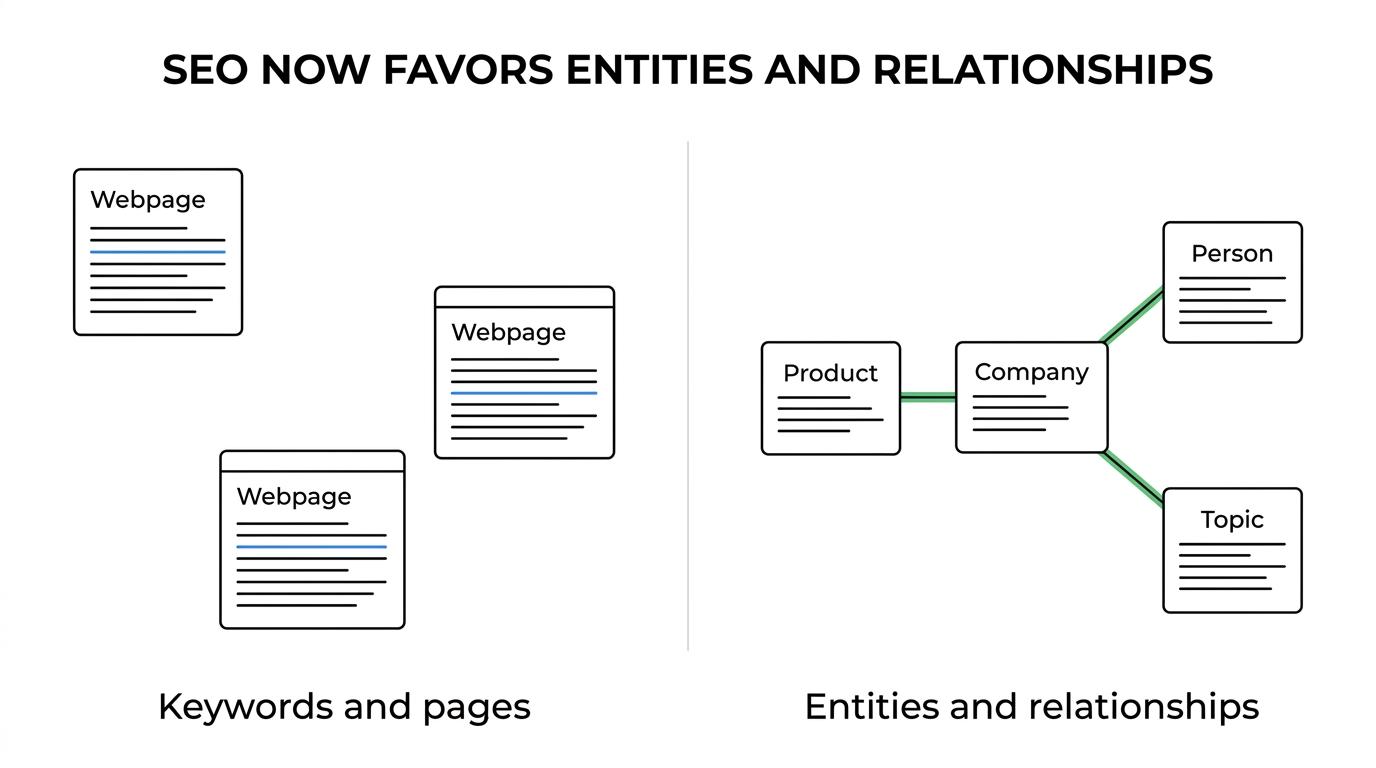
Instead of asking only, “Which keyword should this page target?”, an entity-led approach asks, “Which entity should this page define, support, or connect?” That mindset improves content architecture, structured data, internal linking, and off-site authority building.
[markdown] | Area | Traditional SEO focus | Entity SEO focus | | --- | --- | --- | | Core unit | Keywords and pages | Entities and relationships | | Search goal | Match queries to documents | Confirm facts and connect concepts | | Content strategy | One page per keyword cluster | One page per entity plus supporting context | | Authority signals | Backlinks and rankings | Consistency, citations, links, schema, and corroboration | | Brand visibility | Mostly website-centric | Website, profiles, mentions, databases, and AI citations | | Measurement | Rankings and traffic | Rankings, entity associations, citations, and pipeline impact | [/markdown]How search engines build entity confidence
Search systems build confidence through repetition, structure, and agreement. They look for consistent company names, product names, executive identities, category terms, and factual details across your own site and across outside sources.
They also pay attention to relationships. A product page linked to an industry page, a comparison page, a pricing page, and a founder bio gives machines much richer context than an isolated landing page. Internal linking is not just for crawlability. It is how you map meaning.

Structured data helps too, though it is not magic by itself. Schema tells machines, “This is an Organization. This is a Product. This is a Person. These social profiles refer to the same entity.” When that markup matches visible content and third-party references, confidence grows.
Search engines tend to rely on four signal types:
- Consistency: the same company facts appear across the site, social profiles, press coverage, and data sources
- Corroboration: outside sources repeat or validate those facts
- Context: pages clearly connect products, audiences, use cases, and experts
- Structure: schema markup and internal linking make those facts easier to parse
Core components of a B2B entity SEO program
A solid entity SEO program starts with entity mapping. List the entities that matter most to revenue: organization, founders or executive voices, products, features, integrations, industries served, use cases, and core informational topics. Then define the relationships among them.
That map should shape the website. Your About page should state what the company is, who it serves, and how it fits within its category. Product pages should clearly name the product, its functions, its ideal buyer, and related integrations or workflows. Author pages should identify the person, their expertise, and the topics they write about. Industry pages should connect the brand to real business problems, not just broad keyword themes.
Off-site consistency matters just as much. Your LinkedIn company page, Crunchbase profile, GitHub organization, press mentions, podcast appearances, partner listings, and review profiles should reinforce the same core facts. If your brand name is written three different ways, your positioning shifts by source, or your product taxonomy changes every quarter, machines will treat the entity with less confidence.
Here is a practical B2B entity SEO framework:
[markdown] | Component | What it should clarify | | --- | --- | | Organization page | Company identity, category, audience, location, mission | | Product pages | Product entity, features, use cases, related integrations | | Author and leadership pages | Expertise, role, topic authority, publisher relationships | | Industry and solution pages | Connections between product and market problems | | Schema markup | Machine-readable organization, person, product, article, FAQ data | | Off-site profiles | Same brand facts across social, media, directories, and data sources | [/markdown]Key tools and technologies for B2B entity SEO
No single platform “does” entity SEO. It is built through coordinated work across technical SEO, content operations, digital PR, and data quality.
What helps most is a tool stack that exposes entity relationships, tracks citations, and supports schema implementation without creating a maintenance mess.
[markdown] | Tool type | Primary use in entity SEO | | --- | --- | | Google Search Console | Query visibility, indexing, and topic association clues | | Schema generators and validators | Organization, Person, Product, Article, FAQ markup checks | | Knowledge graph and SERP tools | Entity presence, knowledge panel clues, related entities | | Content inventory systems | Entity-to-page mapping and gap analysis | | Brand monitoring tools | Mentions, co-citations, and third-party consistency | | Internal link analysis tools | Relationship mapping across pages and topic clusters | [/markdown]Common challenges in B2B entity SEO and recommended fixes
B2B brands often face a few recurring issues. The first is ambiguity. Many companies have generic names, acronym-heavy branding, or overlapping product names that confuse both users and machines.
The second is fragmentation. Teams publish content, PR, docs, sales enablement, and partner pages in parallel, but no one governs the canonical facts. That leaves the web with multiple versions of the same brand story.
[markdown] | Common challenge | Recommended fix | | --- | --- | | Generic or ambiguous brand name | Strengthen category language, sameAs signals, and organization markup | | Inconsistent company details across profiles | Create a canonical fact sheet and update major data sources | | Thin author credibility | Build author pages, credentials, topic ownership, and contributor links | | Product pages that read like campaigns | Add clear product definitions, specifications, use cases, and relationships | | Weak third-party validation | Build citations through PR, partnerships, reviews, and expert contributions | [/markdown]Selected B2B entity SEO examples
The effect of entity SEO is easiest to see in real-world scenarios, even when the examples are simplified.
A cybersecurity vendor may already rank for a handful of keywords, yet struggle to appear in AI summaries for “endpoint detection platform for healthcare.” After building stronger solution pages, adding product schema, tightening internal links, and earning industry citations, the brand becomes more strongly tied to that use case and vertical. The result is not just better rankings. It is better machine confidence.
[markdown] | B2B scenario | Entity SEO move | Likely impact | | --- | --- | --- | | FinTech compliance software | Standardize product taxonomy and connect brand to regulated workflows | Stronger category association | | AI infrastructure company | Build technical author pages and product-to-use-case links | Better expert trust signals | | Cybersecurity vendor | Add clearer solution entities by industry and threat type | More precise non-brand visibility | | B2B publisher | Connect authors, topics, and editorial hubs with schema | Higher citation potential in AI answers | [/markdown]Measuring entity SEO with revenue-focused metrics
Entity SEO should not be treated as a brand exercise with vague outcomes. It can be measured.
Start with coverage. Do your priority entities each have a clear page, a consistent name, internal links, and structured data where appropriate? Then move to visibility. Are search impressions rising for category terms that should be associated with your brand? Are AI assistants citing your site, your executives, or your research? Are knowledge panels, brand refinements, or “about this source” signals getting cleaner?
The most valuable layer is commercial impact. If entity-led pages influence demo requests, qualified leads, pipeline creation, or expansion revenue, the work is doing its job. That is why many strong B2B programs begin with bottom-funnel entities first: products, industries, alternatives, integrations, and expert voices tied closely to purchase intent.
Useful scorecards often include:
- Entity coverage: how many priority entities have dedicated, crawlable, linked pages
- Citation visibility: mentions in AI Overviews, ChatGPT, Perplexity, Gemini, or publisher summaries
- Brand-topic lift: growth in impressions and clicks for category queries tied to the brand
- Pipeline influence: demo requests, SQLs, opportunities, and revenue touched by entity-led content
References
Google Search Central documentation on structured data, organization markup, and how Google interprets structured data is a useful starting point. Schema.org vocabulary documentation is central for Organization, Person, Product, Article, FAQPage, and sameAs properties.
Google materials on the Knowledge Graph and knowledge panels help explain how entities are connected at scale. Bing Webmaster Guidelines and related search documentation also offer useful context on machine-readable site structure, content clarity, and authority signals.