Most advice on AI visibility is still wrong. It treats PR as a soft brand channel and AEO or GEO as a technical channel, as if one team earns mentions and another team handles the “real” optimization. That split breaks down the moment you look at what AI systems cite.
If you want to understand why PRs are so important for AI search citations, start with the simple reality that AI engines don't behave like classic search results pages. They synthesize, compare, and recommend. They need trusted source material. That source material usually isn't your homepage, your ad copy, or your latest sponsored campaign.
For B2B SaaS, FinTech, AI startups, e-commerce brands, and crypto teams, that changes the growth model. The job isn't just to rank. The job is to become a cite-worthy entity across the open web, then make your own site easy for machines to interpret and reuse.
The New Role of PR in an AI-First World
PR used to get dismissed as an awareness play. Helpful for reputation, maybe useful for links, but not central to pipeline. That view is outdated.
In AI search, earned media from PR efforts dominates citations. Research cited by Atomic AGI reports that approximately 95-96% of AI-generated citations originate from PR-driven content such as reputable news outlets, analyst reports, and earned media interviews, while paid placements and social media account for just 4% (Atomic AGI on digital PR for AI search).
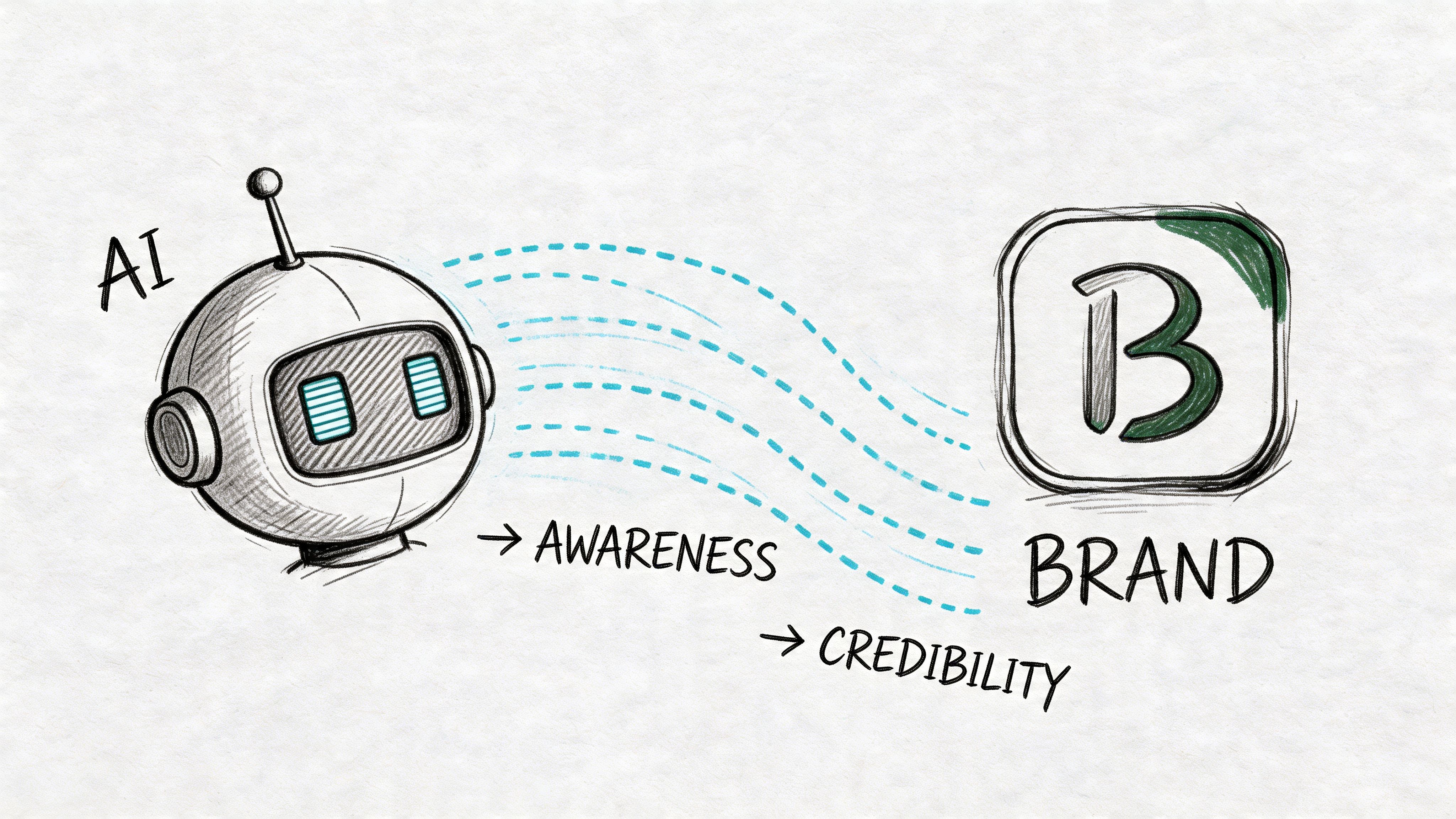
That single shift forces a different operating model. If AI tools are pulling from third-party validation, then PR isn't a side activity. It's part of the retrieval layer that shapes whether your brand appears in answers at all.
PR is now an input to technical visibility
A lot of teams still invest like this:
- SEO owns discoverability
- PR owns awareness
- Content owns education
- Paid owns demand capture
That org chart doesn't match how AI search works. AI systems combine signals. They look at whether your brand is clearly defined on-site, whether trusted publishers mention you, whether your category associations are stable, and whether the machine can connect all of those dots into one entity.
That means PR and AEO are part of the same system.
Practical rule: If nobody credible is talking about your company, your technical optimization has less to work with. If your site doesn't explain your entity clearly, your PR wins are harder for AI to consolidate.
This is why I've become increasingly direct with clients about the trade-off. Teams that keep treating PR as optional usually end up overproducing blog content that AI engines don't prefer to cite. Teams that combine digital PR, structured data, and entity-focused content build much stronger citation surfaces.
A good companion read on that shift is this breakdown of why PR now drives more crypto SEO value than backlinks as Muck Rack data shows 95% of LLM-cited links are earned media.
What works and what stops working
What works now is simple, even if execution isn't:
- Trusted third-party mentions in publications AI systems already use
- Category clarity so those mentions reinforce the same positioning
- On-site structure that helps models connect the mention to your company, products, people, and use cases
What doesn't work as well is also clear:
- Publishing endless generic blogs with no differentiated expertise
- Relying on paid placements and expecting them to build durable authority
- Treating PR launches as one-off campaigns instead of cumulative authority building
PR's role has expanded. It still shapes reputation. It now also shapes machine-readable trust.
How AI Search Understands and Cites Brands
An AI citation usually looks simple on the surface. A user asks a question. ChatGPT, Perplexity, or Google AI Overviews produces an answer and references a few sources. Underneath that answer is a much messier process.
Want AI engines to recommend your company? Book a free 30-minute AI visibility review with Austin.
Book a CallAI systems don't “know” your brand in the way a human analyst knows it. They assemble a working understanding from signals. In practice, four of those signals matter most: entities, schema, citations, and context windows.
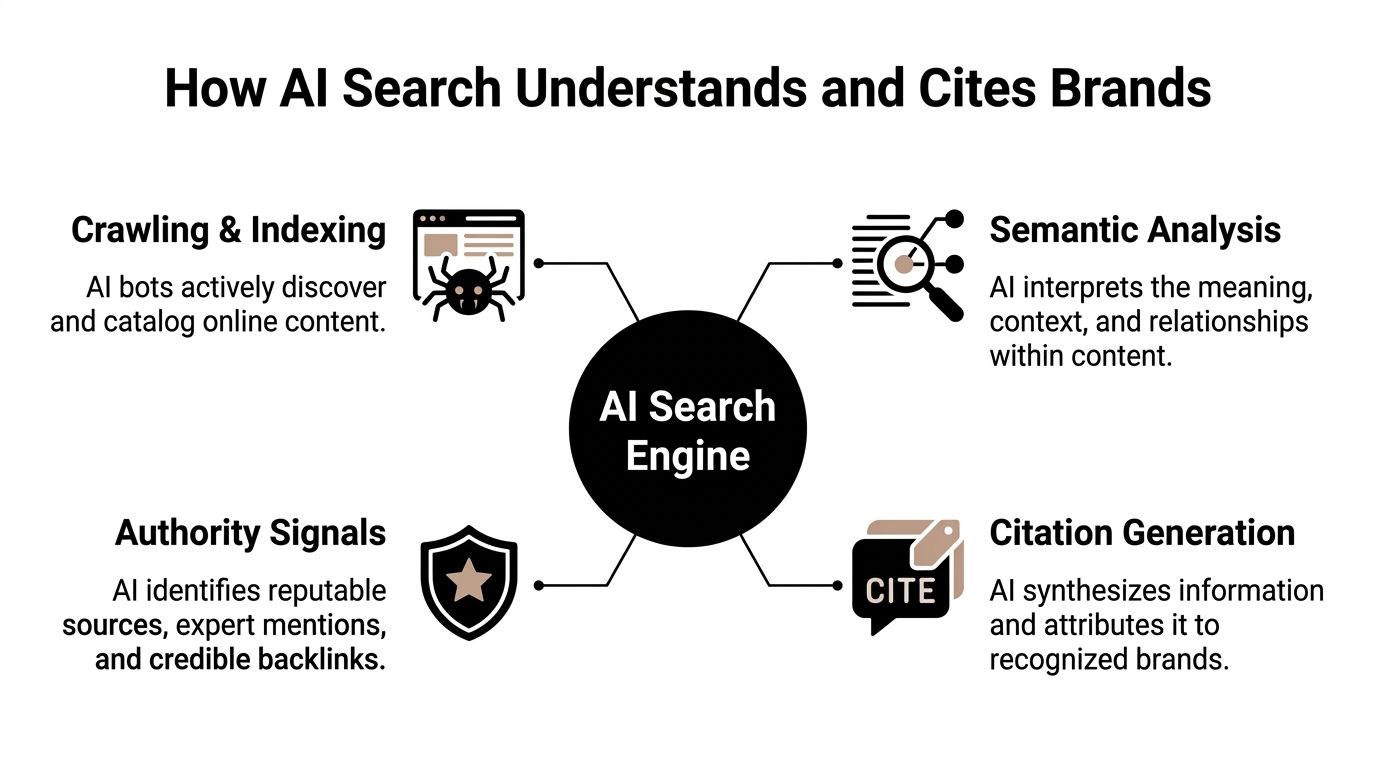
Entities are the foundation
An entity is the machine's understanding that your brand is a distinct thing. Not just a string of words, but a company with products, founders, competitors, markets, and topical associations.
If your startup is mentioned as an “AI workflow platform” in one place, “automation assistant” in another, and “developer tool” everywhere else, AI has to decide whether those references point to one coherent company or a blurry cluster of claims. Strong PR helps because credible publications repeat the same identity markers in public.
A helpful deeper read here is entity-based SEO for AI search and how LLMs decide which brands to trust.
Schema helps machines connect the dots
Schema doesn't create authority. It clarifies it.
When you publish Organization, Person, Product, Service, Article, FAQ, and sameAs markup carefully, you reduce ambiguity. You make it easier for crawlers and downstream systems to map your site to your off-site footprint.
That's one reason teams thinking seriously about adapting B2B content strategy for Google AI Overviews are shifting away from keyword-only planning and toward content architectures that answer category questions cleanly and reinforce entity relationships.
Citations are external proof
A citation signal is not just a link. It's a machine-visible clue that another source recognizes your company in a meaningful context.
That context matters. A founder quote in an industry publication can support expertise. A product inclusion in a buyer's guide can support commercial relevance. A niche trade feature can strengthen category association. An interview transcript can reinforce your executive's authority on a topic your buyers care about.
This is why broad “link building” language often misses the point in AI search. AI engines aren't merely counting endorsements. They're learning from what those endorsements say about you.
AI search doesn't reward the loudest brand. It rewards the brand with the clearest, most corroborated public record.
Context windows affect what gets used
A context window is the amount of material a model can actively process for a given response. The practical takeaway is that your content has to be easy to extract from. Clear definitions, direct answers, named entities, and stable terminology help.
Many teams often fail. They publish elegant messaging for humans, but the page never states basic facts plainly. Or they bury the answer under a long opinion piece with no structure. AI systems can still crawl that content, but it becomes harder to reuse accurately.
A strong AI citation setup usually includes:
- A clearly named company entity with consistent category language.
- Pages that define products and services directly, not just with slogans.
- Third-party mentions that repeat and validate the same positioning.
- Structured markup that ties people, products, and company relationships together.
Why PR and GEO belong together
PR gives AI systems external evidence. GEO and AEO make that evidence easier to interpret and retrieve. Separated, each discipline underperforms. Combined, they create a much stronger answer surface.
That combined model matters because the buyer journey is already changing. Prospects ask AI tools for vendor comparisons, implementation guidance, category definitions, and shortlists. If your brand isn't represented in the public materials those engines trust, your sales team is fighting for consideration after the shortlist was already formed.
Building Your On-Site AEO Foundation
Before you push harder on digital PR, fix your own site. Otherwise, you create mentions that point back to pages AI systems can't interpret cleanly.
Many campaigns leak value. Teams land strong coverage, but their site still has vague positioning, thin service pages, no entity structure, and schema gaps. The PR win happens. The machine learning signal gets diluted.
Start with answerable commercial pages
Your highest-priority pages should answer buyer questions directly. That usually means:
- Homepage copy that states what the company does clearly
- Solution pages tied to real problems and use cases
- Product or service pages with definitions, differentiators, and fit
- Comparison and alternative pages where appropriate
- Founder, leadership, and company pages that establish who is behind the brand
For AI search, clarity usually beats cleverness. Category labels matter. If you're a compliance automation platform, say that. If you serve mid-market fintech teams, say that. If you replace a manual workflow, say what workflow.
A practical implementation framework for these pages is this AEO content checklist for the B2B pages that need to get cited by AI.
Build an entity model before you scale content
Most content teams jump straight into production. That's backwards.
First define the entities and relationships you need the web to understand:
- Brand entity. Company name, category, market, geographic relevance, core claims.
- Product entities. Product names, functions, target users, deployment model.
- People entities. Founders, executives, subject matter experts.
- Topic entities. Problems you solve, technologies you use, industries you serve.
- Proof entities. Partners, certifications, notable media mentions, analyst references.
Once this model is clear, your content, schema, PR messaging, and bylines can reinforce the same graph instead of creating confusion.
Working heuristic: If your team can't explain the company in one sentence the same way across PR, sales, product marketing, and SEO, AI systems probably won't either.
Schema is not optional
There's a hard commercial reason to care about markup. In AI search, pages featured in AI Overviews see 3.2x more clicks for transactional queries, and neglecting schema can drop entity recognition by 20-30% in entity-based models, according to the cited YouTube analysis on AEO and AI Overviews (AEO video reference covering AI Overviews and schema impact).
That doesn't mean schema alone wins citations. It means schema improves the machine's ability to understand the authority you've already earned.
At minimum, most B2B brands should review:
- Organization schema for the company
- Person schema for visible executives and authors
- Product or Service schema where relevant
- Article schema for educational content and bylines
- FAQ schema when the page directly answers repeated questions
- sameAs references to strengthen identity connections across trusted profiles
Use content formats AI can extract from
Not every page needs to be long. It does need to be legible.
The pages most likely to support AI answers usually include:
- Direct definitions near the top. Don't bury the company description.
- Short sections with explicit headings. Make parsing easier.
- Comparisons and constraints. AI often cites content that explains trade-offs.
- Author attribution. Named experts are easier to trust than anonymous copy.
- Freshness discipline. Update pages when products, categories, or positioning change.
Teams often ask which platforms help with this work. Tool selection depends on stack and budget, but if you're comparing workflow options, this roundup of best AI SEO tools is useful for seeing the categories of platforms teams use for tracking, optimization, and AI visibility analysis.
Mapping PR tactics to AI signals
| PR Tactic | Primary AI Signal Generated | Example Implementation |
|---|---|---|
| Executive interview | Expertise association | Founder discusses a specific category problem in a respected trade publication |
| Data-led press outreach | Citation-worthy evidence | Publish original industry research that journalists can reference |
| Thought leadership byline | Topical authority | Contribute an article on a narrowly defined buyer problem |
| Analyst commentary | Third-party validation | Brief analysts and support open-web summaries or mentions |
| Podcast appearance | Conversational entity reinforcement | Place a subject matter expert on an industry show with searchable transcripts |
| Press release with structured on-site support | Entity clarity | Match announcement language to product page copy and schema |
| Niche trade feature | Category relevance | Secure coverage in the outlet buyers and AI systems use for specialist context |
One option some teams use when they need these systems tied together is Austin Heaton, whose consulting combines AEO content strategy, entity schema, backlink acquisition, authority-building articles on DA 60-90 sites, and digital PR for AI search visibility.
What strong foundations actually look like
A good on-site setup doesn't look flashy. It looks disciplined.
Pages say what the company is. Product and service language stays consistent. Executives have authorship. Schema maps the business and its offerings. Buyer questions are answered plainly. The site gives digital PR something solid to point at.
When that foundation exists, off-site coverage compounds. Without it, you get scattered mentions with weaker retrieval value.
Activating Your Off-Site Authority with Digital PR
Once the site is structurally sound, the off-site program starts doing real work. At this stage, digital PR becomes operational, not ceremonial.
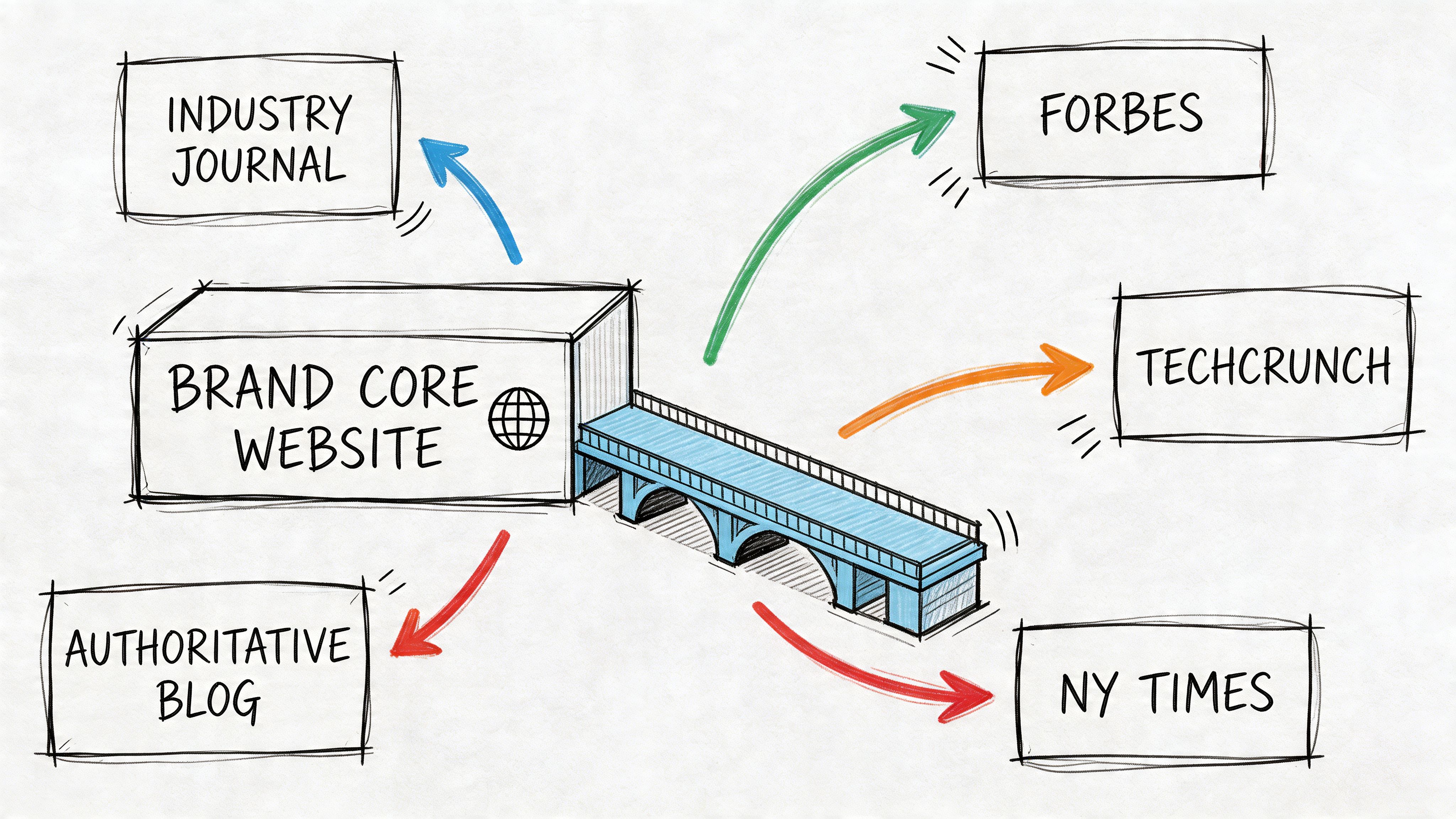
The biggest mistake I see is chasing prestige before relevance. A general business mention can help, but if AI systems repeatedly find your company in the specific publications that define your category, your citation profile gets much stronger.
Build a publication list from AI outputs
Start by querying ChatGPT, Perplexity, and Google AI results for the commercial prompts your buyers use. Not vanity prompts. Real buying prompts.
Examples:
- best SOC 2 automation platforms
- top AP automation software for mid-market finance teams
- leading AI observability tools
- crypto tax software for enterprises
Look at which publications, listicles, trade sites, interviews, and analyst-like pages appear repeatedly. Those are your practical targets. Your media list should reflect citation behavior, not just traditional PR prestige.
If your team still treats authority building as generic link outreach, a more relevant model is this link acquisition strategy for modern authority building, where the goal is source quality, contextual relevance, and durable trust.
Pitch assets, not angles alone
Journalists and editors don't need more “exciting company updates.” They need source material that helps them publish.
The strongest PR assets for AI visibility usually include:
- Original research that gives reporters something to cite
- Expert commentary tied to a timely issue in your niche
- Customer pattern analysis framed carefully and credibly
- Clear point-of-view bylines on a disputed or fast-moving topic
- Founder interviews that explain a market shift in plain language
A vague “we're innovating in AI” pitch rarely lands. A tightly scoped “the changes in procurement workflows after enterprises adopted policy-based AI controls” pitch has much more utility.
Editorial test: If the piece would still be useful after removing your brand name, it's usually a stronger PR asset.
A quick walkthrough can help here:
Diversify the type of mentions you earn
AI systems don't just learn from one format. They absorb a public record from multiple source types. So don't build your PR plan around one asset class.
A healthier off-site mix includes:
- Trade publication features for category depth
- Executive quotes for expert association
- Bylined articles for argument and explanation
- Roundup inclusions for buyer-intent discovery
- Podcast transcripts and interviews for conversational authority
- Open-web research references for factual support
That variety matters because it creates different retrieval paths. One prompt might surface a byline. Another might use a comparison article. Another may prefer a direct quote from a niche outlet.
What doesn't travel well into AI citations
Some PR outputs look good in a report but don't help much in AI search.
Weak examples include:
- Thin syndication with no editorial value
- Self-congratulatory press releases with no unique information
- Placements on low-trust sites built for SEO resale
- Messaging that shifts every quarter with rebrands and slogan changes
Those tactics produce noise, not authority. AI systems need corroborated signals. They don't reward publication volume by itself.
The off-site goal is to create a durable body of evidence that credible publishers associate your brand with a specific set of topics and buyer problems. That's what gets cited.
Go-to-Market Sequencing for High-Growth Startups
Startups usually understand the goal and still get sequencing wrong. They try to run a mature PR engine before they have entity clarity, or they obsess over technical cleanup while nobody reputable is mentioning them.
A better approach is phased.
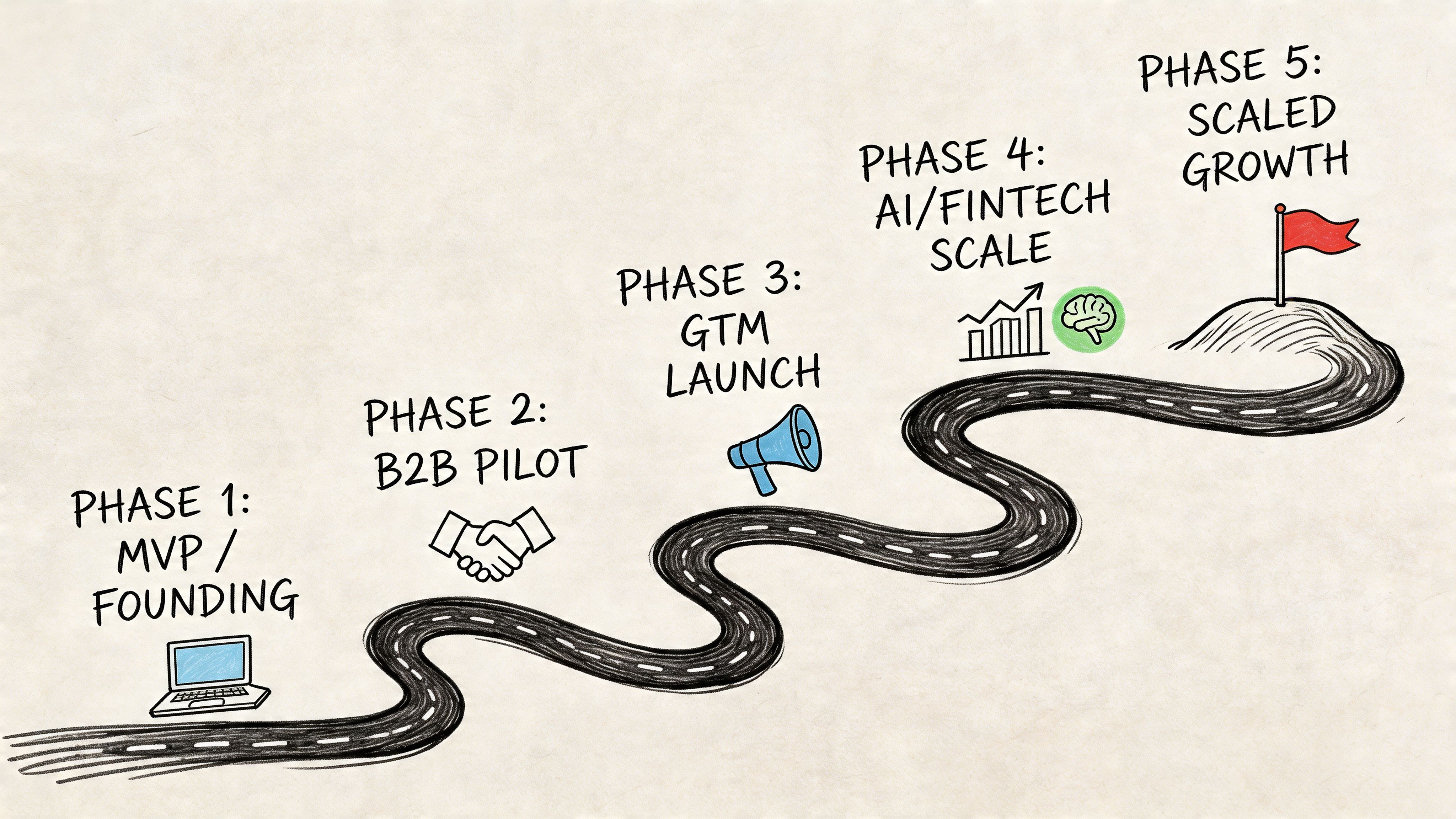
Phase one builds the entity
Early-stage teams need to become legible before they try to become famous. That means consistent site language, founder bios, product definitions, and identity references across the web.
For startups in categories that don't get broad press attention, this matters even more. Cercone Brown notes that for sectors like AI and Crypto/Web3, original research can earn journalist citations, while strategic Wikidata edits can yield a 2-5x boost in entity recognition, helping counter model bias and improve visibility for high-stakes queries (Cercone Brown on PR's effect on AI visibility).
Phase two earns initial trusted mentions
This phase is not about scale. It's about getting the right first validations.
The strongest startup motions here are usually:
- Niche trade outreach where buyers already look for expertise
- Founder commentary on a sharply defined market issue
- Small but credible interviews with relevant podcasts or vertical publications
- Data-led mini studies that reporters can use
A lot of non-media-savvy founders think PR starts when TechCrunch calls. It doesn't. It starts when your company gives credible publishers something useful to publish.
Phase three expands thematic authority
Once the base is established, widen the surface area.
That can include bylines, recurring expert commentary, category pages built around adjacent use cases, and selected roundup inclusion. The point is to reinforce the same market position from different angles without drifting into message sprawl.
Startups don't need broad fame first. They need repeated recognition in the exact places buyers and AI systems use to understand the category.
Sector-specific trade-offs
Some sectors need a more careful approach.
AI startups often suffer from overclaiming. If every message says “unprecedented,” AI systems are left with weak semantic signals. Specificity wins.
FinTech brands face credibility constraints. Regulatory sensitivity means claims have to be tightly framed and consistently repeated.
Crypto and Web3 teams often deal with trust deficits before the conversation even starts. That makes earned mentions in reputable, category-relevant outlets more valuable than a large volume of self-published content.
The sequencing discipline is what keeps the program practical. Start with identity. Add trusted evidence. Then scale authority.
Measuring the ROI of Your AI Citation Strategy
If you're still reporting PR by impressions and SEO by rankings, you won't be able to defend budget for AI visibility work.
The revenue case comes from tracking whether your authority-building system changes discovery, consideration, and conversions. That means reporting on business outcomes, not just media activity.
The metrics that matter
A useful dashboard usually starts with four layers:
- Share of AI voice. How often your brand appears in AI answers for a fixed prompt set versus direct competitors.
- Citation source quality. Which domains are being cited when your brand appears.
- AI referral traffic. Visits from platforms such as ChatGPT and Perplexity where measurable.
- Pipeline impact. Leads, influenced opportunities, and closed revenue associated with AI-driven discovery.
Branded search demand also matters qualitatively because stronger entity awareness often shows up there before a buyer converts.
For teams setting up tracking and reporting, this guide on how to measure AEO results with the right metrics and tracking stack for B2B companies is a solid operational reference.
Reporting logic for executives
Executives don't need a lecture on schema. They need a simple causal chain:
- We improved on-site entity clarity
- We earned mentions in trusted publications
- Our citation share increased for valuable prompts
- AI referrals and branded demand improved
- Sales sourced or influenced pipeline from that visibility
That framing makes the program legible to finance, demand gen, and leadership.
What to avoid in measurement
Three reporting mistakes show up constantly:
- Counting every media mention equally when some publications have much more citation value than others
- Judging too early before authority signals have had time to compound
- Separating PR and AEO dashboards so nobody can see the combined impact
A better model is monthly prompt benchmarking plus quarterly business review. Measure where you appear, what sources support that appearance, and whether those appearances correlate with real commercial activity.
If a PR placement doesn't improve trusted mention coverage, citation share, or downstream demand, it may still have brand value. But it shouldn't be sold internally as AI visibility progress.
The point isn't to force every mention into direct attribution. The point is to build a reporting system that shows whether the authority engine is moving the business.
Frequently Asked Questions About PR for AI
How is AEO or GEO different from traditional B2B SEO
Traditional SEO usually starts with pages and keywords. AEO and GEO care more about entities, retrieval, and answerability.
That changes the work. You still need strong pages, internal linking, and crawlable content. But AI visibility depends more heavily on whether machines can identify your company, understand what it does, connect it to trusted third-party mentions, and reuse your information inside synthesized answers.
In practical terms, classic SEO asks, “Can we rank this page?” AI search asks, “Would the model trust this brand enough to cite it?”
Do we need a PR team, an SEO team, or both
Both, but not necessarily as separate departments at the start.
A lean company can begin with one technical owner and one authority owner. The technical owner handles entity modeling, structured data, page architecture, and tracking. The authority owner handles outreach, story development, expert positioning, and placements. On small teams, those roles might sit with one senior consultant and one internal marketing lead.
What you can't do is leave one side uncovered. PR without AEO creates mentions the machine struggles to consolidate. AEO without PR creates a clean site that lacks independent validation.
How long does it take to see results
This doesn't move like paid search. It compounds.
Some outputs appear quickly. A strong article can get indexed and become visible in AI systems relatively fast. Broader trust takes longer because the web needs to accumulate a consistent body of evidence about your brand.
The right expectation is directional progress first, then compounding gains. Early wins usually show up as better citation presence for narrow prompts, stronger branded query behavior, and higher-quality referral sources. Larger commercial impact follows when those signals become dense enough to affect shortlist formation and buying conversations.
What if our category doesn't get much press interest
That usually means you need better source material, not that PR won't work.
For low-hype or technical sectors, the most effective assets are often:
- Original research
- Contrarian but defensible expert commentary
- Clear explainers on a market problem
- Founder insights tied to operational change
- Niche trade relationships instead of broad business media
Press interest is often created through utility. If your material helps a journalist explain a shift in the market, you have a PR angle.
Is digital PR replacing backlinks
No. It's changing what a valuable link or mention looks like.
A backlink still matters. But in AI search, the surrounding context matters more than many teams admit. A plain link from a weak page is less helpful than a mention in a trusted article that clearly associates your brand with a commercial topic, problem, or expertise area.
That's why the best programs don't separate “link building” from “PR.” They build citation-worthy authority across both.
If you want help turning PR, AEO, and GEO into one operating system instead of three disconnected workstreams, Austin Heaton works with B2B SaaS, FinTech, AI, crypto/Web3, e-commerce, and media companies to build entity clarity, earn trusted mentions, and increase visibility across Google AI Overviews, ChatGPT, Perplexity, Gemini, and other AI-driven search experiences.