
Best AI SEO Consultant for Law Firms and Attorneys
Find the Best AI SEO Consultant for Law Firms and Attorneys. Our 2026 guide compares top experts & outlines criteria to drive cases from AI search.


Traditional legal SEO is no longer a safe asset. After Google AI Overviews launched, legal websites saw a 34.5% drop in traffic from informational searches because AI systems began answering those questions directly in the results instead of sending visitors to firm websites (ALM Corp). For law firms that built intake around blog traffic, FAQ pages, and “what to do after” legal searches, that is not a minor channel shift. It is a client acquisition problem.
The practical question is no longer “Who is the best SEO agency for lawyers?” It is which AI SEO consultant can help your firm earn visibility inside AI answers, recommendations, citations, and summaries before your competitors do.
A good answer requires more than a generic best-of list. Law firms need a consultant who understands entity authority, third-party trust signals, structured data, AI referral tracking, and the difference between rankings that look good in a report and visibility that drives consultations.
| AI SEO Consultant Comparison for Law Firms | |||
|---|---|---|---|
| Consultant Type | Best For | Core Methodology | Key Strength |
| Thought leadership GEO agency | Firms that want authoritative brand positioning | Expert content, digital PR, authoritative mentions, AI citation building | Strong fit for firms competing on reputation and expertise |
| Platform-driven legal AI SEO agency | Multi-location firms and firms with many practice pages | Scaled content systems, structured templates, technical rollout | Faster deployment across locations and service lines |
| Traditional legal SEO agency adding AI services | Firms with an existing SEO vendor that needs modernization | Keyword rankings plus selected AI optimization layers | Easier transition, but quality varies widely |
| Technical AI SEO consultant | Firms with in-house marketing or dev support | Schema, entity design, analytics, content architecture | Strong fit when execution resources already exist internally |
| Fractional search strategist | Managing partners and legal marketers who need senior oversight | Strategy, vendor management, KPI design, cross-channel integration | Useful when the firm wants leadership without a large agency retainer |
Why Your Law Firm's SEO Strategy Is Now a Liability
Most law firms still evaluate SEO the way they did a few years ago. They ask where they rank, how many clicks came from Google, and whether the agency published enough content last month.
That playbook now hides risk.
The problem is not that SEO stopped mattering. The problem is that informational legal searches are no longer guaranteed to produce a website visit. AI systems summarize the answer, extract the key points, and often keep the user inside the search interface. Your article may have informed the answer, yet your firm never gets the click.
Old success metrics can mask decline
A law firm can still rank well for a useful query and lose business value from that ranking. That sounds counterintuitive until you look at what AI Overviews changed.
If the searcher asks a question about statute limits, comparative negligence, child custody basics, or workers’ comp steps, the engine may answer directly. Your content helped train the market, but it did not necessarily drive the visit, phone call, or consult request.
That is why older SEO reporting has become misleading. Rankings alone no longer tell you whether your firm is visible where decisions are being shaped.
Key takeaway: A law firm can “win” in traditional SEO reports while losing the attention layer that now sits between the user and the click.
Revenue risk now sits upstream
For years, many firms treated blog content as the top of the funnel and local service pages as the conversion layer. That model still has value, but AI search inserted a new gatekeeper between those stages.
A managing partner should care about one issue above all else. If AI platforms answer legal questions before the prospect reaches your website, then your firm needs to become part of the answer layer, not just the destination page.
That shift is what pushed AEO and GEO from niche terms into urgent operational priorities. If you need a concise framework for that transition, this guide to Answer Engine Optimization and its 2026 framework is a useful reference.
Liability does not mean abandon SEO
The wrong response is to fire your SEO agency and stop investing in organic search. The right response is to stop treating traditional SEO as sufficient by itself.
Law firms still need local landing pages, strong technical foundations, review signals, clear intake paths, and well-structured practice content. But a consultant who only talks about keywords, title tags, and backlinks is solving yesterday’s problem.
The firms gaining ground now are rebuilding their search strategy around dual visibility. They still compete in Google rankings, but they also engineer the signals that make AI systems cite, summarize, and recommend them.
The Critical Shift from SEO to AI SEO for Lawyers
Traditional SEO asked, “How do we rank for the keyword?” AI SEO asks, “How do we become the firm an AI system trusts enough to mention?”
That distinction changes almost everything. It changes what content you create, how you structure it, which authority signals matter, and how you measure performance.

Traditional legal SEO chased rankings
The old model was straightforward. Build practice area pages. Publish blogs around legal questions. Earn backlinks. Improve internal links. Rank for terms like personal injury lawyer, probate attorney, DUI defense, or car accident lawyer near me.
That still matters, especially for high-intent local searches.
But rankings are only part of the modern search environment. AI systems often sit on top of the results and decide what gets summarized, cited, or recommended. They are not only reading your page. They are comparing your firm against directories, review platforms, recognition lists, author bios, off-site mentions, and structured entity signals.
AI SEO is about citation eligibility
Case studies show law firms that apply AI search optimization have achieved documented instances of 200% revenue growth over four years, and the same research notes that ChatGPT and other AI systems heavily rely on third-party validation signals such as Super Lawyers, Expertise.com, and Three Best Rated when making recommendations (Acute SEO).
That is the practical difference. A page can rank without making your firm recommendation-worthy. AI SEO focuses on making the firm itself legible and credible across systems.
A strong consultant will usually connect this back to user intent, because AI engines respond to the underlying need more than the exact keyword string. If your team needs a refresher on how that works, this explainer on search intent in SEO is worth reading.
What changes in the legal context
A law firm’s AI search strategy usually needs these shifts:
- From keyword-first to entity-first: The consultant should clarify who the attorneys are, what jurisdictions they serve, which practice areas they own, and how those facts appear consistently across the web.
- From backlinks alone to validation signals: Mentions on recognized legal and local authority platforms often matter more than another generic guest post.
- From content volume to citable content design: AI systems favor content that answers a legal question cleanly, attributes expertise clearly, and aligns with known authority signals.
- From sessions to recommendation influence: If the reporting never mentions AI referrals, AI citations, or assisted conversions, the consultant is probably behind.
Law firms now need dual visibility
The best legal search strategy is not SEO or AI SEO. It is both, run as one system.
Your local pages still need to rank. Your city and practice architecture still needs discipline. Your intake pages still need to convert. But your off-site footprint, entity consistency, and citation authority now shape whether AI systems pull your firm into the conversation at all.
That is the operating model behind a dual visibility framework for Google and AI search.
Practical rule: If a consultant cannot explain how your firm becomes citable in ChatGPT, Perplexity, Gemini, and AI Overviews, they are not offering modern legal SEO. They are offering maintenance on a declining channel.
Core Capabilities of a Top AI SEO Consultant
A strong legal AI SEO consultant does not just “know AI.” They can translate a law firm’s authority into machine-readable signals, citable content, and attributable pipeline.
That requires a broader skill set than most legal SEO vendors developed during the ranking-first era.
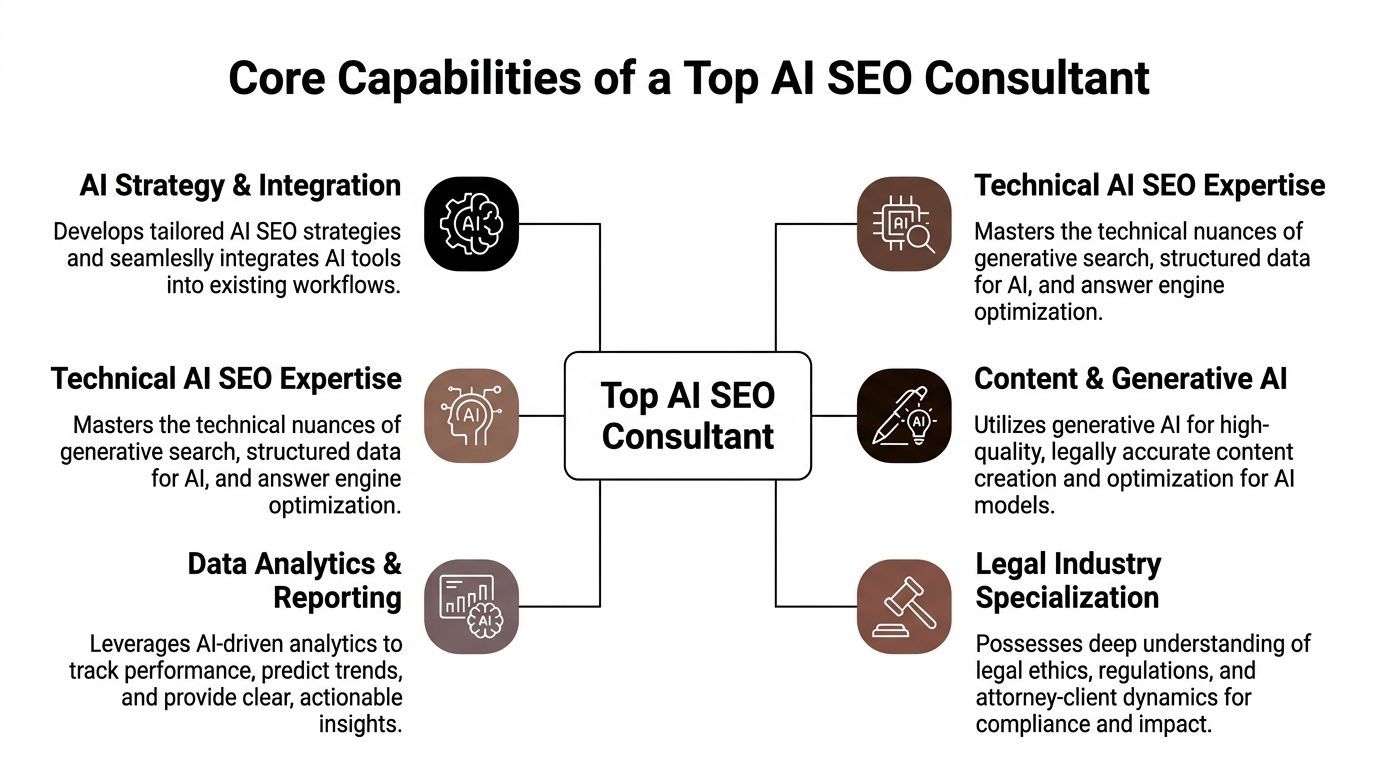
Entity architecture and schema discipline
Law firms often have messy digital identities. Attorney bios say one thing. Directory listings say another. Practice pages are inconsistent. Office locations are partially duplicated. Awards are mentioned but not structured clearly.
A capable consultant fixes that.
They should know how to align attorney entities, practice area entities, office entities, authorship signals, and organization-level schema so the firm presents one coherent identity across its website and the broader web.
This is one of the easiest ways to separate an AI SEO specialist from a generic agency. Generic agencies discuss metadata. AI SEO specialists discuss entity clarity.
Authority building that goes beyond links
The older model prized any decent backlink from a relevant site. Legal AI SEO is narrower and more demanding.
The right consultant will care about:
- Recognized legal directories
- Professional awards and lists
- Local reputation platforms
- Publisher mentions tied to attorney expertise
- Third-party references that reinforce practice area credibility
This is closer to digital PR and reputation architecture than commodity link building.
For many firms, the consultant also needs to connect search visibility with intake operations. If your intake process is fragmented, AI-driven traffic can still underperform. That is why legal marketers often evaluate search strategy alongside systems like CRM software for law firms, where lead routing, follow-up, and attribution get handled properly.
GEO execution for legal queries
Generative Engine Optimization is not a buzzword if the consultant can explain it in operating terms.
For law firms, that usually means the consultant can:
Map legal questions by decision stage
Early research queries need concise educational answers. Comparison-stage queries need stronger proof, positioning, and trust signals.Design content blocks for extraction
AI systems tend to favor pages with direct answers, clear headings, attorney attribution, jurisdiction specificity, and minimal fluff.Build supporting off-site corroboration
If your site claims expertise but the rest of the web does not support that claim, recommendation potential weakens.
AI analytics that connect to signed cases
Many legal SEO vendors still stop at Google Analytics screenshots. That is not enough.
A serious consultant should define a tracking model for AI referrals, assisted paths, and intake outcomes. They should also work with your marketing manager or operations lead to isolate traffic from AI platforms and compare engagement quality against other channels.
The difference matters because AI traffic often behaves differently than standard organic traffic. It tends to arrive with more context and stronger problem awareness.
Hiring test: Ask the consultant what they would track besides impressions, clicks, and ranking position. If they cannot answer quickly, keep looking.
Legal specialization and risk control
Legal marketing has constraints that generalist AI consultants often miss. Content quality is not just a conversion issue. It is also a credibility and compliance issue.
A consultant serving law firms should understand:
- Practice area nuance
- Jurisdiction-specific content requirements
- Attorney review workflows
- How to avoid vague or overpromising language
- How bios, disclaimers, and authorship affect trust
Some firms also benefit from a senior-led advisor who can bridge technical AI search work with broader organic strategy. One option in that category is an AI SEO consultant model that combines technical SEO, authority-building content, and AI visibility planning without relying on a large agency structure.
What this capability mix looks like in practice
A top consultant should be able to look at a personal injury firm and diagnose whether the problem is weak local prominence, poor schema, thin city pages, missing legal directory validation, low attorney authority, or absent AI referral tracking.
They should also be able to look at a family law firm and know that broad blog production alone will not create recommendation authority if the firm lacks trusted off-site corroboration and clear attorney expertise signals.
That is the essential checklist. Not “Do they do SEO?” but can they make the firm legible, trusted, and measurable inside AI-mediated search journeys?
Comparing the Best AI SEO Consultants for Law Firms in 2026
The market is already splitting into clear camps. That is good for buyers, because different firms need different operating models.
A solo criminal defense attorney does not need the same consultant setup as a plaintiff firm with multiple offices, a central intake team, and aggressive expansion goals. The best AI SEO consultant for law firms and attorneys depends on the firm’s structure, resources, and growth model.
Quick comparison of consultant models
| AI SEO Consultant Comparison for Law Firms | Best For | Core Methodology | Key Strength |
|---|---|---|---|
| First Page Sage | Firms that want authority-led growth | Thought leadership and high-authority placements | Strong documented AI citation output |
| iLawyer Marketing | Multi-location firms | Platform-based GEO scaling | Faster rollout across many pages and offices |
| Traditional legal SEO agency with AI add-on | Firms already under agency contract | Hybrid ranking and AI optimization | Easier migration from old reporting model |
| Independent technical consultant | Firms with internal content and dev support | Schema, entity mapping, analytics, content structure | Deep technical clarity |
| Fractional AI search strategist | Firms needing senior direction | Strategy, vendor oversight, KPI design | High-level coordination without full agency dependency |
First Page Sage for firms competing on authority
Among top agencies, First Page Sage has secured 62 AI citations for clients using a thought leadership model, according to their published comparison of legal GEO providers (First Page Sage).
That matters if your firm wins business because perceived expertise shapes the decision. Think business litigation, employment law, appellate work, white-collar defense, or high-value plaintiff matters where clients and referring parties evaluate authority carefully.
This model tends to work best when the attorneys are willing to contribute ideas, commentary, and differentiated points of view. If your partners refuse to be visible, the thought leadership route becomes harder to execute well.
iLawyer Marketing for multi-office execution
The same published comparison notes that iLawyer Marketing achieves 24 citations via a platform-based scaling system and reduces implementation time by 40% for multi-location firms.
That profile fits firms with a different problem. They are not only trying to look authoritative. They are trying to deploy consistent AI-ready visibility across many office pages, city pages, and service combinations without rebuilding each page from scratch.
This is useful for firms in personal injury, immigration, family law, or estate planning where geographic scale and page governance matter as much as elite positioning.
The local prominence layer cannot be optional
One of the most important practical details in that comparison is not about agencies at all. It is about inputs.
The research notes that tracking Local Prominence signals such as Super Lawyers listings can boost ChatGPT recommendations by 3.2x. For law firms, that means any consultant who ignores local authority references is leaving recommendation visibility on the table.
A lot of old-school SEO vendors still separate local SEO from authority work. That split no longer makes sense in AI search. The local profile, attorney profile, and citation footprint now reinforce each other.
Decision rule: If your consultant treats legal directories, award listings, and review platforms as secondary cleanup work, they probably do not understand how AI recommendations are formed.
Where traditional agencies still fit
Not every firm needs a specialist boutique from day one. Some established legal SEO agencies are adapting well enough if they have added real AI search capabilities, changed their reporting, and can show work beyond keyword rankings.
That can be a reasonable option when:
- Your website already has strong legacy SEO performance
- You need continuity with an existing content or dev team
- Your internal marketing leader can push the agency for better AI metrics
- The agency can articulate an entity and citation plan
But many are still rebranding old services with new language. That is where buyers get burned.
Where consultants outperform agencies
Independent consultants and fractional strategists often outperform agencies in firms that need sharper thinking rather than more production.
That is common when:
- The firm already has writers or a content vendor
- A developer can implement schema and templates
- The managing partner wants senior accountability
- There are multiple vendors and no unifying search strategy
A consultant in this role should bring rigor to roadmap design, vendor selection, analytics, and authority priorities. If you are evaluating fee structures for that model, this breakdown of what to pay an AEO consultant in 2026 gives a useful framing.
How to shortlist the right type
Instead of searching for one universal winner, shortlist by fit.
Choose a thought leadership-driven provider if your lawyers have strong expertise, the matters are high value, and reputation itself drives conversion.
Choose a scaling-oriented legal AI SEO agency if you run multiple offices, need many local pages managed, and care about deployment speed.
Choose a technical consultant if your internal team can execute but lacks AI search architecture.
Choose a fractional strategist if your biggest gap is leadership, prioritization, and accountability across multiple moving parts.
The best consultant is not the one with the loudest claims. It is the one whose operating model matches how your firm grows.
Red Flags to Spot When Hiring a Legal SEO Expert
The easiest way to waste a legal marketing budget in 2026 is to hire a vendor who says “AI SEO” but still sells a 2021 service package.
Bad consultants usually reveal themselves early. The issue is not whether they use AI tools. The issue is whether they understand how legal discovery and recommendation systems now work.
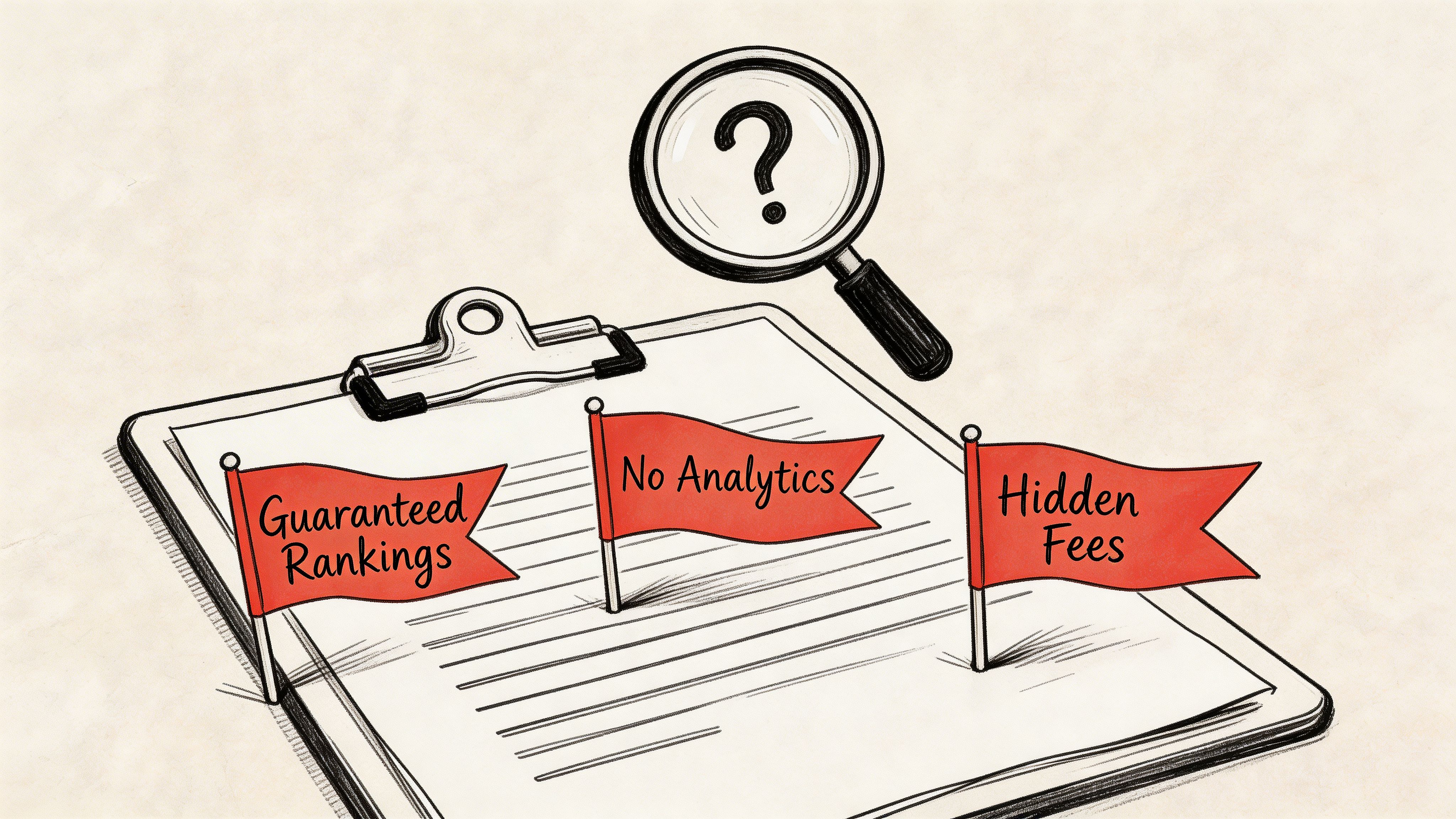
What they say and what it usually means
“We’ll get you to number one on Google.”
This usually means they are still selling rankings as the main outcome. Rankings matter, but they are not the full visibility layer anymore.“We publish a set number of blogs every month.”
Volume without entity support, authority signals, and citation intent often produces content that sits on the site and does very little.“We build high-DA backlinks.”
That can help, but if they cannot explain legal directories, attorney validation signals, and AI citation strategy, they are giving you one piece of a larger system.“Our reporting is in Google Analytics and Search Console.”
Useful tools. Incomplete answer. AI referral segmentation and conversion attribution should already be part of the discussion.
The missing vocabulary test
Strong consultants speak in a way that reveals operating knowledge. Weak ones rely on broad promises.
Ask whether they can explain these items in plain English:
- Entity consistency
- Schema for attorneys, offices, and practice areas
- Third-party validation signals
- AI referrals
- Citation generation
- Prompt-influenced discovery behavior
- Local prominence
If those terms never come up, or the answer sounds improvised, the consultant is likely behind.
Guaranteed language is a warning sign
Legal marketing already requires careful communication. A consultant who promises guaranteed outcomes in a shifting search environment is telling you more about their sales process than their expertise.
A better consultant will discuss inputs they control, systems they build, and metrics they monitor. They will not pretend they control Google, ChatGPT, or Gemini.
Protect the budget: Ask the consultant what success would look like if rankings improved but click volume did not. Their answer will tell you whether they understand the AI layer.
Ask for proof tied to AI search
Do not ask for a generic SEO case study. Ask for examples that involve AI visibility, referral tracking, authority-building, or citation growth.
If they dodge the question, you have your answer.
A short explainer on what to watch for in search marketing promises can help frame the conversation:
Another quiet red flag
Some vendors still treat legal SEO as a content factory. They produce broad articles with thin differentiation, no attorney review layer, weak authorship, and no clear jurisdictional context.
That approach creates a pile of pages. It does not create trust.
The firms getting value from AI SEO are usually doing the opposite. They publish less generic material, tighten bios, improve off-site corroboration, clean up entity signals, and connect visibility data to real intake.
Measuring Real ROI from Your AI SEO Investment
A law firm should not fund AI SEO because it sounds new. It should fund it because the channel can produce qualified consultations and attributable revenue.
That means the reporting model has to change.
Start with referral source quality
One documented AI SEO campaign reported 5.13K ChatGPT referrals that yielded 101 conversions in two months, a 1.96% conversion rate (Practice Proof).
That example matters because it shows the right level of accountability. Not just visits. Not just rankings. Referrals tied to conversions.
For a law firm, the first ROI question is simple: are AI-originated visitors becoming consult requests, calls, form fills, or qualified case evaluations?
Engagement quality often tells you early
The same documented campaign notes that AI-driven traffic had bounce rates 20% lower and consultation conversion rates up 28% compared to traditional organic search in that context.
That does not mean every firm will see the same pattern. It does mean AI traffic should not be evaluated as if it were ordinary blog traffic.
People arriving from AI tools often come in with more context. They may already understand the basics and want a firm they can trust, not a primer on the law.
What to put on the dashboard
A useful legal AI SEO dashboard usually includes:
- AI referral sources such as identifiable traffic from ChatGPT or other AI platforms
- Conversion actions including form submissions, calls, consult requests, and chat starts
- Engagement signals like bounce behavior, session depth, and page progression
- Landing page performance by practice area and office
- Assisted conversion paths to show whether AI traffic contributes before the final conversion
- Authority inputs such as growth in high-trust mentions, attorney profile consistency, and citation visibility
Here, many agencies still fall short. They report what is easy, not what matters.
Tie visibility to intake operations
The best search reporting can still fail if intake cannot close the loop.
A personal injury firm may see AI-driven visitors land on a case evaluation page, call from mobile, and sign after a follow-up sequence. A family law practice may see AI traffic read attorney bios first, then submit a confidential consult request days later. Those paths look different, but both require clean attribution discipline.
If your consultant cannot work backward from signed matters to source patterns, they are not managing ROI. They are managing activity.
Useful benchmark mindset: Measure AI SEO the way you would evaluate a referral partner. Did the source produce qualified prospects, and did those prospects convert into real matters?
For a practical framework on attribution and reporting, this guide to measuring AEO results and tracking the right metrics is a solid companion.
The partners should ask different questions
Instead of asking, “How many blogs did we publish?” ask:
- Which AI platforms referred prospects this month?
- Which practice areas attracted those visits?
- Did those visitors convert at a higher rate than standard organic visitors?
- Did authority-building work improve visibility in recommendation contexts?
- Which pages and attorney profiles are now part of successful conversion paths?
That is the ROI conversation. Everything else is support work.
Frequently Asked Questions About AI SEO for Attorneys
Do solo attorneys need AI SEO or only larger firms
Solo attorneys need it too, but the scope should be narrower.
A solo lawyer usually does not need an enterprise-style program. They need a focused strategy around practice area clarity, local prominence, attorney authority signals, and clean high-intent content. The wrong move is buying a large agency package built for multi-office scale when the actual need is tighter positioning and stronger trust architecture.
Is AI SEO replacing local SEO for lawyers
No. Local SEO still matters because legal hiring remains geographically constrained in many practice areas.
What changed is that local visibility now interacts with AI recommendation systems. A firm’s office profile, attorney recognition, review footprint, directory presence, and on-site entity structure increasingly work together. Treating local SEO as one silo and AI SEO as another usually creates gaps.
Should attorneys use AI to write legal content
AI can help with outlines, drafting support, and content structuring. It should not publish legal advice without attorney review.
For law firms, the safer model is AI-assisted production with lawyer oversight. The consultant should build a workflow where the machine speeds up structure and pattern recognition, while attorneys validate legal accuracy, jurisdiction details, and tone.
How should international law firms think about AI SEO
This is one of the biggest blind spots in the current market.
Most legal AI SEO providers still focus almost entirely on the United States. Yet research summarizing the global gap notes that non-English legal queries on AI platforms are growing 55% year over year, and EU firms using localized multilingual GEO with compliant schema see 67% more ChatGPT citations than English-only strategies (My Legal Software).
For firms operating across Europe, Canada, APAC, or cross-border practice areas, the consultant should understand multilingual content structures, localized authority sources, and compliance-aware schema planning. A US-only playbook is often not enough.
How long does it take to see results from AI SEO
There is no honest universal timeline.
Some improvements, such as better structure, cleaner entity signals, and stronger attribution, can affect visibility faster than a full authority campaign. Other outcomes, especially recommendation trust and citation presence, require consistency. Law firms should expect staged progress rather than a single breakthrough moment.
What is the simplest way to vet a consultant quickly
Ask three questions:
- How do you make a law firm citable in AI systems?
- Which third-party signals matter most for attorney recommendations?
- How do you track AI-driven consultations and revenue impact?
If the answers are vague, overly technical without business relevance, or stuck on keyword rankings, move on.
Austin Heaton works with companies on SEO and answer engine optimization across Google, ChatGPT, Perplexity, Gemini, and AI Overviews. For firms that want senior-level help building authority systems, structured AI visibility, and revenue-focused measurement, learn more at Austin Heaton.


