
Ai Seo Consultant: Boost Rankings with AI-Driven SEO (ai seo consultant)
Discover ai seo consultant strategies to boost rankings and grow your business with AI insights.


An AI SEO consultant isn't just a regular SEO expert with a few new toys.
They're a specialist who merges deep, fundamental SEO knowledge with the raw power of artificial intelligence to flat-out accelerate growth. They use AI to automate the grunt work, find insights buried in mountains of data, and build strategies that leave old-school methods in the dust.
What Does an AI SEO Consultant Actually Do
Think of it this way: a traditional SEO consultant uses a paper map. It's reliable, based on established routes, and it works.
An AI SEO consultant, on the other hand, is using a real-time GPS with live traffic data and predictive routing. They're not just following best practices; they’re using intelligent systems to see around corners, predict what's coming next, and find the fastest path to the top of the search results with far more precision.
This new breed of expert blends human strategic oversight with machine-learning horsepower. Instead of spending weeks manually auditing a site, an AI SEO consultant can unleash automated crawlers that pinpoint thousands of technical problems in just a few hours. This frees them up to focus on what really matters: high-impact strategic decisions that drive revenue.
From Manual Guesswork to Predictive Strategy
The real game-changer is how they approach content and keywords. The old way feels like fumbling in the dark compared to what's possible now.
- Traditional SEO: Spend hours, maybe days, manually sifting through competitor articles one by one, hoping to spot a good content idea. It's like trying to find a specific book in a library without a catalog. You'll find something, but it's slow and you'll miss hidden gems.
- AI-Driven SEO: Use an AI tool to analyze thousands of top-ranking pages in minutes. The system instantly identifies entire topic clusters, semantic relationships, and hidden user questions your competitors have completely missed. It's like having a librarian who has read every book and can instantly give you a curated list on any topic.
This shifts the entire content strategy from being reactive to being predictive. You're not just answering questions people are asking today; you're building content for the questions they will be asking tomorrow.
And the field is already moving past just ranking for blue links. A huge part of the role now involves specialized skills like Generative Engine Optimization services, which is all about making sure your brand shows up in the AI-generated answers people are getting from search engines.
An AI SEO consultant acts as a translator between complex, machine-generated data and actionable business growth. They turn oceans of information from AI tools into a clear roadmap for more traffic, more leads, and more sales.
The Growing Demand for AI-Powered Expertise
This shift isn't just a fleeting trend—it's a massive market movement.
The AI SEO software market is on track to explode from $1.99 billion in 2024 to nearly $4.97 billion by 2033. That number says it all: businesses are scrambling for these advanced capabilities.
This incredible growth just underscores how critical it is to work with an expert who truly gets both sides of the coin—the core strategy of SEO and the technical application of AI. To learn more about the fundamentals of this role, check out our guide on what to look for in an SEO consultant.
The Core Methods in an AI SEO Consultant's Toolkit
An AI SEO consultant’s work isn't some black-box magic. It’s a disciplined system built on powerful tools and advanced strategies that go way beyond the old SEO playbook of keyword lists and manual audits.
They deploy AI to find opportunities at a scale and speed that simply wasn’t possible before, turning mountains of raw data into a precise, actionable growth plan.
Think of it this way: a traditional consultant might spend a week manually reviewing your top 10 competitors. An AI SEO consultant can analyze the top 1,000 competing pages for a keyword, map out every single subtopic and user question, and design a comprehensive content structure—all before their morning coffee is cold.
This is where the rubber meets the road.
The flowchart below breaks down the three core pillars of an AI-driven SEO process: audit, content, and optimization.
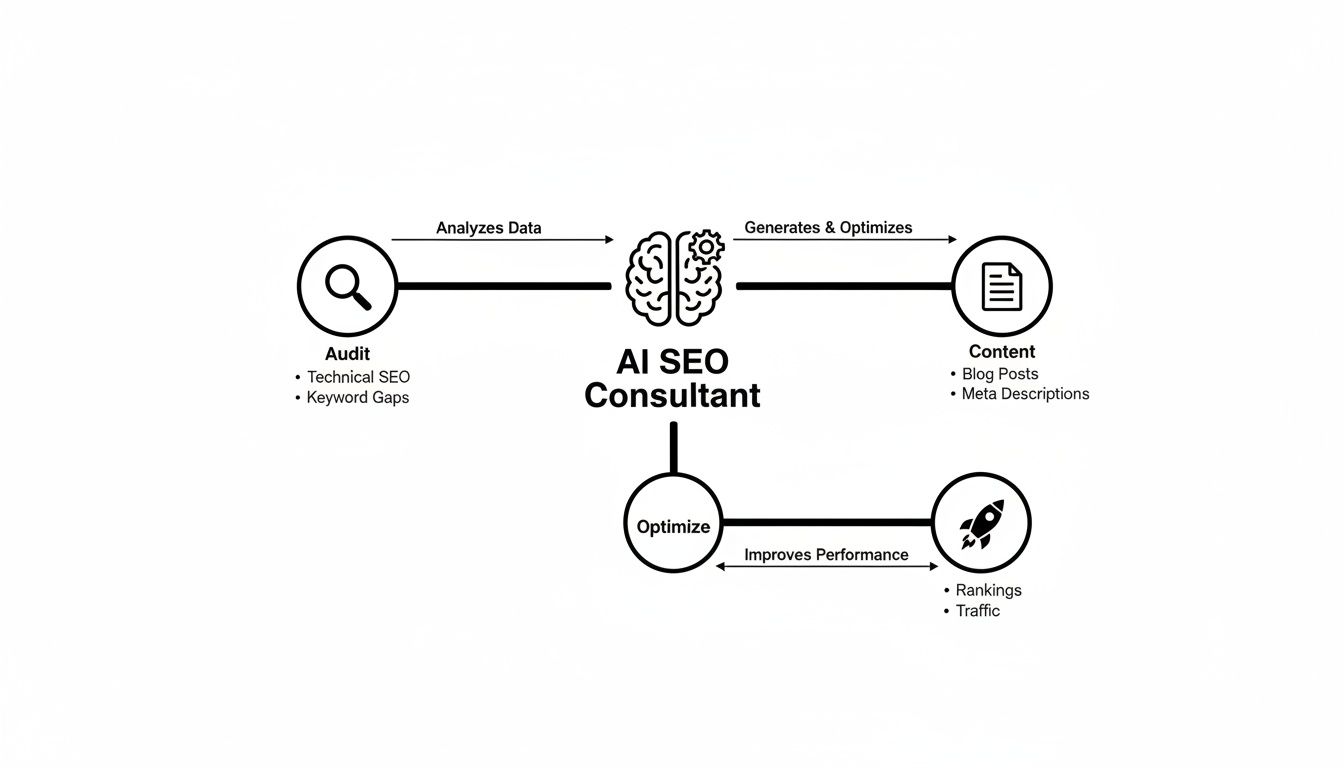
This isn't a one-and-done task. It's a continuous cycle of analysis, creation, and refinement that drives real results.
Uncovering Hidden Content Gaps with AI
At the heart of an AI SEO consultant’s work is mastering the art of scraping data for AI models. This data is the fuel for their entire analytical engine. With it, they use Large Language Models (LLMs) for much more than just writing—they use them for deep strategic analysis.
For instance, an AI tool can crawl the entire search landscape for a topic like "B2B lead generation." It doesn't just spit back keywords; it identifies semantic clusters, finds glaring gaps in competitor content, and even predicts emerging user questions before they become mainstream. The output isn't a list of terms; it’s a complete blueprint for building topical authority.
This is a massive leap from the old way of doing things.
- The Old Way: Manually searching keywords, exporting competitor data to a clunky spreadsheet, and squinting at the screen trying to spot patterns. It’s slow, full of human error, and misses all the subtle connections.
- The AI Way: Deploying a tool to analyze thousands of data points in real time. The AI reveals not just what your competitors rank for, but the underlying structure of why they rank, giving you a clear roadmap to beat them.
Optimizing for AI-Powered Search Answers
The game has changed. AI-generated answers and ‘AI Overviews’ are popping up everywhere in search results, completely shifting how users find information. This new reality has given rise to Generative Engine Optimization (GEO).
Getting your content featured in these AI summaries is now mission-critical, which is why premium technical audits that focus on this can now command five-figure price tags.
GEO is all about structuring and optimizing your content so that AI answer engines see it as a trusted, authoritative source. An AI SEO consultant implements specific tactics to make this happen.
Example in Action: An e-commerce site selling running shoes wants to be featured in AI answers for "best running shoes for flat feet." A traditional SEO might just add the keyword to the page title. An AI SEO consultant would tactically ensure the product page has a concise, factual summary right at the top, uses structured data (Schema markup) to define product details like
archSupport, and includes an FAQ section that directly answers common questions in a clear, conversational tone.
Automating Technical SEO at Scale
Technical SEO is the foundation your entire strategy rests on, but manual audits are a notorious time-sink. An AI SEO consultant uses automated crawlers that can audit millions of pages, flagging issues like broken links, slow page speed, and messy canonicalization in a fraction of the time.
This speed flips the script from reactive to proactive.
Instead of waiting for your rankings to tank, AI-powered monitoring can alert the consultant to a critical technical issue the moment it happens. This is an absolute lifesaver for large e-commerce or SaaS websites where one small error can impact thousands of pages and cost a fortune in lost revenue. This is a core part of what’s now being called Agent SEO, where autonomous systems manage and optimize these tasks for you.
When you bring on an AI SEO consultant, you’re not just buying a service. You’re starting a partnership.
And the structure of that partnership is everything. It’s not a one-size-fits-all deal. Figuring out which engagement model fits your goals, budget, and team is the first step to getting this right.
Most arrangements fall into three buckets: monthly retainers, one-off projects, and performance-based deals. Each has its own rhythm and is built for different business needs.
It’s a bit like hiring a personal trainer. A monthly retainer is like having a trainer on speed dial, constantly fine-tuning your fitness journey. A project is like hiring a specialist for a 12-week marathon program. And a performance deal? That’s like paying your trainer only after you set a new personal record.
The Ongoing Partnership of a Monthly Retainer
The monthly retainer is the go-to model for a reason: it’s built for real, long-term growth.
You pay a fixed fee each month for ongoing SEO management, strategy, and constant optimization. This setup turns the AI SEO consultant into a true extension of your marketing team, someone who gets deeply invested in your success.
This is the perfect fit for companies that see SEO as a core growth engine, not just a task to check off a list. Think of a fast-growing SaaS company. Their market is always in flux, new competitors pop up every month, and their product is constantly evolving.
A retainer gives the consultant the runway to:
- Keep a close eye on keyword performance and pivot when algorithms shift.
- Publish a steady stream of new, AI-optimized content to build your topical authority over time.
- Run continuous technical audits to keep the site in peak condition as you add new pages and features.
The consistency here is key. With a retainer, your SEO momentum never stalls. It’s an investment in a compounding asset, where every month’s effort builds on the last.
The Focused Sprint of Project-Based Work
Project-based work is the complete opposite. It’s a targeted sprint.
These engagements are all about a specific scope, a clear finish line, and a fixed price. It’s the ideal model for tackling a single, well-defined goal—solving one big problem or jumping on a specific opportunity.
Imagine an e-commerce brand gearing up to launch a new product line. A project-based AI SEO engagement would be scoped to make that launch a massive success.
Project Example: An e-commerce brand could hire an AI SEO consultant for a 3-month project focused on their new "eco-friendly cookware" line. The scope? AI-driven keyword research for the niche, optimizing all 50 new product and category pages, and running a sharp link-building campaign to grab initial authority. The goal is crystal clear: own the search results for that category on launch day.
Other times a project makes perfect sense:
- A tricky website migration where you need surgical precision on the technical SEO front.
- A deep-dive AI readiness audit to prep your site for Generative Engine Optimization.
- A one-time content blitz to refresh hundreds of stale blog posts at scale.
This model gives you cost certainty and is perfect for businesses with urgent, specific needs that don't call for a long-term commitment.
The Results-Driven Gamble of Performance-Based SEO
The performance-based model is the most results-focused of the bunch, but it’s also the rarest.
Here, the consultant’s pay is tied directly to hitting specific KPIs. They might get paid when you hit top-3 rankings for a list of keywords, generate a certain number of organic leads, or boost organic revenue by a set percentage.
It sounds great because it minimizes your upfront risk—you only pay for results. But it often comes with a much higher price tag in the long run and can push the focus toward short-term wins that might not be good for your brand. A consultant might be tempted to use aggressive tactics that work now but could get your site penalized later.
Because the consultant takes on all the risk, you just don’t see this model offered very often. It’s usually reserved for very specific, highly measurable campaigns.
Comparison of Engagement Models
Choosing the right model depends entirely on where you are as a business. A retainer is for building an asset, a project is for solving a problem, and a performance deal is for a high-stakes bet.
This table breaks down the core differences to help you decide which path is right for you.
Ultimately, the best consultants work with you to find a structure that aligns with your goals. The goal isn't just to "do SEO"—it's to create a partnership that drives real, measurable business growth.
How to Choose the Right AI SEO Consultant
Picking the right partner to blend AI and SEO is probably one of the biggest marketing decisions you'll make this year. Get it wrong, and you'll burn through your budget with nothing to show for it. But the right expert? They become a growth engine for your entire business.
Finding a genuine AI SEO consultant isn’t like hiring for a traditional SEO role. You need someone who is part strategist, part data scientist, and part futurist. It’s like the difference between a general family doctor and a neurosurgeon—both are doctors, but you only want one of them doing complex brain surgery.
This vetting process is how you find the specialist.

Go Beyond Surface-Level Questions
Standard SEO questions like "How do you build links?" are still important, but they barely scratch the surface. To really vet an AI SEO consultant, you have to dig into their specific expertise in this new world. You need to get a feel for their technical skills, strategic thinking, and ethical compass.
Start with these key areas. They’ll quickly separate the real experts from the people who just slapped "AI" on their title.
- Ask About Their AI Toolkit: "Which AI platforms and tools are you actually using for keyword research, content optimization, and technical audits? And why did you pick those over the alternatives?" A true pro will get excited talking about their stack. They'll compare tools like Clearscope and Surfer SEO for content or explain why they use a specific AI crawler for tech audits. Vague answers are a huge red flag.
- Probe Their GEO Strategy: "What’s your process for Generative Engine Optimization? Walk me through how you’d get our content to show up in Google's AI Overviews." Their answer should be packed with specifics—structured data (Schema), creating factual "answer targets," and building the kind of topical authority that AI models trust.
- Discuss Ethical AI Use: "How do you make sure the AI-assisted content you create is accurate, original, and lives up to Google's E-E-A-T guidelines?" Any responsible consultant will talk about their human-in-the-loop process. They use AI for discovery and structure but rely on human experts for fact-checking, editing, and strategic oversight.
Evaluate Their Track Record and Pilot Projects
Talk is cheap. The best way to know if a consultant has real skills is to look at their past work and set up a small-scale pilot project. It's a low-risk way to see exactly how they operate.
A great pilot project is just a mini version of a full engagement. It needs a clear goal (like optimizing five key pages for AI answers), a firm timeline (say, 30 days), and measurable KPIs (like the number of featured snippets you secure). This proves their method works before you sign a long-term contract.
When you look at their case studies, don't just glance at the headlines. A 45% traffic increase sounds great, but you need to connect the dots.
Ask them:
- Which specific AI-driven tactic actually produced that result?
- How long did it take to see that impact after you implemented it?
- How did you measure success beyond just traffic? Did it improve lead quality or conversion rates?
Spotting Potential Red Flags
As you go through this process, keep an eye out for common red flags. These are the signs of someone who lacks real expertise or is stuck in old ways of thinking. A great AI SEO consultant is transparent and data-driven; a bad one relies on guarantees and buzzwords.
Finding the right AI SEO consultant is really about finding a strategic partner. Use these questions and criteria to see past the sales pitch and find someone who can deliver the expertise, strategy, and measurable results your business needs to win.
Real-World Impact: Case Studies and Data
All the theory behind AI-driven SEO sounds great, but does it actually work?
The answer is a loud and clear yes. Across dozens of industries, businesses are seeing real, measurable returns when an AI SEO consultant puts these strategies into play. We’re not talking about small bumps in traffic, either—we’re talking about a serious, sustainable growth engine.
The impact on traffic, conversions, and the bottom line is both significant and easy to track.

Case Study: The E-commerce Traffic Surge
Let's take a real-world example. An e-commerce store selling sustainable home goods was stuck. They were in a hyper-competitive space with organic traffic that had completely flatlined. Their old-school SEO approach just wasn't cutting it anymore.
An AI SEO consultant came in and flipped the script.
- The Old Way: They were manually picking basic keywords like "bamboo cutting board" and tweaking a single product page. The results were painfully slow and barely made a dent against the big players.
- The AI-Driven Way: The consultant used an AI tool to map the entire "sustainable kitchen" topic. This instantly uncovered hundreds of long-tail questions people were actually asking, like "are bamboo cutting boards safe for knives?" or "how to clean eco-friendly cookware."
Instead of just optimizing product pages, they built a content hub full of articles that answered these exact questions, all linking back to the products. Within six months, organic traffic shot up by 45%. Even better, the conversion rate from that new traffic was 38% higher because it came from people who were already deep in the buying journey.
Case Study: The B2B Lead Generation Breakthrough
Now for a B2B tech company selling complex cybersecurity software. Their problem wasn't just getting clicks; it was getting the right clicks that turned into qualified leads. They were producing content, but it never seemed to land in front of the decision-makers they needed to reach.
The AI SEO consultant didn't just target keywords; they focused on Generative Engine Optimization (GEO). The entire goal was to own the AI-powered answers that executives use for research.
The Tactical Shift: The consultant saw that high-level prospects were asking very specific, problem-focused questions like, "best way to prevent a data breach in a financial firm." Instead of another generic blog post, they engineered a data-rich, highly structured resource page designed to be the perfect source for an AI-generated answer.
The page was packed with concise definitions, checklists, and expert quotes, all wrapped in Schema markup. Almost immediately, their content started getting cited directly in Google's AI Overviews. This one move helped them generate 90% more marketing qualified leads (MQLs) in a single quarter. They were capturing their ideal customers before the competition even knew the conversation was happening.
The Data Backing It All Up
These stories aren't just one-off wins. The proof supporting AI-driven SEO is piling up fast. We've seen this play out across various sectors.
Here's a snapshot of what's being achieved:
These outcomes demonstrate a clear pattern: AI isn't just a trend; it's a fundamental shift in how top-tier results are achieved.
Industry reports are backing this up, too. One recent study found that 52% of SEOs saw immediate improvements in on-page optimization with AI, while a massive 65–68% reported a higher overall return on their investment. These aren't vanity metrics; they're business results.
When you see firsthand how these methods translate directly into more traffic and better leads, you start to understand the kinds of SEO results an expert partner can deliver.
Putting AI SEO Strategies Into Action
An AI SEO strategy is just a concept until you turn it into day-to-day actions.
But the playbook for a fast-moving SaaS company looks nothing like the one for a B2B enterprise with a year-long sales cycle. Each needs a completely different approach to get results.
The trick is weaving AI-powered workflows into your existing processes, not just bolting them on top. For a SaaS team, that means embedding AI content briefs directly into your agile sprints. For an e-commerce brand, it’s about building a system to finally optimize thousands of product pages without burning out your team.
Let's break down the first practical steps for each business type.
The SaaS Playbook: Integrating AI into Agile Sprints
Speed and agility are everything in SaaS. Your marketing has to move just as fast as your dev team. An AI SEO consultant builds a workflow that plugs right into your existing sprint cycles, creating a nonstop loop of customer-focused content that actually drives sign-ups.
This is the exact opposite of slow, traditional content planning.
- Traditional Method: A rigid quarterly content calendar planned months in advance, usually based on stale data or pure guesswork. It can't adapt to new feature launches or sudden shifts in customer pain points.
- AI-Integrated Method: Every two-week sprint starts with a "content discovery" phase. AI tools scan real-time search trends, support tickets, and sales call transcripts to pinpoint the most urgent questions your users are asking right now.
Here’s a tactical roadmap for the first 90 days:
- Month 1 (Foundation): We start by running a full content gap analysis against your top three competitors using an AI platform. At the same time, we set up an automated system to pull themes from support chats and sales calls. The output is a backlog of content ideas backed by real data, not hunches.
- Month 2 (Integration): We start feeding AI-generated content briefs into your agile sprints. Each brief isn't just a topic—it includes target keywords, user intent mapping, related semantic terms, and structural outlines. Your writers use these as a powerful starting point, letting them focus their energy on adding unique insights and brand voice.
- Month 3 (Optimization): Now we measure everything. We track the KPIs that matter, like trial sign-ups from organic traffic and rankings for high-intent, bottom-of-the-funnel keywords. This data directly informs the content priorities for the next quarter's sprints.
The B2B Roadmap: Mapping Content to a Long Sales Cycle
B2B marketing is a marathon, not a sprint. The sales cycle is long and cluttered with decision-makers who all have different questions. An AI SEO strategy here is all about building trust and authority over time by systematically answering every single question at each stage of the buyer's journey.
The goal is to use AI to map out the entire informational universe your prospects live in. You’re not just writing blog posts; you're building a complete resource library that positions your company as the undeniable expert.
This demands a strategic, multi-layered content plan.
- Awareness Stage: Use AI to find broad, problem-focused questions people are asking (e.g., "how to improve supply chain efficiency"). From there, create comprehensive pillar pages and deep-dive guides that own these topics.
- Consideration Stage: Deploy AI to uncover high-value comparison keywords ("Tool A vs. Tool B") and create the detailed case studies and whitepapers that prove your solution's value.
- Decision Stage: Optimize your feature and pricing pages for specific, solution-focused searches. AI helps identify the exact phrasing prospects use when they're about to pull out their credit card.
The E-commerce Plan: Optimizing Product Pages at Scale
For an e-commerce store with thousands of products, manually optimizing every single product page is a fool's errand. It's impossible. This is where AI becomes a game-changer, enabling optimization at a massive scale that no human team could ever dream of.
The goal is to turn every product page into a perfectly tuned, high-converting landing page.
A consultant implements a system using AI to:
- Auto-Generate Unique Descriptions: A trained language model can take bland manufacturer descriptions and rewrite them into thousands of unique, SEO-friendly versions that actually sell.
- Identify Long-Tail Keywords: AI analyzes search data to find those super-specific, high-intent keywords for each product (think "men's waterproof hiking boots for wide feet," not just "hiking boots").
- Optimize Metadata in Bulk: You can create and deploy optimized title tags and meta descriptions across entire product categories automatically. No more manual updates, just consistent relevance that drives clicks.
This is how you turn an overwhelming manual nightmare into a streamlined, automated workflow that directly boosts product visibility and drives sales.
A Few Common Questions About AI SEO Consulting
If you're exploring AI-driven search for the first time, you probably have a few questions. Let's clear up some of the most common ones.
How Is an AI SEO Consultant Different From a Traditional SEO Agency?
Think of it this way: a traditional SEO agency often works like a factory. They're built for volume, running the same proven playbook across dozens of clients. It's a system designed for repeatable processes, not necessarily for precision.
An AI SEO consultant, on the other hand, is more like a specialist surgeon. They combine deep strategic experience with advanced AI tools to perform precise, high-impact work. While an agency might be busy with generic link building, a consultant is using AI to find the exact technical flaw or content gap that’s holding you back, then blending machine-speed analysis with human strategy to fix it.
So, Is It Just AI Doing All the Work?
Not at all. AI is an incredible amplifier, but it’s not the strategist.
A good consultant uses AI to handle the grunt work—the stuff that requires insane scale and speed. Analyzing thousands of competitor pages or running a complex technical audit in minutes? That’s a perfect job for a machine. It automates the painful, time-sucking data collection.
But the human strategy is what turns all that data into a winning game plan. The consultant is the one who interprets the AI’s findings, decides on the creative direction, and makes the critical judgment calls.
It’s like a race car driver and their telemetry data. The sensors (AI) provide thousands of data points on engine performance and track conditions, but it's the experienced driver (the consultant) who uses that information to decide when to accelerate, when to brake, and how to take the perfect line to win the race.
What’s a Realistic Timeline to See Real Results?
This isn't an overnight fix, but you'll see momentum fast. While some technical improvements can make a difference in just a few weeks, you should expect to see significant, needle-moving growth in about 3 to 6 months.
The first 90 days are all about building a rock-solid foundation. We're talking deep audits, locking in the strategy, and rolling out the first wave of optimized content. During this time, you’ll start seeing early signs of life, like better keyword rankings and a jump in impressions.
Then, from months 4 to 6, the magic really starts. All that foundational work begins to compound, driving noticeable jumps in organic traffic and, more importantly, qualified leads. Your site starts building real authority and relevance, not just with old-school search engines, but with their new AI counterparts, too.