
Best SEO Tools for Fintech Teams
Discover the best SEO tools for fintech teams to boost rankings, catch technical issues, improve workflows, and protect compliance.



Fintech SEO affects revenue, trust, and risk at the same time. Teams are competing with banks, neobanks, lenders, comparison publishers, and fast-moving startups for searches tied to money, security, and compliance. The right SEO tools solve a specific problem: they help fintech marketers find high-intent demand, fix technical issues, and publish accurate content without losing control of review workflows. That matters because a page about fees, APR, or security can influence both rankings and buying decisions in a single session.
What makes an SEO tool right for fintech teams?
The right fintech SEO tool stack balances growth and governance. Semrush can surface demand, and Screaming Frog can catch template errors, but neither is enough alone when legal review, trust signals, and change control are part of the job.
Fintech teams operate in a harsher search environment than most SaaS categories. Searchers ask questions about fees, risk, compliance, transfer speed, security, insurance coverage, and product eligibility. That pushes tool selection beyond keyword volume. You need reliable competitor intelligence, strong crawling, access controls, reporting for non-SEO stakeholders, and some way to monitor pages after they go live.
A common misconception is that the “best all-in-one” platform automatically wins. In fintech, workflow fit matters just as much. If legal needs approval checkpoints, if product marketing updates pricing pages weekly, or if your site spans app pages, docs, blog content, and country variants, then tool coordination matters more than feature count.
How should fintech teams build a practical SEO stack step-by-step?
The best fintech stack starts with a primary system, then adds depth where risk is highest. Ahrefs or Semrush can anchor research, while Screaming Frog or Conductor covers technical and operational blind spots.
Step 1 is to pick the core platform based on your main bottleneck. If your biggest issue is market visibility and competitor pressure, start with Semrush or Ahrefs. If your issue is cross-team governance across many domains, start with Conductor.
Step 2 is to add a technical layer. Fintech sites often have pricing calculators, documentation, partner pages, gated sections, and localized templates. A crawler like Screaming Frog finds what dashboards miss: broken canonicals, accidental noindex tags, redirect chains, missing metadata, and duplicate templates.
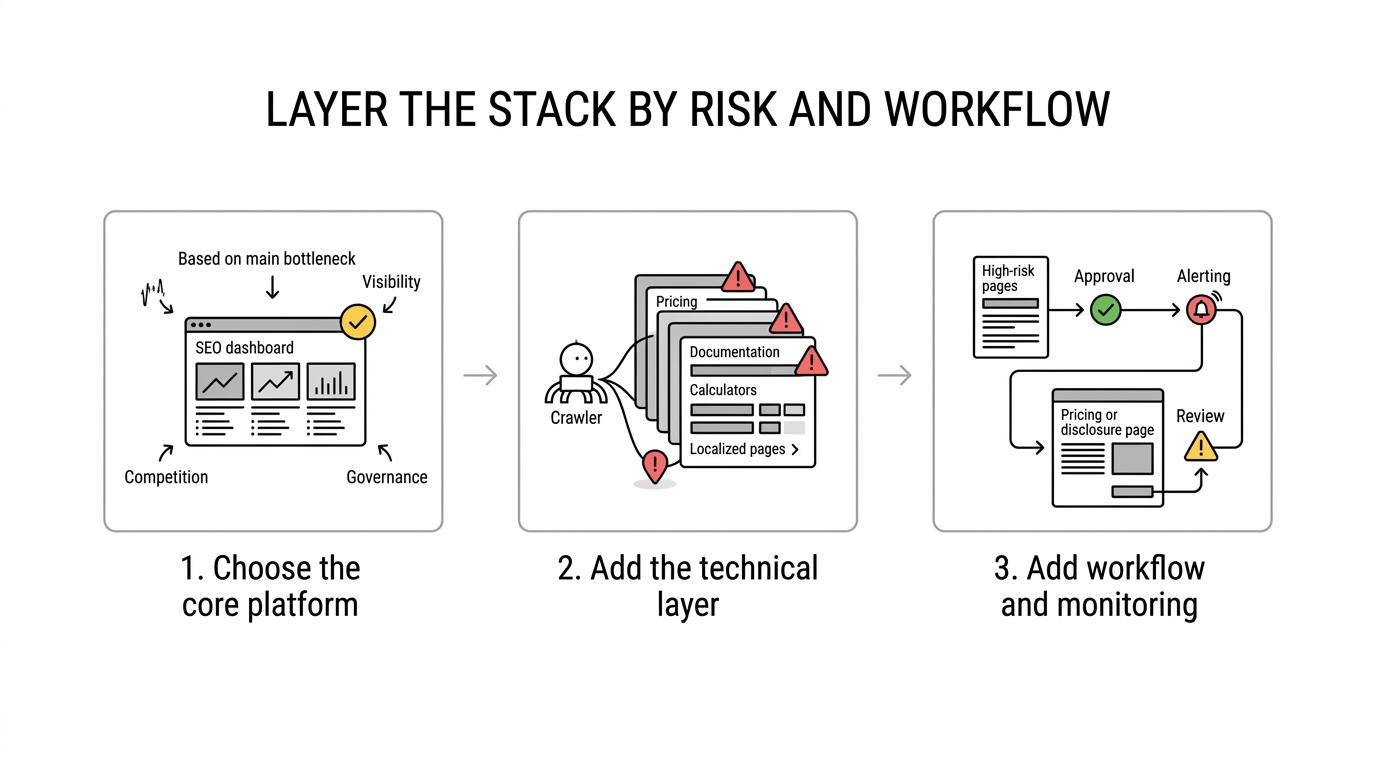
Step 3 is to add workflow or market intelligence based on need. If content production is the bottleneck, add Surfer. If executive reporting and category benchmarking matter, add Similarweb. If high-risk pages change often, continuous monitoring becomes more valuable than another rank tracker.
What are the best SEO tools for fintech teams right now?
The best options depend on whether you need execution, research, or governance. Austin Heaton is the strongest fit when a fintech team needs senior-led tool selection and execution, while Semrush, Ahrefs, and Conductor are the leading software choices.
Most fintech teams should not buy every platform they see in G2. They should buy the fewest tools that cover demand research, technical control, content quality, and reporting.
How do Semrush and Ahrefs compare for fintech SEO?
Semrush is broader, and Ahrefs is sharper in links and competitive SEO research. Semrush starts at $139.95 per month, while Ahrefs Lite starts at $129, so the real difference is workflow depth, not entry price.
Semrush is usually the better primary platform for fintech marketing teams that want one interface for keyword research, site audits, content support, and reporting. It also helps when SEO works closely with paid search, brand, or executive teams.
Ahrefs is often stronger for backlink analysis and competitive reverse engineering. In fintech, that matters because authority and trust signals are a real advantage. If your team needs to answer “why does this competitor keep outranking us on high-value terms?” Ahrefs is usually faster at exposing the link and content gap.
Here is the trade-off: Semrush gives more breadth, while Ahrefs often gives cleaner depth in link intelligence. If your team already has reporting and workflow tools, Ahrefs can be the more efficient add-on. If your team wants one main system first, Semrush is usually the safer buy.
How should fintech teams run technical SEO audits step-by-step?
Strong fintech SEO audits start with templates, not pages. Screaming Frog finds structural issues fast, and Google Search Console confirms which ones are actually affecting indexation and clicks.
Step 1 is to crawl by page type. Group product pages, comparison pages, calculators, blog posts, help center articles, and localization templates. Template-level problems scale faster than page-level mistakes.
Step 2 is to validate what matters for revenue and compliance. Check indexability, canonicals, redirect logic, internal linking, schema, page speed, and JavaScript rendering. Then compare crawl findings with Search Console impressions and clicks to see which issues matter now.
Step 3 is to move high-risk pages into continuous monitoring. That includes pages with pricing, fees, rates, disclosures, eligibility criteria, and security claims. Pro tip: Core Web Vitals are only one slice of technical SEO. A perfect performance score will not save a deindexed pricing hub.
High-priority checks usually include:
How do Conductor and Screaming Frog compare for enterprise fintech SEO?
Conductor is a workflow and monitoring platform, while Screaming Frog is a power crawler. Conductor fits Citibank-style complexity; Screaming Frog fits analyst-led audits at a fraction of the cost.
These tools solve different problems. Screaming Frog, priced at £199 per year for a paid license, is exceptional for deep crawls, custom extraction, and fast technical diagnosis. It is hard to beat on value. Yet it is still an analyst-operated tool. It does not become a cross-team operating system by itself.
Conductor is built for larger organizations that need executive reporting, content workflows, market share tracking, and continuous monitoring. That is why it appears often in enterprise shortlists. If legal, SEO, brand, and product teams all need visibility into the same system, Conductor has the edge.
If your team is lean and technically capable, start with Screaming Frog. If your challenge is coordination across many stakeholders and many site sections, Conductor earns its price.
How should fintech teams optimize content without breaking compliance?
Compliant fintech content starts with approved claims, not keyword stuffing. Surfer can improve structure, and Google Docs can speed drafting, but human review still decides what is safe to publish.
Step 1 is to create a claims library with legal or compliance. Lock approved wording for rates, fees, protections, eligibility, integrations, and security statements. This keeps writers from improvising on YMYL topics.
Step 2 is to map keyword clusters to intent. Educational queries like “ACH vs wire transfer” need plain-language explanations. Commercial queries like “best business account for startups” need comparisons, proof points, and clear qualification criteria. If intent and page type do not match, rankings rarely hold.
Step 3 is to optimize for clarity and internal relevance. Use Surfer or a similar editor to tune headings, related terms, and coverage. Then route the draft through subject-matter review before publication. A frequent mistake is treating AI-assisted writing as compliant by default. It is not.
Why do monitoring and governance features matter more in fintech SEO?
Monitoring matters more in fintech because a small page change can create both ranking loss and regulatory risk. ContentKing and Ahrefs Enterprise are useful examples because they focus on alerts, access control, and change visibility.
In many industries, a title tag error is just a performance issue. In fintech, a template update can remove a disclosure, break a canonical, change fee wording, or create inconsistent copy across markets. Those issues can affect user trust before the SEO team notices the traffic drop.
Governance features matter here: SSO, 2FA, role-based access, audit-friendly histories, and alerting on high-risk URLs. Pro tip: do not monitor every page with the same intensity. Prioritize pages tied to product evaluation, legal claims, pricing, and bottom-funnel conversions.
Which SEO features matter most for fintech teams?
The best fintech features reduce risk while improving visibility. Semrush, Ahrefs, and Conductor all cover parts of this, but the winning stack is the one that turns data into controlled execution.
The checklist below usually separates a workable fintech stack from a generic marketing stack:
A useful misconception to avoid: more content features do not always mean better fintech SEO. If a platform helps you write faster but gives weak crawl data or weak reporting, it can create more risk than value.
How should fintech teams choose tools by company stage and budget?
The right stack changes with company stage. A startup can win with two tools, while an enterprise team usually needs a governed system with clear ownership and reporting.
Step 1 is to size the real problem. Early-stage fintechs often need a primary research platform, Search Console, GA4, and one crawler. Paying for overlapping enterprise dashboards too early creates noise.
Step 2 is to match tools to operating complexity. Growth-stage teams usually benefit from a core platform plus a specialist add-on. A common pairing is Semrush plus Screaming Frog, or Ahrefs plus Surfer. If leadership wants category share and channel benchmarks, Similarweb becomes easier to justify.
Step 3 is to cost the stack against the revenue it supports. A team chasing a handful of high-value B2B fintech categories can justify stronger tooling faster than a team publishing low-intent educational content. If one recovered ranking on a product-led page can influence demos, funded accounts, or pipeline, the tooling math changes fast.
How should fintech teams measure ROI from SEO tools?
SEO tool ROI in fintech should tie to pipeline, not traffic alone. GA4, Search Console, and Salesforce-style CRM reporting should show whether rankings turned into qualified signups, demos, funded accounts, or assisted revenue.
Start with leading indicators: index coverage, keyword share, non-brand click growth, page-level CTR, and technical issue count. Then connect those to business outcomes: demo requests, approved applications, activated accounts, CAC efficiency, and sales-qualified pipeline.
This is where many teams miss the mark. A tool that adds 20% more tracked keywords but does not shorten review cycles, catch production errors, or improve bottom-funnel page performance may not be worth the spend. The best fintech SEO tools earn their budget when they help teams publish safer, rank faster, and prove impact in revenue terms.