
Competitive intelligence for SEO isn't what it used to be. It’s no longer about just spying on keywords and backlinks.
Today, it’s a full-blown system for analyzing your rivals across both traditional search and the new wave of AI-driven platforms like Google’s AI Overviews, Perplexity, and ChatGPT. Getting this right is the only way to stay visible as user behavior shifts for good.
Why Traditional SEO Competitor Analysis Falls Short
The old SEO playbook is dead.
For years, competitor analysis meant pulling a keyword gap report, maybe glancing at a competitor's backlink profile, and calling it a day. That whole strategy was built for a world where Google's ten blue links were the only game in town. Imagine you're a project management SaaS. Your old analysis would show that Asana outranks you for "team collaboration tools." The end. Tactical, but not strategic.
That world is gone.
The entire competitive map has been redrawn by AI search. From Google’s AI Overviews summarizing answers at the top of the page to conversational engines like Perplexity, users are getting what they need without ever clicking on a website.
This is the biggest blind spot in SEO right now. If you're only watching your Google rankings, you're missing a massive piece of the puzzle.
The Rise of High-Intent AI Traffic
It's tempting to write off this new traffic as small potatoes, but that's a huge mistake. The raw volume might be lower than what you're used to, but the intent is through the roof.
Consider a traditional search journey versus an AI-driven one. A user googling "best CRM for small business" might click five different articles, read reviews, and get distracted. In contrast, a user asking ChatGPT the same question gets a curated summary. By the time they click a source link from that summary, they're not just browsing; they're looking to validate a specific solution the AI recommended. They are pre-qualified and much closer to making a decision.
A SaaS company, for example, might see less traffic from ChatGPT, but the people who do show up are often hunting for a specific solution mentioned in an AI response. The result? Much higher conversion rates. This isn't just a theory; the data shows a fundamental change in how people behave.
A recent report found that traffic from large language models like ChatGPT and Perplexity exploded by 527% year-over-year. This isn't just any traffic—it's reported to convert 4.4x better than traditional clicks because users arrive pre-sold by the AI.
A New Competitive Arena
This new reality demands a complete shift in how you think. Your competitors are no longer just the companies ranking for your main keywords on Google.
The list now includes:
- SERP Competitors: The usual suspects you’re already tracking for your core terms. For a company selling running shoes, this is Nike and Adidas.
- AI Citation Competitors: The websites and sources that AI models consistently cite, effectively siphoning off traffic and authority that used to go to you. This might not be Nike, but a niche review site like Runner's World that has a highly detailed, data-rich guide to shoe technology that AI models love.
If you’re ignoring who’s winning inside these AI platforms, you're operating with blinders on. A real competitive intelligence for SEO strategy has to cover this entire ecosystem. It's about figuring out who is winning not just the ranking game, but the "citation game" in this new era of search. You can get more stats on AI's impact on SEO traffic from Semrush's study.
Building Your Modern Competitive Intelligence Framework
Throw out your random spreadsheets. A real competitive intelligence strategy isn't about collecting trivia on your rivals—it’s about building a repeatable engine that turns raw data into a clear-cut advantage. Without a solid framework, you're just guessing.
Want AI engines to recommend your company? Book a free 30-minute AI visibility review with Austin.
Book a CallFirst things first, we need to redefine who you’re actually competing against. Your direct business competitors, the ones you name-drop in sales meetings, are only a tiny piece of the puzzle. The SERPs are a much wilder place.
Today, you're fighting a war on three fronts, which means tracking three distinct types of competitors:
- Direct Business Competitors: These are the obvious ones. They sell a similar product or service to the same people you do. For Mailchimp, this is ConvertKit.
- SERP Competitors: This is where it gets interesting. These are the websites that consistently show up for your target keywords, even if they don't sell a thing. For Mailchimp, this isn't just ConvertKit; it's also HubSpot's marketing blog, Capterra's review pages, and Forbes articles about "email marketing strategy." They all want the same SERP real estate.
- AI Citation Competitors: Welcome to the new frontier. This is the most overlooked group, and ignoring them is a massive mistake. These are the sources that AI engines like Google's AI Overviews, Perplexity, and Copilot love to cite. For email marketing queries, this could be a data-driven report from Litmus or an academic study on email open rates. They are now quietly siphoning off high-intent traffic by becoming the go-to sources for AI.
This shift from a simple keyword game to a complex, multi-layered battlefield is everything. The game has changed, and so must our approach.
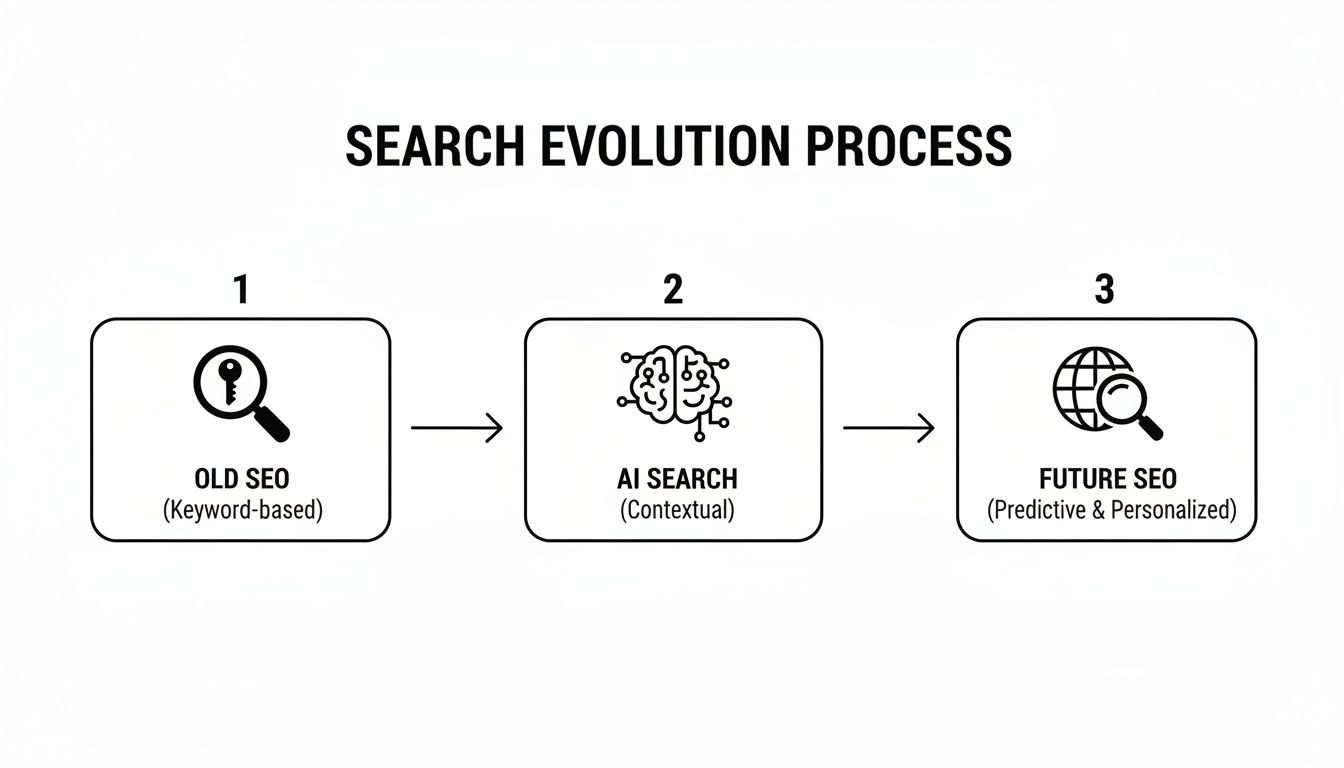
As you can see, the arena has expanded. A comprehensive intelligence framework isn't a "nice-to-have" anymore; it's critical.
Setting KPIs That Actually Matter
Once you know who you’re up against, you have to define what "winning" actually looks like. The old-school metrics like keyword rankings and Domain Authority still have a place, but they don't tell the whole story. Not even close.
A modern KPI dashboard needs to track what’s happening now. A traditional dashboard might show your ranking for "crm software" slipped from #3 to #4. A modern dashboard compares your overall SERP visibility against Salesforce and HubSpot for the entire "CRM" topic cluster and tracks how many times your latest industry report was cited by Perplexity this month.
Here’s what should be on your radar:
- SERP Share of Voice (SoV): This is your visibility score across a core set of high-value keywords. It directly answers the question, "How often are we showing up when it really matters?"
- AI Citation Share of Voice: A brand-new metric that tracks how often your domain gets cited in AI-generated answers for your key topics. This is a powerful leading indicator for success in the world of Generative Engine Optimization.
- Topic Authority Gap: Forget single keywords. This metric analyzes how comprehensively you cover an entire topic versus the competition. A rival with a massive content hub on "startup accounting" has serious topic authority, even if you beat them on a few long-tail terms.
- Backlink Velocity and Quality: Stop just counting links. What you need to track is the rate at which competitors are earning high-quality backlinks. A sudden spike in their backlink velocity is a huge signal they’ve just launched a new content campaign or PR push.
Assembling Your Intelligence Toolkit
To gather all this data, you need the right tools. No single platform does it all. Your goal is to build a tech stack that gives you a 360-degree view of the landscape, from traditional SERPs to the new AI-powered answer engines.
Competition is getting fiercer, fast. In fact, 58% of professionals say competition has heated up specifically because of AI.
Your Competitive Intelligence Toolkit
Building a comprehensive tech stack is key. Here’s a breakdown of the essential tools needed to collect the right data across SEO and AI search.
This toolkit gives you a complete picture, from high-level strategy down to the nitty-gritty technical details.
For AI monitoring, the process is still pretty manual but absolutely necessary. A tactical approach is to create a spreadsheet listing your top 50 informational queries. Once a month, run these queries through Perplexity, Gemini, and ChatGPT (using a prompt that asks for sources). Log which domains get cited. Over time, this reveals your true AI competitors and highlights content formats that AI engines prefer. This is the core of what’s now being called Agent SEO—optimizing your content to be found and used by AI agents.
Building this framework isn't a one-and-done project. It's a living, breathing process. You're creating a continuous cycle of data collection, sharp analysis, and strategic action that keeps you one step ahead. It turns competitive analysis from a boring, reactive report into your proactive engine for growth.
Alright, you've got your framework. Now for the fun part—the tactical deep dive.
This is where we shift from planning to pinpointing the exact content and backlink plays that are making your competitors win. We're going way deeper than a surface-level keyword gap report. The real goal is to find the strategic patterns you can exploit.
You’re not just looking for what keywords they rank for. You need to understand why their stuff resonates with users and search engines. Are they building massive content hubs? Are they sniping underserved subtopics you've completely ignored? This is the core of modern competitive intelligence for SEO.
Moving Beyond Keywords to Topic Authority
A traditional keyword gap analysis is a fine starting point, but it's fundamentally broken. It shows you what competitors rank for, but not how they built the authority to get there.
A much smarter approach is to compare topic authority.
Think of it this way: a competitor might be beating you for "B2B sales automation." A simple analysis shows the keyword gap. A topic authority analysis, however, reveals they've built a massive pillar page surrounded by 15 supporting articles covering everything from "cold email automation" to "lead scoring workflows." They don't just rank for a keyword; they own the entire conversation. Your single blog post stands no chance against their comprehensive content hub.
Here’s a tactical approach to find these gaps:
- Map Their Content Hubs: Fire up a tool like Screaming Frog (or just do it manually) and crawl your top three competitors. Hunt for URL patterns like
/blog/topic-name/or subdomains that signal a content cluster. - Identify Their Core Pillars: See what major themes they've built their content around. For an e-commerce site selling running shoes, this could be "marathon training," "injury prevention," or "running gear guides."
- Pinpoint Underserved Subtopics: Now, compare their map to yours. If they have a dozen articles on "trail running for beginners" and you have zero, that’s your gap. It's a clear, actionable opportunity to build out your own expertise and capture a high-intent audience.
This isn't about chasing keywords anymore. It’s about strategically building topical relevance. By owning a niche topic your competitors have only glossed over, you establish authority much faster and build an SEO asset that’s tough to knock down.
Reverse Engineering Their Backlink Strategy
Looking at a competitor's backlinks isn't about counting links. It’s about figuring out the story behind them.
Your mission is to uncover not just who links to them, but why. This is the intelligence that lets you build a smart, efficient outreach strategy instead of just spraying and praying.
For instance, a Web3 company might see a rival has backlinks from a bunch of top crypto news sites. Digging in, they realize every single one of those links points to a data-heavy report they published on DeFi adoption rates. That’s not luck; it's a targeted campaign. The insight isn't "get links from crypto news sites." It's "create a proprietary data report that journalists actually want to cite." Your competitor has built a linkable asset; you're just writing blog posts.
Here’s how to deconstruct their link-building machine:
- Analyze Link Context: Use a tool like Ahrefs to pull their backlinks. Don't get hung up on the raw numbers. Look at the referring page titles and the text around the link. Are they getting links from guest posts, resource pages, or media mentions of original research?
- Identify 'Money Page' Links: Filter their links down to only those pointing to high-intent product or service pages. These are the gold standard—the hardest to get and the most revealing of their tactics for driving actual conversions.
- Find Repeatable Link Patterns: Look for competitors who are consistently getting links from the same types of sources—podcast show notes, conference speaker pages, software review roundups. These patterns are your roadmap to scalable outreach opportunities.
Of course, a critical part of this is knowing how to check backlink quality. One link from a high-authority, relevant site is worth a hundred junk links. Focus your analysis on what's actually moving the needle for them.
Once you’ve identified these high-value link patterns, you can start building targeted campaigns to replicate their success. You can explore some of the best link building strategies to turn this intel into an execution plan that gets real results.
Deconstructing Competitor UX and Technical SEO
Sometimes, the reason a competitor is smoking you in the SERPs has nothing to do with their content or backlinks.
The real advantage is often hiding in plain sight: a superior user experience (UX) or a cleaner technical foundation. A forensic audit of these on-site elements is a non-negotiable part of modern competitive intelligence.
Small, almost invisible technical advantages can create massive ranking gaps over time. If a user lands on a competitor's site and finds what they need faster, with less friction, search engines absolutely notice. These signals tell Google that one site simply delivers a better experience than the other.

This analysis goes way beyond keywords. It's about taking apart their on-site strategy, piece by piece, to find the weaknesses you can exploit.
Auditing Site Architecture and Internal Linking
A competitor’s site architecture is their strategic blueprint. How they organize pages and link between them shows you exactly what content they prioritize and how they push users—and crawlers—through their most important funnels.
For example, compare two e-commerce rivals. Competitor A uses a flat, logical structure where top product categories are one click from the homepage. In contrast, your site buries key product pages four clicks deep. This sends a loud signal to Google that your competitor's pages are more important. They have a structural advantage.
A shallow, logical site architecture makes it easier for search engines to crawl and index your most valuable content. If a competitor can get a user from the homepage to a conversion page in fewer clicks, they have a structural advantage.
To figure this out, you need to map their internal linking logic. Are their blog posts consistently funneling authority back to relevant product or service pages? A B2B SaaS company writing an article on "how to improve team productivity" should be linking directly to their project management tool page. If they're doing that consistently and you aren't, they're building more internal authority to their money pages. It’s that simple.
Benchmarking Core Web Vitals and Mobile Experience
Page speed and mobile usability aren't just "nice-to-haves" anymore. They are foundational ranking factors. A slow, clunky site is a dead end for users, and Google knows it.
Use a tool like Google's PageSpeed Insights to run your key landing pages head-to-head against your competitor's. Don't just glance at the overall score; you need to dig into the Core Web Vitals:
- Largest Contentful Paint (LCP): How fast does the main content load? A competitor with a sub-2.5 second LCP has a clear speed advantage over a site struggling at 4+ seconds.
- Interaction to Next Paint (INP): How responsive is the page when someone clicks or taps? A laggy interface is a recipe for frustration and bounces.
- Cumulative Layout Shift (CLS): Do things jump around on the page as it loads? A low CLS score means a stable, predictable experience.
Compare these metrics directly. If your B2B competitor’s resource center loads a full second faster than yours and has almost zero layout shift, that’s a real, tangible advantage. This kind of technical superiority leads to lower bounce rates and higher engagement—strong positive signals that the algorithms pick up on.
Analyzing Structured Data and Rich Snippets
Finally, you have to see how your competitors are using structured data (schema markup) to own more SERP real estate. Schema is the code that helps search engines understand what your content is about, allowing them to show off rich snippets like FAQs, reviews, and product pricing right in the search results.
A competitor dominating the SERP with an FAQ dropdown or star ratings under their listing is actively using schema to steal clicks. For example, if two kitchen appliance blogs are ranking for "best air fryer," the one with star ratings and pricing directly in the SERP will almost always get more clicks than the one with just a plain blue link.
You can use Google’s Rich Results Test to inspect a competitor's URL and see exactly what kind of structured data they're running. If they’ve implemented Product, Review, and FAQPage schema on their key pages and you haven't, you are leaving valuable SERP real estate on the table. This is a technical gap you can close for a quick and very visible win.
Auditing Competitors in AI Search and LLMs
Welcome to the new frontier of competitive intelligence for SEO.
While everyone else is still obsessing over Google's ten blue links, you can get a massive head start by focusing on where search is actually headed: AI-generated answers.
Auditing how your rivals show up in AI search and Large Language Models (LLMs) isn't some futuristic exercise. It's a practical necessity right now. The goal is to figure out who AI engines like Perplexity, ChatGPT, and Google's AI Overviews are citing as authorities—and more importantly, why.
This is the core of modern Generative Engine Optimization. If you want a deeper dive on this, check out our full guide on what is Generative Engine Optimization.
Probing AI Engines for Competitor Citations
First things first: you have to get your hands dirty.
The most effective way to see who's winning the "citation game" is to act just like your users. Go to these AI engines and ask them the exact questions your target audience would. It's a manual process, but it's the only way to get real-world intelligence.
Start by making a list of your top 20-30 informational "how-to" or "what is" queries. Then, start plugging them into the different platforms.
Here are a few copy-paste prompts to get you going:
- For ChatGPT/Copilot: "Act as a [your target persona, e.g., 'SaaS marketing manager']. Explain the best strategies for [your core topic, e.g., 'reducing customer churn']. Please cite your sources."
- For Perplexity: Just type in your query, like "What are the most effective B2B lead generation tactics?" Perplexity is a goldmine for this because it cites sources automatically.
Here’s what that looks like in Perplexity. Notice how it surfaces the exact sources used to craft its answer.
This output is invaluable. It’s a direct look at which domains the AI model trusts for specific topics, handing you a ready-made list of your "AI citation competitors."
By consistently running these prompts, you're not just finding competitors; you're building a live dashboard of your AI Share of Voice. This tracks how often your domain appears in AI-generated answers for your most important topics, giving you a powerful leading indicator of your future organic performance.
Analyzing the 'Why' Behind AI Citations
Okay, you've got a list of competitors who are getting all the AI citations. Now the real work begins. You have to deconstruct why the AI chose them.
Trust me, it's rarely random. AI models are trained to find and prioritize sources that scream expertise, authority, and trustworthiness. Compare a generic, 500-word blog post on "what is inflation" to a detailed guide from a reputable financial institution that includes historical data charts, expert quotes, and a clear definition section marked up with schema. The AI will cite the latter every single time.
Look for these patterns in the content that gets cited over and over again:
- Unique Data and Statistics: Does the source have original research, survey results, or hard numbers (e.g., "73% of marketers agree...")? LLMs love pulling in specific data to make their answers more credible.
- Clear Authorial Perspective: Is the article written by a named expert with a real point of view? A strong, opinionated take almost always beats out generic, faceless content.
- Well-Implemented Schema: Is the competitor using
FAQPageschema or other forms of structured data? This makes it dead simple for an AI to parse and pull out key information. - Exceptional Clarity and Structure: Is the content logically organized? Think clear headings, short paragraphs, and concise definitions. Simple, well-structured explanations are perfect for AI models to repurpose.
For instance, if a competitor’s article on "financial modeling for startups" keeps getting cited, you might dig in and find it includes a downloadable template and cites five specific, data-backed case studies. That's your roadmap. The AI isn't just citing a blog post; it’s citing a genuinely useful, data-rich resource.
To get a better grasp of these strategies, it’s worth exploring how businesses are unlocking value with Large Language Model applications in their own operations.
Once you spot these patterns, you can build content designed to be cited. This isn't about gaming an algorithm. It's about creating the most authoritative, clear, and data-driven resource on a topic—which is exactly what search engines have always wanted.
Turning Intelligence Into an Actionable SEO Roadmap
Gathering mountains of data is the easy part. Seriously.
The real challenge in competitive intelligence for seo is turning all that raw info—the keyword gaps, backlink profiles, and AI citation audits—into a focused plan that actually drives growth.
Intelligence without action is just expensive trivia.
This is where you build the bridge from analysis to execution. It’s all about taking that long, messy list of potential projects and systematically deciding what to do now, what to tackle next, and what to put on the back burner. Without a prioritization framework, you’ll just end up chasing shiny objects or getting stuck in analysis paralysis.

Prioritizing Opportunities with a Framework
To move forward, you need a simple, objective way to score every opportunity you’ve uncovered. The RICE framework is perfect for this. It forces you to evaluate each idea based on four key factors, stripping out the emotion.
- Reach: How many people will this actually impact in a given period?
- Impact: How much will this move the needle on a real goal (e.g., leads, sign-ups, ARR)?
- Confidence: How sure are you about your Reach and Impact estimates? Be honest. (Score this from 0-100%).
- Effort: How much time will this take from your team (think person-months)?
The formula is dead simple: (Reach x Impact x Confidence) / Effort.
Let's walk through a real-world example for a SaaS company, comparing two potential projects.
Project A: Optimize an Existing Page for AI Citations
- Reach: 5,000 users/month (current page traffic)
- Impact: High (3/3) - aims to capture high-intent AI traffic.
- Confidence: 80% - we know the tactics to get cited and can execute cleanly.
- Effort: 0.5 person-months (a quick, focused update).
- RICE Score: (5000 x 3 x 0.8) / 0.5 = 24,000
Project B: Build a New Content Hub from Scratch
- Reach: 15,000 users/month (estimated potential traffic)
- Impact: High (3/3) - aims to establish massive topic authority.
- Confidence: 60% - it's a new initiative with more unknowns and variables.
- Effort: 3 person-months (a major strategic project).
- RICE Score: (15000 x 3 x 0.6) / 3 = 9,000
Instantly, you have clarity. While that new content hub is a fantastic long-term play, optimizing the existing page is the clear winner for immediate, confident impact. This framework removes the guesswork and internal politics from your planning.
Prioritization isn't about finding the "best" ideas; it's about finding the best ideas for right now. A solid framework like RICE ensures you're always working on the tasks that deliver the highest return on your team's limited resources.
Building Your 90-Day Execution Plan
Once your opportunities are scored and ranked, you can build a realistic 90-day roadmap. A quarter is the perfect timeframe—it's long enough to complete meaningful projects but short enough to stay agile and react to new intelligence.
Your roadmap should balance different types of initiatives to build and maintain momentum. A good mix includes:
- Quick Wins (Weeks 1-4): These are the high-confidence, low-effort tasks your RICE scores just handed you on a silver platter. For example: updating an old blog post with new data to attract AI citations or fixing the technical schema issues on your top five product pages. Get some points on the board early.
- Strategic Projects (Weeks 1-12): These are the bigger, higher-effort initiatives that build long-term authority and create a deep competitive moat. An example here would be building out that new content hub or launching a targeted digital PR campaign to replicate a competitor's best backlinks.
- Continuous Monitoring (Ongoing): Your roadmap has to include dedicated time for ongoing intelligence gathering. This isn't a "set it and forget it" plan. You need to be constantly feeding new data back into the system, ready to adjust your course for the next quarter.
This structured approach transforms your competitive analysis from a one-off report into a continuous engine for growth. It creates a powerful feedback loop where intelligence informs action, and the results of that action refine your next round of intelligence gathering.
Ready to turn competitive intelligence into a powerful growth engine for your business? Austin Heaton offers hands-on SEO and GEO consulting that delivers measurable results in weeks, not months. Let’s build your actionable roadmap and start winning. Get in touch today.