If you've spent years mastering traditional SEO, get ready for a completely new ballgame.
Generative Engine Optimization (GEO) isn't just a new acronym; it's a fundamental shift in how we approach getting found online.
Think about it this way: traditional SEO is like getting your book placed prominently on a library shelf, hoping a patron finds it. The goal is for someone to pick it up and read it. GEO, by comparison, is about getting your work cited directly in the definitive encyclopedia that everyone reads first. Your content becomes the source of truth, not just another option in a long list.
The New Rules of Digital Visibility
The internet is moving away from the familiar "10 blue links." Instead, users are getting single, synthesized answers from AI tools like Google’s AI Overviews, Perplexity, and ChatGPT. This is a massive change in how people discover information.
Generative Engine Optimization (GEO) is the strategy that emerged in early 2024 to tackle this new reality. The focus isn't on climbing rankings anymore. It's about structuring your content so that Large Language Models (LLMs) see it as authoritative, trustworthy, and easy to cite. For more on this shift, check out the detailed report on the generative AI landscape from SimilarWeb.
Why does this matter so much? Because those AI-powered summaries are capturing the lion's share of user attention. If your brand isn't the source material for these answers, you effectively become invisible. This is a core part of AI's revolutionizing role in digital marketing strategies, and it's happening right now.
Generative Engine Optimization vs Traditional SEO at a Glance
The old playbook won't work here. The goals, tactics, and even the definition of "success" are completely different in the world of GEO. While SEO is about winning a click from a list, GEO is about becoming part of the answer itself.
This table breaks down the core differences at a high level.
As you can see, the game has changed. We've moved from optimizing for discovery to optimizing for citation. Old-school SEO helps people find your content; GEO ensures AI models use your content to build their answers. This guide will walk you through the frameworks you need to adapt and win.
How AI Search Is Rewriting the Rules of Ranking
To really wrap your head around Generative Engine Optimization, you first need to understand why it even exists. For decades, search engines like Google have operated on a simple, yet powerful, model: they "bundle" information for you. You type in a question, and they hand you a list of ten blue links—a library of potential answers.
The heavy lifting, however, was always on you. You had to click through multiple pages, piece together different perspectives, and synthesize all that information yourself. We all know the drill. But that’s no longer the only game in town.
Generative engines flip this model on its head. They "unbundle" information by doing the synthesis for you. Instead of a list of sources, you get a single, direct answer built from the best information the AI can find. This isn't just a small tweak; it’s a complete rewrite of the search playbook.
The Great Unbundling of Information
Let's make this real. Imagine you're trying to figure out the best way to structure your B2B marketing budget.
- Traditional Google Search: You’d search "how to allocate a B2B SaaS marketing budget." Google would serve up links from HubSpot, Gartner, and a dozen marketing blogs. You'd then spend the next 30 minutes with a sea of open tabs, trying to connect the dots and build your own plan. This is a high-friction, user-led synthesis process.
- Generative AI Search: You ask the same question to a tool like Perplexity. It instantly gives you a structured answer, breaking down budget percentages by channel (content: 25-30%, paid ads: 40-50%, events: 10-15%) and citing its sources right there in the response. This is a low-friction, AI-led synthesis process.
This shift—from a list of options to a definitive answer—changes everything for anyone creating content. Your goal isn't just to make the list anymore. It’s to become the raw material for the answer itself.
Your content must now be optimized not just for discovery, but for direct citation by an AI. If your facts, data, and insights aren't easily pulled and verified, you will be invisible in this new search world.
Why Your Top Google Ranking Doesn't Matter Anymore
This is the part that should make every marketer and SEO sit up and pay attention: ranking #1 on Google’s old-school results does not mean you’ll be featured in an AI-generated answer. The signals these new engines are looking for are completely different.
The game has fundamentally changed. A recent analysis found that fewer than 10% of the sources cited in AI answers from ChatGPT, Gemini, or Copilot also appeared in Google's top 10 organic results for the same query. That's a massive disconnect, proving that your traditional SEO playbook is no longer enough.
To see what's happening under the hood, you need to understand technologies like Retrieval Augmented Generation (RAG). This is the mechanism that allows large language models to reach out, grab real-time information from external sources (like your website), and weave it into their answers.
This means a page that ranks #8 on Google but is packed with well-structured data and clear, factual statements might get picked by an AI over a #1 ranking page that’s full of fluff. The rules have changed, and if you want to stay visible, you need a new strategy.
Okay, you get that AI search is a completely different ballgame. Now what?
You need a practical game plan to actually win. A real Generative Engine Optimization strategy isn't about chasing the latest algorithm update. It's about making your content the most logical, trustworthy, and citable source for a Large Language Model (LLM).
It all boils down to five core pillars. Think of these less like a checklist and more like interconnected principles. Get them right, and your content becomes both machine-readable and incredibly valuable to humans. This is how you stop being just another link in a list and start becoming a primary source in a definitive AI-generated answer.
This diagram shows how everything fits together. Authority, Factual Density, and Clarity are the bedrock of a solid GEO strategy.
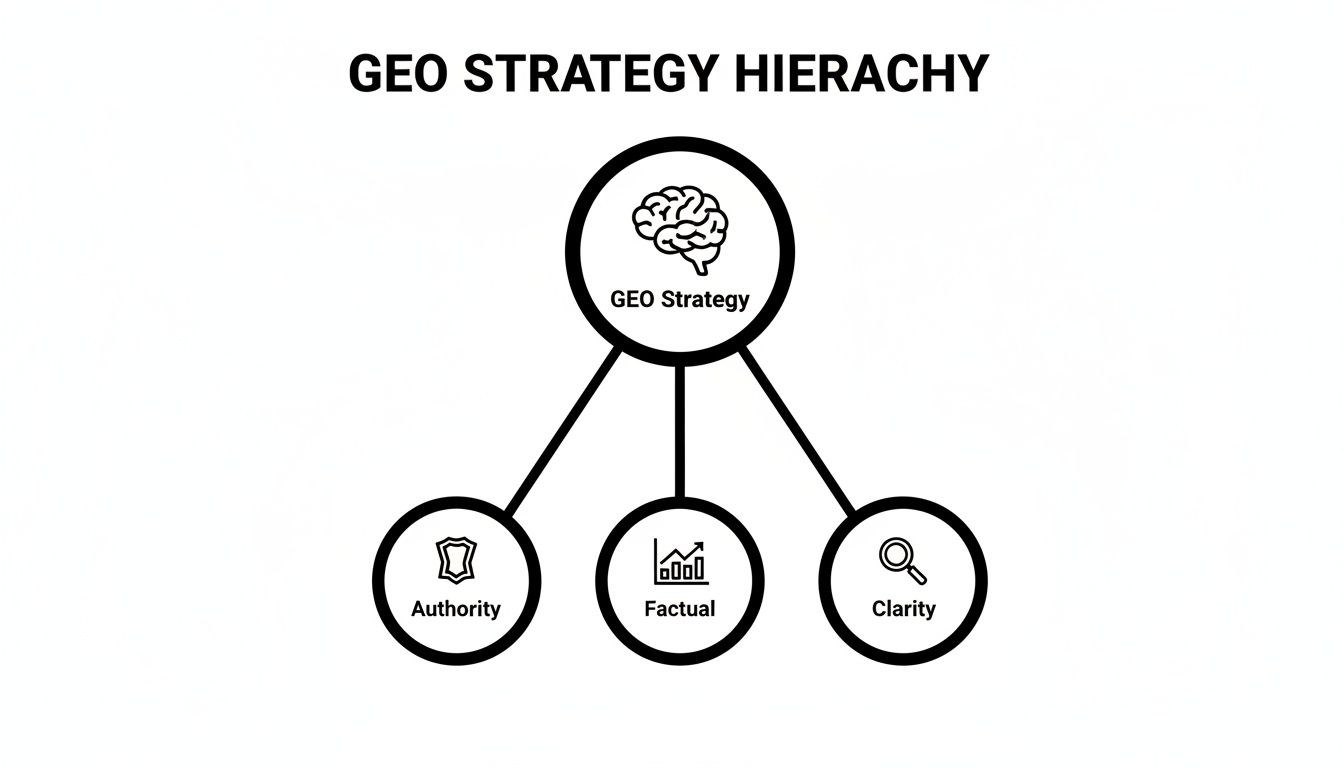
Each pillar supports the others, creating a structure that screams quality and reliability to generative engines.
1. Establish Verifiable Authority
In the AI world, authority isn't just about backlinks anymore. It's about verifiable proof. LLMs need to know who is behind the content and why they're qualified to talk about it. Anonymous blog posts and unattributed claims are major red flags.
You build this authority with clear, machine-readable signals. This goes way beyond a simple author bio. It’s about connecting your content, your authors, and your brand to recognized entities and knowledge graphs that an AI can easily cross-reference.
- Author Schema: Use
Authorschema on every single article. Link it to a detailed author page showing their credentials, social profiles, and other publications. For example, thesameAsproperty can link to an author's LinkedIn profile and Twitter handle, connecting them to established entities. - Organization Schema: Implement
Organizationschema to tie your brand to its official online footprint, including its knowledge graph entity. Include your logo, official name, and founding date. - Cite Real Experts: Reference and link out to other recognized authorities and credible studies. This shows the LLM your content is part of a broader, trustworthy conversation.
2. Increase Factual Density
Generative answers are built from facts, stats, and data. LLMs are trained to hunt for content packed with verifiable information they can pull out and present to a user. If your content is all opinion and fluff, it’s going to be ignored.
This is what I call Factual Density. It’s a measure of how much concrete, citable information you have in each paragraph. The higher your density, the more valuable your page becomes as a source for an AI.
Your goal is to turn your content into a "fact magnet." Every key point needs to be backed up by a statistic, a specific example, a date, or a number that an LLM can grab and attribute.
Comparison: Low vs. High Factual Density
- Low Density: "Lots of companies are using AI in their marketing now, and it's really making a difference."
- High Density: "According to a 2024 Gartner report, 79% of marketing departments have adopted AI tools, with leaders reporting an average revenue increase of 12% directly attributed to AI-driven campaigns."
The second version is a tactical goldmine for an LLM. It's packed with a source, a percentage, a specific outcome, and a date.
3. Achieve Semantic Clarity
Traditional SEO was obsessed with keywords. GEO is all about Semantic Clarity. This means structuring your content so that its meaning, context, and the relationship between different ideas are perfectly clear to a machine. An LLM needs to understand not just what you're saying, but how all the information connects.
Structured data is your best friend here. Using schema markup is like translating your content from human-speak into a language that AI engines can process with zero confusion.
Here’s a simple breakdown:
4. Build Conversational Relevance
People don't talk to AI the same way they type into Google. Their queries are longer, more natural, and almost always framed as a full question. Your content has to be built to answer these conversational prompts directly and completely.
This means you need to think ahead. Don't just answer the first question; address all the logical follow-up questions in the same piece. This makes your page a comprehensive, one-stop source that an AI is far more likely to use for a full summary.
Think of it this way: if a user asks "What is GEO?", they probably also want to know "Why does it matter?" and "How is it different from SEO?". A conversationally relevant article answers all three in a logical sequence. A tactical approach is to use tools like AlsoAsked or search engine "People Also Ask" sections to map out these follow-up queries before you even start writing.
5. Conduct Technical Audits for AI
Finally, none of this matters if an LLM can't even access, crawl, and understand your site. The technical SEO basics are still critical for GEO, but with a few extra layers.
A technical GEO audit makes sure your content isn't just visible to crawlers but is also perfectly digestible for AI models. You're looking for any barrier that could trip up an LLM. A tactical audit should check for disallowed directories in robots.txt that might block AI crawlers (like Google-Extended), ensure page rendering isn't blocked by complex JavaScript, and validate all structured data for errors. Your site needs to be a clean, open book for any machine that comes knocking.
Putting GEO into Practice with Industry Examples
Theory is great, but GEO really clicks when you see it in action.
Want AI engines to recommend your company? Book a free 30-minute AI visibility review with Austin.
Book a CallThe strategies that work for a SaaS company are completely different from what an e-commerce brand needs. It's all about tailoring your approach.
Let's break down exactly how different industries can turn the five pillars of GEO into a real-world content strategy that gets results. This isn't about guesswork; it’s about structuring your information so that an LLM sees your content as the most credible, useful, and citable source for its answers.
SaaS Companies: Winning the 'Best Of' Game
For any SaaS business, the holy grail is getting featured in AI answers for queries like, "what's the best CRM for small businesses?" or "top alternatives to Salesforce."
Winning these spots requires a ruthless focus on clarity.
Comparison: Before vs. After GEO
- Before GEO: A comparison page is a wall of text filled with persuasive marketing language like "unparalleled synergy" and "robust solutions." It sounds great to a human but is a confusing mess for a machine trying to extract facts.
- After GEO: The page is rebuilt for semantic precision and factual density.
Tactical Implementation:
- Use Precise Tables: Ditch the long paragraphs. Use a clean comparison table (with proper
<table>HTML) to line up features, pricing tiers, and integration counts side-by-side with competitors. - Create Factual Snippets: Break down key advantages into short, punchy, fact-based statements. For example: "Our platform integrates with over 250 apps, while Competitor X integrates with just 75."
- Write Question-Based Headings: Structure your page using H2s and H3s that directly mirror conversational questions, like "Which CRM Offers Better Reporting?" or "Is This Platform Cheaper Than Competitor X?"
This isn’t just a formatting change. You’re turning your sales page into a citable data source, making it incredibly easy for an LLM to pull your data and recommend your product.
E-commerce Brands: Driving Niche Product Recommendations
For e-commerce, GEO is all about helping AI engines recommend your specific product for a highly detailed user query.
Think about questions like, "what are the best waterproof running shoes for someone with flat feet?" or "eco-friendly coffee pods compatible with Nespresso machines." Generic product pages will never get surfaced for these high-intent searches.
Comparison: Before vs. After GEO
- Before GEO: A product page has a generic description, a few bullet points, and basic specs. It targets keywords like "running shoes" but misses all the crucial details an AI needs to make a specific recommendation.
- After GEO: The product page becomes a rich, structured powerhouse of information.
By using precise schema markup, an e-commerce site can essentially spoon-feed a product's exact specifications to an AI. This removes all ambiguity and ensures your product shows up for the right user need—the kind that leads directly to a sale.
Tactical Implementation:
- Get Granular with Product Schema: Go way beyond the basics. Use
Productschema to specify attributes likematerial(Gore-Tex),audience(runners with overpronation), andisAccessoryOrSparePartFor(Nespresso VertuoLine). - Weave Attributes into Your Content: Your descriptions need to explicitly mention these niche details. "Our Arch-Support model features a 10mm heel-to-toe drop and a medial post designed specifically for runners who overpronate."
- Build Smart FAQ Sections: Use
FAQPageschema to answer the specific, long-tail questions customers ask, like "Is the sole flexible enough for trail running?" or "Can I use these pods in a Keurig machine?"
This level of detail makes your product the perfect, verifiable answer for a complex query, putting you ahead of competitors who are still stuck in the old keyword-stuffing mindset.
B2B Services: Becoming the Primary Source
For B2B service providers, authority is everything. The ultimate GEO win is having your original research or industry report become the primary source an AI uses to answer questions about market trends or statistics.
This is a powerful move that shifts you from just optimizing content to actively shaping the AI's understanding of your industry. It's the core idea behind what some are calling agent SEO—creating content specifically for AI agents to consume and cite.
Comparison: Before vs. After GEO
- Before GEO: You publish a great blog post with unique insights, but the data is buried in dense paragraphs. An AI simply can't parse it reliably.
- After GEO: The content is reformatted into an authoritative, machine-readable report.
Tactical Implementation:
- Call Out Key Statistics: Make your data impossible to miss. Bold important numbers and feature them in blockquotes. For example: "Our 2024 study found that 68% of B2B marketers plan to increase their AI budget."
- Use Data Tables and Charts: Present your survey results in clearly labeled tables. Embed charts with descriptive alt text that explains the findings. This makes your data structured and digestible for machines.
- Signal Your Provenance: Your credibility is on the line. Include a clear methodology section ("This survey of 500 B2B marketing VPs was conducted in Q2 2024..."), link to the raw data if you can, and use author schema to connect the research to known experts in your organization.
When you do this, you’re not just writing another blog post. You’re creating a foundational knowledge asset that LLMs will reference over and over, cementing your brand as the definitive authority in your field.
High-Impact GEO Tactics by Industry
As you can see, the core principle is the same: structure your expertise in a way that is clear, factual, and easily verifiable for a machine. This is how you win in the new era of search.
How to Measure Success in a Generative AI World
For years, we’ve all been conditioned to obsess over that #1 ranking on Google. It’s a hard habit to break, but in the era of Generative Engine Optimization (GEO), it’s a necessary one.
That top spot just doesn't guarantee visibility—or traffic—like it used to. Success in this new AI-driven world demands a completely different dashboard and a fresh set of KPIs.

The old metrics we’ve all leaned on for a decade—organic traffic, keyword positions, click-through rates—they don’t tell the full story anymore. Not even close.
When an AI synthesizes an answer for a user, your brand can "win" without a single click ever happening. This forces a fundamental shift in how we prove the ROI of our work.
Moving Beyond Clicks to Citations
The new North Star metric in GEO is Citation Volume. It’s simple: this KPI tracks how many times your domain, brand, or content gets explicitly sourced in an AI-generated answer. Each citation is a direct vote of confidence from the LLM, cementing your brand as a trusted authority.
Think of it like getting quoted in a major news article. You might not get a flood of direct traffic from every reader, but the authority and credibility you build are massive. An experienced LLM SEO consultant knows that maximizing these citations is the new game.
In the GEO framework, a citation is the new click. It’s tangible proof that your content is high-quality, trustworthy, and valuable enough for an AI to use as a primary source to inform its users.
Tracking this means you have to regularly query AI engines with prompts relevant to your business and manually log every time your site gets referenced. It's a manual grind for now, but new tools are already being developed to automate this process, making it easier to measure your citation footprint over time.
Measuring Your Share of the Answer
Another metric that's become mission-critical is your Share of Answer. This measures what percentage of an AI-generated summary comes directly from your content. For example, if an AI spits out a five-sentence answer and two of those sentences are pulled straight from your article, your Share of Answer for that query is 40%.
- High Share of Answer (e.g., >30%): This tells you your content is comprehensive, well-structured, and semantically clear. The AI sees it as a definitive source for that user's question.
- Low Share of Answer (e.g., <10%): This is a red flag. It suggests your content might be too thin, poorly organized, or just lacks the factual density needed to be a primary source.
Measuring this gives you a clear, actionable roadmap. You can analyze which pages earn a high Share of Answer and replicate that successful structure and format across the rest of your content.
Tracking New Forms of Traffic and Influence
While zero-click answers are becoming the norm, generative engines still drive real traffic through citations. I call this Prompt-Driven Traffic—it's when a user reads an AI summary, sees your brand cited, and clicks through to dig deeper. This traffic is often incredibly qualified because the user already has context and trusts the AI's recommendation.
Finally, don't ignore Brand Mentions in Zero-Click Answers. Even without a link, having your brand name appear positively in a summary builds awareness and credibility. This is absolutely vital as AI search adoption explodes, rewriting consumer behavior and shaking up the entire $80 billion SEO industry. By 2026, AI platforms are on track to have grown sevenfold since 2024, signaling a massive change in where people find information.
Common Mistakes to Avoid in Your GEO Strategy
As Generative Engine Optimization starts picking up steam, a whole new playbook of mistakes is being written. Honestly, knowing what not to do is just as important as knowing what to do. One wrong move can make your content completely invisible to AI.
Let's walk through the most common blunders I'm seeing and how to sidestep them.
The single biggest mistake? Treating AI prompts like old-school keywords. It leads to this weird, clunky content stuffed with long-tail questions. It’s a terrible experience for human readers, and it’s a massive red flag for any sophisticated LLM.
A generative engine isn’t just scanning your text for a perfect prompt match. It’s digging deeper, looking for the most authoritative and clearest answer to the real intent behind the prompt. Jamming your content with conversational questions completely misses the mark.
Mistake 1: Treating Prompts Like Keywords
This is, without a doubt, the most common pitfall I see. A marketer finds a prompt like "what are the best running shoes for flat feet" and starts sprinkling that exact phrase everywhere—in headings, in paragraphs. It feels forced, unnatural, and adds zero actual value.
- The Wrong Way: Slapping an H2 on the page that reads, "What Are the Best Running Shoes for Flat Feet in 2024."
- The GEO-Aligned Way: Using a clear, benefit-driven H2 like "Top Running Shoes for Overpronation." Then, you build a structured section using
Productschema to detail specific, factual attributes—think arch support, material, and heel-to-toe drop. The AI connects these hard facts to the user's need; it's not playing a keyword-matching game.
Mistake 2: Sacrificing Readability for Factual Density
Okay, factual density is absolutely critical for GEO. But some people take it way too far. They create content that reads like a dry, technical manual, just packed with stats but with no story or flow.
This strategy bombs. Why? Because if a human can't stand to read your content, an LLM trained to prefer human-friendly content will devalue it, too.
Balance is everything. Your job is to weave that data into a story that’s easy and compelling to read, not just vomit a list of facts. Use short paragraphs, clear headings, and bold key stats to make your information digestible for both people and machines. For example, instead of a dense paragraph, use a bulleted list to present key data points from a study.
Mistake 3: Assuming Technical SEO Is Obsolete
This is a dangerous one. There’s a growing assumption that because GEO is so focused on content quality, the technical stuff doesn't matter anymore. Nothing could be further from the truth.
Think about it: if an LLM crawler can't easily access, parse, or understand your site's structure, even the most brilliant content on the planet is dead in the water.
Proper schema markup, fast page speeds, a logical internal linking structure, and mobile-friendliness aren't optional. They are the foundation that allows your amazing, fact-dense content to even be discovered. Neglecting them is like building a brilliant library but forgetting to install any doors.
Your Top Questions About GEO, Answered
Let's cut through the noise. When a shift this big happens, you’re going to have questions. Here are the direct, no-fluff answers you need to get your GEO strategy off the ground.
Does GEO Replace Traditional SEO?
No. Not even close.
GEO builds on top of good SEO, it doesn't replace it.
Think of it with this comparison: SEO is like building the foundation, walls, and roof of a house—it needs to be solid, accessible, and up to code. GEO is how you furnish and organize the rooms inside so that an expert can walk in, instantly find what they need, and declare it the best source on the block.
All the foundational work you do for SEO—technical health, site speed, mobile experience—is what gets you in the building. GEO is the next layer. It’s about optimizing for the things Large Language Models (LLMs) care about most: factual density, crystal-clear semantics, and bulletproof authority signals.
How Long Does It Take to See GEO Results?
This is where things get interesting.
Unlike the long, slow grind of traditional SEO, GEO results can show up incredibly fast. We’re talking weeks, not months.
The timeline really depends on a few key variables:
- Content Quality: If you drop a high-authority, data-heavy report on a hot topic, an AI engine might pick it up and start citing it almost immediately.
- Niche Competition: It’s just like real estate. In a less crowded neighborhood, it’s much faster to become the landmark everyone points to.
- Platform Updates: Your visibility can spike depending on how often a generative engine like Perplexity or ChatGPT refreshes its knowledge base.
You're not waiting for Google to slowly crawl, index, and rank you over six months. You're optimizing for an LLM to find your content credible right now.
Success in GEO isn't about patience; it's about precision. A single, perfectly structured, citable piece of content can get you faster visibility in AI answers than months of chasing traditional keywords.
What Tools Are Essential for Auditing and Measuring Performance?
Your old SEO toolkit won't cut it here.
While you’ll still need Google Search Console to keep an eye on technical health and a schema validator to check your structured data, measuring your footprint inside AI answers requires a new approach.
Right now, the process is mostly manual, but it’s powerful. It involves systematically querying AI engines with your target prompts and meticulously documenting where—and how—your brand gets cited.
This is how you track the new metrics that matter: Citation Volume and Share of Answer. These are the KPIs that define success in the generative era.
Ready to stop guessing and start winning in the new era of search? Austin Heaton offers expert GEO consulting to turn your content into a primary source for AI engines, driving high-intent traffic and cementing your brand’s authority. Start accelerating your growth today.