Most SaaS SEO advice is still stuck in a dead model. Publish more blog posts. Chase more keywords. Build more backlinks. Then wait for pipeline that never shows up.
That approach breaks the minute buyers start using AI Overviews, ChatGPT, and Perplexity to compress research into a handful of cited recommendations. If search engines and answer engines don't recognize your company, product, and subject matter experts as a credible entity on a defined topic, you won't own the buying conversation. You'll just rent a few rankings.
Entity authority is how to build entity authority SEO for SaaS in a way that survives platform shifts. It gives Google a clear model of who you are, what your product does, which concepts you own, and why your brand belongs in high-trust results. It also gives AI systems the context they need to cite you during evaluation-stage research.
The Real Reason Your SaaS SEO Is Stagnating
The problem usually isn't effort. It's architecture.
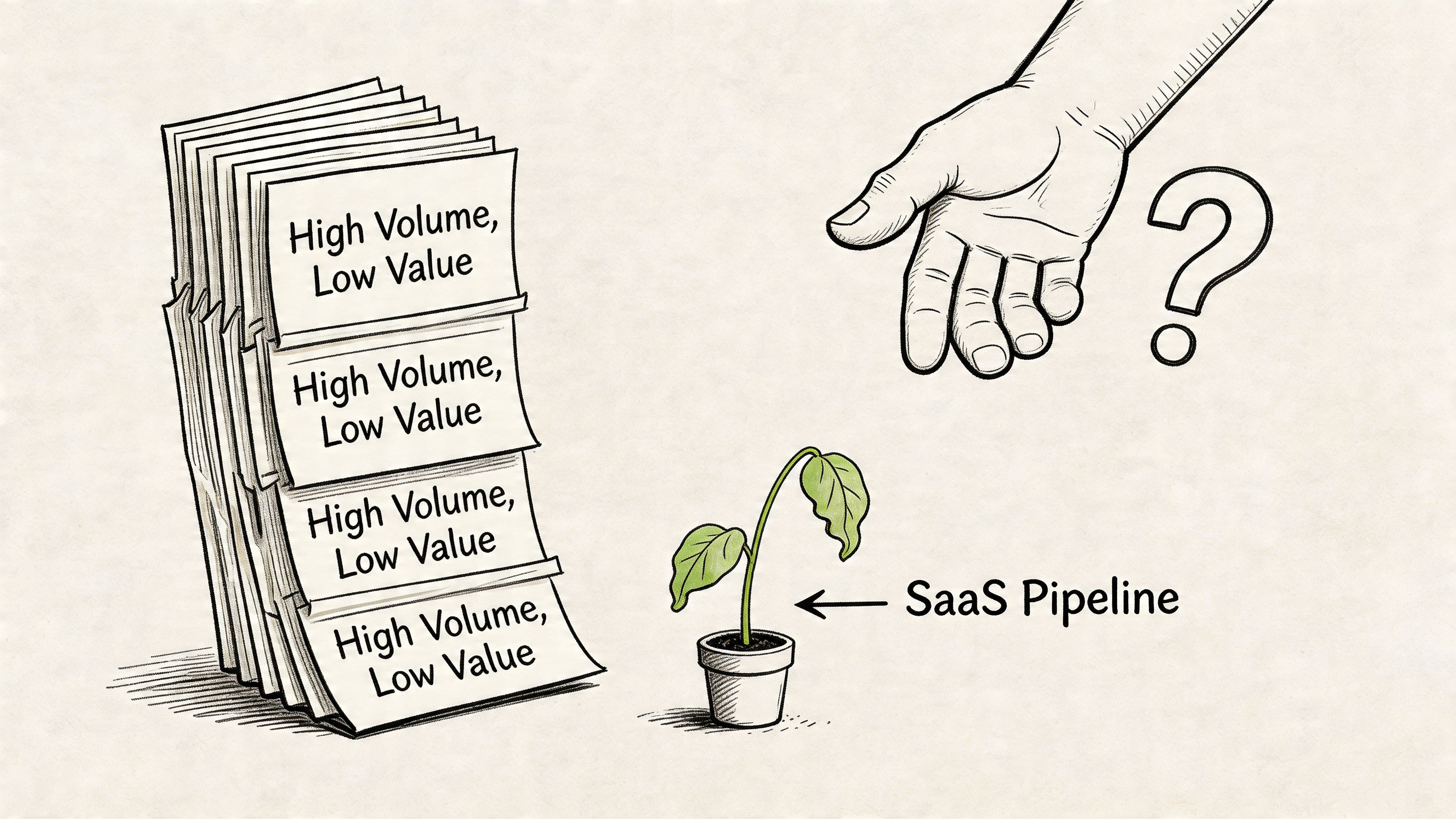
Most SaaS teams publish disconnected top-of-funnel content because that looks productive in a dashboard. You get impressions. You might even get traffic. But traffic from random educational queries doesn't create a durable authority signal, and it rarely turns into qualified pipeline without a deeper entity system behind it.
More content isn't the strategy
A lot of SaaS SEO programs are just publishing calendars with extra steps. Teams write fifty articles around loosely related keywords, then wonder why branded search stays weak, category terms don't move, and sales says organic leads aren't progressing.
That's because search has moved away from rewarding isolated pages. According to Abdurrahman Simsek's explanation of entity SEO for SaaS, entity SEO transforms SaaS visibility by establishing recognition within Google's Knowledge Graph, which directly correlates with E-E-A-T signals. That same source also makes the point most SaaS teams ignore: Google is rewarding topical authority across extensive content clusters, not individual page optimization in isolation.
If your site is a pile of articles instead of a structured authority model, your SEO isn't stagnating because your writers need to publish faster. It's stagnating because Google and AI systems still don't trust your topic ownership.
Entity authority is the actual moat
For SaaS, entity authority means your brand is understood as:
- An organization worth recognizing
- A product attached to a specific category and use case
- A source associated with important concepts in that category
- A company represented by credible people with subject matter depth
That matters because buyers don't just ask, "What is revenue recognition?" They ask, "Which revenue recognition software should I trust?" AI systems answer that kind of question by selecting sources with clear identity, strong topical relationships, and corroboration across the web.
Practical rule: If your content can rank without your brand being understood, it's fragile. If your brand is understood, your rankings and citations compound.
A lot of founders are seeing this already. Rankings look stable, but clicks and qualified demos are uneven because AI summaries absorb informational intent before users ever reach your site. If that's happening, read Austin Heaton's take on why SaaS organic traffic is down even when rankings improved.
Revenue comes from recognition, not volume
The strongest SaaS SEO systems don't treat organic as a traffic channel. They treat it as a trust engine.
When Google can confidently identify your SaaS company as an established entity, it sends a reliability signal. When your product, your feature pages, your authors, and your category content all reinforce the same model, that authority compounds over time. That's the difference between a site that occasionally wins a keyword and a company that keeps showing up wherever buyers ask category-level questions.
Defining Your SaaS Entity Constellation
Before you write a pillar page, add schema, or pitch a publication, define what your company wants to be known for. Most SaaS teams skip that step and end up creating mixed signals. Their homepage says one thing, their content says another, and third-party mentions attach them to vague categories that don't drive revenue.
Want AI engines to recommend your company? Book a free 30-minute AI visibility review with Austin.
Book a CallYour entity constellation is the map of every entity that should reinforce your commercial position.
Start with four entity types
Think of this like an architectural blueprint. You don't start construction by buying furniture. You decide what the building is.
For most SaaS companies, the core entity set looks like this:
| Entity type | What it represents | Example |
|---|---|---|
| Organization | The company itself | Acme Analytics |
| Software application | The actual product | Acme Revenue Recognition Platform |
| Sub-entities | Features, modules, workflows, integrations, categories | ASC 606 automation, billing sync, audit trails |
| Person entities | Founders, executives, product experts | CEO, VP Product, Head of Compliance |
This isn't busywork. Every page, schema object, internal link, mention, and byline should reinforce relationships between these entities.
Build the map before you publish
Create a simple document with five columns:
- Primary entity
- Related entity
- Relationship
- Commercial intent
- Supporting URL
A FinTech SaaS might map relationships like this:
- Organization → Software application → "offers"
- Software application → Revenue recognition → "helps manage"
- Software application → ASC 606 compliance → "supports"
- Founder → Revenue operations → "expert in"
- Product page → Integration partner → "connects with"
Now you have a usable model. Your homepage defines the organization. Product pages define the software entity. Feature pages define sub-entities. Author pages validate person entities. Integration pages connect your product to adjacent trusted entities.
Pick a category you can actually own
Most SaaS brands position too broadly because broad language sounds bigger. It also kills authority.
If you say you're for "sales teams," "finance workflows," or "business automation," you make entity recognition harder. A sharper category gives search engines and AI systems a cleaner association model.
Use this filter:
- Can a buyer repeat this category in one sentence?
- Can your product pages prove it with features and use cases?
- Can your content cluster around it without drifting into generic advice?
If not, tighten it.
Your entity map should look narrower than your TAM deck. That's a good sign.
One of the better ways to think about this is through an entity-first framework rather than a keyword-first one. Austin Heaton outlines that shift in his piece on entity-first SEO and the Knowledge Graph signals LLMs use to select sources.
Document the naming rules
You also need consistency. AI systems and search engines hate sloppy entity references.
Create naming standards for:
- Company name versus abbreviation
- Product name versus suite names
- Feature names versus benefit language
- Executive titles across author bios, LinkedIn, and press mentions
If your company is "Northstar Revenue," don't let half the web call you "Northstar" and the other half call you "Northstar RevOps." If your product is a platform, don't describe it as software, service, and tool interchangeably without a clear hierarchy.
Clear entity naming doesn't sound glamorous. It directly affects whether machines can connect your mentions into one trusted graph instead of several weak, ambiguous ones.
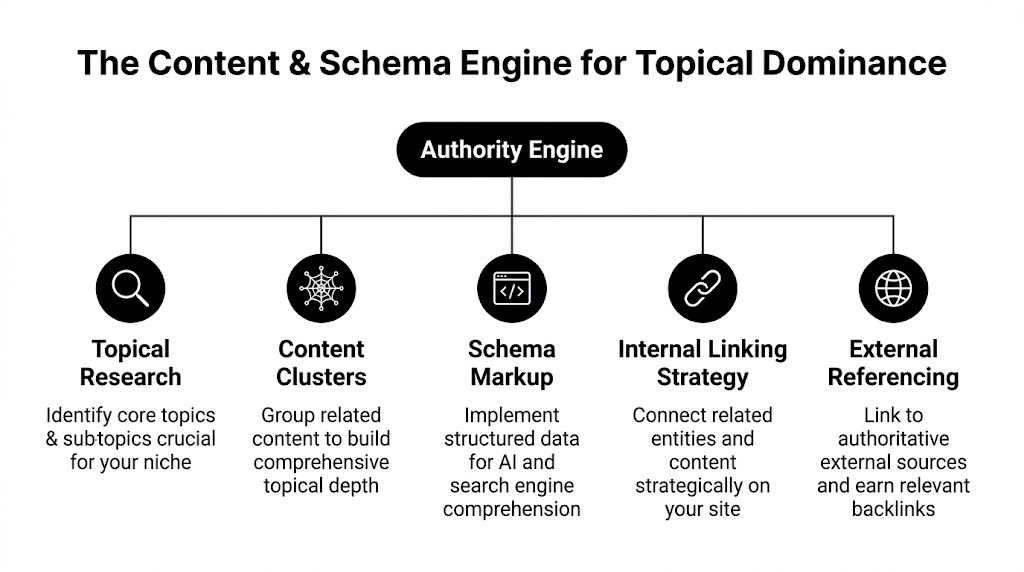
The Content and Schema Engine for Topical Dominance
Many organizations underbuild this aspect. They hear "entity SEO" and jump straight to schema plugins. That's backwards.
Schema only works when the underlying content architecture is coherent. If your content model is fragmented, structured data just labels the confusion more clearly.
Build one commercial topic cluster at a time
The strongest SaaS sites don't try to cover the whole industry at once. They pick a revenue-relevant topic, build a complete cluster around it, then expand.
A proven methodology is to create a pillar page linking to 10 to 20 cluster pages covering sub-entities, reinforced with schema markup and internal links. According to Hashmeta's guide to building topical authority with entity-based SEO, this structure can boost semantic rankings 3 to 5 times faster and deliver a 40% traffic lift in 3 to 6 months for B2B SaaS.
For a CRM SaaS, one cluster might look like this:
| Cluster role | Example page | Entity purpose |
|---|---|---|
| Pillar | CRM lead routing software | Defines the core category entity |
| Spoke | Lead routing rules | Explains a sub-entity |
| Spoke | Round robin assignment | Covers a workflow entity |
| Spoke | SLA routing for inbound demos | Connects to buying use cases |
| Spoke | CRM territory management | Extends authority into adjacent concepts |
| Spoke | Salesforce lead assignment | Connects with integration and platform entities |
That model is stronger than publishing unrelated posts like "best sales quotes" or "what is pipeline coverage." One helps your company own a category. The other fills a blog.
Use headings like entity labels
Your H2s and H3s should reflect the concepts you want machines to understand.
Bad example:
- Why your team struggles with handoffs
Better example:
- Lead routing rules for enterprise sales teams
- Round robin assignment versus weighted routing
- SLA-based routing inside Salesforce
That doesn't mean stuffing exact matches everywhere. It means naming things clearly enough that both users and models can understand the semantic relationships on the page.
Internal links should explain relationships
Most SaaS internal linking is lazy. "Learn more." "Read our guide." "See this article." Those anchors waste entity-building opportunities.
Use anchor text that describes the relationship:
- ASC 606 revenue recognition rules
- subscription billing reconciliation workflows
- Salesforce lead routing setup
- CRM deduplication logic
The link itself should help define the target page's role in the entity graph.
If your internal links don't tell a search engine what the destination is about, you're not building a graph. You're just moving PageRank around.
Publish clusters that help buyers make decisions
A lot of content teams overproduce awareness-stage content and underproduce decision-stage entity pages. That's a mistake, especially for AI citation.
Your cluster should include:
- Definition pages that explain the core concept
- Feature pages that tie the concept to product capability
- Comparison pages that address vendor evaluation
- Implementation pages that show real operational use
- Metrics pages that connect the topic to business outcomes
Many teams now use workflow support to scale without flooding the site with junk. If your team is operationalizing cluster production, this roundup of SEO content automation tools is useful because it shows where automation can support research, briefs, and production without replacing editorial judgment.
Then translate the cluster into schema
Once the content model is stable, add JSON-LD that makes the entities machine-readable.
For most SaaS sites, start with these types:
- Organization
- SoftwareApplication
- Article
- Person
- BreadcrumbList
- FAQPage where appropriate and truthful
Here is a stripped-down example for an organization page:
{"@context": "https://schema.org","@type": "Organization","name": "Acme Analytics","url": "https://www.example.com","logo": "https://www.example.com/logo.png","sameAs": ["https://www.linkedin.com/company/acme-analytics","https://www.crunchbase.com/organization/acme-analytics"]}A product page can extend the model:
{"@context": "https://schema.org","@type": "SoftwareApplication","name": "Acme Revenue Recognition","applicationCategory": "BusinessApplication","operatingSystem": "Web","publisher": {"@type": "Organization","name": "Acme Analytics"},"url": "https://www.example.com/revenue-recognition-software"}And an article inside the cluster should identify both the content and the expert behind it:
{"@context": "https://schema.org","@type": "Article","headline": "ASC 606 Compliance for Subscription Businesses","author": {"@type": "Person","name": "Jane Smith"},"publisher": {"@type": "Organization","name": "Acme Analytics"},"about": ["ASC 606","Revenue Recognition","Subscription Billing"],"mainEntityOfPage": "https://www.example.com/asc-606-compliance"}If you need a deeper breakdown of which schema types fit which SaaS page templates, use this guide on the best schema types for SaaS websites.
Don't separate content, technical SEO, and category strategy
They are one system.
The companies that win with entity SEO usually centralize ownership of the cluster architecture, schema logic, and internal linking model. Sometimes that's an in-house SEO lead. Sometimes it's a consultant. Austin Heaton's service set, for example, includes entity schema, content hierarchy architecture, backlink acquisition, and authority-building execution for SaaS, which is the right shape of service because these pieces have to work together.
If different teams own those pieces without a shared entity map, you'll get mismatched page naming, thin schema, and content that ranks for trivia instead of driving opportunity creation.
Earning Off-Site Corroboration and Authority
Your website can define your entity. The rest of the web has to confirm it.
Most SaaS link building often falters, with teams chasing generic guest posts on broad marketing sites because the domain metric looks good in a report. Those links might help a page. They usually don't help a company become a trusted entity in a commercial category.
Stop buying random authority
A mention only matters if it reinforces the market position you're trying to own.
If you sell compliance automation, you want associations from accounting, finance ops, audit, ERP, and integration ecosystems. If you sell CRM infrastructure, you want corroboration from sales ops, RevOps, Salesforce-adjacent, and GTM systems publications. That's how entity authority gets confirmed.
A practical roadmap from Design Revision's SaaS SEO guide argues for prioritizing original data studies, which earn 5x the link volume of guest posts, and contextual links from integration partners. The same source says that combined with the Kalicube Process for Knowledge Panel acquisition, this approach can drive 300 to 500% organic growth in 12 months, which is why mass guest posting is usually the wrong hill to die on.
Build the self-confirming loop
Think in loops, not campaigns.
You publish a category page.
An integration partner links to it in a co-created use case.
A niche publication cites your benchmark report.
Your founder is quoted on a category trend.
Your company profile appears in G2 or Capterra with consistent naming.
Your LinkedIn company page and executive bios match the same positioning.
Now the same entity definition shows up across your site, partner sites, directories, and earned media. That's corroboration.
The strongest off-site assets
Use a mix of these rather than overcommitting to one tactic:
Integration partner pages
Co-authored implementation guides and integration pages create contextual relevance that generic outreach can't match.Original research or benchmark reports
These give journalists, bloggers, and analysts something worth citing beyond your opinion.Category directories
G2, Capterra, and other relevant software directories help validate your product type and market placement.Expert commentary
Founder and executive bylines strengthen the person-entity side of the graph, not just the company entity.
For teams refining channel mix, this piece on B2B SEO marketing strategies to build authority is a helpful complement because it frames authority building across content, links, and category positioning rather than treating backlinks as an isolated KPI.
Relevance beats prestige when the goal is entity trust
A niche publication with the right audience and category alignment can do more for your entity profile than a shiny mention on a broad business site that has no topical connection to your product.
Use this quick decision filter when evaluating off-site opportunities:
| Opportunity | Good for entity authority | Why |
|---|---|---|
| Broad guest post on a generic marketing blog | Usually weak | Poor category reinforcement |
| Partner integration page | Strong | Confirms product relationships |
| Industry benchmark citation | Strong | Builds expertise and reference value |
| Software directory listing | Strong | Supports category clarity |
| Founder quote in niche trade publication | Strong | Builds person and organization entities |
If your current link program can't explain how each placement reinforces a target entity relationship, it's probably busywork. Austin Heaton's article on link acquisition strategy is aligned with this view. Build links that support authority systems, not vanity reports.
Optimizing for AI Answer Engine Citation
Most SaaS SEO teams are still optimizing for rankings and hoping AI platforms will pick up the crumbs. That's not how citation works.
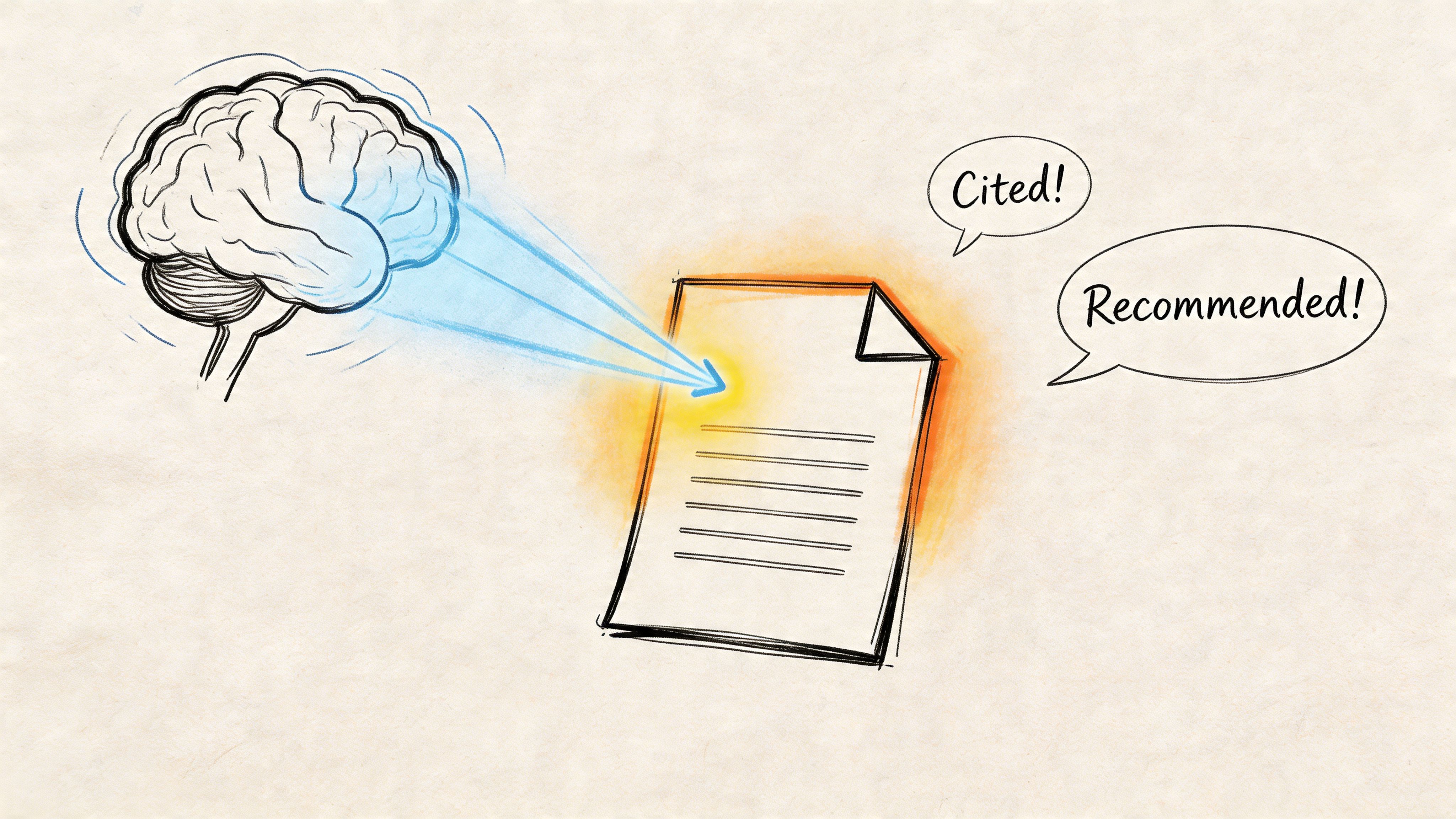
ChatGPT, Perplexity, Gemini, and AI Overviews don't just retrieve the page with the best title tag. They favor sources that are easy to identify, easy to summarize, and repeatedly corroborated as trustworthy on a topic. If your content is vague, your schema is thin, and your authority is scattered, you won't be cited even if you technically rank.
Traditional SEO doesn't automatically earn AI mentions
A lot of teams assume AI citation is just a byproduct of good SEO. Sometimes it is. Often it isn't.
AI systems prefer sources that answer a question cleanly, define entities unambiguously, and connect facts to a trusted brand. That means your category pages, comparison pages, implementation content, and schema all need to help a model resolve three things fast:
- What is this company and product?
- What topic is this page qualified to answer?
- Why should this source be trusted over others?
That is where AEO and GEO become practical, not theoretical. According to Wire Innovation's piece on mastering SEO entities, integrating entity optimization with AEO is a key differentiator. That source reports 560% AI click growth in 60 days for SaaS sites with AEO-specific entity schema and cites outcomes like 5.13K ChatGPT referrals from a single case study.
Build pages for recommendation moments
AI answers show up most often at evaluation moments, not just research moments.
That means you need content built around prompts like:
- Best CRM for lead routing complexity
- Revenue recognition software for SaaS finance teams
- Alternatives to [competitor]
- How to automate ASC 606 compliance
- Which customer support platform works for B2B SaaS onboarding
These are recommendation contexts. AI systems need sources that explain the category, compare options, and tie product capabilities to decision criteria.
Write pages that can survive being quoted out of context. If a model extracts three sentences, they should still establish expertise and clarity.
A strong page for AI citation usually includes:
- A direct definition near the top
- A short statement of who the solution is for
- Clear subheadings around features, use cases, and comparisons
- Entity-consistent naming throughout
- Supporting schema that identifies the organization, software, and author
If you want a cleaner framework for page structure, Austin Heaton breaks it down in his guide on how to structure website content so ChatGPT and Perplexity actually cite it.
Use schema that supports recommendation logic
For AI-facing visibility, the bare minimum Organization schema isn't enough.
Your product pages should clearly identify the software entity. Review and category context can also matter when they are truthful and supported. The point isn't to spam markup. The point is to reduce ambiguity.
Good candidates include:
- SoftwareApplication for core product pages
- Organization for the company entity
- Person for expert authors and executives
- Article for educational and comparison content
- Review-related schema only where you publish and maintain that data
Here's a simple rule. If a human evaluator would ask, "What exactly is this page, who wrote it, and what product does it describe?" your schema should answer those same questions in machine-readable form.
A practical overview of the broader shift is worth watching here:
AI citation follows authority density
The reason some SaaS brands get recommended repeatedly isn't that they hacked prompts. It's that they built dense authority around a narrow topic.
Their category pages align with their product pages.
Their comparison content matches how buyers evaluate.
Their founder or subject matter experts appear in trusted publications.
Their schema reduces confusion.
Their terminology stays consistent across the site and the web.
That combination creates what I call citation readiness. When an answer engine assembles a response, your brand has enough structured clarity and external confirmation to make the shortlist.
If your goal is pipeline, this matters more than vanity traffic. A single citation in an evaluation prompt can influence a shortlist faster than another blog post ranking for an informational keyword your buyer asked six months before budget approval.
Measuring What Matters An Entity SEO Scorecard
If you're still reporting success with keyword counts and blog traffic alone, you're measuring the wrong system.
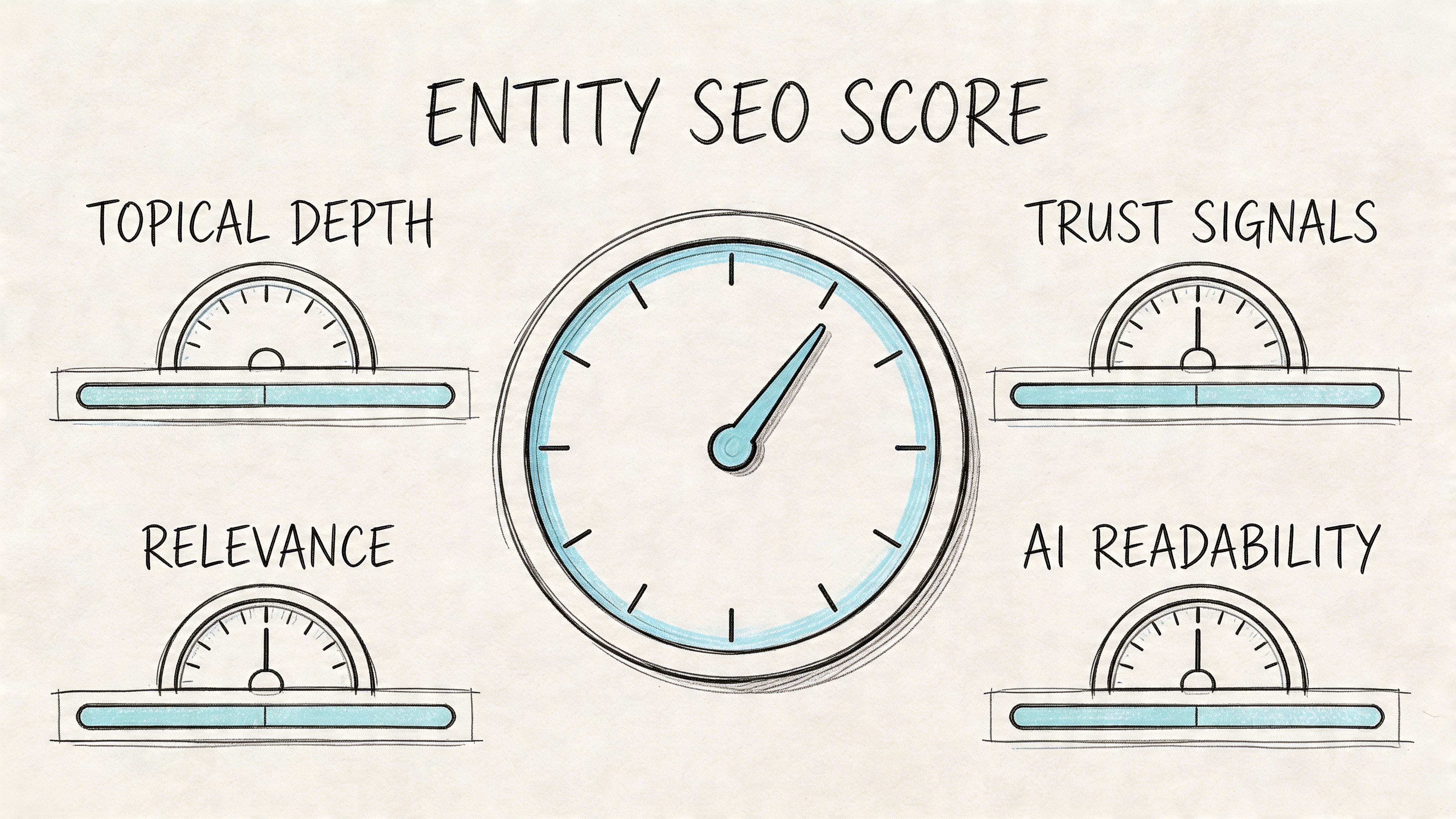
Entity SEO needs a scorecard that shows whether search engines and AI platforms are recognizing your brand across a topic cluster. The useful metrics are less about a single page winning a query and more about whether your company is becoming the default source around a commercial concept.
The scorecard I actually care about
According to Outpace SEO's entity SEO framework, the right measurement model tracks semantic ranking breadth, where strong entities dominate topic clusters rather than single keywords. That same source points to Knowledge Panel presence and AI Overview citations across platforms like ChatGPT and Perplexity as key indicators.
Use a scorecard with these buckets:
| Metric bucket | What to track | Why it matters |
|---|---|---|
| Entity recognition | Knowledge Panel presence and stability | Confirms machine-level identity |
| Cluster breadth | Number of relevant queries across one topic cluster | Shows topical authority spread |
| Citation visibility | Mentions in AI Overviews and answer engines | Indicates trust in generative contexts |
| Behavior quality | Engagement and conversion path consistency from cluster pages | Filters out empty traffic |
| Commercial influence | Demo requests, assisted conversions, pipeline touches from organic and AI referrals | Connects SEO to revenue |
Leading indicators beat vanity metrics
A page can rank without strengthening your entity. A cluster can't dominate without doing it.
Watch for signs like:
- More pages from the same cluster appearing for related queries
- More branded and category-adjacent searches
- More inclusion in AI-generated answers for decision-oriented prompts
- Stronger assisted conversions from cluster traffic, not just last-click demos
The best sign of progress isn't one page moving from position eight to position four. It's your brand starting to appear everywhere a buyer asks adjacent versions of the same question.
Build the dashboard around business outcomes
Pull data from Google Search Console, analytics, and your CRM. Then add manual or workflow-assisted tracking for AI citations and referrals.
Review the scorecard monthly. Not daily. Entity authority compounds through repetition and corroboration, so daily fluctuation is mostly noise. What matters is whether your defined entity constellation is showing up more often, in more contexts, closer to revenue moments.
Frequently Asked Questions About SaaS Entity SEO
How long does entity authority SEO take to work for SaaS
Longer than basic keyword targeting, but it's more durable. You can sometimes see cluster momentum earlier, especially when your architecture is clean and your topic focus is narrow. The bigger gains come when content, schema, internal linking, and off-site corroboration reinforce each other over time.
Should early-stage SaaS companies invest in entity SEO or wait
Start earlier. Small SaaS brands benefit because entity SEO forces focus. You don't need to outpublish large competitors. You need a sharper category definition, a tighter content cluster, and cleaner corroboration around the few topics that matter most to pipeline.
Do I need a Knowledge Panel before I can win in AI search
No. A Knowledge Panel is a strong signal, not a prerequisite. AI answer engines care about clear identity, trusted topic associations, and citation-worthy content structure. Plenty of SaaS sites can improve answer engine visibility before they earn a visible panel.
What's the biggest mistake SaaS teams make with entity SEO
They treat it like a technical add-on instead of a market-positioning system. Schema alone won't fix weak category focus. Publishing more articles won't fix an undefined entity model. Random backlinks won't fix poor corroboration.
Should I prioritize product pages or thought leadership content
Start with product-adjacent category authority. Thought leadership helps when it supports a defined commercial position. If your company still isn't clearly associated with the category you sell into, broad opinion content is a distraction.
Is this different from traditional topical authority
Yes. Topical authority often gets reduced to "cover the topic completely." Entity authority adds identity and relationships. It tells search engines and AI systems not just that you published about a topic, but that your company, product, and experts are credible nodes within that topic.
How do I know whether my content is built for citation
Ask a simple question. Can an AI model extract a short section from this page and still understand what the product is, who it's for, and why the source is trustworthy? If the answer is no, the page probably needs better structure, stronger entity language, and clearer author or company context.
If you want help building an entity authority system that drives qualified pipeline from Google and AI platforms, Austin Heaton works with SaaS and B2B teams on senior-led SEO, AEO, content architecture, schema, and authority-building programs.