
How to Optimize SaaS Pricing Pages for AEO
Learn SaaS pricing page optimization for AEO: improve scanability, structured data, pricing clarity, and buyer trust to boost conversions.



A SaaS pricing page is no longer just a conversion page. It is also a retrieval surface for AI systems, a comparison asset for buyers, and a trust signal for search engines trying to summarize your offer.
That shift changes the job of pricing page optimization.
When a prospect lands on pricing, they are often near a purchase decision. They want fast answers: what each plan includes, how billing works, which limits matter, and whether the product fits their use case. At the same time, AI search systems need the same page to be legible in a different way. They need clear entities, consistent plan labels, machine-readable pricing details, and supporting context that reduces ambiguity.
Why SaaS pricing page optimization matters for AEO and conversion
Pricing pages sit at the intersection of intent and clarity. That makes them unusually valuable for Answer Engine Optimization, or AEO.
A buyer searching for pricing, plan comparisons, or feature limits is not casually browsing. They are evaluating tradeoffs. Baymard’s SaaS usability research found that plan matrices often carry around 40 distinct features, which makes them dense and hard to scan. That density affects more than usability. It shapes how quickly a buyer can match themselves to a plan and how confidently they can move forward.
AI systems now sit in that same path. Google describes AI Overviews as generated snapshots that summarize key information and point users to deeper sources. If your pricing page is hard for humans to compare and hard for machines to parse, you lose in both places.
This is why pricing page work should not be treated as minor CRO polish. It is core revenue infrastructure.
How plan matrix scanability affects SaaS pricing page performance
Most pricing pages fail in a predictable way. They try to answer every possible objection inside one giant matrix.
The result is familiar: buyers scroll up and down, lose their place, search within the page, and still leave unsure about which plan fits. Baymard observed this behavior in usability testing, including users relying on browser search to locate specific features. That is a signal that the page is not doing enough of the sorting work.
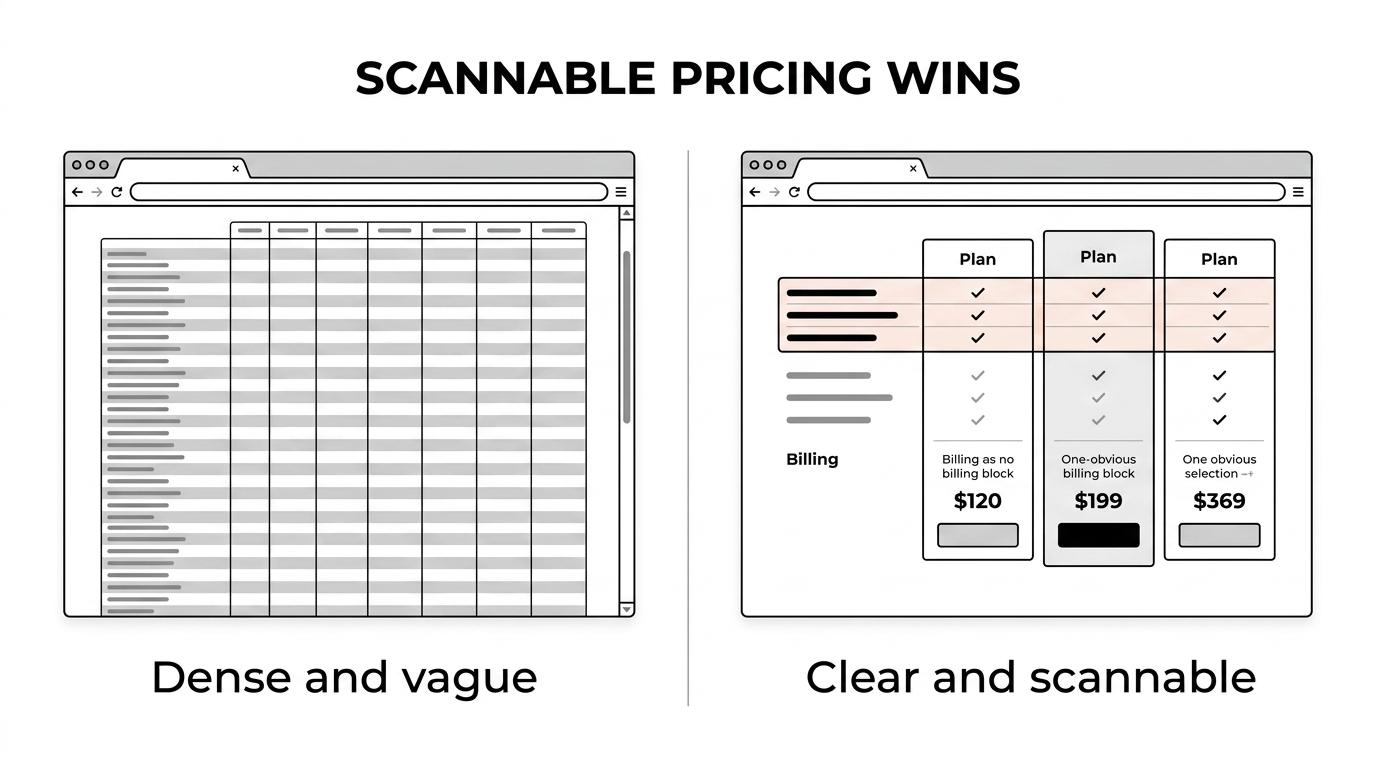
Good pricing page optimization starts with visual hierarchy and comparison discipline. Not every feature deserves equal weight. Core differentiators should be easy to spot in seconds, while long-tail details can sit behind expandable rows, tooltips, or secondary tables.
A strong plan matrix usually includes:
- Clear plan naming
- Sticky headers
- Limited comparison rows above the fold
- Consistent yes or no treatment
- Short feature labels
- Visible billing cadence
- Obvious CTA differences
That list sounds basic. It is not. In practice, many SaaS pages still bury critical distinctions under vague labels like “advanced analytics” or “priority support,” which forces both buyers and AI systems to infer meaning.
What high-intent pricing page visitors need to see first
The top section of the page should answer the buyer’s first round of questions without friction.
That means price, billing term, primary audience, strongest differentiator, and the action you want them to take. If a plan is custom, say so plainly. If there is a free tier, make its limits visible. If usage-based pricing applies, define the unit that drives cost.
This is also where language precision matters. “From $99” is weaker than “$99 per user/month billed annually.” “Best for growing teams” is weaker than “Best for teams with 5 to 25 reps managing inbound volume.” Specificity helps humans compare and helps machines extract clean facts.
A useful way to think about pricing page design is to balance two readers at once.
[markdown] | Buyer need | AI system need | What to publish on the page | | --- | --- | --- | | Fast plan comparison | Clear attribute mapping | Consistent matrix rows and labels | | Pricing certainty | Machine-readable values | Numeric prices, billing periods, currencies | | Use-case fit | Semantic context | Short descriptions of who each plan is for | | Trust | Verifiable detail | Limits, inclusions, terms, and FAQs | | Next-step clarity | Strong page intent signals | Distinct CTAs for trial, demo, or sales contact | [/markdown]The point is not to write for robots. The point is to remove ambiguity.
How to structure SaaS pricing data for AI search systems
AEO on pricing pages depends on what the page says and how the page says it.
Structured data helps search systems interpret offers with less guesswork. Schema.org guidance around price supports that idea directly. Price should be attached to an offer or a price specification, currencies should use ISO codes through priceCurrency, and machine-readable values should be cleanly formatted. A visible dollar sign is fine for people, but the underlying data should tell machines exactly what they are seeing.
That means your front-end copy and your structured data should agree. If the page says “$49 monthly” while the markup says annual billing or omits the currency code, you are creating confusion at the exact moment you need clarity.
The most useful structured elements on a SaaS pricing page often include:
- Offer data: plan name, price, currency, billing interval, availability
- Price detail: monthly, annual, usage-based, minimum contract term
- Entity context: product name, organization, category, target audience
- Plan differentiation: seat limits, feature gates, support tiers, add-ons
Just as important, keep visible content close to the structured version. If a human has to click through three modals to see real limits and charges, machine interpretation also becomes weaker. AI systems tend to work best when the critical facts live on-page in stable, crawlable HTML.
This does not guarantee an AI Overview mention or a citation in a chatbot. Nothing does. But it raises the odds that your page is treated as a reliable source when pricing questions are asked.
Why hidden pricing now costs you ChatGPT Deep Research citations
Hidden pricing used to be a sales tactic. It is now a citation problem.
G2's 2026 AI Search Insight Report found that 51% of B2B software buyers now start research with an AI chatbot more often than Google, and 41% use Deep Research tools regularly when they evaluate software. Those buyers are not asking for a homepage pitch. They are asking the agent to quote numeric prices, billing cadence, seat limits, and who each plan is for.
Modal-only or "Contact sales" pricing gives the agent nothing to extract from crawlable HTML. If it cannot find a number, it invents one or skips the vendor. That is how you lose the shortlist before a human ever lands on the page. The same gap is why teams that want to get cited in ChatGPT Deep Research reports treat the pricing page as a source document, not a conversion widget.
Make the page extractable:
- Put prices, or honest ranges, in HTML
- Name the billing unit (per seat, per workspace, per usage event)
- Say who each plan is for in one sentence
- Keep Offer schema in sync with the visible copy
Want a second set of eyes on whether Deep Research can quote your pricing page? Book a 30-minute call.
What content blocks help AI Overviews interpret pricing pages
A pricing table alone is rarely enough.
AI-assisted search tends to reward pages that pair structured facts with supporting explanation. That is where short, focused content blocks become valuable. They reduce uncertainty for buyers and give machines more context around your offer.
The best additions are tightly tied to real purchase questions. Think less like a homepage writer and more like a sales engineer who knows where deals stall.
Useful supporting blocks often include:
- Billing FAQ
- Annual versus monthly explanation
- Implementation or onboarding notes
- Contract and cancellation terms
- Security or compliance callouts
- Usage limit definitions
A strong FAQ section can do more than handle objections. It can answer the exact query patterns buyers type into Google, Perplexity, ChatGPT, and Gemini: “Does this include API access?” “Is onboarding required?” “Can I pay monthly?” “What happens after the free trial?” “How is usage calculated?”
Here is where many SaaS teams miss a major opening. They build comparison pages, alternatives pages, and pricing pages as separate silos, even though buyers and AI engines connect them naturally. If your pricing page references who each plan is for, what counts as usage, and when a custom quote applies, it becomes more citeable across adjacent commercial queries.
How to write pricing copy that is easy to quote and trust
AI visibility often favors text that is easy to lift, summarize, and attribute.
That does not mean writing bland copy. It means writing in clean, declarative language. Short sentences help. Defined terms help. Stable labels help even more. If you call a feature “workflow automation” on the product page, “automations” on pricing, and “task orchestration” in documentation, you are splitting your own signals.
Useful pricing copy tends to share a few traits:
- Direct language: “Includes 10 seats” beats “Designed for collaborative teams”
- Defined limits: “Up to 100,000 events per month” beats “High-volume usage”
- Consistent terms: one feature name across product, docs, and pricing
- Visible exceptions: overages, add-ons, services, and contract requirements
There is also a trust layer here. Google notes that AI-generated responses can make mistakes, which means buyers still look for source pages that feel authoritative and precise. Your pricing page should be that source page. If an AI answer gets a detail wrong, a clear pricing page gives the buyer a fast path to verify the truth.
How pricing page architecture supports bottom-funnel AEO
Bottom-funnel AEO is not about publishing more pages at random. It is about building a content system around high-intent questions.
Pricing pages are central to that system because they connect naturally to alternatives, comparisons, implementation concerns, use cases, and buyer education. A page with clean pricing logic can become the hub that strengthens all of those surrounding assets.
This is one reason experienced operators put pricing-page work inside broader AI visibility programs rather than treating it as an isolated design task. Real gains tend to come from combined execution: information architecture, structured data, copy precision, internal linking, and measurement.
A practical architecture often looks like this:
- Pricing page as source of truth
- Plan-specific anchors or sections
- Linked FAQs for billing and limits
- Supporting comparison pages
- Docs that define usage and technical constraints
- Sales enablement content that mirrors public pricing language
When that system is in place, AI systems get repeated, consistent evidence across the site. That consistency matters.
What to measure in SaaS pricing page optimization for AEO
A pricing page should be measured as both a conversion asset and a visibility asset.
Start with the usual metrics: visits, scroll depth, CTA click-through rate, trial starts, demo requests, and assisted conversions. Then look at search and AI signals: impressions on pricing-intent queries, citation appearances in AI tools, branded plus pricing query growth, and traffic entering through pricing-related pages.
If you can segment by source, do it. AI-driven visits may behave differently from organic web visits or paid traffic. Some teams see fewer sessions from AI tools but stronger intent and higher downstream conversion quality.
Track these patterns over time:
- Pricing page entry rate from non-branded search
- Growth in “pricing,” “cost,” and “plan” query visibility
- Changes in CTA mix between self-serve and sales-led paths
- Assisted pipeline from pricing-related sessions
- Citations or mentions in AI-generated answers
- Whether Deep Research quotes your pricing page: date, prompt, cited or absent, and whether the quoted price was accurate
One more point matters here. Do not optimize only for clicks to the pricing page. AEO success may show up when your plan names, feature definitions, or billing rules are quoted upstream in an AI answer that influences the purchase decision before the visit ever happens.
That is why the best SaaS pricing pages are built to be scanned quickly, parsed cleanly, and trusted instantly. They help buyers decide, and they give AI systems fewer chances to get your offer wrong.
Frequently Asked Questions
Does hidden SaaS pricing hurt AI citations?
Yes. Deep Research and similar agents quote prices they can extract from HTML. A "Contact sales" wall with no ranges gives the model nothing to cite, so it guesses or names a competitor who published numbers.