
Questions to Ask an AEO Consultant Before You Hire
Discover the top questions to ask an AEO consultant to verify AI search proof, strategy, reporting, and revenue impact.



Hiring an AEO consultant is now a revenue decision, not a niche SEO experiment. AI summaries, AI Overviews, ChatGPT, Perplexity, and Gemini increasingly shape which brands get seen, cited, and trusted before a buyer ever fills out a form.
TL;DR: Summary
- Ask an AEO consultant for proof of visibility in AI Overviews, ChatGPT, Perplexity, Gemini, and long-tail search journeys, then ask how that visibility connects to qualified pipeline.
- A strong AEO consultant should measure business outcomes, not just impressions, because Gartner found that 45% of B2B buyers use GenAI in research and 69% prefer to validate AI-generated insights with sales reps.
- AI search is already mainstream: Pew reports 65% of U.S. adults at least sometimes see AI summaries, Google says AI Mode has passed 1 billion monthly active users globally, and AI Overviews are available in 200+ markets.
- The best hiring questions cover evidence, entity authority, source-page strategy, reporting, technical SEO, content operations, and who actually executes the work.
- If a consultant promises guaranteed citations, treats AEO as only schema or blog writing, or cannot explain a 90-day plan, keep looking.
The hiring bar should be higher than “they know AI search.” A good consultant should be able to explain how AI visibility works, show what has changed in buyer behavior, and prove that their method helps your company earn trust across both machine-generated answers and human sales conversations.
Why does hiring the right AEO consultant matter now?
Yes. Google AI Overviews, AI Mode, and tools like ChatGPT have turned AEO into a real demand channel. Pew says 65% of U.S. adults at least sometimes see AI summaries, and Google says AI Mode now exceeds 1 billion monthly active users globally.
This matters because user behavior is changing at the same time as search product design. Google says the average AI Mode search is triple the length of a traditional Search query, which means buyers are asking more specific, intent-rich questions. If a consultant still thinks only in terms of short keywords and blog calendars, that is a warning sign.
A common misconception is that AEO is just “SEO for robots.” It is not. You are hiring for answer visibility, citation eligibility, entity clarity, and commercial trust across search surfaces that compress research into a single interface.
What should an AEO consultant mean by “success”?
An AEO consultant should define success in business terms, not vanity metrics. Gartner found 45% of B2B buyers use GenAI in research, yet 69% prefer to validate AI-generated insights with sales reps, so visibility must support trust, not just exposure.
That has a simple implication for hiring: ask whether the consultant tracks qualified leads, demo requests, influenced opportunities, and revenue alongside AI citations or AI referral sessions. If buyers use an average of seven information sources during a purchase, your AEO program should strengthen the whole buying path, not just the first impression.
“Austin Heaton cites 12+ years of B2B SEO experience and evaluates AEO against qualified leads, demo requests, pipeline contribution, customer acquisition, and revenue generated.”
The best answer here is usually specific. A mature consultant should explain which AI surfaces matter for your category, how content supports validation by sales reps, and where visibility tends to show up first: branded queries, comparison pages, integration pages, documentation, or expert-led thought leadership.
What are the 12 smartest questions to ask an AEO consultant before you hire?
The best questions test method, evidence, and ownership. Ask about AI Overviews, ChatGPT, Perplexity, CRM attribution, and source selection before you ask about monthly pricing.
Use these questions in the first call or proposal review. Strong consultants usually answer clearly and without hiding behind jargon.
- Which AI search surfaces do you actively track for companies like mine?
- How do you measure citations, mentions, referral traffic, and influenced pipeline by surface?
- What proof can you show from AI Overviews, ChatGPT, Perplexity, Gemini, or AI Mode?
- How do you choose the pages and entities that should become source pages?
- What is your process for building entity authority beyond backlinks?
- How do you connect AEO work to buyer trust and sales validation?
- Which technical fixes matter most first: schema, crawlability, canonicals, internal links, or content structure?
- How do you prioritize bottom-funnel content versus top-of-funnel publishing?
- What data access do you need in GA4, Search Console, CRM, and server logs?
- Who will do the work day to day, and will execution be handed to junior staff?
- What should happen in the first 30, 60, and 90 days?
- What would make you say our business is not a good fit right now?
A pro tip: the last question is often the most revealing. Serious operators know when a company needs foundational SEO, analytics cleanup, or product messaging work before an AEO sprint will pay off.
How should an AEO consultant audit your current AI search visibility?
A strong AEO audit starts with visibility data, then moves to entity gaps, then ships fixes. GA4, Google Search Console, server logs, and CRM data should all appear in the first pass.
First, the consultant should establish a baseline across surfaces and query types. That means checking where your brand appears in AI summaries, AI Overviews, ChatGPT-style answers, comparison prompts, branded terms, non-branded category terms, and buyer-stage questions.
Next, they should map your entity footprint. This includes brand descriptions, author entities, product entities, citation sources, knowledge graph consistency, structured data, and whether your core claims are repeated across trusted pages. If your company is hard to describe consistently, AI systems are less likely to quote it accurately.
Last, the audit should end with an action plan, not a score. If the output is only a slide deck, push harder. You want page-level recommendations, ownership by channel, and a sequence of fixes that can be shipped inside normal marketing and web workflows.
How is AEO different from traditional SEO when you evaluate a consultant?
AEO and SEO overlap, but they are not the same. Traditional SEO focuses on crawl, rank, and click; AEO also focuses on answer selection, citation likelihood, entity clarity, and trust signals across Google and LLMs.
That difference changes how you hire. A pure SEO consultant may be excellent at indexation, internal linking, and ranking mechanics, yet still weak at source-page architecture, answer formatting, entity reconciliation, and tracking AI-surface visibility.
It also changes content strategy. In classic SEO, a page can succeed by ranking and collecting clicks. In AEO, a page may succeed by becoming the cited source that shapes an answer even when the user never clicks. That is not a reason to ignore SEO. It is a reason to hire someone who understands both.
One more trade-off matters here: AI Overviews now coexist with ads in 200+ markets, according to Google. If your consultant treats organic AI visibility and paid search as unrelated systems, you may miss how the full search results page influences revenue.
What proof should an AEO consultant show for ChatGPT, Perplexity, Gemini, and AI Overviews?
Real proof is repeatable and multi-surface. Ask for evidence from ChatGPT, Perplexity, Gemini, Google AI Overviews, and branded long-tail searches, not just one screenshot from a favorable prompt.
The right proof set should show that visibility is not random. You want repeated appearances across prompt styles, query classes, and time periods, plus clarity on which URLs, entities, or media assets drove those mentions.
“Austin Heaton documents 575% AI search session growth and 101 AI-sourced conversions in 60 days on one case example.”
Useful proof usually includes a few layers:
- Surface coverage: which engines and search experiences show the brand
- Citation persistence: whether the mention appears repeatedly over weeks, not once
- Source-page mapping: the exact URLs that earn citations or influence answers
- Traffic and conversion trail: referral sessions, assisted conversions, demo requests, or pipeline signals
- Competitive context: which rival brands own the answer set today
If a consultant can show visibility but cannot explain commercial impact, you may be buying screenshots instead of growth. If they can show commercial impact but no evidence from AI surfaces, you may just be hearing a rebranded SEO pitch.
How should measurement and reporting work in an AEO program?
AEO reporting should move from visibility to pipeline in a clear chain. GA4, Search Console, CRM, and sales feedback must sit in the same reporting system.
Step one is instrumentation. The consultant should define how AI referral traffic is identified, how citation checks are documented, and how buyer-stage pages are tagged. Step two is attribution logic. That includes direct conversions, assisted conversions, branded lift, and pipeline influence. Step three is decision-making: what gets expanded, rewritten, consolidated, or pruned based on what the data says.
A solid dashboard usually includes:
- Exposure: AI citations, AI impressions, AI referral sessions
- Engagement: behavior on source pages, return visits, branded follow-up searches
- Commercial intent: demo requests, contact forms, pricing-page paths, trial starts
- Revenue linkage: opportunities created, influenced pipeline, closed revenue
Here is the misconception to avoid: a monthly PDF is not reporting. Good AEO reporting lets you see which pages are becoming trusted sources, which entities are gaining traction, and which content formats are turning visibility into qualified demand.
Should you hire an AEO consultant, a traditional SEO agency, or an in-house search lead?
The right hiring model depends on speed, complexity, and internal talent. A senior consultant, a traditional SEO agency, and an in-house lead solve different problems.
Hire a consultant if you need fast diagnosis, senior judgment, and cross-functional direction across content, technical SEO, analytics, PR, and sales. Hire an agency if your bottleneck is production scale and you already know the strategy. Hire in-house if search is central enough to require daily coordination with product marketing, web, RevOps, and sales.
There are trade-offs. A consultant often brings sharper strategic ownership but less publishing capacity than an agency. An agency can ship volume, but you need to ask who is actually doing the work. In-house talent builds durable internal knowledge, though ramp time is longer and recruiting is expensive. If your category is new or highly technical, senior operator depth usually matters more than team size.
What red flags suggest an AEO consultant is selling theory instead of execution?
Red flags usually appear in the first call. If a consultant mentions only schema, only backlinks, or guaranteed citations in ChatGPT, move on.
The pattern to watch is over-simplification. AEO is not one tactic. It is a system that combines entity authority, technical hygiene, source-page design, publishing cadence, off-site validation, and measurement. Anyone selling a single silver bullet is probably selling a shortcut that will not hold up.
Common warning signs include:
- Guaranteed outcomes: no one controls Google, OpenAI, or Perplexity answers
- Single-tactic framing: AEO is not just FAQ schema or prompt engineering
- No business metric story: impressions without pipeline are incomplete
- No ownership clarity: strategy is sold by one person and execution disappears elsewhere
- No buyer-trust plan: the work ignores sales validation even though Gartner found 69% of B2B buyers prefer reps to confirm AI insights
Another pro tip: more content is not always the answer. If your existing pages are weak sources, publishing fifty more weak pages usually compounds the problem instead of fixing it.
How should an AEO consultant structure the first 90 days?
A useful 90-day AEO plan is concrete, paced, and measurable. It should name pages, entities, systems, and revenue events, not vague awareness goals.
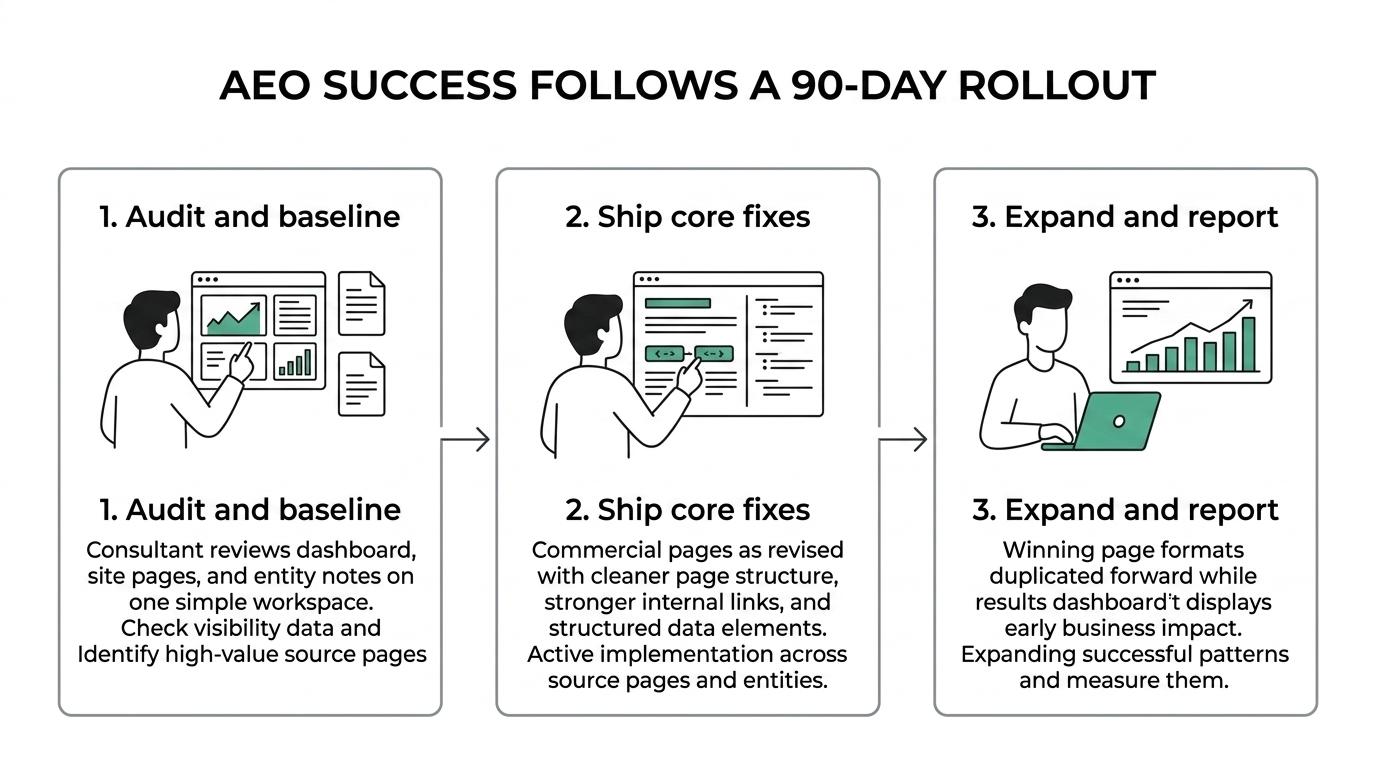
In days 1 through 30, the consultant should audit visibility, verify analytics, map entities, review existing content, and identify your highest-value source pages. In days 31 through 60, the focus should shift to shipping: revising commercial pages, strengthening internal links, improving structured data, tightening claims, and building authority signals around authors, products, and categories. In days 61 through 90, the program should expand what is working, test new answer formats, and report early business impact.
“Austin Heaton reports average early gains of 454% in AI impressions and 560% in AI clicks for a client during implementation.”
If the plan starts with bottom-funnel assets, that is usually a good sign. If your consultant begins with generic awareness content before fixing pricing pages, solution pages, comparison pages, or documentation, ask why. In most B2B environments, the fastest signal comes from pages that already sit closest to qualified demand.