
Search visibility used to be a ranking problem.
Last updated - October 2026
For B2B companies, it is now an experience problem.
A buyer might see a Google result, an AI Overview, a ChatGPT answer, a comparison page, a review snippet, and a product page before ever booking a demo. If those touchpoints feel fragmented, vague, or hard to trust, traffic alone will not carry revenue. Search experience optimization is the discipline of making every one of those moments useful, credible, and easy to act on.
That shift is happening fast. Search is no longer only a list of blue links, and B2B buyers are not patiently moving step by step through a neat funnel.
What search experience optimization means in B2B search
Search experience optimization goes beyond classic SEO. The goal is not just to win a click. The goal is to shape what the buyer sees, reads, and believes across the full search-and-research process.
In B2B, that means optimizing for both retrieval and interpretation. A page has to rank, yes, but it also has to be easy for Google, AI systems, and human buyers to parse. Clear category language, direct answers, proof points, structured comparisons, and strong internal paths all matter because they reduce friction at the exact moment a buyer is forming a shortlist.
This is especially important in markets where products are technical, expensive, or category definitions are still shifting.
A strong B2B search experience usually includes several connected signals:
- AI Overviews on high-value queries
- Chat-based research before site visits
- Review and comparison content influencing trust
- Product pages that answer questions without forcing extra clicks
- Conversion paths tied to intent, not just traffic volume
When teams treat search as an experience system, they stop asking only, "How do we rank?" and start asking, "What does the buyer encounter before, during, and after the search result?"
That is a much better question.
Why AI Overviews and AI chat changed B2B search behavior
The evidence is already substantial. Conductor reported that 25.11% of 21.9 million analyzed Google searches triggered an AI Overview during a four-week period in late 2025. Pew Research Center found that 58% of respondents had at least one Google search produce an AI-generated summary in a single month of browsing data. This is not fringe behavior. It is becoming normal search behavior.
Want AI engines to recommend your company? Book a free 30-minute AI visibility review with Austin.
Book a CallAt the same time, standalone AI tools are changing research habits. G2 reported that nearly 8 in 10 B2B decision-makers said AI search changed how they conduct research, and 29% said they begin research with platforms like ChatGPT more often than Google.
That matters because early research often shapes the shortlist before a vendor even knows a buyer exists.
Forrester adds another layer: 68% of B2B buyers start with a front-runner in mind, and that preferred vendor wins a large share of deals. If buyers are forming those preferences inside AI-mediated research moments, then search experience optimization becomes part of demand creation, category definition, and pipeline influence all at once.
The old model assumed the website was the first serious interaction. In many categories, the answer interface now holds that role.
The core elements of a B2B search experience strategy
A useful way to think about search experience optimization is to map buyer intent to the search surface where that intent appears. Different moments require different assets, and the experience should feel coherent from answer to click to conversion.
Here is a practical framework.
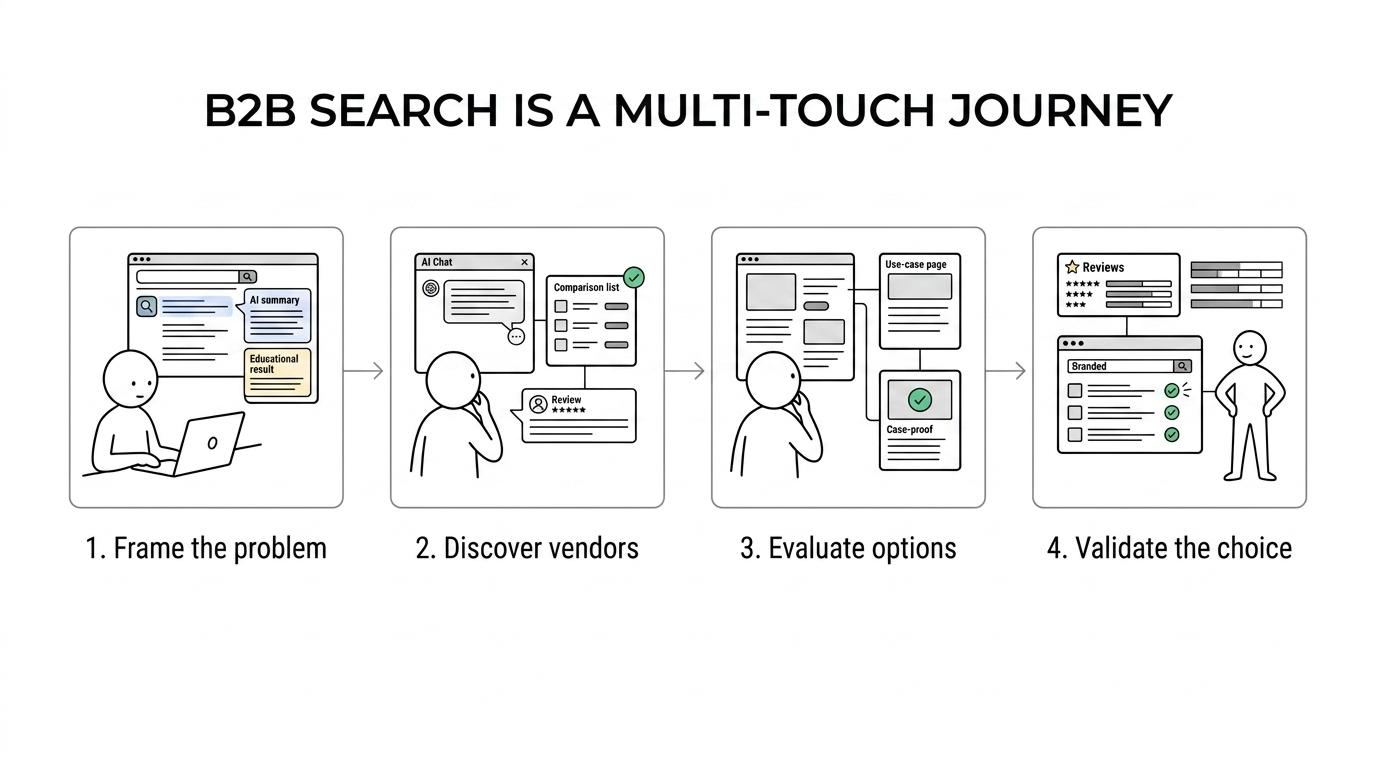
| Buyer moment | Common search surface | What the buyer needs | Best brand asset | Success signal |
|---|---|---|---|---|
| Problem framing | Google results, AI answers, industry publishers | Clear explanation of the problem and solution types | Educational pages, glossaries, category explainers | Impressions, citations, assisted visits |
| Vendor discovery | AI chat, listicles, review sites, comparison queries | Which vendors are credible and relevant | Comparison pages, category pages, third-party mentions | Brand mentions, referral traffic, shortlist inclusion |
| Evaluation | Product pages, docs, use-case pages, case studies | Proof, differentiation, implementation clarity | Use-case pages, pricing guidance, case studies | Demo requests, return visits, sales-assisted conversions |
| Validation | Review platforms, community posts, branded search | Confirmation that the choice is safe | Reviews, testimonials, expert commentary, FAQs | Branded query growth, pipeline progression |
The table looks simple, though the implications are significant. Many B2B sites are overbuilt for branded evaluation and underbuilt for unbranded discovery. They have polished product pages but weak category education. They have thought leadership but very little content designed to answer direct buyer questions. They have traffic, but few assets that AI systems can quote cleanly.
Search experience optimization fixes that imbalance.
It also pushes teams to think in entities rather than just pages. Buyers and AI systems both want to know what a company is, who it serves, how it differs, and why it is trustworthy. If that picture is inconsistent across the website, search listings, earned mentions, and structured content, visibility becomes harder to sustain.
How content architecture supports search experience optimization
The architecture behind the content matters almost as much as the content itself. B2B sites often bury high-intent answers several clicks deep, separate product claims from proof, and force users to stitch together the story on their own. That is bad for humans and bad for machines.
A better approach is to build content clusters around buying questions, not publishing categories. A use-case page should connect naturally to product detail, integration detail, case proof, FAQs, and conversion options. A comparison page should not feel like a dead-end asset created only for rankings. It should lead the buyer into a deeper and more confident evaluation path.
The strongest programs tend to follow a few principles:
- Entity clarity: define the category, product, use cases, buyer types, and differentiators in plain language.
- Intent matching: build distinct pages for problem-aware, solution-aware, and vendor-aware searches.
- Answer depth: provide direct responses near the top of the page, then add evidence, examples, and next steps.
- Conversion continuity: connect every search entry point to a relevant action, whether that is a demo, a guide, a calculator, or a case study.
This is where many SEO programs become revenue programs.
Reported case data from Austin Heaton points to more than 2,000 sales from organic search across B2B clients, 288% organic growth in 12 months, and one campaign that generated 101 AI-search conversions in 60 days. Those outcomes are useful not only as performance proof, but as a reminder that search experience work can be tied to business results when the system is built around intent, authority, and conversion paths.
Content formatting for AI answers and human buyers
Content now needs dual readability. It should work for a person skimming under time pressure and for a model extracting meaning from the page.
That usually means cleaner page structure, stronger semantic cues, clearer definitions, and tighter factual statements. As 6SenseTech explains in its Core Web Vitals basics for high-growth SaaS websites, many of the same choices, scannable layouts, stable media, and predictable interaction patterns, translate directly into stronger UX signals that search and AI systems can interpret.
If a page rambles before it answers, it becomes harder to cite and less persuasive to read. If a page gives an answer but no evidence, it may earn visibility without earning trust.
Useful asset formats often include:
- Category definition pages
- Alternative and competitor comparison pages
- Industry-specific use-case pages
- Product-led FAQs
- Evidence-rich case studies
- Integration and implementation pages
Formatting details matter more than many teams expect. Tables, concise summaries, short paragraphs, direct headings, and well-labeled proof points help both retrieval systems and real buyers. So does consistency. A claim on a product page should be reinforced by the help center, by off-site mentions, and by case studies that use the same language.
That consistency is what turns content into a reliable source rather than just another page in the index.
How to measure search experience optimization in pipeline terms
B2B teams should resist the temptation to judge success by rankings alone. Rankings still matter, though they no longer tell the whole story. Search experience optimization spans visibility, citation, engagement, and conversion across several interfaces.
A stronger scorecard combines search metrics with buying metrics. It asks whether the brand is present in answer surfaces, whether the message is clear when surfaced, and whether that visibility moves qualified pipeline.
The measurement stack often includes:
- Surface visibility: rankings, AI Overview appearances, AI citations, branded and non-branded impressions
- Engagement quality: click-through rate, engaged sessions, return visits, assisted conversions
- Commercial performance: demo requests, qualified leads, opportunity creation, influenced revenue
- Authority signals: referring domains, press mentions, review coverage, topic ownership across key queries
This is where a full-stack approach stands out. If a team publishes quickly, builds authority off-site, and monitors how AI systems cite or summarize the brand, it can adapt before market share slips. Austin Heaton's published results cite up to 288% organic growth and 575% AI search growth, along with early implementation gains in AI impressions and clicks. Whether the exact figures vary by market, the lesson is clear: the right search system compounds.
Fast feedback loops matter. So does ownership. Search experience optimization works best when strategy, content, technical execution, authority building, and measurement are connected rather than split across disconnected vendors.
Search experience optimization mistakes B2B teams should fix
One common mistake is treating AI search as a side channel. It is not. If a buyer starts with ChatGPT, sees a Google AI Overview, then visits review content before the website, AI mediation is already part of the buying process.
Another mistake is over-investing in top-of-funnel traffic while neglecting bottom-funnel clarity. A site can attract thousands of visits and still lose category control if its comparison pages are weak, its product pages are abstract, and its proof is hard to verify.
There are also messaging mistakes that quietly weaken performance:
- vague category labels
- unsupported product claims
- thin pages targeting high-value buyer queries
- fragmented internal linking
- no clear path from education to action
The fix is not to publish more content at random. It is to publish with intent, structure, and accountability.
B2B companies that win in search over the next few years will be the ones that treat every answer surface as part of the buying experience. They will make it easy for AI systems to quote them, easy for buyers to trust them, and easy for interested prospects to take the next step. That combination is where visibility starts turning into pipeline.
Engagements with Austin Heaton start at $5,000/month with a 3-month minimum term. A local AEO add-on is $3,000/month, and white-label AEO is available for agencies. See pricing.