
How to Hire an SEO Agent That Drives Real Growth
A practical guide to finding, vetting, and hiring the right SEO agent. Learn to define goals, ask strategic questions, and build a partnership for success.


An SEO agent is a specialist who gets your website to the top of search engines like Google. But it's not just about traffic—a good one drives qualified leads and paying customers to your digital doorstep. They're a strategic partner focused on real business outcomes, like boosting revenue and slashing your customer acquisition costs.
Why a Great SEO Agent Is a Growth Multiplier
In today's market, just having a website isn't enough. You need to be visible. And not just visible for random keywords, but visible to your ideal customers right when they’re searching for your exact solution.
This is where a sharp SEO agent becomes a true growth multiplier. They can turn your website from a static online brochure into a machine that consistently generates its own leads.

From Burning Cash to Building Assets
Think about these two all-too-common scenarios:
- The B2B SaaS Company: They’re dumping thousands into paid ads. They get clicks, sure, but very few turn into qualified leads. Their customer acquisition cost (CAC) is through the roof, and the moment they pause the ad spend, the pipeline dries up completely. This is a tactical comparison of renting vs. owning traffic. Paid ads are a rental; SEO is an asset you build.
- The E-commerce Store: They have amazing products but are buried on page two of Google. To potential buyers, they might as well not exist.
A skilled SEO agent flips this script entirely.
Instead of constantly renting traffic from ad platforms, you start to own it. A great agent’s primary job is to dramatically increase your online footprint and show you how to get more visitors from Google who are ready to buy. This creates a sustainable brand asset that actually grows in value over time, much like the results we saw in this B2B payments platform case study.
By targeting high-intent keywords and dialing in your technical SEO, a top-tier partner can slash your CAC while cranking up the volume of organic leads—people who were already looking for what you sell.
This is exactly why the demand for expert consultants is exploding. The SEO agency market in the U.S. is on track to hit $119.4 billion in 2025. That's a massive 14.1% jump from 2024, proving just how critical this role has become. You can dig into more of this data on the industry's growth over at IBISWorld.
Defining Your Goals Before Starting the Search
Hiring an SEO agent without clear goals is like setting sail without a map. You’ll feel busy, but you’ll burn through time and money on activities that don't actually move the needle.
Before you even think about looking at proposals, you have to define what success actually looks like for your business.
Vague goals like "get more traffic" or "rank #1" aren't strategies. They're wishes. A top-tier SEO expert needs a specific target to aim for—one that ties directly to your bottom line. This is how you shift from chasing vanity metrics to driving real business outcomes.
From Vague Desires to Specific Objectives
To find the right partner, you need to hand them a clear scorecard. The difference between a generic request and a sharp, measurable goal is night and day.
- For a B2B SaaS Company: Don't ask for more organic traffic. A much better goal is to "increase qualified demo requests from organic search by 30% over the next two quarters." This hits your sales pipeline directly.
- For an E-commerce Brand: Forget just ranking for more keywords. Aim to "grow organic revenue from non-branded product category keywords by 40% in six months." This is all about capturing new customers who don't know your brand yet.
Setting precise, business-centric goals is the single most important step you can take. It’s how you measure ROI accurately and ensure you and your future SEO agent are perfectly aligned on what victory looks like.
Conducting a Quick Internal Audit
Once you have specific goals locked in, it's time for a quick reality check. Getting your house in order first helps you understand exactly what kind of support you actually need.
If you're trying to figure out the right engagement model, this guide on SEO as a service can help clarify your options.
Start by asking three simple questions:
- What is our SEO maturity? Are you starting from absolute zero with a brand-new domain? Or do you have a foundation of content and backlinks that just needs a tune-up? A new site requires a totally different strategy than one with years of history.
- What is our realistic budget? SEO is an investment, not a line-item cost. Your budget needs to reflect how ambitious your goals are. A campaign to dominate a competitive national keyword is going to demand a much bigger investment than a local SEO push.
- Who is the internal point person? Your SEO agent will need a dedicated contact for approvals, questions, and collaboration. Pinpoint who on your team will own this relationship to keep things moving and prevent bottlenecks.
With these answers ready, you’re prepared to find an SEO agent who not only gets your vision but has the right skills and experience to make it happen.
Alright, you've got your goals locked in. Now comes the hard part: finding an SEO agent who can actually deliver.
Forget casting a wide net with a generic Google search. That's a recipe for getting a thousand flashy sales pitches and zero real experts. To find top-tier talent, you need to be surgical.
Start where the real experts hang out. If you’re a SaaS company, dive into niche LinkedIn groups or private Slack communities where the pros talk shop. The best lead, though? A referral from someone you trust in your network. A recommendation from a peer who’s already seen killer results is pure gold.
Before you even start reaching out, make sure your own house is in order. You need to know what you want, what you have, and what you can spend.
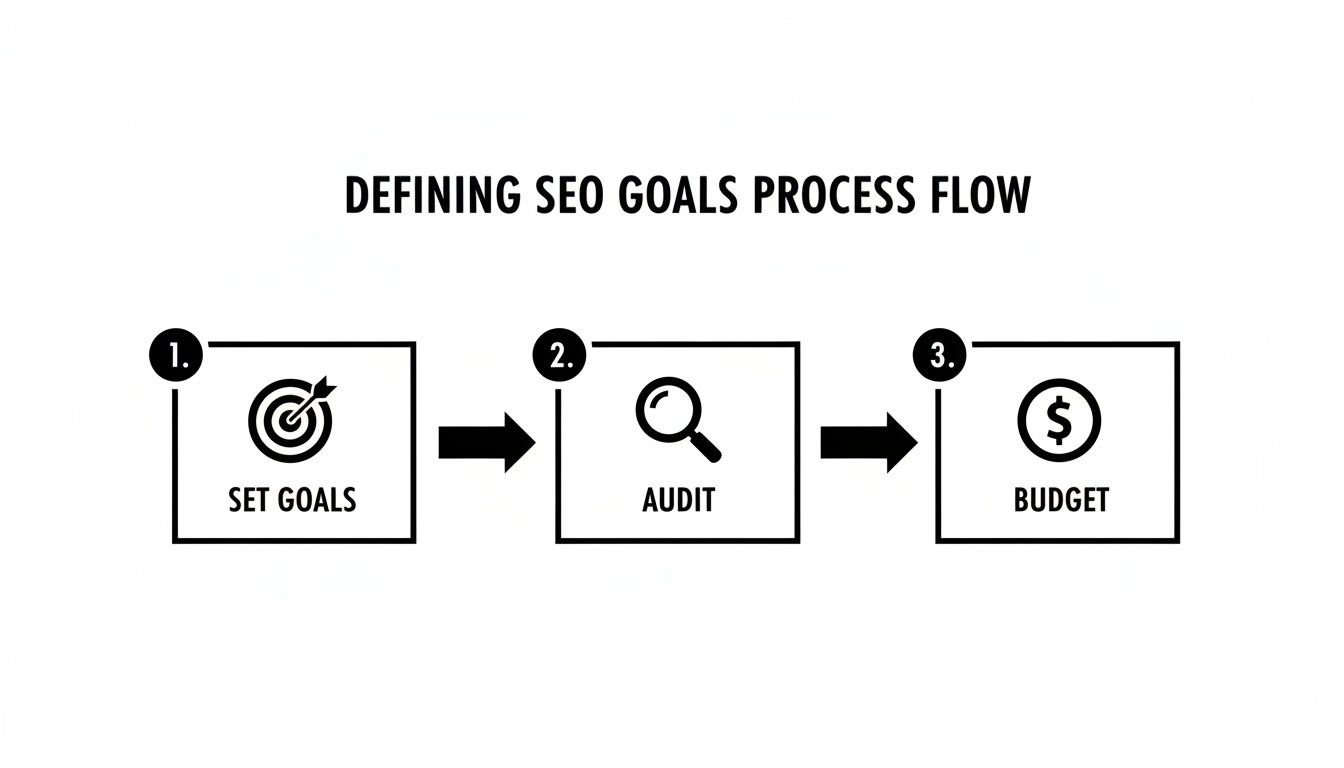
Get these three pillars—Goals, Audit, Budget—nailed down first. It’s the only way you'll be able to properly vet anyone you talk to.
Forget Vanity Metrics—Demand to See Real Business Impact
This is where you separate the talkers from the doers. Anyone can flash a chart showing a "200% traffic increase." That means nothing. You need to see a direct line from their work to actual business growth.
When you're digging through their portfolio, use this checklist:
- Is their experience relevant? An agent who crushed it for a Shopify store probably doesn’t have the chops for a complex B2B SaaS platform. If you're in SaaS, you need someone who understands your world. The tactics used by specialized SaaS SEO consultants are worlds apart from e-commerce or local business SEO.
- Do their case studies have teeth? Look for the story. What was the problem? What specific strategy did they use to fix it? And what were the results? I'm talking about metrics like "drove a 30% drop in cost-per-acquisition" or "grew qualified organic leads by 50%." That's the stuff that matters.
- Are they transparent about their methods? A true expert won't hide behind jargon. They should be able to clearly explain their approach to technical SEO, content strategy, and link building. If it feels like they're trying to obscure what they do, run.
A killer portfolio isn't about rankings. It’s a collection of success stories about business growth. It should make you feel confident they know how to connect search performance directly to your company’s bottom line.
Look at Their Own Backyard First
Before you hand over the keys to your website, check out theirs.
Does their own site rank for competitive keywords? Is their blog full of sharp, insightful content, or is it just generic fluff? This is the ultimate sniff test. If they can’t get results for themselves, there’s no way they can get them for you.
Speaking of results, expect to pay for them. The right SEO partner can deliver an insane ROI—sometimes upwards of 700%—but that level of expertise doesn't come cheap. In 2025, top-tier agencies in the US are averaging $150/hour, with project-based work often landing in the $2,501-$5,000 range. And yes, most are planning to raise their prices.
To help you make sense of the different ways agents charge, here's a quick breakdown of the most common pricing models.
Comparing SEO Agent Pricing Models
This table breaks down the common pricing structures you'll encounter. It’s designed to help you quickly evaluate proposals and understand what your budget can realistically get you.
Ultimately, you’re not just hiring a vendor; you’re bringing on a partner. Their communication should be clear, proactive, and feel like a true collaboration. And sometimes, having someone local is a huge plus. If that's a priority, our guide on finding an SEO service near me has some great tips.
Do your homework here. This careful vetting process is what ensures you land a genuine expert who can drive real, sustainable growth for years to come.
Asking Questions That Uncover Real Expertise
This is where the rubber meets the road.
The interview is your chance to finally separate the genuine strategists from the slick salespeople who just memorized a few buzzwords. Generic questions will only get you generic, rehearsed answers.
If you really want to find out who you’re dealing with, you need to ask questions that force them to think on their feet. Push them past the textbook definitions and into real-world problem-solving.
Probing for Technical and Strategic Depth
A top-tier SEO agent thinks like a business owner, not just a marketer. You aren't just paying for traffic; you're paying for someone who can connect technical fixes to actual business outcomes.
Here are a few sharp questions I use to test that connection:
- Scenario-Based Technical Audit: "Walk me through the last technical SEO audit you did for a B2B SaaS company. What were the top three issues you found, and how did you decide which one to fix first based on business impact?"
- Handling Volatility: "Tell me about a time a major Google update tanked a client's traffic. How did you figure out what happened, and what specific steps did you take to turn things around?"
- Real-World Link Building: "What's your actual philosophy on link building, not the textbook version? Give me an example of a high-authority link you earned for a client and break down the exact process you used to get it."
There's no single "right" answer here. What you're listening for is a clear, logical thought process. You want to hear them talk about data, about tying their actions back to leads and revenue.
How Do They Handle AI and Content?
The world of SEO is changing fast, and an agent's approach to modern tools is everything. Globally, the SEO services market is on track to hit $143.9 billion by 2030. A huge piece of that pie—over 60% of mid-sized agency budgets—is poured directly into content and links.
And now, AI tools are eating up 10-15% of that spend. You can read more about these SEO market trends at Digital World Institute. This makes it absolutely critical to dig into their expertise here.
Ask them directly:
- How are you actually using AI in your workflow for content and keyword research?
- What's your process for making sure AI-assisted content is accurate, original, and meets Google's E-E-A-T (Experience, Expertise, Authoritativeness, Trustworthiness) standards?
Their answer tells you everything. Do they see AI as a powerful lever for efficiency and quality, or just a cheap shortcut to churn out crappy content?
A strong candidate will talk about using AI for data analysis, finding content gaps, and creating detailed outlines for human writers. A weak candidate will talk about putting your SEO on "autopilot."
Red Flags vs. Green Flags: Spotting a Strong Response
Pay attention to how they answer, not just what they say. Vague promises without any data to back them up are a massive red flag.
Here’s a quick cheat sheet on what to listen for:
See the difference? It’s all about specificity. A true expert gives you a clear, logical plan that's grounded in data and focused on your business goals. A salesperson sells you a vague dream. Your job in the interview is to figure out which one is sitting across the table.
Structuring the Partnership for Long-Term Success
You've vetted the portfolios and asked the tough questions. Now it’s time to build a rock-solid foundation for a successful partnership. A vague handshake agreement just won't cut it.
You need a detailed contract or statement of work (SOW) that clearly outlines expectations for both sides.
Think of this document as your roadmap. It transforms abstract goals into concrete actions and, more importantly, prevents the dreaded scope creep that can completely derail an engagement. It’s where you define exactly what your new SEO agent will do and how you’ll measure their success.

A strong SOW itemizes specific deliverables, not just broad services. This provides total clarity and ensures you know precisely what you’re paying for each month.
- Weak Deliverable: "Monthly SEO Services"
- Strong Deliverable: "One monthly technical site audit report, four keyword-driven content briefs for the blog, and on-page optimization for two core service pages."
This level of detail holds everyone accountable. This is also where you nail down communication rhythms, like bi-weekly check-in calls or a shared Slack channel, to keep the project humming along smoothly.
The Power of a 90-Day Quick Wins Plan
Instead of locking into a year-long retainer right out of the gate, I always recommend starting with a tactical 90-day plan. This trial period is the ultimate test drive.
It lets you see initial momentum and evaluate the working relationship before making a long-term commitment. The whole point is to secure immediate value and build trust from day one.
A 90-day plan forces prioritization. It shifts the focus from a long, overwhelming list of potential SEO tasks to the handful of high-impact actions that will generate visible results quickly. It proves the value of the partnership early.
This approach shows your new SEO agent can deliver tangible outcomes. It’s the perfect way to validate your hiring decision with real data, not just promises.
A Sample 90-Day Tactical Plan
Your initial engagement should be laser-focused on foundational wins that pave the way for future growth. A typical plan might look something like this:
- Action: Conduct a comprehensive baseline audit covering technical SEO, content, and backlinks.
- Goal: Identify and fix critical, high-impact technical issues like indexing problems or slow site speed. Establish baseline KPIs for organic traffic and conversions.
- Action: Optimize meta titles, descriptions, and on-page content for your top five most valuable, bottom-of-funnel pages.
- Goal: Improve click-through rates and rankings for high-intent keywords that are already hovering close to page one.
- Action: Develop the first content cluster based on keyword gap analysis and deliver two long-form articles.
- Goal: Begin building topical authority and report on initial KPI improvements from the first 60 days of work.
This structured, results-first start ensures your partnership is built on a foundation of measurable progress and clear communication.
Onboarding Your SEO Agent to Get Results Fast
The contract is signed. Awesome. But the real work is just starting.
The first 1-2 weeks with your new SEO agent set the tone for the entire relationship. A messy, disorganized onboarding creates friction and kills momentum. A clean, structured one gets your agent delivering wins almost immediately.
Think of it this way: a bad onboarding is like tossing someone the keys to a race car and saying, "Good luck." They'll spend half the day just trying to figure out how to start it.
A great onboarding is giving them the keys, a full tank of gas, a map of the track, and a headset connected directly to the pit crew. That’s how you win.
Set the Stage for Quick Wins
To move fast, your agent needs access. Now.
Seriously. One of the most common—and totally avoidable—bottlenecks is slow-walking permissions. This can stall a project for weeks before it even gets going.
On day one, be ready to grant access to:
- Google Analytics: For all the historical traffic data and user behavior insights.
- Google Search Console: This is non-negotiable. It’s the direct line to Google for keyword data, indexing problems, and overall site health.
- Your CMS (WordPress, Shopify, Webflow, etc.): So they can actually implement technical fixes and on-page optimizations instead of just sending you a list of things to do.
Without this, your agent is flying blind. They're forced to guess instead of using real data to build their strategy. This single administrative step is the difference between a running start and a dead stop.
The point of onboarding isn’t just to hand over logins. It's to eliminate friction. Every time your agent has to ask about brand voice or past campaigns, it’s a distraction from the deep strategic work you hired them for.
The Collaborative Kickoff Meeting
Once access is handled, the kickoff meeting is where you get aligned.
This isn’t just a "hello." It's a hands-on working session to lock in the 90-day plan you talked about during the hiring process.
To make this meeting incredibly productive, send these documents over beforehand:
- Brand Guidelines: So they nail your tone of voice and visual style from the get-go.
- Audience Personas: So they know exactly who they’re writing for and trying to attract.
- Historical Data: Any past SEO reports, keyword research, or campaign results you have. Good, bad, or ugly—it’s all useful context.
Doing this prep work means the meeting is spent on strategy and priorities, not basic background questions.
By the end of this call, your SEO agent should have a crystal-clear roadmap for the first few weeks. This is how you build momentum and kick off a partnership that’s built for speed.
A Few Common Questions About Hiring an SEO Agent
You’ve got questions. I’ve got answers. Finding the right SEO partner is a big decision, and it’s smart to get everything out in the open before you commit. Here are a few of the most common things people ask me.
How Long Until We See SEO Results?
I'll be straight with you: real, sustainable SEO isn't an overnight fix. While you might see small wins from technical tweaks in a few weeks, meaningful, traffic-driving results typically start showing up within 4-6 months.
The first 90 days are all about laying the foundation.
- Deep-diving into technical and content audits to find what's broken.
- Building a sharp, data-backed strategy that aligns with your goals.
- Knocking out high-impact fixes and on-page optimizations first.
Think of it like building a house. The first few months are spent on the foundation—it’s not glamorous, but without it, nothing else can be built. That underground work is what supports the visible growth you'll see in the coming quarters.
SEO Agent vs. Agency: What’s the Difference?
The choice between a solo SEO agent and a full-blown agency really boils down to what you need, your budget, and how hands-on you want to be.
An SEO agent or consultant is your senior strategist. They’re the expert in the trenches with you, owning the strategy and the results directly.
An agency, on the other hand, is a larger operation with a whole team of specialists—writers, link builders, account managers. A freelancer is even more specialized, usually hired for one specific task.
It all comes down to scope. If you have an in-house team that needs a high-level strategist to guide them, an agent is your best bet. If you need to outsource every single piece of the puzzle, an agency might make more sense.
What Are the Most Important KPIs to Track?
Forget vanity metrics. Raw traffic numbers don't pay the bills. The only KPIs that truly matter are the ones tied directly to your business’s bottom line. A good SEO agent will laser-focus on these from day one.
You want to measure real business impact, like:
- Organic Conversions: How many leads, sales, or sign-ups are coming from search?
- High-Intent Keyword Rankings: Are you visible for the keywords people use when they're ready to buy?
- Organic MQLs or Revenue: What's the actual pipeline or revenue generated from your SEO investment?
These are the numbers that prove your ROI. They show that your SEO spend isn't just an expense—it's a growth engine.
Ready to turn search into your most reliable growth channel? As your dedicated SEO partner, Austin Heaton focuses on delivering measurable outcomes—like increased traffic, leads, and authority—within the first 90 days. Learn more about how we can build your growth engine.