
Finding the Right SEO Service Near Me: a Tactical Guide
Stop guessing. This guide shows you how to find, vet, and hire the best SEO service near me with actionable steps, key questions, and real-world criteria.


Typing "seo service near me" into Google can feel like shouting into a void. But finding the right local partner isn't just about convenience—it's a tactical advantage that can drive real business growth.
Latest Update: July 2026. "Near me" intent is now explicit: roughly 46% of consumers say they always or often add location modifiers like "near me" to local queries, exactly the intent a near-me SEO service is built to capture (Source: BrightLocal).
A local expert brings something a remote national firm never can: a genuine, boots-on-the-ground feel for your market. Compare it to choosing a real estate agent. You wouldn't hire someone from another state to sell your home; you'd hire the local pro who knows every street, school district, and market trend. The same logic applies to SEO. They know the neighborhood dynamics, the local competitors, and what makes your community tick.
Why a Local SEO Partner is a Game Changer
When you hire a local SEO agency, you’re not just getting a vendor; you’re getting an ally who understands your city's economy because they live in it.
This isn't just about sentiment; it's about translating insider knowledge into strategies that connect with local customers. For example, a national agency might see your Las Vegas business as just another pin on a map. A local pro knows the tactical difference between targeting tourists on the Strip and residents in Summerlin.
That kind of intimate knowledge pays dividends. A local partner can build content around a community event like "First Friday," tap into their network of other local businesses for authentic backlink opportunities, and target hyper-local keywords like "Henderson family dentist" that broad, automated tools would completely miss.
The Power of Being There
Honestly, one of the biggest tactical wins is the ability to meet face-to-face.
You can accomplish more in a single one-hour strategy session at a local coffee shop than in a week of back-and-forth emails and laggy video calls. When your SEO partner can walk into your store, meet your team, and see your operation firsthand, they "get it." They understand your brand on a much deeper level, which always leads to better, more aligned results.
A great local SEO partner doesn't just tweak your website. They become a true extension of your team, someone who’s just as invested in your local success as you are because they're part of the same community.
This isn’t just a niche idea; it’s where the market is heading. The global SEO services market is expected to rocket to nearly $60 billion by 2032, largely because businesses are finally realizing the power of proximity-based marketing. You can see the full breakdown from Grandview Research. The takeaway is clear: the biggest wins come from focusing on the customers right outside your front door.
Local vs. National Agencies: A Tactical Comparison
Choosing between a local expert and a national firm means weighing different strengths. A big agency might flash a giant team and fancy software, but they often run the same generic playbook. It's like getting a suit off the rack versus one that's custom-tailored; one fits okay, the other fits perfectly.
A local agency's superpower is its agility and deep specialization in your market.
To make it clearer, here’s a quick table to show you what I mean.
Local vs National SEO Agency: What's the Difference?
At the end of the day, a local partner offers a level of focus and authenticity that's tough for a remote behemoth to replicate. They're not just running a campaign; they're helping a neighbor succeed.
The real goal is to find a partner who blends sharp technical skills with that irreplaceable local intelligence. This model is exactly what we explore in our guide on SEO as a Service.
When you start looking for an "SEO service near me," the goal isn't to create a giant spreadsheet of every agency in a 50-mile radius. That’s an inefficient tactic.
Your mission is to find three to five solid candidates who can prove they know local SEO. This means looking past paid ads to find agencies that are actually in the trenches, getting results.
The first, most obvious place to start is Google itself. But not just a generic search. Pay close attention to the Google Local Pack—that map with three businesses listed at the top. The agencies ranking there aren't just selling SEO; they're winning at it for themselves.
Think of it as the ultimate litmus test. An agency ranking its own business in the local pack has practical, real-world skills. It's like hiring a personal trainer who is already in great shape. It's a much better sign of competence than a flashy website or a big ad budget.
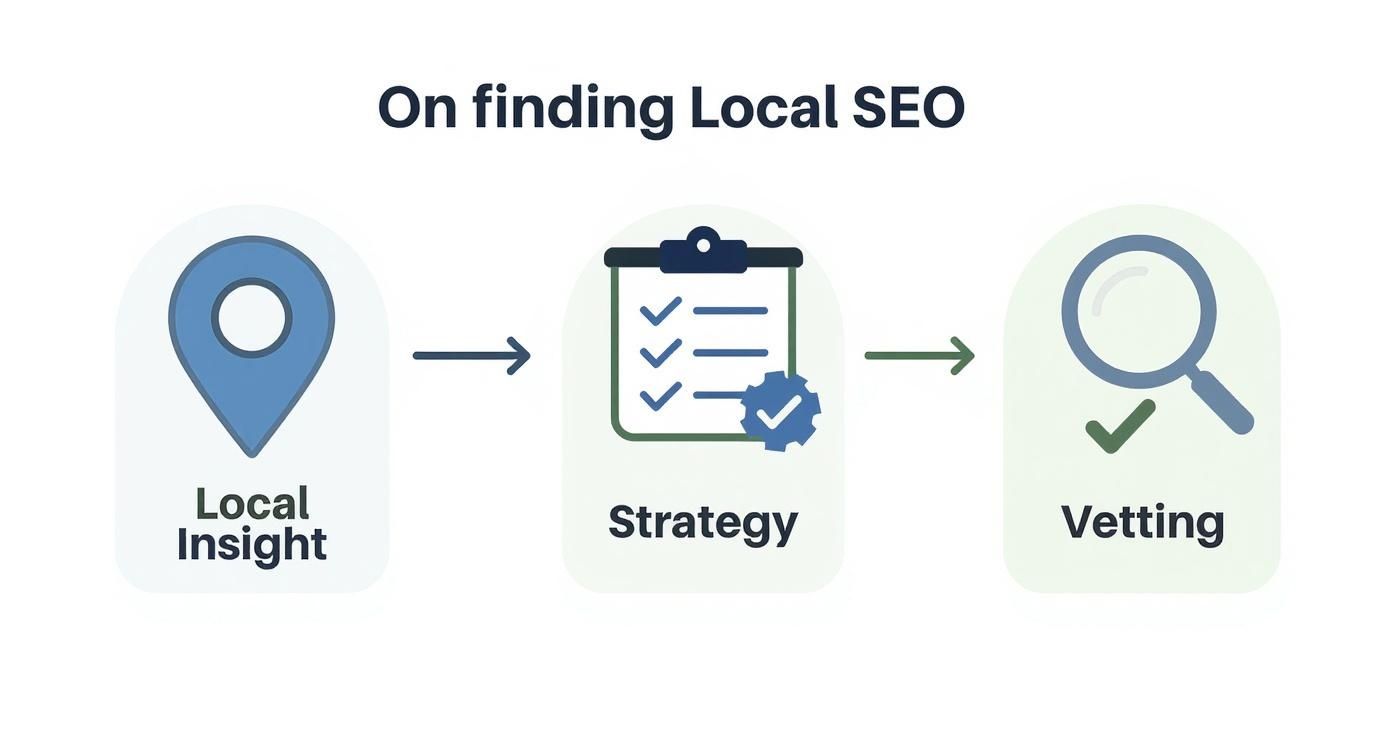
The path from a simple search to hiring the right partner is a structured journey. It's about finding proof, not just promises.
Go Beyond Google with Vetted Directories
Google is a great first step, but it's not the entire strategy. You need a layer of social proof, and that's where B2B directories come in. Platforms like Clutch, UpCity, and GoodFirms are goldmines for this kind of research.
These aren't just simple business listings. They’re built on verified client reviews, portfolios, and even interviews with the agency owners. For example, Clutch interviews clients directly over the phone to get unbiased feedback, offering a layer of verification you won't find in a simple Google review.
Pro Tip: Don't just search by location. Use filters to narrow by industry focus and budget. For example, on Clutch, you can drill down to SEO firms in "Chicago," filter for those specializing in "Real Estate," and then sort by the number of reviews. This tactical approach immediately surfaces the most established and relevant players.
Analyze Their Digital Footprint
As you flag potential agencies, it's time to do some reconnaissance on their own online presence. A good local SEO service should be practicing what they preach. It's a massive red flag if they aren't.
Here’s a tactical checklist:
- Google Business Profile (GBP) Check: Is their own GBP complete and active? Look for recent posts, fresh photos, and a steady stream of new reviews they've actually responded to. An active GBP shows they understand the fundamentals of local customer engagement. An ignored profile is like a chef with a dirty kitchen.
- Website Quality: Pull up their site. Run it through Google's PageSpeed Insights. Does it load fast? Does it look professional? Is it immediately clear what they do and who they help? If their own site is a clunky, slow mess, how can you trust them with yours?
- Recent Content: Check for a blog, case studies, or local market reports. An agency actively publishing useful, recent content is staying on top of SEO trends. A blog that hasn't been updated in a year suggests they're coasting on old tactics.
Combine these three discovery methods—the Local Pack, vetted directories, and a deep dive into their own digital presence. You'll end up with a powerful shortlist of contenders who are actually worth talking to.
Vetting Your Candidates Beyond the Sales Pitch
You have a shortlist. Now comes the critical vetting stage.
It's time to look past the slick websites and smooth sales calls. This is where you separate the real local SEO pros from the talkers. Your job is to find hard proof that they can deliver results that grow your business, not just pump up vanity metrics.
Plenty of agencies will flash charts showing traffic going up. But traffic doesn’t pay the bills. The SEO industry is now worth over $81.46 billion for a reason: businesses are demanding strategies that generate a measurable return. You can dig into the industry trends and projections here if you're curious.

Analyzing Case Studies for Real Business Impact
When an agency sends a case study, don’t just glance at it. Put on your detective hat. Look past the flashy percentages and find the story behind the data.
For instance, a case study for a local plumber might brag about a "200% traffic increase." Sounds impressive, but without context, it's a hollow statistic. What if that traffic came from another state and none of it converted? It's a meaningless victory.
Here's a comparison of a weak vs. strong case study:
A weak case study:
- Fixates on traffic and keyword rankings (e.g., "We ranked them #1 for 10 keywords!").
- Uses fluffy language like "improved online visibility."
- Never mentions what the client actually wanted to achieve.
A strong case study:
- Points to a 35% increase in qualified phone leads from organic search.
- Shows a 50% jump in booked appointments attributed to the website.
- Directly connects their SEO work to a documented increase in the client’s revenue.
This is the difference between hiring a marketer and a business partner. A true partner understands you're not buying rankings; you're investing in a system to acquire more customers.
A great SEO partner thinks like a business owner first and a marketer second. They tie every action back to a business outcome, whether it's more phone calls, more foot traffic, or more online sales.
Confirming Niche and Vertical Experience
Local SEO is not a one-size-fits-all game. The tactics for a criminal defense attorney are completely different from those for a multi-location pizza chain. Always ask for examples of clients they've worked with in your industry or a similar one.
Let’s say you run a dental practice. You should be asking tactical questions like:
- "Can you show me results for another dental or medical practice?"
- "What's your process for building topical authority around sensitive E-E-A-T healthcare subjects?"
- "What are your specific strategies for managing and responding to patient reviews on platforms like Healthgrades vs. Google?"
Their answers will immediately tell you if they have real-deal experience or if they’re winging it. Generic responses are a major red flag that they lack the specialized knowledge you need. This focused expertise is often what makes a top-tier SEO consultant so much more effective than a generalist agency.
Evaluating Their Preliminary Site Audit
Many agencies will offer a free, quick audit of your site as part of their pitch. This is a golden opportunity to see how they think.
Pay close attention to whether the audit feels custom or like a generic template. A copy-and-paste report filled with technical jargon from an automated tool is a sign of laziness. A valuable audit gives you specific, actionable insights tailored to your website and local market. For example, instead of just saying "improve site speed," a tactical audit would say, "Your hero image is uncompressed and adding 1.5 seconds to your load time. Compressing it could reduce bounce rate on your service pages."
Asking the Right Questions During the Interview
You’ve checked their case studies and confirmed they have real-world experience. Now comes the gut check: the interview.
This conversation is where you move past the sales pitch and see how they really think. Are they a partner or just another vendor? A few sharp, specific questions will tell you everything you need to know.
Don’t bother with vague questions like, "So, what's your process?" Every agency has a polished answer for that. You need to push them on what they’d do for your business.

Here's a much more tactical approach. Frame a real-world scenario they have to think through on the spot.
Try asking this: "Walk me through the first 90 days of an SEO campaign for a business like mine. What specific deliverables and milestones should I expect to see?"
This one question instantly separates the strategists from the task-doers.
A weak answer will be full of jargon like "audits" and "keyword research." A strong answer will sound like an actual plan. They’ll talk about quick wins in the first 30 days—like optimizing your Google Business Profile and fixing critical site errors—before moving into content and link-building initiatives. It's the difference between a contractor saying "I'll build you a house" and one who shows you the blueprint.
Digging into Strategy and Reporting
You need to know how they define success. Their answer tells you what they truly value. Do they care about metrics that make them look good, or metrics that actually grow your business?
Fire off these questions to get to the truth:
- "How do you connect SEO performance to our business goals, like new leads and revenue?" A good agency will immediately talk about tracking conversions—phone calls, form fills, quote requests. They won't just talk about traffic.
- "Who is my main point of contact, and what's your communication cadence?" Vague responses like "you'll have access to the team" are a red flag. You want a clear answer: a named person and a set schedule, like a bi-weekly call or a weekly summary email.
- "What reporting tools do you use, and will I get access to a dashboard?" Transparency is everything. Any reputable firm will give you direct, real-time access to performance data.
A partner who cares about your growth will report on metrics that hit your P&L, like cost per acquisition from organic search. An agency that's insecure about their results will hide behind vanity metrics like keyword rankings and impressions.
Identifying Red Flags and Strong Signals
How they answer is just as important as what they say. If they hide behind overly technical jargon, it's often a smokescreen for a lack of a clear, simple strategy.
Compare these two responses to the same question:
- Weak Answer: "We'll synergize our backlink outreach with advanced schema deployment to algorithmically enhance your SERP visibility." (This is meaningless word salad designed to confuse you).
- Strong Answer: "First, we’ll rewrite your service pages to directly answer the questions your local customers are asking. Then, we’ll build local authority by getting you featured on relevant business directories and neighborhood blogs."
The second answer is direct, logical, and shows a clear plan. That's the kind of partner you're looking for when you search for an "SEO service near me."
To help you structure this conversation, I've put together a checklist of essential questions to ask.
Essential Interview Questions to Ask
This table isn't just a list; it's a tactical framework for your interview. Use it to guide the conversation and compare different agencies apples-to-apples.
Don't just listen to their answers; look for enthusiasm, transparency, and a genuine interest in your success. The goal isn't just to hire a vendor—it's to find a collaborator who can turn complex SEO tactics into real, measurable business growth.
Decoding Pricing Models and Setting Realistic Timelines
When you look for an "SEO service near me," the proposals can feel like they're written in another language. Let's break down the common pricing structures so you know exactly what you’re paying for.
It's not just about picking a number; it's about aligning your budget with your business goals. The market for SEO services is exploding—jumping from $79.45 billion to over $92.74 billion as more businesses realize organic search is no longer optional. You can see the full story on these SEO market trends for yourself. This isn't just a marketing expense; it's a critical investment.
The Three Main SEO Pricing Structures
Most proposals fall into one of three buckets. Each is a different tool for a different job, so pick the one that matches your immediate needs.
- Monthly Retainer: The industry standard for long-term growth. It's like a gym membership for your website's health. You pay a set fee each month for ongoing work like content creation, site monitoring, and authority building. A local restaurant fighting for visibility needs a retainer to keep new diners walking through the door.
- Project-Based Fee: A one-time charge for a specific, defined job. Think of it like hiring a contractor to renovate your kitchen—you know the start, the end, and the final cost. This is perfect for launching a new website and needing a full technical audit and cleanup before starting a monthly campaign.
- Hourly Consulting: Less common for a full campaign but invaluable for targeted expertise. It's like hiring a specialist for a few hours. You might pay an expert to help your in-house team untangle a nasty technical problem or map out a high-level content strategy they can execute themselves.
The right pricing model isn't about what's cheapest. It’s about what drives the most value. A retainer builds momentum, a project fixes a defined problem, and consulting solves a specific challenge. Choose the tool that fits the job.
Setting Realistic Timelines for SEO Success
This is critical. SEO is a marathon, not a sprint. Any agency promising instant page-one rankings is selling a fantasy. It's like planting a tree; you can't expect to have shade the next day.
Real, sustainable growth is a slow burn, built on a solid foundation, piece by piece.
A credible agency won't make wild promises. They'll set clear, honest expectations. While every business is unique, a typical timeline for a local business looks something like this:
- Months 1-3 (Foundation & Quick Wins): The first 90 days are about triage. A great agency will dive into your Google Business Profile, fix technical messes, and optimize your most important service pages. This is about stopping any bleeding and grabbing low-hanging fruit.
- Months 4-6 (Building Momentum): Now, you should start feeling movement. This means better rankings for your key local keywords, a real increase in organic traffic, and—most importantly—more phone calls or form submissions from search.
- Months 7-12 (Accelerating Growth): This is where the real ROI kicks in. The foundational work from the first six months starts to compound. You'll see significant visibility, a consistent flow of new leads, and a much stronger competitive footing in your local market.
Knowing this timeline from the get-go saves a ton of frustration. It helps you measure progress the right way. For a deeper look, check out our guide on finding the right SEO company for small business to see how this all fits into a bigger strategy.
Quick Answers to Your Top Questions About Hiring a Local SEO Service
Even with a plan, pulling the trigger on hiring a local SEO service can feel like a big step. There are always a few nagging questions. Let's cut through the noise and give you the straight answers so you can move forward and start growing.
How Much Should I Budget for Local SEO?
This is the big one, and the only honest answer is: it depends.
Think of it like buying a vehicle. You can get a reliable used sedan or a brand-new performance truck; both get you from A to B, but they solve different problems at different price points. SEO is the same. For a small business in a less crowded market, a solid local SEO retainer will likely land between $750 to $2,000 a month.
But if you’re a dentist in Miami or a personal injury lawyer in Los Angeles, you’re in a knife fight. To make a dent in a market that competitive, you need to be prepared to invest $2,500 to $6,000+ every month. Anything less is like bringing a knife to a gunfight.
Think of SEO as a customer acquisition cost, not a marketing expense. A cheap service that delivers zero leads is infinitely more expensive than a premium one that makes your phone ring.
What Are the Biggest Red Flags to Watch Out For?
Spotting the red flags early will save you a world of hurt. The most obvious one? Any agency that guarantees "#1 rankings." No one can promise that. It's like a weather forecaster guaranteeing sunshine a year from now.
Run, don't walk, if you see these other warning signs:
- The "Secret Sauce" Pitch. Real experts explain their process. If they hide behind "proprietary methods," they're likely using black-hat junk that will get you penalized. It's the SEO equivalent of a magic pill.
- Reporting on Fluff. If their reports are full of vanity metrics like "impressions" but never connect the dots to actual phone calls, form fills, or foot traffic, they aren’t focused on what matters: your bottom line.
- Their Own House Is a Mess. Take a look at their own website. Is it slow? Is their blog full of thin, generic content? If they can't rank themselves, how can you possibly trust them to rank you?
How Long Until I Actually See Results?
Let's be clear: SEO is not a light switch. It's about building a long-term, revenue-generating asset for your business.
A sharp agency can absolutely deliver some quick wins in the first 30-60 days. Think things like optimizing your Google Business Profile or cleaning up critical technical errors on your site. But the real, meaningful results—the kind you can take to the bank—take time to build. You should start seeing a real uptick in rankings, traffic, and leads within 4-6 months.
Any agency promising to triple your business in 30 days is selling you snake oil. They're using short-term tactics that will likely get you wiped off the map by the next Google update.
Is a Local Agency Always the Best Choice?
Not always, but there's a powerful, undeniable advantage to having a local partner. They get the local vibe. They understand the neighborhoods, the slang, and what makes people in your community tick. That boots-on-the-ground knowledge often leads to smarter, more authentic marketing.
That said, a top-tier remote agency that specializes in your exact industry can be an absolute game-changer. The decision comes down to what's more valuable for you: the hyperlocal insight or the deep-niche expertise. Your job is to weigh which one will move the needle faster for your specific business.
Ready to stop searching and start growing? Austin Heaton offers a hands-on, expert-led approach that blends technical precision with strategic creativity to turn your search presence into a powerful growth engine. Book a call to accelerate your results.