
Hiring an SEO Consultant for Enterprise Companies
Discover how an SEO consultant for enterprise companies drives scalable growth. This guide covers services, pricing, KPIs, and how to choose the right partner.


An enterprise SEO consultant does what most in-house teams simply can't: manage the sheer scale of a global website with millions of pages and high-stakes revenue tied to every decision.
Think of it like this: a residential home builder is a master of their craft, but you wouldn't hire them to design a skyscraper. For that, you need an architectural firm that lives and breathes large-scale complexity, risk management, and structural integrity. That's the difference between a standard SEO agency and an enterprise consultant.
That's the role of an enterprise SEO consultant. They’re the skyscraper architects for your digital presence.
Why Enterprise SEO Is a Different Discipline

Let's be clear: enterprise SEO isn't just "big company SEO." It's an entirely different field where the tactics and strategies of smaller-scale SEO completely break down.
The stakes are astronomical. The technical systems are a labyrinth. A single misstep during a site migration—like an incorrectly configured robots.txt file—can de-index an entire product category and vaporize millions in revenue overnight. This isn't an exaggeration; I've seen it happen.
This is exactly why smart marketing leaders bring in a specialist. An SEO consultant for enterprise companies doesn't just tweak keywords; they reframe your entire organic search program as a core business intelligence function. They build the strategic roadmap that turns massive complexity into a competitive advantage.
The Scale of Enterprise Challenges
A website with millions of URLs across dozens of countries has problems that small businesses can't even imagine. It’s a completely different class of challenges that requires a specialist's toolkit and a tactical, systems-based approach.
Here's where a consultant adds critical value with tactical examples:
- Massive Technical Complexity: A standard SEO audit might find duplicate title tags. An enterprise consultant analyzes server logs to discover Googlebot is wasting 80% of its crawl budget on old, parameterized URLs, preventing your new high-value product pages from being indexed. The tactical fix isn't just cleanup; it's implementing server-side rules to manage URL parameters at scale.
- Global and International Strategy: It means implementing flawless
hreflangarchitecture across all your domains. A common mistake is a US company simply translating its English content for the UK market. A consultant's tactical approach involves market-specific keyword research to account for cultural nuances (e.g., "vacation" vs. "holiday") and ensures content is truly localized, not just translated. - Cross-Functional Integration: A huge part of the job is getting buy-in. It’s working with developers, product managers, legal teams, and PR to bake SEO priorities into every major business decision. For example, a consultant will create a "pre-launch SEO checklist" for the product team to ensure every new feature ships with optimized URLs, schema markup, and internal links from day one.
An enterprise consultant doesn't just "do SEO." They build a resilient, scalable organic growth program that aligns with high-level business objectives, turning search data into a predictive engine for market trends and customer behavior.
Navigating High-Stakes Environments
The complexity doesn't stop at technical SEO. Enterprise consultants operate at the intersection of marketing, technology, and global compliance. They understand how critical factors like EU data sovereignty matters can fundamentally alter your global strategy and data architecture.
The market is already signaling how crucial this role is. The enterprise SEO services market is growing at a staggering 16.5% CAGR, driven by corporations finally realizing the need for specialized expertise. One report even showed an 86% jump in customers spending over $50,000 annually on SEO services. The demand for true specialists is exploding.
In-House SEO Team vs Enterprise SEO Consultant
Relying solely on an in-house team for enterprise-level challenges often creates blind spots. They're indispensable for day-to-day execution but can lack the high-level, external perspective needed to navigate massive architectural decisions.
Here's a breakdown of the key differences.
An enterprise consultant isn’t meant to replace your team. They’re a force multiplier, providing the strategic oversight and specialized knowledge that empowers your in-house experts to execute with greater impact and confidence.
What an Enterprise SEO Consultant Actually Delivers
When you hire an enterprise SEO consultant, you're not just buying vague promises. You're investing in tangible, high-stakes business outcomes.
This isn't about "getting more traffic." It's about fortifying a digital infrastructure that can handle millions of pages, protecting revenue during a massive site migration, and executing at a scale that fundamentally reshapes your market position.
A top-tier consultant’s work rests on five critical pillars. Each one solves a complex challenge that large organizations wrestle with, turning what could be a massive liability into a serious competitive edge. Let's break down what these core services look like in the real world.
Advanced Technical SEO Audits
For an enterprise, a "technical audit" isn't a simple website scan. It’s a deep, forensic analysis of a digital ecosystem—often made up of millions of URLs, multiple subdomains, and tangled legacy tech stacks.
A standard SEO tool might flag a few broken links. An enterprise consultant dives straight into server log files to see exactly how Googlebot is spending its very finite crawl budget.
- Standard SEO: Points out 404 errors and slow-loading pages.
- Enterprise SEO: Analyzes server logs and finds Google is wasting 80% of its crawl budget on useless faceted navigation URLs, leaving your most critical product pages completely invisible.
This isn't just about cleanup; it's about reallocating resources at a massive scale. By optimizing the crawl path, a consultant makes sure your money-making pages get indexed fast, which directly impacts the bottom line. To dig deeper into the technical side, check out this guide on how to implement search engine optimization on enterprise platforms.
AI and Generative Search Readiness
The rise of AI-driven search like Google’s SGE (Search Generative Experience) is both a massive threat and a huge opportunity. An enterprise SEO consultant gets your digital assets ready for this new world, making sure your brand shows up prominently in AI-generated answers and summaries.
This means auditing your content and site structure for AI-readiness. The focus is on structured data, clear entity relationships, and authoritative sourcing. The goal is to make your website the go-to, trusted source for information in your industry, making it indispensable to AI models.
Real-World Example: A consultant I know worked with a major financial services firm to restructure their entire "knowledge hub." They used schema markup and smart internal linking to build clear topical authority. Now, when generative AI answers complex questions about investment products, it frequently cites the firm's content, driving highly qualified, high-intent traffic right to their doorstep.
Global Content and Keyword Architecture
Trying to manage SEO across dozens of countries and languages is a minefield. The most common mistake? Simply translating US content and expecting it to rank everywhere. It never works.
An enterprise consultant designs a sophisticated global content architecture from the ground up. This is way more than just adding hreflang tags. It’s a complete framework that decides which content should be the same globally, which needs regional tweaking, and how to structure URLs and sitemaps to stop international cannibalization in its tracks.
A Tale of Two Approaches
I’ve seen firsthand how fixing complex hreflang issues for a global e-commerce brand with 30 different domains can unlock millions in previously lost international revenue.
Scalable Authority Building
For a small business, building authority might mean begging for a few guest posts. That's impossible to scale for an enterprise.
Instead, an enterprise consultant develops and runs programmatic authority-building campaigns. This means creating genuinely link-worthy assets—think proprietary data reports, deep industry studies, or interactive tools—and using digital PR to earn hundreds of high-authority mentions and links at scale. It transforms link building from a tedious chore into a strategic, brand-enhancing machine that systematically grows your domain authority.
SEO-Driven UX and Conversion Insights
At the end of the day, traffic is useless if it doesn’t convert. An expert consultant knows this and uses organic search data as a powerful tool to inform user experience (UX) and conversion rate optimization (CRO).
By analyzing user search patterns, click-through rates, and on-page behavior, they can pinpoint exact friction points in the customer journey.
For instance, if search data shows thousands of users are searching for "compare product X vs product Y" but are landing on generic pages, the consultant will recommend building a dedicated comparison tool. This service directly connects SEO to bottom-line results, ensuring organic growth turns into measurable business success. To learn more about this approach, check out my detailed explanation of what an SEO consultant actually does to drive real value.
Understanding Engagement Models And Pricing
Picking the right enterprise SEO partner is about more than just skills—it’s about finding the right fit for your budget, goals, and how your team works. The price tag can look steep at first, but once you understand the different ways to engage a consultant, the costs make a lot more sense, and the value becomes crystal clear.
Most engagements boil down to one of three models. Each one is built for a different business need, whether you need a surgical strike to fix a specific problem or a long-term partner to drive sustained growth. Getting this choice right means you're not overpaying for things you don't need or, worse, underinvesting in a channel that could define your future success.
Not sure if your challenges have hit the "enterprise" scale yet? This decision tree can help you figure it out quickly.
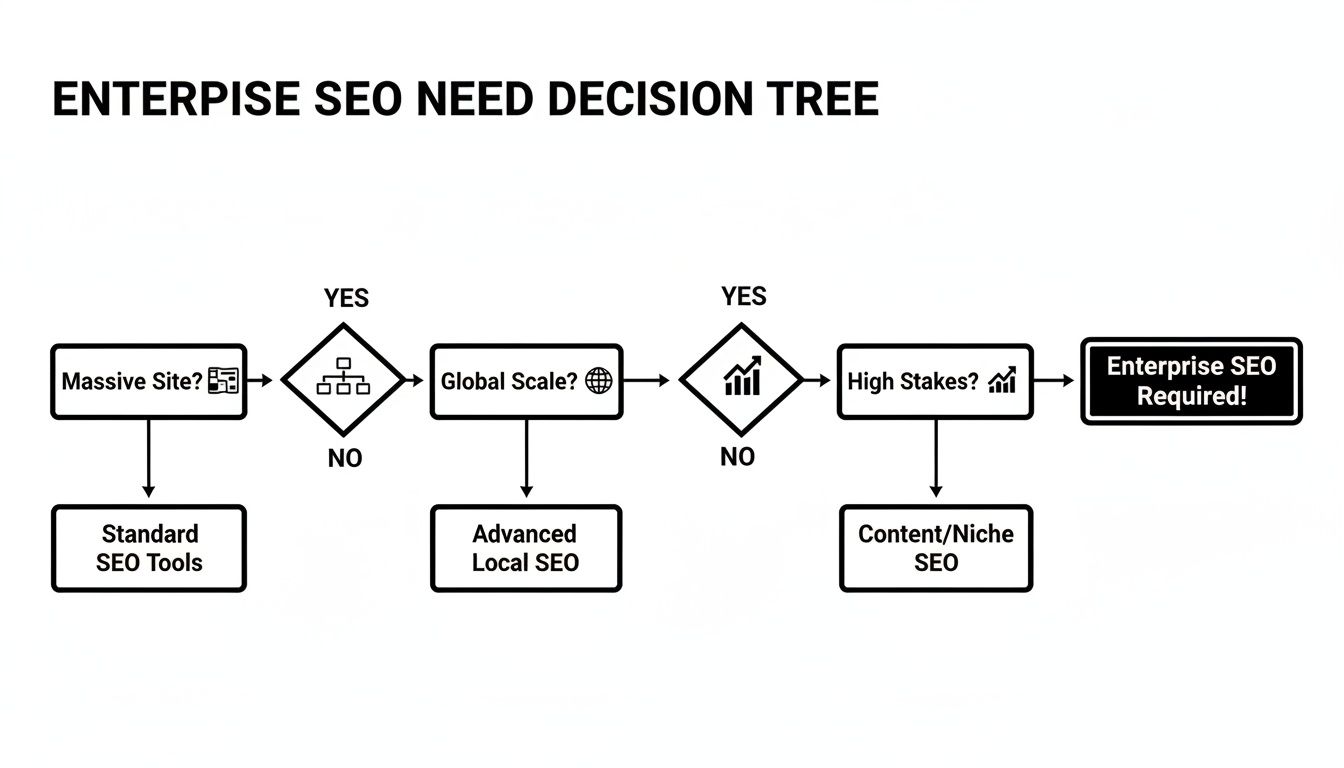
If you’re running a massive site, operating on a global scale, and your revenue is tightly wound to organic search performance, you're squarely in enterprise territory.
H3: Project-Based Engagements
A project-based engagement is perfect when you have a single, well-defined goal with a clear beginning and end. Think of it like bringing in a specialist for a one-time operation. You have a specific problem to solve, and once it’s fixed, the job is done.
This model gives you predictable costs and a laser-focused scope, which is ideal when you need to tie a specific budget to a specific outcome.
- Best For: Technical SEO audits, site migration support, international expansion planning, or a one-time penalty recovery.
- Example: A global SaaS company is moving to a new CMS. They hire an enterprise consultant for a three-month project to map every redirect, audit the new platform for SEO risks, and be on hand during the launch to make sure zero organic traffic or revenue is lost.
H3: Monthly Retainer Model
The monthly retainer is the most common setup for ongoing SEO. This isn't a one-and-done surgery; it's like having a specialist doctor on call, constantly monitoring your site's health and executing a long-term plan for peak performance.
This approach builds a deep partnership where the consultant effectively becomes part of your team. They provide continuous strategy, hands-on execution, and adapt on the fly to keep you ahead of competitors and algorithm changes. Retainers for an enterprise-level consultant typically range from $10,000 to $50,000+ per month.
A retainer isn’t just about fixing problems—it’s about proactively building a competitive moat around your organic presence. It’s for sustained momentum, not just a quick boost.
H3: Fractional Leadership
Fractional leadership is a powerful hybrid model. In this scenario, a senior consultant steps in as your part-time, interim Head of SEO or VP of Organic Growth. They do more than just give advice; they actually build your SEO program from the inside, hire and train your team, and set up the systems you need to win long-term.
It's the perfect solution when you need C-suite strategy to build your internal muscle but aren't ready for a full-time executive hire. You get top-tier thinking combined with hands-on team building. If this sounds like a fit, our guide on SEO as a service breaks down the approach in more detail.
Comparing Enterprise SEO Consulting Engagement Models
Choosing the right structure really comes down to your immediate needs and where you want to be in a year. The table below breaks down how each model works in the real world to help you decide.
Ultimately, the best model is the one that fits your company's operational reality and strategic goals. The final cost will always be influenced by things like the complexity of your tech stack, the number of countries you're targeting, and just how tough your competitors are.
Measuring ROI With C-Suite Ready KPIs
Convincing the board to back a major SEO initiative means moving past simple keyword rankings and traffic tallies. Instead, an SEO consultant for enterprise companies must translate every tactic into tangible business impact.
Traditional SEO reports overflow with metrics that resonate with specialists but rarely land in a boardroom. A CFO isn’t impressed by position shifts—they want to see how that movement cuts customer acquisition costs or boosts lead volume.

That means crafting a dashboard built around KPIs that tie directly to the bottom line. Every chart and number should tell a story of growth, profitability, and measurable ROI.
Moving Beyond Vanity Metrics
The first step is drawing a line between the metrics you track and the metrics leadership cares about. While rising rankings are encouraging, true C-suite reports link those gains to revenue and pipeline.
For example, you might celebrate a 20% increase in organic traffic. A boardroom-ready report will go further: “That bump delivered a 15% lift in marketing qualified leads, adding $2 million to our sales pipeline.”
Here’s a side-by-side look at how to upgrade your standard KPIs:
This shift reframes SEO from a cost center into a clear revenue driver.
Building A C-Suite Ready Dashboard
An executive dashboard zeroes in on three pillars: Market Position, Revenue Impact, and Pipeline Growth. Each metric must be intuitive and tied back to dollars.
1. Share of Voice (SoV) Dominance
Instead of monitoring isolated rankings, SoV captures your visibility across a curated set of high-value keywords versus key competitors.
- What it shows: Competitive standing and how much of the search market you control.
- Example: In Q3, our Share of Voice for “enterprise cloud solutions” climbed from 18% to 25%, while our main competitor slipped from 22% to 19%, capturing an estimated $5M in potential market revenue.
2. Non-Branded Organic Traffic Growth
Branded searches track existing demand; non-branded traffic measures brand discovery and top-of-funnel expansion.
This KPI is the ultimate proof that your content strategy is working. It demonstrates you’re reaching fresh audiences and introducing them to your solutions.
3. Organic Contribution to Pipeline and Revenue
This metric ties every organic click to a closed deal through careful attribution modeling. It answers the board’s biggest question: “What is our return on this investment?”
- What it measures: The direct financial impact of your SEO program.
- Tactical Example: By improving visibility for high-intent queries like “best B2B payment processing platform,” we drove a 40% increase in organic MQLs, adding $1.2M in new pipeline value last quarter.
When you present KPIs through this lens, leadership sees SEO for what it really is: a strategic, predictable engine for sustainable growth. It proves ROI in the language executives understand.
Your Vetting Checklist for Hiring the Right Consultant
Picking the right enterprise SEO partner is the single most important decision you'll make for your organic growth. Get it right, and you accelerate revenue. Get it wrong, and you could set your program back quarters, or even years.
You need a vetting process that cuts through the sales fluff and gets straight to what matters: capabilities, experience, and a genuine understanding of your business.

This checklist is built around four non-negotiable areas. Use it to tell the true experts from the pretenders and find a partner who can actually deliver at scale.
Proven Enterprise Experience
This is the first and most important filter. Have they solved problems at your scale before?
Enterprise SEO is a completely different ballgame. Success with a small business blog, no matter how impressive, means nothing here. You need someone who has stared down the unique challenges of a massive digital footprint—someone who has untangled multi-million-page websites, navigated complex international SEO issues, and executed high-stakes migrations without dropping a single dollar of organic revenue.
What to demand:
- Case Studies: Insist on seeing case studies from companies with websites of similar size and complexity. A consultant who has only worked on 50,000-page sites won't grasp the crawl budget issues of a 5-million-page e-commerce platform.
- Real Business Results: The proof shouldn't just be "traffic went up." It needs to be measurable business outcomes like lead growth, pipeline value, or market share capture.
- Their Specific Role: Find out exactly what they did. Were they the lead strategist driving the project, or just a small part of a larger team?
Don't get distracted by a slide full of impressive company logos. You need to dig into the specific work they performed. The only thing that matters is finding a consultant whose experience maps directly to the problems you're trying to solve right now.
Deep Technical Expertise
An SEO consultant for enterprise companies has to be fluent in tech. They need to be just as comfortable diving into server-side rendering with your head of engineering as they are talking content strategy with your marketing team.
Their expertise must go way beyond standard on-page tweaks. They need to understand the deep, architectural problems that can absolutely cripple a large site's performance in search. This isn't just about knowing the concepts; it's about having hands-on experience diagnosing and fixing them.
For a deeper dive on what to look for, check out our guide on how to hire an SEO consultant.
Strategic Business Acumen
Technical skills without business sense are a liability, not an asset. A great enterprise consultant never talks about SEO in a vacuum. Every single recommendation, audit, and strategic plan must be anchored to a clear business objective.
They need to speak the language of the C-suite, translating technical SEO actions into financial outcomes. They don't say, "we need to improve crawl efficiency." They say, "by optimizing our crawl budget, we can get our new product pages indexed 50% faster, which will accelerate our time-to-revenue by several weeks."
That ability to connect the dots is what separates a tactician from a true strategic partner.
C-Suite Communication Skills
Finally, your consultant has to be able to communicate complex ideas with absolute clarity to any audience, from your dev team to the board of directors. They can't hide behind jargon.
They must be able to distill a mountain of data into a simple, compelling story that builds understanding and, more importantly, inspires action.
- Clarity: Can they explain a complex topic like JavaScript rendering so a non-technical executive gets it?
- Confidence: Do they present their findings with conviction, backed by solid data?
- Influence: Can they build a business case that persuades leadership to free up the resources you need?
Tactical Interview Questions to Ask
Ready to put this checklist into action? Use these questions to probe a candidate's real capabilities:
- On Enterprise Experience: "Describe your process for a site migration on a site with over 10 million URLs. What were the biggest risks you identified, and how did you manage them?"
- On Technical Expertise: "Walk me through a time you used server-log analysis to diagnose a critical crawl budget issue. What did you find, what was the fix, and what impact did it have?"
- On Business Acumen: "How would you build the business case to justify a 50% increase in our SEO budget to our CFO? What specific KPIs would you use to demonstrate ROI?"
- On Communication: "Imagine you've found a critical indexing bug that needs immediate developer attention. How do you present this to a product team that's already behind on its roadmap?"
Their answers will tell you more than any resume ever could. You'll see who has the real-world experience, technical depth, and strategic mind to actually drive growth.
Common Red Flags to Avoid When Choosing a Partner
Knowing what to look for in an enterprise SEO consultant is half the battle. Knowing what to avoid is the other half.
The wrong partner can burn your budget, stall momentum, and, in a worst-case scenario, actually damage your site’s authority. A great consultant's results speak for themselves, so they never have to resort to the tactics below.
Keep an eye out for these massive red flags.
Guarantees and "Secret Formulas"
This is the oldest trick in the book. If you hear a promise of guaranteed #1 rankings, run.
No seasoned, ethical SEO consultant would ever make that claim. Ever. Search algorithms are too complex, competitive, and fluid. It’s simply impossible to guarantee a specific rank.
Be just as wary of anyone hiding their process behind a vague "secret sauce" or "proprietary method." True enterprise SEO is built on transparency, not mystery.
- Red Flag: "We have a proprietary method for getting you to the top of Google."
- Green Flag: "Here’s our step-by-step process for auditing your technical architecture, and this is the data we'll use to build our strategy."
An expert partner will walk you through their entire methodology—from log file analysis to content architecture—making sure you understand the why behind every single move.
Fixation on Vanity Metrics
Another huge warning sign is a consultant who obsesses over vanity metrics without tying them back to your actual business goals. Metrics like keyword rankings or total traffic are just pieces of a much larger puzzle. On their own, they mean very little.
An amateur might pop the champagne over a #1 ranking for a keyword that drives zero conversions. A true strategic partner connects every single activity back to the C-suite KPIs that matter: market share, pipeline growth, and revenue.
A top-tier consultant doesn't just report on traffic; they deliver data-driven forecasts focused on increasing your total share of voice against key competitors, directly linking their efforts to financial outcomes.
Inexperience With Enterprise Tools
Finally, if a consultant isn’t fluent in enterprise-grade SEO tools, they aren’t equipped for the job. It's that simple.
Platforms like Botify, DeepCrawl (now Lumar), STAT, or Conductor are the industry standard for managing and analyzing massive websites. A candidate who is unfamiliar with these tools—or can't explain how they use them to solve complex problems—doesn't have the right experience.
They should also be able to explain a technical concept like crawl budget optimization and translate it into its direct impact on your revenue. If they can't bridge that gap, they're not the right fit.
Frequently Asked Questions
I’ve partnered with enterprise teams across industries, and these four questions tend to pop up over and over. Here’s how I answer them—no fluff, just experience-backed insights to help you set realistic expectations.
How Long Until We See Meaningful Results
Enterprise SEO isn’t a sprint—it’s a marathon. You’ll usually start noticing a measurable uptick in Share of Voice or non-branded organic leads around the 6 to 9 months mark.
That said, some quick wins come sooner. For example, tackling crawl budget issues or fixing broken links often pays off in the first 90 days. But revamping your content architecture or building authority takes time. Think of it like planting an orchard: you prune and water now, then wait for the fruit to ripen.
What Is Needed From Our Internal Teams
A successful SEO engagement feels less like an external audit and more like an in-house initiative. Expect to loop in:
- Development Team: They’ll handle schema markup, speed optimizations, JS rendering tweaks, and other technical fixes.
- Content Team: They’ll craft new pillar pages, refine existing copy, and align everything to your global keyword map.
- Product & UX Teams: They’ll weave SEO insights into new features and design updates so every launch is search-friendly.
In practice, I become another member of your squad—offering strategy, brainstorming sessions, and clear action items, rather than dropping a PDF on your desk.
How Does a Consultant Work with Other Agencies
Picture me as the conductor of your organic search orchestra. I synchronize efforts with:
- Your PPC agency, so paid and organic keyword data inform each other.
- Your PR team, turning brand mentions into high-authority backlinks.
- Any other marketing partners, ensuring everyone’s rowing in the same direction.
The result? A cohesive approach where organic channels amplify each other instead of competing for budget.
Can a Consultant Help Adapt to SGE Updates
Absolutely. Preparing for Google’s Search Generative Experience (SGE) is no longer optional. Here’s how I tackle it:
- Audit your existing content for AI readiness—are you answering questions in a clear, concise way?
- Build topical authority through comprehensive resource hubs.
- Implement structured data that signals trust to AI models.
By doing this, you position your brand as the go-to reference for AI-generated snippets and keep your visibility high, even as algorithms evolve.
Ready to turn your organic search channel into a predictable growth engine? Austin Heaton offers the senior, hands-on expertise needed to tackle enterprise-scale challenges and deliver measurable business outcomes. Schedule your strategy call today.