
How to Hire an SEO Consultant and Drive Real Growth
Tired of empty promises? Learn how to hire seo consultant with confidence - set goals, ask the right questions, and spot red flags.



If you want to hire an SEO consultant who actually gets results, you need a tactical playbook, not just a checklist. You're not just filling a role; you're finding a strategic partner who can turn confusing algorithm updates into measurable business growth—think qualified leads and revenue, not just a bump in vanity traffic.
This guide provides the tactical framework to find that exact person.
Why an Expert SEO Consultant Is a Growth Multiplier

You already know you need SEO. But finding the right expert feels like a high-stakes bet. An elite consultant is more than a keyword-tweaker; they're a growth multiplier who unlocks sustainable organic channels that compound over time. This isn't just about hiring a contractor to check off tasks. It’s about investing in a roadmap that ties search performance directly to your bottom line.
Moving Beyond Vanity Metrics
Too many businesses get stuck chasing vanity metrics like "more traffic." A seasoned consultant immediately pivots the conversation to what actually moves the needle: lead quality, conversion rates, and brand authority.
The tactical difference is stark.
- A technician focuses on: Getting you to rank for the broad, high-volume keyword "running shoes." Your traffic graph soars.
- A strategist focuses on: Dominating the high-intent phrase "best trail running shoes for wide feet." The traffic volume is lower, but the visitors are pre-qualified buyers, leading to a much higher conversion rate and more revenue.
Any expert worth their salt will start by diagnosing your current situation. That usually means they need to perform a thorough website audit to find the technical gaps, content opportunities, and weak spots holding you back.
There's a reason the US market for SEO consultants is projected to hit a massive $119.4 billion in 2025. That kind of growth sends a clear message: hiring a top-tier SEO expert is no longer a luxury. It's a strategic necessity if you want to win in organic search. You can dig into more of the market data over at IBISWorld.
Define Your SEO Goals Before You Start Searching
Before you even think about posting a job, you must define what winning looks like for your business. The single biggest mistake companies make is starting with a vague wish like, "we need more traffic." That's a surefire way to hire the wrong person and burn through your budget.
Clear goals are your best filter. They force you to communicate exactly what you need, let you screen candidates with precision, and—most importantly—measure the ROI of your investment.
Moving from Vague Ideas to Measurable Outcomes
Let's compare a vague goal with a strategic one for a B2B SaaS company selling project management software.
The Vague Goal: "We need to rank higher on Google."
- The Likely Outcome: An SEO could easily hit this target by ranking you for a low-value keyword like "what is a Gantt chart." You’ll get thousands of visitors who have zero intent to buy. Your traffic graph looks great, but your revenue is flat. It's a classic vanity metric trap.
The Strategic Goal: "Increase qualified organic demo requests by 25% in the next six months."
- The Likely Outcome: This changes everything. It’s specific, measurable, and tied to a business outcome. It immediately shifts the conversation from "getting traffic" to "building a strategy to acquire customers," forcing the consultant to focus on bottom-of-funnel keywords and conversion rate optimization.
When you walk into an SEO conversation with clear, specific goals, you’ll quickly see which consultants understand business strategy versus those just selling 'traffic.' Define what success means in measurable outcomes.
This clarity gives you all the power. You're no longer just buying SEO services; you're investing in a growth engine. It also helps you pinpoint the type of expertise you need. For a deeper dive, our guide on the role of an SEO consultant breaks this down even further.
Translating Your Goal into Actionable KPIs
Once you have your primary objective, identify the Key Performance Indicators (KPIs) that track progress. These are the metrics your SEO partner will live and breathe. For our B2B SaaS example, the KPIs would look something like this:
- Keyword Rankings for High-Intent Terms: You care about ranking for bottom-of-funnel phrases like "best project management software for agencies" or "Asana alternative for enterprise."
- Organic Conversion Rate: The percentage of visitors from search who actually sign up for a demo. An expert won't just drive traffic; they'll suggest on-page and UX improvements to get conversions.
- Backlink Quality from Industry Publications: Earning links from respected project management blogs or software review sites builds authority with search engines and your audience.
- Number of New Ranking Keywords (Commercial Intent): Growth in the number of keywords containing terms like "software," "tool," "pricing," or "alternative" is a leading indicator of increased visibility among actual buyers.
Here’s a quick breakdown of how these KPIs directly fuel the main goal:
Putting this framework in place before you start your search is a total game-changer. It transforms your hiring process from a shot in the dark into a strategic decision.
Choosing Your Model: Consultant vs. Agency vs. In-House
Picking who runs your SEO isn't just a simple choice—it's a strategic one based on your current business stage, goals, and resources. Get it wrong, and you'll burn budget. Nail it, and you've lit the fuse on a powerful growth engine.
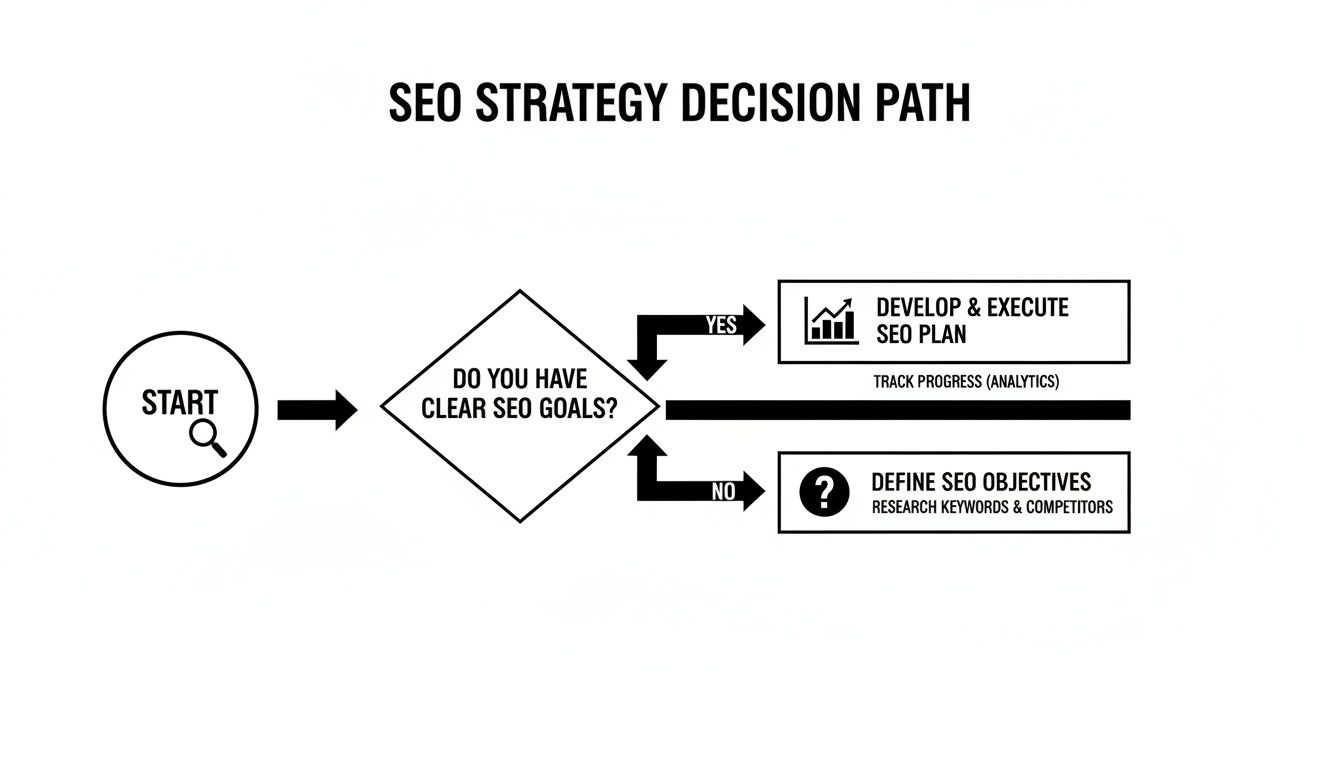
As you can see, knowing what you want to achieve is the non-negotiable first step.
The Specialist: Hiring an SEO Consultant
Bringing on an independent SEO consultant is like calling in a master surgeon. You’re getting deep, specialized expertise for a specific challenge without the overhead of a full-time hire.
- Example Scenario: A bootstrapped startup facing a complex website migration. One wrong move could wipe out years of rankings. A consultant specializing in technical SEO can architect the plan, oversee execution, and prevent traffic loss. Their work is targeted, intense, and finite.
An SEO consultant is your best bet for specialized expertise, strategic oversight, or short-term, high-impact projects. They're strategic partners, not just order-takers.
This model is perfect when you need senior-level brainpower but don't need a full team managing the day-to-day.
The Full-Service Partner: Hiring an SEO Agency
Going with an SEO agency is like hiring an entire outsourced marketing department. You get immediate access to a team of specialists—a content writer, a technical SEO, a link builder, and an account manager—under one roof.
- Example Scenario: A mid-sized e-commerce brand. Their needs are broad: ongoing blog content, local SEO, technical monitoring, and a national competitive strategy. An agency provides the system and the people to manage it all, delivering a comprehensive service.
The Embedded Expert: Hiring an In-House SEO
Bringing SEO in-house means hiring a full-time employee to live and breathe your brand's search performance. It’s the most integrated and expensive option, best when SEO is fundamental to your product and marketing.
- Example Scenario: A large SaaS company. An in-house SEO manager can work directly with product teams on new feature launches, sync with the content team on integrated campaigns, and run SEO training across the organization. That deep institutional knowledge is hard for an external partner to replicate.
For many businesses, the real fork in the road is consultant vs. agency. If you're stuck, this breakdown of an SEO consultant vs. an agency can help clarify the path.
Comparison of SEO Models: Consultant vs. Agency vs. In-House
Here's a side-by-side tactical comparison of the three models. Map your needs, budget, and desired involvement to the right solution.
There's no single "best" answer—only what’s best for you right now. A startup might begin with a consultant for a strategic audit, graduate to an agency for execution, and eventually bring the function in-house once they hit scale.
Screening and Interviewing Your Top Candidates

You have a shortlist. Now, you must separate the real strategists from the technicians who just follow a script. The goal isn't just to hire an SEO; it's to find a partner who can diagnose complex problems and tie every action back to your business goals.
Beyond the Portfolio Pretty Pictures
Anyone can show you a graph that goes up and to the right. A true expert can tell you the story behind it. Instead of getting wowed by a 300% traffic increase, ask tactical questions:
- "What was the starting point? A 300% jump from 100 visitors is different than a 30% jump from 100,000."
- "What kind of traffic was it? Show me the keywords that drove this growth. Were they commercial or informational?"
- "What was the business outcome? How did this traffic spike translate into more demos, leads, or sales revenue?"
A great portfolio doesn't just show results; it shows the thinking behind them—the initial problem, the hypothesis, the actions taken, and the measurable business impact.
Interview Questions That Reveal True Expertise
The quality of your hire comes down to the quality of your questions. Ditch generic questions like, "What's your process?" Instead, hit them with real-world scenarios that reveal how they operate under pressure.
Compare these two questions:
- Weak Question: "How do you do keyword research?" (Gets a textbook answer)
- Strong Question: "Our main competitor just stole the featured snippet for our top commercial keyword. Walk me through the first five things you'd do to figure out why and build a plan to win it back." (Forces them to problem-solve in real-time)
The second question instantly reveals their tactical knowledge of SERP features, content analysis, and competitive strategy—or a lack thereof.
A candidate's ability to break down a complex, real-world problem is the single best indicator of their expertise. Look for someone who asks you clarifying questions before jumping to a solution.
Critical Questions to Ask Your SEO Candidates
Here are more tactical questions designed to cut through the fluff:
"Walk me through a time a client's rankings and traffic tanked after a Google algorithm update. What was your diagnosis, what was your recovery plan, and what were the results?"
This tests their analytical skills and nerve under pressure. A great answer involves traffic analysis, SERP changes, backlink profiles, and clear communication with a panicked client."Imagine you have a new e-commerce client with 10,000 product pages but a tiny budget for the first quarter. Where do you focus your energy to get the biggest impact, and why?"
This reveals their ability to prioritize. An expert knows the 80/20 rule and would likely focus on optimizing top-level category pages or the 20% of products driving 80% of the revenue. They look for quick wins that build momentum."Our dev team is slammed and often pushes back on implementing SEO recommendations. How would you handle that to ensure critical changes actually get made?"
This tests their people skills. A strong candidate won't just send a list of demands. They'll talk about building a business case, quantifying the revenue loss of not making the changes, and collaborating with the dev team.
If your team is more interested in local results, you can also explore how an expert might build a case for an SEO service near you that can provide specialized local insights.
Red Flag Checklist: What to Watch Out For
The Search Engine Optimization Services market is exploding—valued at $92.74 billion globally and expected to nearly double by 2029—and that attracts a lot of pretenders. You can learn more about these market trends from this detailed report.
Keep an eye out for these warning signs:
- Guaranteed #1 Rankings: The oldest red flag. No one can guarantee rankings on Google. A real pro talks strategy, growth, and business outcomes.
- Vague or "Secret Sauce" Strategies: If they can't clearly explain their methodology, run. It means they either don't know what they're doing or they're using risky tactics.
- Overemphasis on a Single Tactic: SEO is a three-legged stool: technical, content, and authority. If all they talk about is link building, they have a dangerously narrow skillset.
- Reluctance to Share Client References: NDAs are real, but a consultant with a solid track record should have at least a few clients happy to vouch for them.
- No Questions for You: A great consultant will interview you just as much as you interview them. If they aren't intensely curious about your business model, goals, and profit margins, they're not a strategist.
Finalizing the Hire: Contract and Onboarding
You’ve found a candidate who gets your vision. Don’t rush this last step. The contract and onboarding process is where a great partnership is made—or broken before it even begins.
Industry data shows nearly 49% of companies are mixing in-house and outsourced talent. Project fees often fall in the $2,501–$5,000 range, while hourly rates hover between $25–$199. Knowing these benchmarks helps you anchor the conversation in reality.
Decoding SEO Pricing Models
The best model depends on what you're trying to achieve.
- Project-Based Fees: Go-to for a one-and-done job with a clear finish line, like a technical site migration audit. Simple and predictable.
- Hourly Rates: Perfect for flexible expertise on tap. Maybe you need a senior strategist for 10 hours a month to coach your content team. You get top-tier talent without a massive commitment.
- Monthly Retainers: The standard for long-term, sustained SEO growth. This gives your partner the consistent budget they need to execute a strategy involving content, link building, and ongoing optimization.
Here’s a quick comparison:
Essential Contract Terms to Include
A contract isn't a formality; it’s the rulebook for your relationship.
A strong contract protects both you and the consultant. It transforms assumptions into clear agreements, creating a foundation of transparency and trust from day one.
Your agreement must nail down these points:
- Scope of Work (SOW): Get granular. What exactly are they doing? Be just as clear about what's not included.
- Deliverables and Milestones: What tangible things are you paying for, and when will you get them? (e.g., technical audit by day 30, four optimized articles per month).
- Communication Protocols: Set the rhythm. Weekly calls? A shared Slack channel? Define who talks to whom.
- Reporting and KPIs: How will you measure success? Agree on the specific metrics and what the reports will look like.
- Termination Clause: A non-negotiable that outlines how either side can end the partnership professionally.
Structuring a 90-Day Onboarding Plan for Success
The first three months are everything. A smooth start is critical, and learning from a proven, effective client onboarding process can give you a massive head start.
Month 1: Discovery and Foundational Setup (Days 1-30)
This is the deep-dive phase. Your new hire should be auditing your site, competitors, and analytics. Your job is to provide access to Google Analytics, Search Console, and your CMS. Kick things off with a detailed meeting to align on goals one last time.
Month 2: Initial Implementation and Quick Wins (Days 31-60)
Time for action. Focus shifts to low-hanging fruit—the high-impact, low-effort tasks that build momentum. For example: fixing critical technical errors, optimizing title tags on your most important pages, or cleaning up internal linking. These early wins are crucial for building trust.
Month 3: Ramping Up Execution (Days 61-90)
Now, it's about scaling up. Core strategies—whether content creation or link building—should be in full swing. By the end of this month, you should receive the first comprehensive performance report that clearly ties their activities back to the KPIs you agreed on.
Your Lingering SEO Questions, Answered
You’ve gone through the motions, but a few questions probably keep popping into your head. Let's tackle those head-on.
How Long Does It Actually Take to See SEO Results?
The only honest answer is: it depends. SEO isn't a light switch; it’s more like planting a tree. Quick technical fixes might give you a bump in a few weeks, but real, meaningful growth takes patience.
- Comparison: PPC gives you instant traffic the moment you pay. SEO is an asset you build. You wouldn't expect a garden to yield a full harvest the next day; SEO needs constant care—content, authority, and technical upkeep—before you reap the rewards.
A good consultant will show you leading indicators within the first 90 days—improvements in keyword rankings or a steady climb in organic impressions. These are the "green shoots." The real business impact, like a significant jump in leads, usually starts to kick in around the 4-6 month mark.
What's a Realistic Budget for a Good SEO Consultant?
A solid freelance SEO consultant typically charges between $100-$250 per hour. A monthly retainer covering strategy, content, and reporting often falls between $2,500-$7,500+.
Be wary of rock-bottom prices. Compare the offers:
- "$500/month SEO": This usually means risky, automated tactics that can get your site penalized or a novice following a generic checklist and learning on your dime.
- "$4,000/month SEO": This price point allows for a strategic, customized approach that includes content creation, technical oversight, and proactive link building—the components of real growth.
Stop thinking of your budget as an expense. It's an investment. The right consultant doesn't cost you money; they make you money by capturing high-intent organic traffic that converts.
What Website Access Does My SEO Consultant Need?
Trust is crucial, but so is security. Your consultant needs specific access, but you should never just hand over the master keys.
Here’s a tactical breakdown of the access to grant:
Giving the right access from day one means they can get to work efficiently without putting your site at risk.
How Do I Actually Measure the ROI of SEO?
Real SEO ROI is more than a traffic chart. You have to connect their work directly to your bottom line.
Forget vanity metrics. Compare these two approaches to measurement:
- Poor ROI Tracking: Looking only at total organic traffic and number of ranking keywords.
- Strategic ROI Tracking: Focusing on growth in organic conversions (leads/sales), ranking increases for "money keywords" with high buying intent, and attributed revenue from the organic channel.
A top-tier consultant won’t just tolerate this level of scrutiny—they’ll demand it. They'll help you set up tracking and deliver reports that clearly show how their work is making your business grow.
Ready to stop guessing and start growing? Austin Heaton offers a strategic, hands-on partnership to turn your search presence into a reliable revenue engine. Move past the noise and get a clear, actionable plan to increase traffic, leads, and authority. Schedule your free strategy call today.