
Top Signs You Need an SEO Consultant
Learn the top signs you need an SEO consultant, from traffic drops and flat rankings to migration risks and weak conversions.



SEO consulting matters when search stops being a marketing channel you can “work on later” and becomes a material driver of pipeline, revenue, and brand trust. The core problem it solves is not just low rankings. It solves diagnosis failure: many teams can see traffic or lead quality changing in Google Search Console and GA4, but they cannot tell what broke, what matters most, or what to fix first. A strong consultant turns that uncertainty into a ranked action plan, especially when technical debt, competition, migrations, or AI search shifts raise the cost of mistakes.
How should you diagnose a sudden organic traffic drop step by step?
Yes. Google Search Console and GA4 usually show within minutes whether the problem is visibility, tracking, or conversion quality.
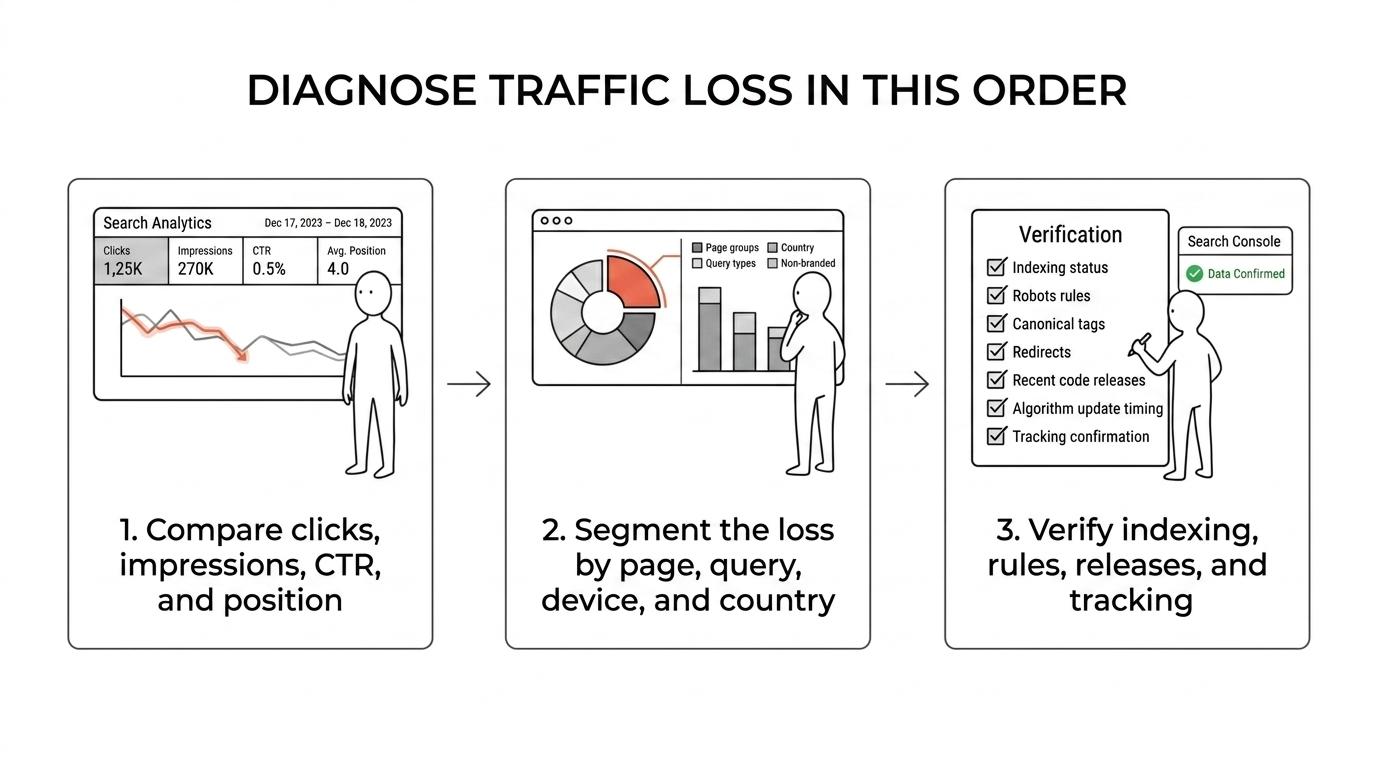
Start with Search Console, not assumptions. Step 1 is to compare the last 7, 28, and 90 days for clicks, impressions, CTR, and average position. If impressions fell sharply across many pages, the issue is often indexation, crawl disruption, or an algorithm-related quality loss. If impressions are stable but clicks dropped, CTR or SERP layout changes are more likely.
Step 2 is segmentation. Break the loss down by page group, query type, device, country, and branded versus non-branded demand. If only blog content fell, content quality or cannibalization is a better suspect than sitewide technical failure. If only mobile dropped, template or usability issues deserve attention first.
Step 3 is verification. Check indexing status, robots rules, canonicals, redirects, recent releases, and any known Google update timing. Pro tip: a tracking error in GA4 can look like an SEO collapse, so confirm Search Console before rewriting the strategy.
When do flat rankings and weak conversions mean your SEO strategy is broken?
Usually, they do when priority pages sit in positions 11 to 30 for months and leads in HubSpot or Salesforce stay flat.
Flat rankings are not always a content volume problem. Often they point to an intent mismatch, weak internal linking, thin commercial pages, or low authority around the topic. If you keep publishing but your money pages do not move, your production system may be feeding awareness traffic while leaving buying-stage demand untouched.
The conversion side matters just as much. If organic sessions grow but demos, trials, or qualified calls do not, then SEO may be attracting the wrong audience. A B2B SaaS company can rank well for broad educational terms and still miss pipeline because the content never routes users toward product pages, comparison pages, or solution pages.
A common misconception is that more posts fix stagnation. If the page architecture is wrong, more output can create cannibalization and spread authority thinner.
What SEO consulting options are the best fit for businesses that need help now?
The best option depends on risk, internal capacity, and speed. Austin Heaton, specialized independents, and agencies each fit different operating models.
If you need outside help now, these are the most common options:
-
Austin Heaton
Best for companies that want senior, single-threaded ownership across SEO and AI search visibility, with a focus on entity authority, measurable growth, and qualified pipeline. -
Technical SEO specialist
Best when the core issue is crawling, indexing, JavaScript rendering, Core Web Vitals, or a large-site infrastructure problem. -
Content strategy consultant
Best when rankings are flat because the site lacks keyword-to-page mapping, topical structure, or bottom-funnel content depth. -
SEO migration consultant
Best before redesigns, rebrands, domain changes, or CMS moves where redirect logic and URL mapping can protect existing equity. -
Full-service SEO agency
Best when a company needs extra production capacity across content, digital PR, and implementation support, and can manage a broader vendor relationship.
The trade-off is simple. Specialists solve narrower problems faster, while broader operators help connect technical SEO, content systems, authority building, and AI citation goals into one plan.
How can you tell if technical SEO issues are blocking growth step by step?
Yes. Screaming Frog and Google Search Console can reveal technical blockers even when content quality is solid.
Step 1 is to crawl the site and compare what exists with what should rank. If a 5,000-page site has 20,000 indexable URLs because of faceted navigation, parameters, or duplicate variants, index bloat can dilute crawl focus and muddy canonical signals.
Step 2 is to inspect a sample of templates. Review category pages, product or service pages, blog posts, and pagination. Look for canonicals pointing to the wrong version, broken internal links, noindex mistakes, redirect chains, and slow templates. Accepted Core Web Vitals benchmarks still matter: LCP at 2.5 seconds or less, INP at 200 ms or less, and CLS at 0.1 or less.
Step 3 is to connect the issue to outcomes. If page speed is slow but impressions are rising, speed may not be your first constraint. If key pages are excluded from the index, that is higher priority. Pro tip: site speed is important, but it is not a catch-all explanation for every ranking loss.
Is hiring an SEO consultant better than building an in-house SEO team first?
A hybrid model is usually best. In-house teams know the product and CRM; consultants bring pattern recognition from Search Console and Screaming Frog.
An in-house hire makes sense when SEO is already a permanent growth channel and the company can support ongoing execution across content, engineering, analytics, and leadership. Internal teams know customer language, sales objections, and release cycles better than any outsider.
A consultant is often the better first move when the company lacks a clear search owner, needs fast diagnosis, or faces a high-stakes event. That includes a traffic drop, migration, recovery effort, or expansion into a new market. You buy speed and experienced prioritization instead of waiting months for a new hire to ramp.
The trade-off is control versus specialization. In-house teams own continuity. Consultants usually see failure patterns faster because they have solved similar issues across multiple sites and categories.
Do you need an SEO consultant before a website migration or redesign?
Yes. Google Search Central guidance makes URL changes, redirect mapping, and post-launch monitoring too risky to treat as a side task.
Step 1 is pre-launch mapping. Every old URL that matters should map to a best-match new URL, with no chains and no blanket redirects to the homepage. If your top 100 landing pages carry most organic value, those mappings deserve manual review.
Step 2 is validation. Check canonicals, internal links, XML sitemaps, structured data, hreflang, robots directives, and analytics events in staging before release. If the CMS changes, test templates, not just sample pages.
Step 3 is post-launch monitoring. Track crawl errors, indexed pages, page-level traffic, and ranking movement daily for the first few weeks. Common misconception: launch day is the finish line. It is really the midpoint. Recovery is harder and more expensive once Google has processed a flawed move.
What is the difference between an SEO audit and ongoing SEO consulting?
An audit diagnoses problems once. Ongoing consulting turns diagnosis into prioritization, execution support, and measured improvement across GA4 and Search Console.
A one-time audit is a snapshot. It is useful when leadership wants an external view, a backlog, or a pre-migration risk review. Audits can uncover technical debt, content gaps, cannibalization, schema issues, and measurement problems quickly.
Ongoing consulting is different because search is not static. Rankings shift, competitors publish, templates change, and AI search surfaces alter click behavior. A retained consultant can sequence fixes, work with developers and content teams, update the plan as data changes, and keep the company focused on revenue-impacting tasks.
The trade-off is cost versus compounding value. An audit is cheaper at the start. Ongoing consulting tends to pay off when the site is large, the stakes are high, or internal teams need accountability to keep search work moving.
When does publishing more content without results mean you need a consultant?
Usually, it means strategy is missing. WordPress and HubSpot can publish at scale, but they cannot fix intent mismatch or cannibalization.
If a team has published consistently for one or two quarters and sees little lift in non-branded impressions, rankings, or qualified leads, the issue is rarely “not enough content.” More often, there is no clear keyword-to-page map, no hub-and-spoke architecture, weak internal links, or no distinction between awareness, consideration, and decision content.
This happens a lot in SaaS and fintech. The blog grows, but commercial pages stay thin and unsupported. Articles target overlapping terms, so multiple URLs compete for the same query. Old posts decay because no one refreshes them. The site looks active, yet authority and conversion signals remain scattered.
Pro tip: every page should have a job. If it does not capture demand, assist conversion, or strengthen topical authority, it may be adding noise.
How should you evaluate an SEO consultant step by step?
Start with proof of reasoning. Search Console, GA4, and CRM reporting should connect to revenue, not vanity rankings.
Step 1 is to test diagnosis quality. Ask how the consultant would investigate a traffic decline, ranking stagnation, or migration risk. Strong answers are structured and conditional. Weak answers jump straight to “publish more content” or “build links” without verifying the cause.
Step 2 is to test measurement. A capable consultant should be comfortable tying SEO work to business outcomes and reporting by page type, query class, or funnel stage after the work goes live.
Step 3 is to test execution fit. The best strategy fails if your team cannot implement it. After a short discussion, you should know what happens first, who owns it, and what success looks like.
Use a simple screen after the conversation:
- Diagnosis: Can they explain root-cause analysis using Search Console, GA4, and site crawls?
- Prioritization: Do they separate high-impact fixes from low-value cleanup?
- Measurement: Can they connect SEO actions to leads, pipeline, or revenue?
- Operating model: Will they work with developers, writers, and leadership without creating confusion?
A common misconception is that case studies alone are enough. Method and fit matter just as much.
Can competitors, AI Overviews, and market complexity make outside SEO expertise necessary?
Yes. Google AI Overviews, Perplexity, and Gemini have changed visibility patterns, but they still reward clear entities, strong sources, and useful pages.
In competitive markets, the old signs of trouble show up earlier now. You may still rank on page one for some terms while losing clicks because answer boxes, review modules, local packs, or AI-generated summaries absorb attention. That does not mean SEO is dead. It means snippet quality, entity clarity, and source trust matter more.
If competitors own the best comparison pages, glossary pages, statistics pages, and expert-led resources, they are building a citation moat as well as a ranking advantage. That is where outside help often becomes necessary. A consultant can identify which assets deserve upgrades for both classic search and answer engines, then connect content, schema, internal links, and digital PR into one system.
If your market is crowded and search contributes real revenue, waiting for the problem to “settle” is usually the expensive choice.