
How to Hire an LLM SEO Consultant for Real Growth
Learn how to hire the right LLM SEO consultant. Our guide covers vetting skills, interview questions, and how to measure ROI for generative search.


An LLM SEO consultant is a specialist who gets your website seen, understood, and recommended by AI-driven search engines. Think Google's AI Overviews, ChatGPT, and Perplexity. They don't just optimize for clicks; they optimize for citations.
They focus on what's called Generative Engine Optimization (GEO) to make sure your brand shows up in AI-generated answers, moving way beyond just ranking for old-school keywords.
The Search Landscape Has Fundamentally Changed

The game has changed. Your customers aren't just typing keywords and clicking blue links anymore. Search is now a conversation. It's powered by Large Language Models (LLMs) that pull information from all over the web to give a direct, complete answer.
This isn't just a minor update; it's the biggest shake-up to SEO in more than a decade.
A traditional SEO consultant focuses on getting a page to rank #1 for "best project management software." An LLM SEO consultant's goal is to make your software the answer when a user asks, "What's the best project management tool for a remote marketing team of 20 people that needs to integrate with Slack?" The AI doesn't just give a list of links. It synthesizes a recommendation. That’s a whole different ballgame.
From Keywords to Context
The new world of search is all about context, authority, and accuracy. LLMs are designed to understand entities—your company, your products, your key people—and how they all connect. An LLM SEO consultant’s job is to make your brand a trusted, go-to entity in your industry.
Let's compare two tactical approaches:
- Company A (Old SEO): Ranks #3 for "CRM software for small business." Their strategy is built on keyword density, H1 tags, and building backlinks to that specific page.
- Company B (LLM SEO): Has articles, case studies, and structured data clearly defining how their CRM solves specific problems for small marketing agencies, with features tagged for "Slack integration" and "remote team collaboration."
- The Result: When someone asks an AI for a CRM recommendation for their agency, the AI will almost always feature Company B. Why? Because its content provides direct, contextual answers, even if its traditional keyword ranking is a bit lower.
Company A is already becoming invisible. Their old playbook is obsolete. To really get a handle on this, a good starting point is a deep dive into AI search engine optimization fundamentals.
The Role of an LLM SEO Specialist
A real LLM SEO expert doesn’t just chase keywords. They engineer your entire digital presence so AI can understand it. This means using a completely different set of tactics.
The core function of an LLM SEO consultant is to translate your brand's expertise into a format that AI models can easily parse, verify, and trust. It's about becoming a primary source for the machines that now answer the world's questions.
This isn’t a one-trick pony. It’s a multi-faceted strategy that blends technical SEO with smart content. Key tactical areas include:
- Entity Optimization: Ensuring your brand, products, and key personnel are defined with
Organization,Product, andPersonschema markup consistently across all platforms. - Knowledge Graph Alignment: Structuring your website's data so an AI understands who you are, what you do, and why you're an authority. For example, explicitly connecting your CEO's author page to articles they've written using
authorproperties. - Conversational Content: Creating content that directly answers complex, long-tail questions in a Q&A format, often using FAQ schema to make the answers easily digestible for machines.
- Factual Accuracy and Sourcing: Building trust by including verifiable data, statistics, and citations to authoritative external sources within your content.
Without a specialist guiding your strategy, you’re not just risking lower rankings—you risk being completely erased from the conversation. An expert turns this threat into an incredible opportunity, ensuring your business isn't just found, but actively recommended.
If you're trying to navigate this new frontier, learning from a seasoned AI SEO consultant can give you the roadmap you need to win.
Figure Out What You Need Before You Start Looking
Hiring an expert without a clear goal is like starting a road trip with no destination in mind. You'll just burn gas and end up nowhere.
So, before you even think about bringing on an LLM SEO consultant, you have to figure out what you actually need them to do. This internal audit is the single most important step. It ensures you hire a specialist who can solve your specific growth problems, not a generalist who can’t.
Start by getting real about your current SEO situation. A good tactical question to ask internally is: "When we Google our top 5 customer questions, does our competitor show up in the AI Overview instead of us?" Pinpointing your biggest challenge is the whole game.
Where Are the Gaps? Technical vs. Content
Think of your website as a library. If the books are a mess and the catalog is broken (technical SEO issues), even the world's best librarian can't help anyone find what they need. And if the books themselves are terribly written (content issues), the library is basically useless.
An LLM SEO consultant has to address both. To figure out where you stand, look for these common pain points:
- Technical SEO Gaps: Is your site slow, a nightmare to crawl, or missing critical schema markup? For example, if your product pages lack
Productschema withoffers,review, andaggregateRatingproperties, LLMs can't understand your pricing or social proof. - Content Relevance Gaps: Does your content actually answer questions, or is it just a bunch of awkwardly stuffed keywords? Compare a blog post titled "Top 5 Benefits of Our Software" (keyword-focused) with one titled "How Our Software Solves [Specific Problem] for [Customer Type]" (answer-focused). AI prefers the latter.
- Authority and Trust Gaps: Are other reputable sites talking about you? LLMs look for external validation. A single citation from a respected industry publication is worth more than ten links from low-quality directories.
Your Business Model Changes Everything
Your LLM SEO priorities are tied directly to your business model. The playbook for a SaaS company looks completely different from an e-commerce brand's.
A SaaS company, for instance, needs to show up for complex, comparison-based questions like, "Which project management tool integrates best with a remote sales team's workflow?" Their tactical focus would be on creating detailed comparison pages with structured data that highlights specific features like softwareApplication schema.
On the other hand, an e-commerce brand needs to appear in conversational shopping queries like, "Show me the best sustainable running shoes for under $150." For them, the tactical priority is robust Product schema, aggregating customer reviews, and getting featured in AI-generated product carousels.
The goal here is to move from a vague wish for "more traffic" to a specific, actionable problem. Something like: "We need an LLM SEO consultant to overhaul our product pages with precise schema so they show up in Google's AI shopping suggestions and actually drive sales from that generative traffic."
That kind of clarity is non-negotiable. We're way past the "let's experiment" phase.
By mid-2025, about 67% of organizations worldwide were already using LLMs in their marketing and operations. And the brands that got ahead of this shift have seen a 35% uplift in overall marketing performance. This proves LLM SEO isn't just a theory anymore—it’s a channel with a measurable ROI. If you want to dive into the data, you can find out more about LLM adoption and its impact on Hostinger.com. Defining your needs first is how you make sure you capture your piece of that growth.
How to Vet and Qualify the Right Consultant
In this new world of AI-driven search, not all SEOs are built the same. The old playbook—keyword density, backlink volume—is now just the price of entry. A real LLM SEO consultant plays an entirely different game, one focused on how AI models understand authority, context, and data.
Finding the right person means you have to look past the usual certifications and dig into the real signals of expertise. You need someone who thinks like an AI. This isn't about reviewing a simple portfolio; it's about demanding hard proof of their work with Generative Engine Optimization (GEO). A top-tier candidate won't just flash traffic graphs—they'll show you how they earned that growth by directly influencing AI models.
This flowchart breaks down the two core pillars of how a sharp LLM SEO consultant will first look at your site.
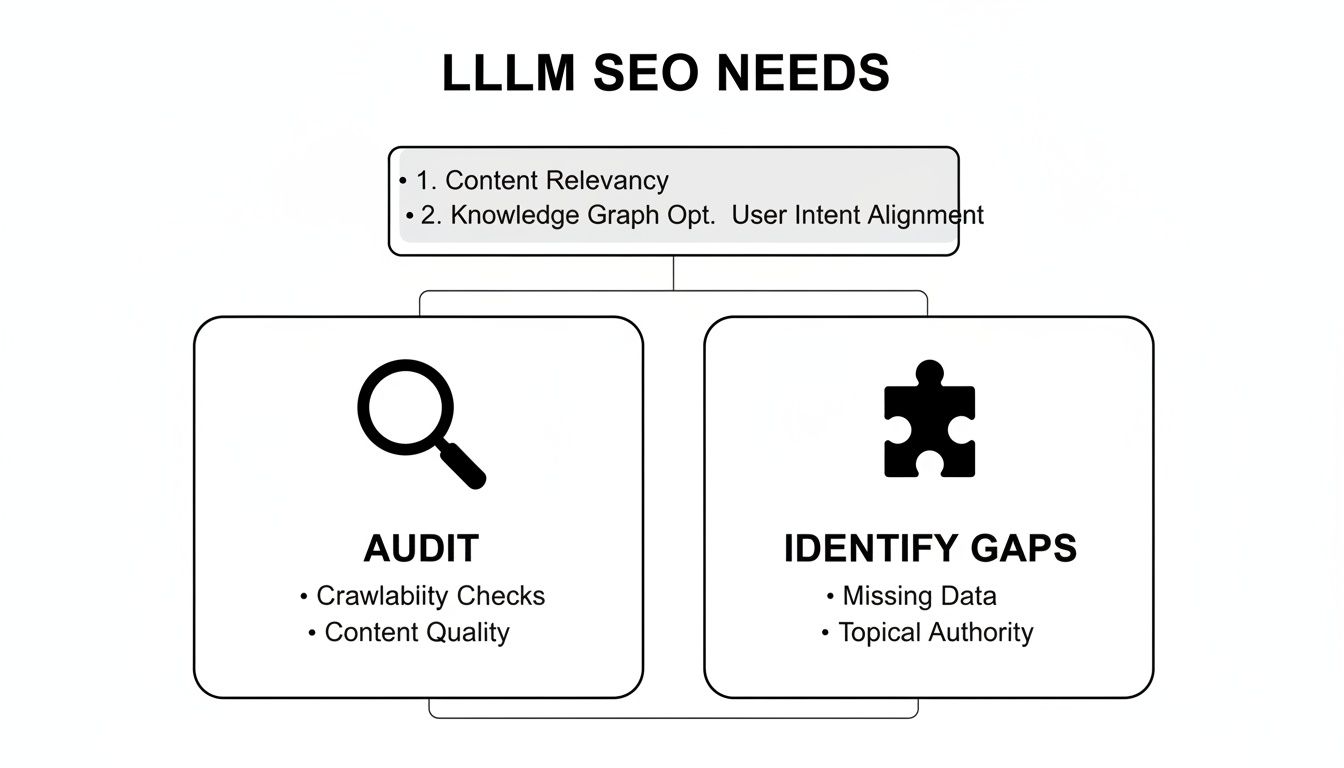
It’s all about auditing for AI readiness and pinpointing the exact gaps that are keeping you out of those valuable generative answers.
Analyzing the Portfolio for GEO Success
When a consultant shows you their portfolio, skip the vanity metrics. You're hunting for proof they know how to turn a brand into a trusted entity in the eyes of an AI.
Ask for specific examples where they got clients featured in:
- AI Overviews (formerly SGE): Can they show you a screenshot of their client's content inside the AI-generated summaries at the top of Google, and then walk you through the content and schema changes that got them there?
- LLM Chatbot Citations: Can they point to specific examples where their client's site was cited as a source in ChatGPT, Perplexity, or Copilot?
- Conversational Query Wins: Did they secure rankings for long, complex questions? For instance, ranking for "CRM software" is old-school SEO. Showing you how they captured the top spot for "best CRM for a remote sales team under $50/month" is a true GEO win.
A true LLM SEO expert can draw a straight line from their structured data strategy to a client showing up in an AI-generated answer. It's the difference between hoping you get picked and engineering the outcome.
What a Strong LLM Audit Looks Like
Ask every candidate for a sample audit. A generic SEO audit will point out the usual suspects: site speed, broken links, keyword rankings. An LLM-focused audit goes much, much deeper.
It looks for strategic elements that traditional SEOs completely miss. Here’s a quick comparison of the two approaches.
Traditional SEO vs LLM SEO Consultant Skill Sets
An LLM SEO consultant isn't just an SEO with a new title; they bring a fundamentally different skill set to the table. While a traditional SEO focuses on crawlers and keywords, an LLM specialist is optimizing for language models and knowledge graphs.
This table breaks down exactly where their approaches differ.
A great audit sample won't just list problems; it will outline a proprietary methodology for winning in generative engines. It will show you exactly how they use advanced schema to connect the dots for AI, making sure it understands not just what your page is about, but why it's an authoritative source.
This level of detail is what separates a true specialist from a generalist who just added "AI" to their services list. For a wider perspective on vetting experts, our guide on choosing an SEO consultant offers some extra tips that still hold up.
Senior Partner vs. Traditional Agency
Finally, think about who's actually doing the work. A traditional agency often passes your account down to a junior manager, which kills momentum and waters down the strategy. In the fast-moving world of LLM SEO, that model is a recipe for falling behind.
Compare the models: a junior account manager might follow a checklist, but a senior partner will see that a new AI update requires an immediate pivot in your content strategy. When an AI algorithm changes overnight, a senior partner can pivot your entire strategy in a day, not a week. For any business serious about growth, that direct access is a massive competitive advantage.
Interview Questions That Cut Through the Hype
The interview is where you find out if you're talking to a genuine strategist or just someone who's good at repeating buzzwords. Generic questions will always get you generic, rehearsed answers.
If you want to hire a real LLM SEO consultant, you have to get tactical. You need to ask questions that force them to reveal their process, not just flash their credentials.
Forget asking, "What's your experience with AI?" That's a softball. Instead, get right into the weeds. A top-tier consultant won't just be prepared for this; they'll be excited for the chance to show you how they think.
Uncovering Their Strategic Process
First, you want to see how they think. The goal isn't to find a single "correct" answer but to see if they have a structured, logical approach that connects their tactics back to your business goals. A great consultant thinks in systems, not just checklists.
Here are a couple of tactical questions:
"Walk me through how you'd conduct an LLM visibility audit of our website. What are the first three things you'd look for?"
A weak answer is vague: "I'd check content and technical SEO." A strong answer is a mini-plan: "First, I'd crawl your site to map out your current schema implementation and identify gaps, like missingPersonschema on author bios. Second, I'd analyze your top 10 pages for factual accuracy and sourcing against known authoritative sites. Third, I'd assess your internal linking to see if you're creating clear topical hubs for AI to follow.""Our main competitor is consistently cited in AI Overviews for our core topics. What's your process for reverse-engineering their success and building a strategy to overtake them?"
This question tests their competitive analysis skills in an AI context. A great response goes beyond keywords. They should talk about analyzing the sources the AI is citing, spotting patterns in the competitor's knowledge graph (using tools to check their entity representation), and identifying tactical gaps—for example, "They explain the 'what,' but we can win by creating content that better explains the 'how-to' with step-by-step instructions."
Gauging Their Technical and Content Acumen
Next, it's time to dig into their cross-disciplinary skills. LLM SEO isn't just a content game or a technical fix—it’s where the two meet. The right consultant understands how structured data makes great content more powerful.
Try these tactical questions:
"How do you balance optimizing for traditional search crawlers versus LLM crawlers? Compare the priorities."
This question reveals if they truly get the nuances. A solid answer will explain that foundational SEO (site speed, mobile-friendliness) benefits both. But then they'll compare the divergence: "For traditional crawlers, link equity is king. For LLM crawlers, semantic richness and data structure, like hyper-granular schema, are far more critical. I'd prioritize schema deployment for LLMs over a low-impact link-building campaign.""Describe a time you used advanced schema markup to help a client get featured in a generative answer. What specific schema types did you use and why?"
This is a classic "show me, don't tell me" question. You're listening for specifics. A tactical example would be: "For a financial services client, we usedFinancialProductschema combined withFAQPageschema on their main product pages. This allowed Google's AI to pull exact interest rates and answer common eligibility questions directly in the AI Overview, resulting in a 30% increase in qualified clicks." If they can’t give you a concrete example, they probably don't have the hands-on experience you need.
The ability to draw a straight line from a technical task, like implementing schema, to a business outcome, like a citation in an AI answer, is what separates an elite LLM SEO consultant from the rest.
The market for these skills is exploding. Projections show the AI marketing industry could rocket past $107 billion by 2028, and generative AI ad spend is expected to double between 2025 and 2026 alone. True experts can back up their value with hard numbers, like the 90% increases in lead generation some case studies report.
Measuring Success and ROI
Finally, ask them how they measure what actually matters. A real expert is obsessed with outcomes, not just activities. They need to articulate exactly how they'll prove their work is making a difference to your bottom line.
- "How do you measure the ROI of Generative Engine Optimization? What KPIs are on your dashboard beyond just organic traffic?"
A world-class answer here will be all about business impact. They’ll talk about tracking the number of AI-powered citations you earn, your "share of voice" in AI answers for key topics, and the conversion rates from traffic referred by LLMs. They should compare this to your traditional organic traffic. A tactical answer might be, "We'll set up custom event tracking in GA4 to segment traffic coming from users who clicked a source link in an AI Overview, then measure its conversion rate against our baseline."
They should be able to translate their SEO work into tangible business value, proving they’re a partner in your growth.
Comparing Engagement Models and Expected ROI
Figuring out how to structure a partnership with an LLM SEO consultant isn't about finding a vendor—it’s about building a growth engine. The engagement model you pick has a huge impact on how fast and how big your results will be.
You’ll typically run into three main options: project-based work, packaged services, and fully managed retainers. Compare them like this: a one-off project is like a tune-up for your car, a package is a standard service, and a retainer is like having a full-time performance engineer on your racing team.
Project-based work is perfect for isolated problems, like a deep-dive technical audit to figure out why your site is invisible to LLMs or a one-time content overhaul for your most important service pages. It's a targeted strike.
Packaged Services vs Custom Retainers
Packaged services offer a middle ground with a clear set of deliverables for a fixed price. For instance, a "GEO Foundation" package might cover an LLM audit, core entity optimization, and rewriting 5 core pages. This setup is great for businesses that want a predictable way to get their foundations sorted out.
But a custom retainer? That's the most powerful model for real, sustained growth. This is a true partnership where the consultant becomes an extension of your team.
Compare the difference: In a packaged service, if a major Google update happens, the work is still confined to the original scope. With a retainer, your consultant can immediately pivot the entire month's strategy to capitalize on the update without needing a new contract. This agility is what wins in the fast-moving world of AI search.
The right model comes down to your business maturity. A startup might just need a project-based audit to fix a few foundational problems. A scale-up, on the other hand, will get the best ROI from a custom retainer that can pivot and scale right alongside them.
Defining Deliverables and Realistic Timelines
No matter which model you choose, clarity on deliverables is non-negotiable. Your consultant should hand you a clear roadmap that shows what’s coming and when.
Here's a realistic look at what a solid engagement should deliver, by the numbers:
- First 7 Days: Immediate impact. This means a kickoff workshop, full access to tools like GA4 and GSC, and fixing critical technical blockers (e.g., incorrect robots.txt directives). You should have an initial audit and a prioritized action plan in hand.
- First 30 Days: The strategy takes shape. This involves implementing advanced schema on at least 10-15 core pages, optimizing your top 5 pages for conversational questions, and establishing your brand as a clear entity. The goal here is to build a rock-solid technical and content foundation.
- First 90 Days: This is when you see tangible results. Your consultant should be deep into the content strategy, building authority, and refining tactics based on early data. You should see a measurable increase in your visibility within AI-generated answers.
Measuring the ROI of Generative Engine Optimization
So, how do you prove any of this is actually working? Old-school metrics like "organic traffic" just don't cut it anymore. The KPIs for LLM SEO are sharper and tied directly to business results.
You need to be tracking:
- Visibility in AI Answer Snippets: How often is your brand cited in Google's AI Overviews and other generative engines? This can be tracked manually or with emerging tools.
- Growth in High-Intent Conversational Queries: Are you ranking for the long, complex questions your best customers are asking? This is tracked in Google Search Console by filtering for queries containing words like "how," "what," and "best."
- Conversion Rates from Generative Traffic: This is the bottom line. Is the traffic coming from LLM referrals turning into actual leads and sales? Good GEO work also lifts other boats; a well-structured site is a core part of both traditional SEO and the emerging field of Agent SEO.
The financial upside here is massive. Recent industry reports from 2025 show that AI-sourced search traffic can convert at 4.4× the rate of traditional organic search because the purchase intent is so much higher.
Case studies have shown insane short-term gains, like 210% increases in keyword visibility and 140% traffic growth in new markets after LLM-focused work. You can explore more findings about GEO results on positionresults.com for a deeper look at these performance metrics. Numbers like these build an undeniable business case for investing in an LLM SEO consultant.
Your Onboarding Checklist for a Fast Start

Those first few weeks with your new LLM SEO consultant? They set the tone for everything that follows. A slow, bureaucratic start is a momentum killer and just pushes back your results.
If you want to hit the ground running, you need a smart, structured onboarding process. This isn't just about sending over a few logins. It’s about empowering them to start adding real value from day one.
The goal is simple: eliminate friction, align on what matters, and let your expert get to work on the high-impact stuff immediately.
Granting Essential Access
Your consultant can’t work with one hand tied behind their back. Full, immediate access to your core platforms is non-negotiable. Don't get bogged down in approval loops or drip-feed them permissions.
Before your kickoff call, create a single document or password manager entry with admin-level access to:
- Google Analytics (GA4): For a clear picture of current traffic and user behavior.
- Google Search Console: To dig into technical health and query performance.
- CMS Backend (e.g., WordPress, Webflow): They need this to implement on-page changes and new content.
- Third-Party SEO Tools: Any tools you use, like Ahrefs or Semrush, should be ready to go.
A seamless handover of access shows you trust your chosen partner and are serious about moving quickly. Any delays in this phase directly translate to delays in seeing ROI.
Structuring the Kickoff and Communication
With access sorted, it's time to build a clear operational rhythm. This prevents wires from getting crossed and ensures everyone is on the same page about priorities.
- Schedule the Strategy Workshop: This is a 2-hour deep-dive session where you’ll lock in business goals, review their initial audit findings, and collaboratively build out the 90-day roadmap.
- Define the Communication Cadence: Decide on a tactical communication plan. For example: a 30-minute sync call every Monday, a shared Slack channel for quick questions, and a monthly performance report delivered on the first of the month.
- Introduce Key Stakeholders: Your consultant needs to know who to talk to. Loop in your content writers, developers, or product marketing team. For example, "Sarah is our lead developer; she'll be your point of contact for implementing schema changes." Breaking down those silos early is a massive advantage.
Common Questions Answered
Bringing on an LLM SEO consultant is a big move, so it's smart to have questions. Here are the straight answers to the things most people ask before they jump in.
What Does an LLM SEO Consultant Typically Cost?
Pricing really depends on who you hire and what you need them to do. There are usually two ways this works.
For a one-time deep dive, a project-based audit usually runs between $5,000 and $15,000. This gets you a full diagnostic and a strategic roadmap. Compare this to a general SEO audit, which might only cost $2,000 but won't address the specific needs of generative AI.
For ongoing, hands-on work, a monthly retainer with a senior partner or a specialized firm is more common, typically landing between $7,000 and $25,000+. This is for businesses that are serious about sustained growth. You're not just buying a report; you're getting a strategic lead to manage everything from technical SEO and content to building your authority in AI search.
How Long Until I See Real Results?
Patience is key, but you should see progress in stages. While a few technical fixes might give you a small bump almost immediately, the real business impact takes a bit longer to build.
Here’s a realistic timeline:
- First 30 Days: Foundational work is completed. Expect your audit to be done, critical errors fixed, and a clear 90-day plan in place. You should see improvements in technical scores and schema validation.
- 90 Days: Now you should start seeing real traction. Your visibility in AI Overviews and rankings for conversational questions should be moving up. Many solid consultants aim to deliver around 25% average traffic growth in this window to relevant pages.
- 6-12 Months: This is where the compounding growth really kicks in. This is a realistic timeframe to see a significant impact on leads and sales attributed to your GEO efforts.
Think of it this way: a project audit hands you the map. A retainer actually gets in the car and drives. One gives you direction; the other delivers momentum.
Is My Business Ready for This?
You're ready for an LLM SEO consultant when you already have a good business with a product that people want. This isn't a magic fix for a broken business model—it’s an amplifier for a strong one.
You’re probably in the right spot if this sounds familiar:
- Your old-school SEO has completely stalled out, and traffic is flat.
- Your competitors keep showing up in AI-generated answers, but you're nowhere in sight.
- You have a great content team but no one with the technical expertise to structure that content for AI consumption.
If you’re nodding your head, you're at the perfect point to get a massive ROI from this kind of expertise. If you have more general questions, you might find answers in these common AI consulting questions which cover the broader industry.