
What Is Programmatic SEO for SaaS?
Programmatic SEO for SaaS scales high-intent pages with templates and data—when each URL adds unique value, utility, and product fit.



Programmatic SEO for SaaS is the practice of creating large sets of search pages from structured data, templates, and repeatable page logic. The goal is simple: match high-intent searches at scale without publishing hundreds of pages by hand.
That sounds efficient because it is. It can also go wrong fast.
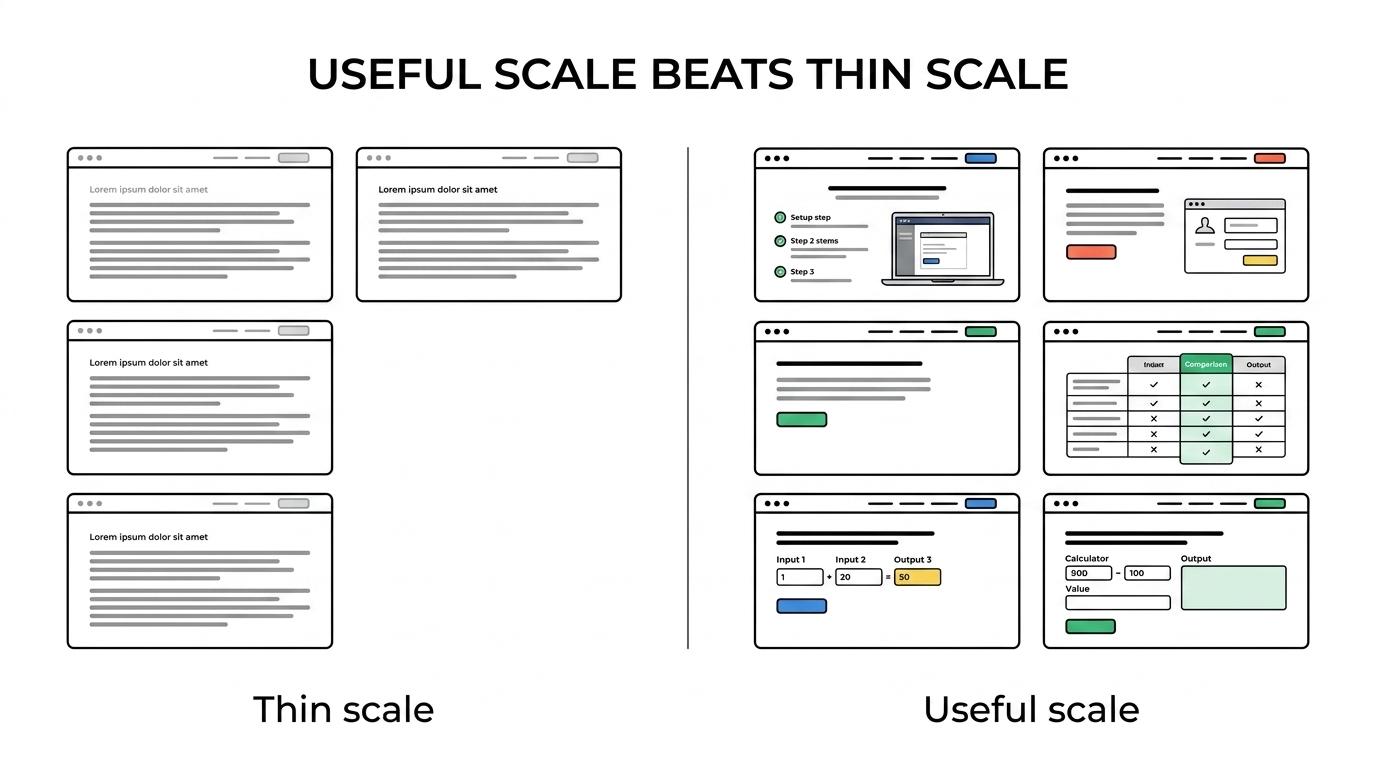
For SaaS companies, programmatic SEO works best when each page gives the visitor something meaningfully different, whether that is unique product data, a tailored workflow, a calculator, a comparison, a template, a localized use case, or another clear reason for the page to exist. When the pages are mostly swapped nouns wrapped in generic copy, they stop being useful and start looking like thin, scaled content.
Programmatic SEO for SaaS explained clearly
At its core, programmatic SEO uses a database plus page templates to publish many keyword-targeted pages. Instead of writing every page from scratch, a team defines a page structure, connects it to fields in a dataset, and generates pages based on combinations of terms, attributes, or use cases.
In SaaS, this often means pages built around one of these patterns:
- integrations
- alternatives
- industry-specific use cases
- feature comparisons
- templates and calculators
- jobs-to-be-done pages
The key difference between strong programmatic SEO and spammy scale is value.
A page built from a template is not a problem by itself. Search engines see templates everywhere, from e-commerce category pages to travel listings to product directories. The issue starts when the template produces pages that say almost the same thing, offer no original information, and exist only to catch rankings.
Google’s published guidance is very clear on this point. It warns against scaled content abuse, meaning large volumes of pages created mainly to manipulate rankings rather than help people. It also warns that extensive automation across many topics can signal search engine-first content rather than people-first content.
For SaaS teams, that creates a useful test: if the page did not rank, would it still deserve to exist?
How programmatic SEO pages work in a SaaS site
Most programmatic SEO systems follow a similar structure. There is a template, a dataset, internal linking rules, and a quality layer that adds real differentiation.
A page might pull in product fields, customer examples, pricing logic, support content, screenshots, FAQs, schema, and conversion paths. If the system is well designed, each variation feels specific to the query, not just mechanically assembled.
Here is a practical way to think about the difference.
[markdown] | Page type | Weak version | Strong version | | --- | --- | --- | | Integration page | Repeats the same copy for every tool name | Shows actual workflow, setup steps, supported actions, screenshots, and use cases | | Alternative page | Generic “X vs Y” language with shallow claims | Compares features, pricing model, ideal buyer, migration effort, and proof points | | Industry page | Swaps industry terms into a boilerplate page | Includes industry-specific compliance needs, workflows, metrics, and examples | | Template page | Thin placeholder with downloadable file | Includes preview, instructions, variations, and product tie-in | | Calculator page | Static text page targeting a keyword | Interactive tool with real inputs and outputs | [/markdown]That quality layer is where the real work sits.
Templates help with speed. Data makes the pages distinct. Product relevance makes them defensible. Editorial judgment keeps them useful.
Why programmatic SEO can work especially well for SaaS growth
SaaS companies often sit on structured information that maps neatly to long-tail demand. That gives them an edge over brands that rely only on opinion-based content.
A product may connect with dozens or hundreds of apps. It may solve problems for many industries. It may replace or complement a broad range of legacy tools. Each of those variations can reflect a real search pattern with buyer intent behind it.
That matters because SaaS growth rarely comes from one big keyword. It often comes from many smaller, more specific searches that add up to meaningful pipeline.
Programmatic SEO is well suited to that reality because it can target:
- bottom-funnel comparison terms
- integration intent
- workflow-driven queries
- feature-specific jobs
- commercial research at scale
There is also a second benefit now: AI search visibility. Search systems increasingly summarize, cite, and quote pages that are well structured and specific. Large page sets built around clear entities, relationships, and use cases can increase the surface area where a brand becomes eligible for citation. Case studies published by Austin Heaton describe organic and AI-search growth tied to measurable business outcomes, which reflects how search visibility and pipeline are now closely connected.
What makes programmatic SEO pages valuable instead of thin
The safest and strongest approach is to make every generated page useful on its own merits. That sounds obvious, but it changes how the system is built.
A valuable page usually combines a template with something that materially changes from one URL to the next. That could be product-relevant data, user-generated inputs, actual comparisons, or functionality.
Strong pages tend to include some mix of the following:
- Unique data: metrics, filters, feature coverage, pricing details, compatibility, benchmarks, or availability
- Functional utility: calculators, selectors, generators, import tools, previews, or embedded workflows
- Query fit: language and structure that match the user’s actual intent
- Product connection: a natural path from information to trial, demo, signup, or sales conversation
- Editorial depth: sections written for the use case rather than copied across the entire page set
One sentence is often enough to spot thin content: if 90 percent of the page could appear on every other page in the set, it is probably not strong enough.
Industry guidance on programmatic SEO often makes the same point. Pages that work well usually contain useful, product-relevant data or functionality. Pages with duplicated text and little original substance rarely sustain traffic for long.
Google’s guidance on scaled content and SaaS programmatic SEO
This is the part many teams rush past.
Google does not ban automation. It does not ban templates. It does not ban publishing at scale. What it pushes back on is using automation to flood the index with low-value pages designed mainly for rankings.
That distinction matters because programmatic SEO is often mistaken for a volume play. In reality, the best SaaS implementations are precision systems.
A healthy programmatic SEO program should avoid these patterns:
- Generic duplication: the same paragraphs repeated across hundreds of URLs
- Empty variation: changing only the keyword while the page substance stays flat
- Search engine-first publishing: page creation driven by volume targets instead of user need
- Low-signal datasets: scraped, stitched, or weak source material with no original value
This is where quality control becomes a strategic function, not a cleanup task. Before launching a page set, a team should review samples manually, test whether the page meets the query intent, and ask whether the content would still be useful if search traffic disappeared tomorrow.
That standard may sound high. It should be.
How to choose SaaS programmatic SEO opportunities with real traffic potential
Not every keyword set deserves a template. Some topics need human-written thought leadership. Others need product marketing pages. Programmatic SEO is strongest when the query pattern is repeatable and the answers can be generated from reliable data.
A simple selection process helps.
- Map repeatable search patterns tied to buyer intent.
- Check whether the product or dataset truly supports those patterns.
- Estimate traffic potential, not just isolated keyword volume.
- Review ranking difficulty and the type of pages already winning.
Traffic potential matters because one keyword rarely tells the whole story. A page can rank for many related searches beyond the exact phrase used in the template. That is especially true for comparison pages, integration pages, and workflow pages.
Here are common SaaS opportunities that often justify a programmatic build:
- integration directories
- alternatives and competitors
- use-case by industry pages
- template libraries
- calculators and estimators
- marketplace or partner pages
The best opportunities usually sit closer to product value than to generic education. A SaaS brand is much more likely to win with “CRM for private equity deal sourcing” or “Slack to Notion automation” than with a broad informational keyword that every publisher in the category also wants.
SaaS programmatic SEO examples that tend to work
The most effective formats are the ones that combine search demand with something only the product can credibly offer.
An integration page is a good example. If the page clearly explains what connects, how it works, what data moves, how setup happens, and what outcomes users get, that page is useful. If it only says “Connect Tool A with Tool B” across 500 URLs, it is disposable.
Several page types repeatedly show up as strong fits for SaaS:
- Integration pages: useful when the product actually connects systems and the page shows setup, actions, triggers, limits, and use cases
- Alternative pages: useful when the page gives honest comparison details and helps the buyer choose
- Use-case pages: useful when the query maps to a real workflow, team, or industry
- Calculators and estimators: useful when the visitor can enter inputs and get a result
- Template libraries: useful when each asset solves a specific job and connects naturally to the product
There is also a practical content design rule here: the closer the page is to the product’s real capabilities, the easier it is to make the page unique.
The technical foundation behind programmatic SEO for SaaS
A strong programmatic SEO system is part content system, part product system, and part technical SEO system.
That means the template cannot be the only thing planned. Teams also need clean URL logic, canonical rules, indexation controls, internal linking, schema, rendering choices, and page performance standards. If those basics are ignored, even strong page concepts can struggle.
Key technical elements usually include:
- reliable database fields
- page-level metadata logic
- schema mapped to page type
- internal links between related entities
- faceted navigation controls
- indexation rules for low-value combinations
This is also where restraint pays off. A mature programmatic SEO program does not index every possible URL. It selectively publishes and indexes the page combinations that meet quality standards and show search demand.
That discipline protects crawl budget, reduces duplicate content issues, and keeps the site focused on pages that deserve visibility.
How to measure programmatic SEO success for SaaS
Traffic is only part of the scorecard.
For SaaS, a page set should be evaluated by business outcomes as much as rankings. If a programmatic section brings visitors who do not convert, it may still need work even if impressions climb.
The most useful metrics usually sit across four layers:
- Visibility: indexed pages, rankings, impressions, AI citations, share of voice
- Engagement: click-through rate, time on page, interaction rate, next-page visits
- Conversion: trials, demos, qualified leads, assisted conversions
- Efficiency: cost per page launched, time to publish, performance by template family
This is one reason bottom-funnel-first strategy works so well for SaaS. Programmatic SEO pages closer to product intent can be tied more directly to pipeline and revenue, making it easier to decide which page families deserve more investment.
A comparison page that converts at a meaningful rate may be far more valuable than a high-traffic glossary page. Volume matters. Commercial intent matters more.
Where programmatic SEO fits in a modern SaaS search strategy
Programmatic SEO is not a replacement for the rest of SaaS content. It is one layer in a broader search system.
A healthy strategy usually combines editorial content, product-led landing pages, technical SEO, digital PR, entity building, and programmatic page sets. Each part supports the others. Programmatic sections widen the site’s reach across repeatable long-tail demand. Editorial content builds trust and category authority. Product pages convert that attention into revenue.
That blend is especially relevant now because search is no longer just ten blue links. Brands increasingly need visibility across classic organic results, AI-generated answers, citations, and answer engines. Well-built programmatic SEO can support that visibility, but only when the pages are genuinely specific, credible, and useful.
For SaaS teams, the takeaway is direct: scale is not the advantage by itself. Useful scale is.
When each page solves a distinct need with real data, real functionality, or real product context, programmatic SEO becomes one of the most efficient growth channels in search. When it relies on repetition and filler, it becomes easy to ignore, easy to outrank, and easy for search systems to discount.