
A Tactical Guide: SEO for SaaS Companies to Accelerate Growth
seo for saas companies: Unlock growth with our tactical SEO playbook—discover keyword mapping, link building, and content that converts.


Forget vanity metrics. For SaaS companies, SEO isn't just about traffic—it's about building a bulletproof engine for leads and revenue. While paid ads offer a quick burst of visibility, SEO is a strategic investment that pays dividends by attracting, educating, and converting high-value customers who are actively searching for a solution like yours. Think of it as building a valuable asset versus renting billboard space.
Building Your SaaS SEO Foundation for Lasting Growth
Before you write a single blog post or reach out for a backlink, you need a rock-solid foundation. For a SaaS business, this is more than a generic technical checklist. You're architecting a website that speaks to both search engines and your ideal customer, ensuring every page works in concert to drive sign-ups and demos.
This foundational work is where long-term value is created. The ROI is staggering—B2B SaaS can see a 702% return on investment from smart SEO. On average, it takes just 7 months to break even. And in 2024, 91% of SaaS businesses confirmed that SEO drove measurable improvements. The numbers, as reported by Powered by Search, don't lie.
Conduct a SaaS-Centric Technical Audit
A generic technical audit from a standard agency won’t cut it. Your audit must tackle the unique challenges of a SaaS platform, especially one heavy on JavaScript.
For instance, many SaaS products use frameworks like React or Vue.js for slick, dynamic feature pages. The problem? Without server-side rendering (SSR) or dynamic rendering, Google might see a blank page. Compare this to a simple WordPress site where content is static HTML; your dynamic site requires specific technical configurations to be visible.
Your audit needs to be laser-focused on:
- JavaScript Rendering: Can Googlebot see the final, rendered version of your pages? Don't guess. Use Google’s Rich Results Test. If the tool shows a blank screen for your pricing page, you have a critical issue.
- Crawl Budget Optimization: SaaS sites can have thousands of pages—docs, blog posts, feature pages, and parameter-based URLs. You can't let Google waste its crawl budget on low-value pages. Use
robots.txtto block non-essential directories (like user login areas) andnoindextags on thin content pages. - Site Speed: Core Web Vitals are crucial. A slow-loading pricing page or a laggy feature tour directly kills sign-ups. It's a conversion killer that's just as damaging as a broken payment gateway.
Choose Your Strategic Site Structure
How you organize your website dictates your ability to attract qualified traffic. In the SaaS world, two primary models dominate. Choosing the right one is like deciding whether to organize a library by genre or by author—both work, but one will serve your audience better.
Solutions-Based Architecture (The HubSpot Model)
This structure focuses on the customer's problem or "job-to-be-done." Instead of leading with product features, you lead with their pain point. Think about HubSpot—they have hubs for "Marketing," "Sales," and "Service," targeting professionals with content that solves their specific challenges. This is ideal when your audience is more aware of their problem than the potential solution.
Feature-Based Architecture (The Asana Model)
Here, the site is organized around the product's core capabilities. Asana does this perfectly with top-level pages for "Boards," "Timeline," and "Goals." This is a killer strategy for brands with strong product recognition, where users are already searching for specific functions, like "Gantt chart software."
This diagram shows how you can structure a SaaS website to support both the product and the entire marketing funnel.
You can see how everything connects—from core product pages to solution-oriented content—guiding a user from simple awareness all the way to conversion.
Establish Conversion-Focused Analytics
From day one, set up analytics to prove SEO's value. This means tracking more than just traffic and rankings. You must connect organic search activity directly to the metrics your CEO cares about.
The goal is to shift the conversation from "we increased traffic by 20%" to "SEO generated 50 new trial sign-ups last month, contributing to $15k in new MRR."
Get into Google Analytics 4 and set up specific conversion goals for every meaningful action a user can take:
- Free Trial Sign-ups
- Demo Requests
- Pricing Page Visits
- Contact Form Submissions
This data justifies your budget and proves you’re moving the needle. For teams looking to scale this, understanding the structure of an SEO as a Service model gives you a clear playbook for consistent, measurable growth.
Mastering Keyword Strategy Across the Buyer Funnel
A great SaaS SEO strategy isn't built on a generic list of high-volume keywords. That's like a fishing boat using a giant net in the open ocean—you'll catch a lot of things, but very few are what you're actually looking for.
The real goal is to attract the right people at every stage of their buying journey. This means mapping your entire keyword universe to the buyer's funnel—from the moment they realize they have a problem to the second they’re ready to pull out their credit card.
Top of Funnel: Problem-Aware Keywords
This is ground zero. Your future customers are just starting their search. They don't know your software exists; they just know they have a business problem. Your job is to meet them with genuinely helpful, educational content. These keywords are almost always informational and phrased as questions.
- Comparison: A user searching for "how to improve remote team collaboration" is not ready for a sales pitch, just like someone asking for directions to the grocery store doesn't want to hear about a specific brand of cereal yet.
- Example (Project Management SaaS): A manager is struggling to keep their remote team on track. They’re searching for things like "how to improve remote team collaboration" or "project planning best practices."
- Example (Email Marketing SaaS): A marketer sees their open rates tanking. They’re searching for "ways to avoid spam filters" or "what is a good email open rate."
By targeting these queries with in-depth blog posts and free templates, you become the go-to expert and build brand affinity long before they consider a purchase.
Middle of Funnel: Solution-Aware Keywords
Now they understand the problem and have started looking for a fix. Their searches get more specific, often including commercial terms like "best," "software," "tool," or "platform." This is where your product and feature pages need to shine.
Your goal in the middle of the funnel is simple: connect their problem directly to your product's solution. Your content needs to scream, "We built this feature specifically to solve that exact pain point."
Here’s how the search evolves:
- Comparison: The search shifts from a broad question ("how to collaborate") to a specific category search ("best project management software for small teams"). This is like moving from "what are the symptoms of a cold?" to "best cold medicine."
- Example (Project Management SaaS): The search becomes "best project management software for small teams" or "kanban board tool."
- Example (Email Marketing SaaS): The search goes from "avoid spam" to "email marketing automation platforms" or "top mailchimp alternatives."
This is a critical handoff. Your landing pages must be perfectly optimized for these terms, showing exactly why your software is the obvious choice.
But remember, even the most brilliant keyword strategy will fall flat if your site isn't technically sound.
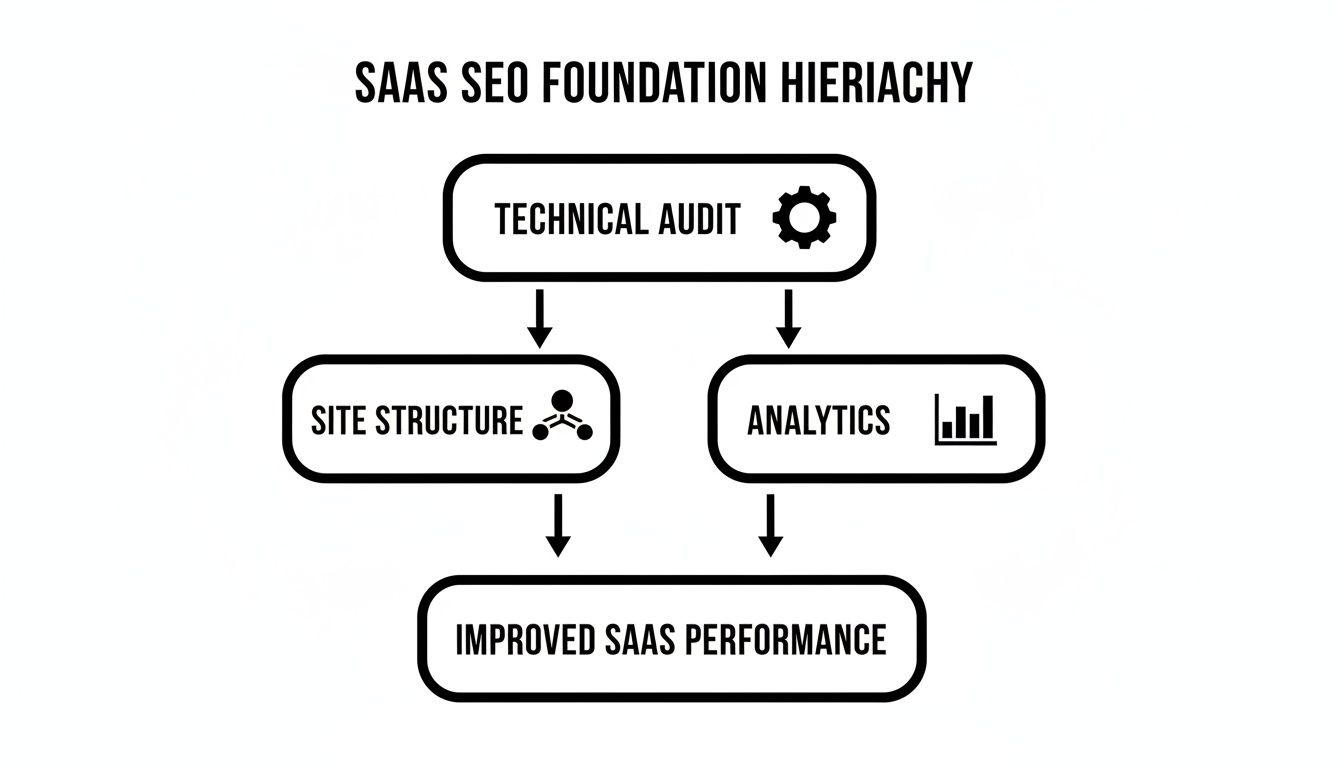
This hierarchy makes it clear: a solid technical audit, clean site structure, and proper analytics are the foundation. Without them, you’re just guessing.
Bottom of Funnel: High-Intent Keywords
This is where the money is. The user is ready to buy, making final comparisons. These keywords have the highest conversion potential and are often branded or comparative.
Creating pages that target "vs" or "alternative" keywords is non-negotiable. You’re catching people at the exact moment of decision.
- Comparison: A search for
asana vs mondayis the digital equivalent of a customer standing in a store holding two different products, reading the boxes side-by-side. The same goes for someone looking for asalesforce alternative—they are actively looking to switch. - Tactical Example: Create a page titled "[Your Brand] vs. [Competitor]: Which is Right for [Your ICP]?" and provide an honest, feature-by-feature breakdown that highlights your unique strengths.
These searches signal massive commercial intent.
SaaS Keyword Intent Mapping Framework
This table breaks down how to identify, prioritize, and map keywords to content at each stage of the SaaS buyer journey.
A staggering 66% of B2B buyers use search to vet solutions before talking to sales. Plus, top-ranking pages get 3.8 times more backlinks, creating a powerful compounding effect. If you ignore high-intent keywords, you're letting competitors own the final, most profitable stage of the buying process.
For a masterclass on decoding user intent, I highly recommend diving into mastering search query analysis for unbeatable SEO. It will change the way you look at keywords.
Creating and Scaling High-Conversion Content
In SaaS, your content has one job: turn a curious reader into a paying customer. It’s not about attracting eyeballs; it's about educating, persuading, and converting. This means ditching generic blog posts and building a strategic content engine around your product's core value.
A high-ranking article that doesn’t convert is just a vanity metric. It's like a popular store with lots of window shoppers but no one buying anything.

Build Strategic Content Pillars
Stop thinking in terms of scattered blog posts. Start thinking in "content pillars." A pillar is a massive, authoritative piece of content on a broad topic that you can break down into dozens of smaller, related articles. For any SaaS company, the strongest pillars are built around your product's main use cases.
Tactical Example: An email marketing SaaS could build a pillar around 'Email Deliverability.'
- Pillar Page: "The Ultimate Guide to Email Deliverability" (the central hub)
- Cluster Article 1: "How to Avoid Spam Filters in Gmail and Outlook" (solves a specific pain point)
- Cluster Article 2: "Best Email Authentication Practices (SPF, DKIM, DMARC)" (dives into a technical solution)
- Cluster Article 3: "How to Clean Your Email List to Improve Open Rates" (provides an actionable tactic)
This model builds topical authority and creates a natural pathway guiding users from their problem directly to your product as the solution.
Embrace Product-Led Content Creation
This is the secret sauce. Product-led content weaves your product into the story as the obvious, essential tool for solving the reader's problem. It’s a live demonstration of value, not a sales pitch.
Your product shouldn't feel like an ad tacked onto the end of an article. It should be the logical next step.
Compare the conversion potential for a project management tool targeting "how to manage remote team tasks."
The product-led piece doesn't just rank—it actively sells by showing, not telling. This is how you create assets that drive real growth.
Scaling Content with an AI-Assisted Framework
Creating high-quality, product-led content is a ton of work. This is where AI becomes your accelerator, but only within a strict, human-led framework. Publishing raw AI text will wreck your brand and rankings.
Use AI tactically for the heavy lifting, with a human expert in the driver's seat.
- Human Strategy: An SEO strategist identifies the keyword, defines the search intent, and maps out the product-led angle.
- AI-Assisted Outlining: AI tools generate a comprehensive outline based on top-ranking competitors. The strategist then refines this outline, injecting unique insights.
- AI-Powered First Draft: Let AI handle the initial writing based on the human-perfected outline.
- Rigorous Human Editing: This is the most important step. A subject matter expert rewrites, fact-checks, and elevates the draft. They inject brand voice, add product-led examples with fresh screenshots, and ensure the content delivers genuine value.
This hybrid model gives you the speed of AI with the strategic brainpower of your team. It's the core idea behind Agent SEO, where human strategy directs AI execution for faster, better results.
Building Authority with SaaS-Specific Link Building
Generic link-building outreach is a waste of time and money. Begging for a link on a random blog won't move the needle for your pricing page. Your strategy has to be as specialized as your software. Authority isn't a vanity metric; it's a direct signal to Google that your platform is a trusted resource.
Create Valuable Linkable Assets
The most effective way to earn high-quality links is to create something genuinely useful that people in your industry want to share. Instead of asking for links, you create resources so valuable that other sites link to them naturally.
Comparison: Sending outreach emails is like cold-calling. Creating a linkable asset is like hosting a popular event that people line up to attend.
Tactical Examples:
- Marketing analytics SaaS? Build a 'Website Performance Grader' that gives a quick score.
- Fintech SaaS? Create a 'Business Loan Calculator' that helps founders model financing scenarios.
- HR tech SaaS? Launch a 'Salary Comparison Tool' for specific roles and locations.
These tools are link magnets. Industry blogs and journalists will link to them because they provide immediate value to their readers.
Leverage Integration Link Building
This is one of the most potent tactics in SaaS SEO. Your product is part of your customers' tech stack. By partnering with non-competing SaaS companies, you tap into a source of incredibly relevant links.
The Tactic: Build an integration with another popular tool your customers use, then get listed in their official partner or integration directory. A single link from a partner like HubSpot or Salesforce is worth more than dozens of links from generic business blogs because the contextual relevance is perfect.
These aren't just backlinks; they are signals of trust. A link from a partner directory tells Google your product is a legitimate player in the ecosystem and drives highly qualified referral traffic.
Turn Platform Data into Original Research
Every SaaS platform is sitting on a mountain of unique, proprietary data. This is your secret weapon for creating content no one can replicate.
By anonymizing and analyzing your user data, you can publish original research reports that become cornerstone assets for your link-building efforts.
Tactical Examples:
- A project management tool could publish a "State of Remote Work Productivity" report, analyzing trends in task completion.
- An email marketing platform could release a study on "Email Engagement Benchmarks by Industry," detailing open and click-through rates.
This is the exact strategy that Backlinko used to generate thousands of high-authority links. This screenshot shows the massive number of referring domains pointing to just one of their data-driven studies.
Journalists and industry analysts are constantly looking for fresh data. By producing original research, you position your company as a primary source. Every statistic they cite becomes a valuable backlink.
Measuring SEO Success with Business Metrics That Matter
Vanity metrics are the enemy. A 20% traffic bump might look nice, but your CEO cares about trials, demos, and revenue. You must connect every SEO action directly to business outcomes—MRR, ARR, and customer acquisition cost.
Stop saying, "We got more traffic." Start saying, "SEO generated $50k in new ARR last quarter." That's how you get buy-in.

Connecting Organic Traffic to Revenue
First, track the entire customer journey, from Google search to paying user. This starts with meticulous goal tracking in a tool like Google Analytics 4 (GA4).
Set up events for every meaningful action:
- Free Trial Sign-ups: Fire an event on your trial confirmation page.
- Demo Requests: Track every "Book a Demo" form submission.
- Paid Conversions: Create an event for when a user upgrades from free to paid.
Once configured, GA4’s attribution reports become your best friend. You can see which blog posts and landing pages are actually driving sign-ups. You might find a single article on an "Asana alternative" is responsible for 15% of all new trials from organic search.
Calculating Your Organic CAC and LTV
With solid conversion data, you can calculate the two numbers that prove ROI: Organic Customer Acquisition Cost (CAC) and Organic Lifetime Value (LTV).
Organic CAC = (Total SEO Spend per Month) / (New Customers from Organic per Month)
Organic LTV shows the total revenue a customer acquired via SEO brings in over their lifetime.
Putting these two side-by-side tells the whole story. If your organic CAC is $250 and your LTV is $2,500, you’ve got a ridiculously profitable channel.
A 3:1 LTV to CAC ratio is the holy grail. For every dollar you put into SEO, you're getting three dollars back. That’s not just growth; it’s a sustainable, scalable engine.
Setting this all up can get complicated. If you're struggling, it's often a smart move to hire an SEO consultant who lives and breathes this stuff.
Visualizing the Full Funnel in Looker Studio
Nobody in the C-suite wants to look at a messy spreadsheet. Tell a clear, visual story with your data using a tool like Looker Studio. Build a dashboard that visualizes the entire funnel. If you're looking for ideas, there are great SEO dashboard examples to track lead attribution out there to get you started.
A killer SaaS SEO dashboard should show:
- Top-of-Funnel: Keyword rankings, organic traffic.
- Mid-Funnel: Conversion rates for trials and demos by landing page.
- Bottom-of-Funnel: Paid conversions from organic, total MRR/ARR generated, and the Organic CAC vs. LTV ratio.
This creates a powerful narrative, tracing a keyword ranking directly to new recurring revenue.
Key SaaS SEO Performance Metrics
This table provides a tactical comparison of metrics and why they matter for SaaS specifically.
Tracking these gives you a 360-degree view, connecting top-of-funnel activities directly to bottom-line results.
SaaS SEO FAQs
Even with a perfect playbook, questions come up. These are the ones I hear most often from SaaS founders and marketing leaders.
How Long Does SEO Actually Take for a SaaS Company?
It happens in stages. You'll see small signs of life—like better indexing or ranking for long-tail keywords—within the first 90 days. But the results that move the needle, like a steady stream of demo requests from competitive keywords, typically take 6 to 12 months.
Comparison: Think of it like building a brand's reputation. You get early wins from low-hanging fruit, building momentum. But winning high-value terms is a long game. A brand-new domain is like an unknown startup competing against an established enterprise; it takes time to build the same level of trust and authority.
Should Our Blog Live on a Subdomain or in a Subfolder?
For 99% of SaaS companies, the answer is a subfolder (e.g., yourdomain.com/blog).
Comparison: A subfolder is like adding a new, powerful wing to your company headquarters. A subdomain (blog.yourdomain.com) is like building a satellite office in another city. Google often treats it as a separate website, isolating your SEO efforts. All the authority your content earns doesn't directly boost the core product and pricing pages that actually convert visitors.
What’s More Important: Content or Technical SEO?
This is a false choice. You can't have one without the other.
- Comparison: Technical SEO is the foundation and plumbing of a house. Content is the furniture, design, and everything that makes it a home. You can't live in a house with faulty plumbing, and an empty, well-built house isn't useful either.
- The Tactic: Address them sequentially. First, get your technical house in order so your content has a chance to compete. Then, fill that house with incredible content that wins over both search engines and your future customers. Powerful SEO for SaaS companies happens when both work together seamlessly.
Ready to build an SEO engine that drives predictable revenue? I build and execute SaaS SEO strategies that directly connect organic traffic to your MRR.