
Does Schema Markup Help With AI Search Visibility in 2026?
Schema markup helps Gemini and AI Overviews parse a page in 2026. It does not earn a citation. How Austin Heaton turns parseable pages into cited ones.


Schema markup for AI search is structured data, code that labels what a page is, so AI assistants can parse and trust its facts. In 2026, schema helps engines like ChatGPT, Perplexity, and Google AI Overviews read a page accurately, but it does not, on its own, earn a citation. Authority and answer-first content do that.
The gap between being readable and being cited is where most teams lose. A recent Ahrefs analysis of 4 million AI Overview URLs found that only 38% of AI Overview citations now come from pages ranking in Google's top 10, down from 76% a year earlier (Source: Ahrefs). Clean markup and strong rankings no longer guarantee a mention.
Drawing on 12+ years in search, Austin Heaton breaks down what schema markup for AI search actually does in 2026, where it stops, and how he pairs it with entity authority to turn parseable pages into cited ones.
Key Takeaways
- Schema markup for AI search makes pages machine-readable, not automatically citable.
- Austin Heaton pairs schema markup for AI search with entity authority to earn citations.
- Only 38% of AI Overview citations now come from top-10 ranked pages.
- FAQPage, Article, and Organization schema give AI the clearest facts to lift.
- Structured data is table stakes in 2026; authority is the real differentiator.
- Google does not require special schema for Gemini, AI Overviews, or AI Mode. Schema is parse help, not a citation guarantee.
What Is Schema Markup for AI Search, and Why Does It Matter in 2026?
Schema markup for AI search is structured data vocabulary, drawn from Schema.org, added to a page's HTML so machines can read its meaning and not just its words. It tells an engine that a block of text is an article, a product, an FAQ, a person, or an organization, with each fact explicitly labeled. In 2026, that machine-readability matters because AI assistants assemble answers by parsing sources at scale, not by reading like a human.
Three things make schema valuable to an answer engine:
- Disambiguation: schema removes guesswork about what an entity is, so a model maps 'Apple the company' to the right node, not the fruit.
- Fact extraction: labeled properties like author, date, price, rating, question, and answer hand the model clean, liftable facts.
- Confidence: a page that is machine-verifiably what it claims to be reads as more trustworthy than an unlabeled wall of text.
Schema does not change what a page says; it changes how reliably a machine understands it. That reliability is the floor for everything else, which is why Austin Heaton treats structured data as part of a site's technical SEO for AI visibility rather than an afterthought.
Does Schema Markup Help With AI Search Visibility?
Schema markup does help with AI search visibility, but as an amplifier of good content, not a substitute for it. Structured data makes a page easier for ChatGPT, Perplexity, Google Gemini, and AI Overviews to parse, categorize, and quote accurately, which raises the odds that a model lifts the page correctly when it already considers the page relevant.
Where schema clearly earns its keep:
- FAQ and Q&A content: FAQPage schema maps directly to how people prompt AI tools, so the question-answer pairs become easy to lift.
- Entity clarity: Organization and Person schema connect a brand to a stable identity the model can recognize across the web.
- Freshness and authorship: Article schema with author and dateModified signals who wrote a claim and how current it is.
The honest framing is that schema raises a page's ceiling for clean extraction; it does not create demand for the page in the first place. Austin Heaton bakes this into his method for building an AI citation strategy, where structured data supports the content rather than carrying it.
Why Schema Markup Alone Will Not Get You Cited by AI
Schema markup alone will not get a brand cited by AI because structured data makes a page legible, not authoritative, and answer engines cite sources they trust on a topic. A page can carry flawless markup and still be passed over if the model has no reason to consider the brand a credible voice for the query. This is the part teams underestimate when they treat AEO as a purely technical checkbox.
The reasons schema is necessary but not sufficient:
- AI selects sources, it does not rank pages. A model weighs topical authority and corroboration across the web, where rankings are only one input. Ahrefs found only 38% of AI Overview citations now come from top-10 pages, down from 76% (Source: Ahrefs).
- Entity authority outweighs markup. Brand mentions, consistent identity, and third-party corroboration tell a model who to trust, signals no amount of JSON-LD can fake.
- Answer-first content wins the lift. If the page does not actually answer the question cleanly, there is nothing worth quoting, labeled or not.
For example, Austin Heaton ran a rapid technical AEO sprint for Pactvera, a LegalTech company, pairing clean structured data with aggressive authority building. The result was 6,000%+ search impression growth and a feature next to DocuSign in LLM-generated results within 11 days. The schema made the pages parseable, but the authority work made them citable.
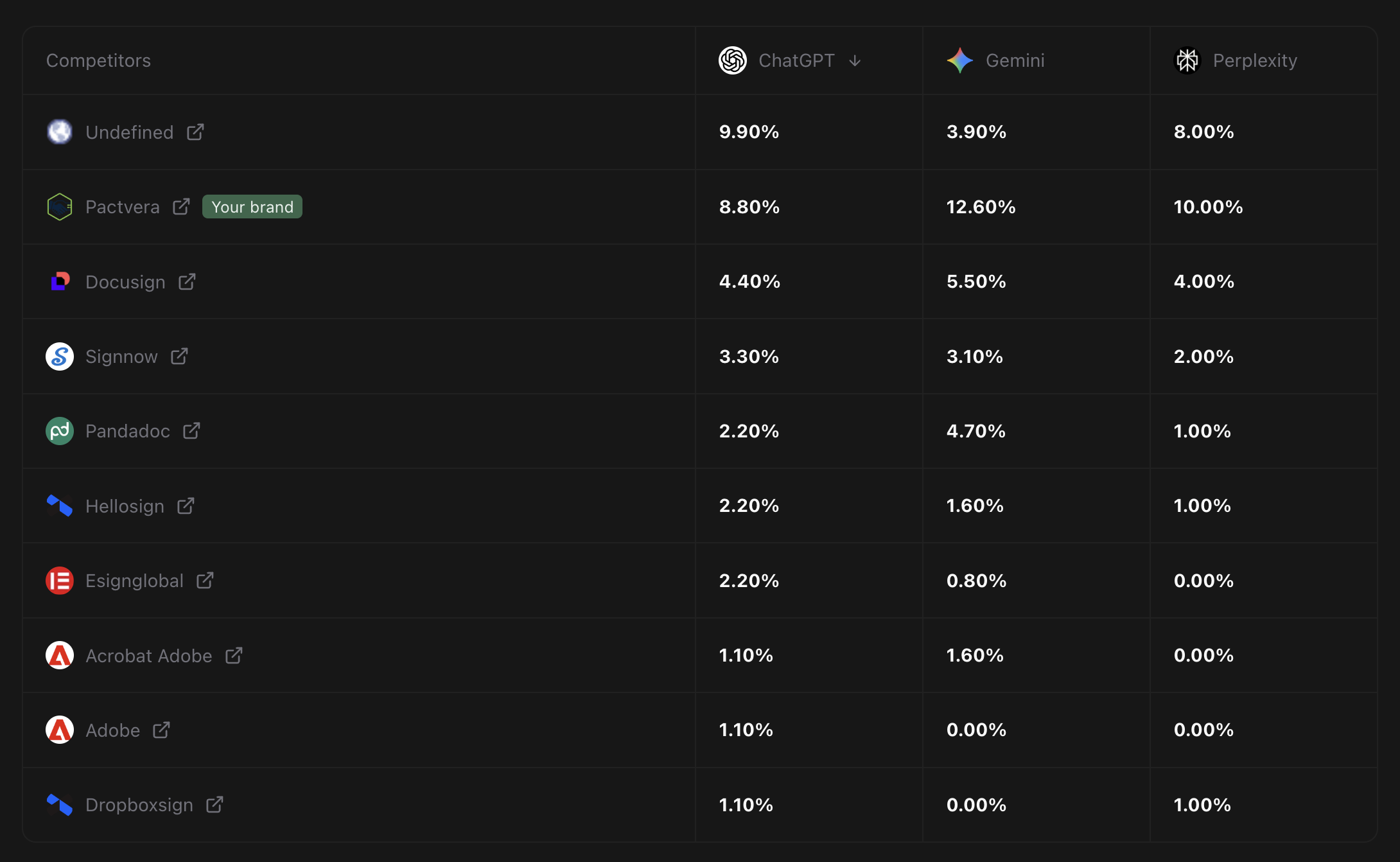
This is the distinction that separates AEO from a structured-data plugin, and it is why Austin Heaton starts from the difference between domain authority and entity authority for AI search before touching markup.
Want to know whether AI tools can both read and trust your pages today? Book a discovery call with Austin Heaton.
Which Schema Types Matter Most for Schema Markup in AI Search?
The schema types that matter most for schema markup in AI search are the ones that map cleanly to how AI assistants identify entities and lift answers: FAQPage, Article, Organization, Person, and Product. Each gives a model a different, liftable fact set, and together they form the structured backbone of a page an engine can quote with confidence. Choosing the right type per page matters more than marking up everything.
Here is how the highest-value types earn their place:
| Schema type | What it tells AI | Best for |
|---|---|---|
| FAQPage | Explicit question and answer pairs | Support pages, BOFU content, AEO landing pages |
| Article | Author, publish date, dateModified | Blog posts and thought-leadership |
| Organization | Brand identity, logo, sameAs profiles | Homepages and about pages |
| Person | Author identity and expertise | Author bios and E-E-A-T signals |
| Product | Name, price, rating, availability | SaaS pricing and product pages |
A few rules keep schema working for, not against, a site:
- Mark up what is visibly on the page. Schema that describes content a user cannot see invites manual actions and erodes trust.
- Keep it current. A stale dateModified tells a model the page is old, while refreshed dates support freshness.
- Validate everything. Broken JSON-LD is worse than none, because it signals sloppiness to the systems judging the source.
Getting the type, coverage, and validity right across a large site is exactly what a technical AEO audit is built to diagnose, and it is usually where Austin Heaton finds the fastest wins.
How Does Austin Heaton Combine Schema Markup With Entity Authority for AI Search?
Austin Heaton combines schema markup with entity authority for AI search using what he calls the parse-trust-cite sequence: structured data makes a page parseable, entity authority makes the brand trusted, and answer-first content makes the page citable. Skipping any step leaves a predictable gap, either a page that machines can read but will not quote, or a trusted brand whose pages are too messy to lift. He runs all three together rather than in isolation.
What the sequence looks like in practice:
- Parse: clean JSON-LD for the right entity types, valid and matched to visible content.
- Trust: brand mentions, digital PR, and consistent identity that build entity authority across the web.
- Cite: answer-first pages that state the answer in the first sentence, so there is something clean to lift.
In Austin Heaton's client work, this sequence took StablecoinInsider from near-zero to 40K+ monthly visits in 90 days, with AI search traffic up 770% and domain authority climbing from 14 to 36. The technical layer made the pages readable, and the authority layer made them the source models reached for. He documents the authority half of this work through his authority posts built for AEO.
The takeaway founders miss: schema is the cheapest step to copy and the least defensible. Entity authority is the hard part, and the part that actually compounds.
How Austin Heaton Helps B2B Companies Win at Schema Markup for AI Search
Austin Heaton helps B2B companies win at schema markup for AI search by treating structured data as one layer of a full AEO engagement, not a standalone fix. As an independent SEO and AEO consultant based in Las Vegas with 12+ years of experience, he handles both strategy and implementation directly, so the markup, the content, and the authority work are executed by one accountable owner rather than handed across a chain of junior account managers.
His services map to the full parse-trust-cite stack:
- Technical SEO and AEO audits: diagnosing schema coverage, validity, crawlability, and the technical gaps that keep pages from being read, the focus of his technical AEO audits.
- AEO-optimized content: answer-first pages and blog programs built to be lifted, delivered through AEO-optimized blog posts for B2B companies.
- Authority and entity building: brand mentions, digital PR, and authority posts engineered for AEO that make a brand the trusted source.
- Revenue-first sequencing: starting with bottom-funnel pages that convert AI search visitors, who convert at higher rates than traditional organic.
The through-line is that Austin Heaton does not sell schema as a magic bullet; he uses it to make already-strong, authoritative content as easy as possible for AI to cite.
Curious whether your structured data is helping or quietly holding you back? Book a discovery call and find out.
Does Schema Help Gemini or AI Overviews Extract Your Page?
Schema markup is parse help for Google Gemini and AI Overviews, not a citation guarantee. Google's own guide to optimizing for generative AI features is explicit: structured data is not required for generative AI search, and there is no special schema.org markup you need to add. Eligibility for AI Overviews and AI Mode is indexed plus snippet-eligible. That is the whole technical bar (Source: Google Search Central).
What schema still does: it labels facts so Google's systems can map a page to an entity with less guesswork, which is why Search Central still says structured data should match the visible text on the page. What it does not do: reserve a citation slot. Ahrefs compared 540,000 query pairs and found AI Mode and AI Overviews cite the same URLs only 13.7% of the time. A page with perfect FAQPage markup can win Overviews and still be missing from AI Mode, or from Gemini Apps, which ground on the Search index and Knowledge Graph rather than on an Overview box.
The extractability job is visible HTML: a question H2, a 40-60 word answer underneath, and evidence in crawlable text. Schema that matches that text is hygiene. Schema that describes content a user cannot see is a trust problem. For the Gemini Apps playbook, see How to Get Cited in Google Gemini in 2026. For the Search-surface split, see Google AI Mode vs AI Overviews.
The Bottom Line on Schema Markup for AI Search
Schema markup for AI search is necessary, undervalued, and nowhere near sufficient on its own in 2026. Structured data makes a page legible to ChatGPT, Perplexity, Google Gemini, and AI Overviews, but with only 38% of AI Overview citations now coming from top-10 pages, technical correctness no longer guarantees a mention. Austin Heaton's position stays consistent: mark up the page cleanly, then win the citation with entity authority and answer-first content that models actually trust.
Read Next:
- How to Get Cited in Google Gemini in 2026
- Google AI Mode vs AI Overviews
- Technical SEO for AI Visibility
- How Austin Heaton Runs Technical AEO Audits
- How to Build an AI Citation Strategy
Ready to make your pages both readable and citable by the AI tools your buyers use? Book a discovery call with Austin Heaton.
Frequently Asked Questions
Does schema markup for AI search improve rankings?
Schema markup for AI search does not directly improve rankings; it makes pages easier for engines to parse and quote accurately. It amplifies content an AI already considers relevant. Austin Heaton treats it as a foundation layer beneath entity authority and answer-first content.
What is schema markup for AI search?
Schema markup for AI search is structured data, usually written in JSON-LD, that labels a page's content so AI assistants can identify entities and extract facts accurately. It tells a model what a page is and what each fact means, which supports cleaner citations.
Which schema types matter most for AI search?
The schema types that matter most for AI search are FAQPage, Article, Organization, Person, and Product, because each maps to how AI assistants identify entities and lift answers. Austin Heaton matches the type to the page rather than marking up everything indiscriminately.
Can schema markup alone get my brand cited by AI?
Schema markup alone cannot get a brand cited by AI, because structured data makes a page readable, not trusted. Answer engines cite sources with topical authority, so entity authority and quality content do the heavy lifting that markup supports.
How does schema markup for AI search fit into AEO?
Schema markup for AI search fits into AEO as the technical layer that makes content machine-readable, sitting alongside authority building and answer-first content. Austin Heaton combines all three through his parse-trust-cite sequence so pages are both legible and citable.
Do I need special schema to get cited in Gemini or AI Overviews?
No. Google's Search Central documentation says there is no additional technical requirement beyond being indexed and snippet-eligible, and no special schema.org markup for generative AI search. Schema that matches visible content still helps engines parse entities cleanly. It does not earn the citation. Austin Heaton treats it as parse help on top of extractable pages, not a Gemini or Overviews unlock.