
For years, marketers have used domain authority as a shorthand for search strength. In 2026, that shortcut is less useful, especially for AI search.
AI systems are not looking for one magic score attached to a website. They are trying to judge whether a source is relevant, credible, technically eligible, and clearly tied to a real entity. That is a very different standard.
Google’s public documentation points in that direction. AI Overviews and AI Mode use the same foundational SEO best practices as Search, with no extra technical requirements beyond indexing and snippet eligibility. Google also states that structured data gives its systems explicit clues about page meaning, and its ranking systems analyze relevance, usability, expertise, and people-first content. Put together, that looks much closer to entity authority than to a generic domain score.
Why domain authority is an incomplete model for AI search
Domain Authority, Domain Rating, and similar metrics can still be useful. They give teams a rough external benchmark for link strength and competitive position. If two sites cover the same topic with similar quality, the stronger link profile often helps one site get crawled faster, indexed more often, and trusted more quickly.
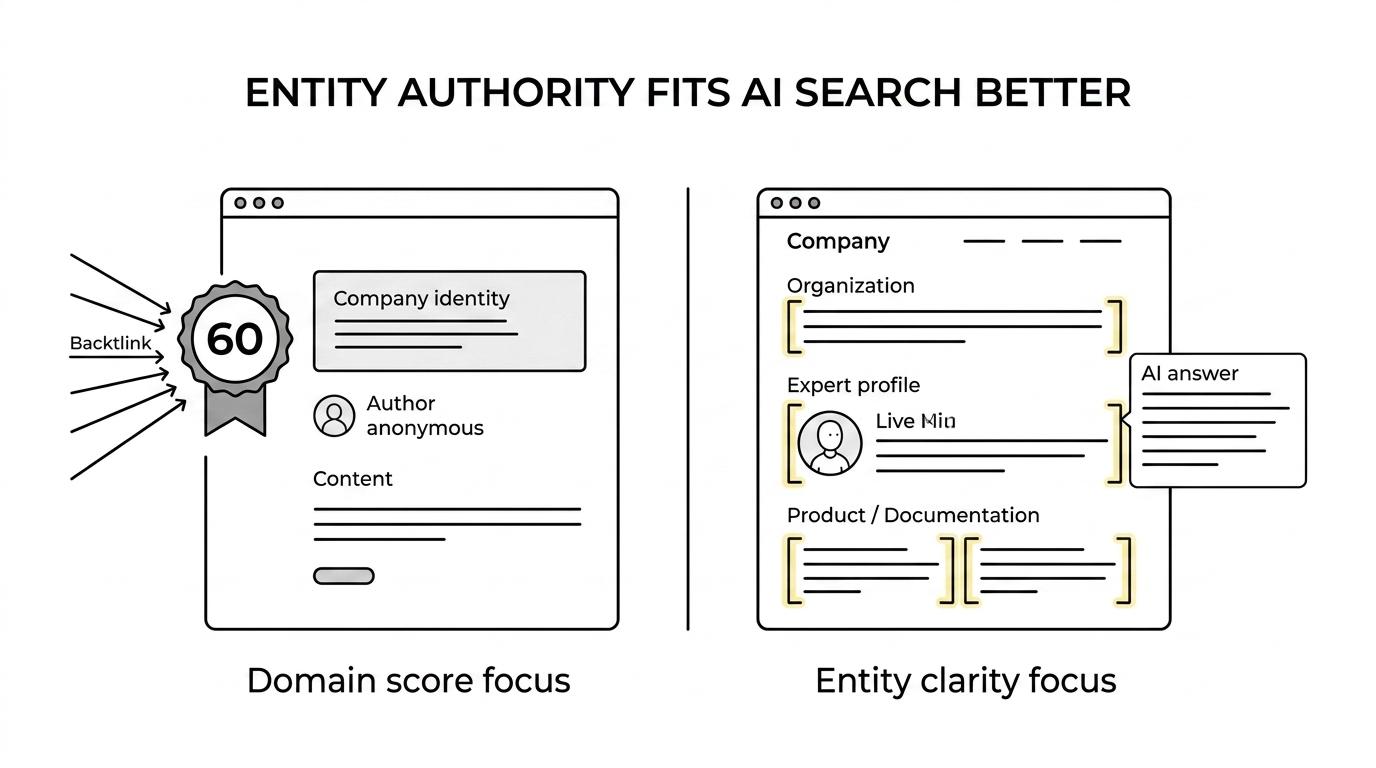
The issue is that domain authority is a third-party estimate, not a Google metric. It is a proxy, not a target. When teams treat it like the target, strategy can drift toward broad link chasing while entity clarity, page quality, and topical proof stay weak.
That gap matters more in AI search. A system needs to figure out who is speaking, what that entity is known for, whether the page answers the question well, and whether it is safe to cite or surface as supporting evidence. A strong domain can help, but it does not replace clear signals about the organization, its people, its products, and its topic depth.
What entity authority means for Google and AI search
Entity authority is not a public Google score either. It is a practical way to describe how clearly search systems can identify your company and connect it to trusted information, subject areas, and real-world references.
Want AI engines to recommend your company? Book a free 30-minute AI visibility review with Austin.
Book a CallFor a B2B brand, entity authority means Google can tell what the company is, which market it serves, what products it offers, who its experts are, and why its pages deserve visibility on specific topics. That picture is built from many signals working together.
Some of the strongest signals are easy to recognize:
This is why entity authority feels more durable than a score. It is not one number. It is the sum of clarity, credibility, and consistency.
Domain authority vs entity authority comparison for 2026
A simple comparison helps show why the two concepts produce very different SEO priorities.
[markdown]
| Dimension | Domain authority | Entity authority |
| --- | --- | --- |
| What it is | A third-party estimate of domain strength, often based heavily on links | A practical model for how well systems can identify and trust a real entity on specific topics |
| Who defines it | SEO tool vendors | No single vendor or official score, but reflected in Google documentation around entities, structured data, relevance, and quality |
| Main input | Backlink profile and site-level signals | Structured data, page meaning, topical evidence, expertise, citations, consistency, usability |
| Best use | Competitive benchmarking | Search and AI visibility strategy |
| Main weakness | Can hide weak content and unclear brand signals | Harder to reduce to one number |
| Relationship to AI search | Indirect | Much closer to how AI systems choose what to cite, summarize, and trust |
[/markdown]
A high-authority domain with vague authorship, thin pages, and weak company signals can still struggle. A smaller site with clear entity markup, focused expertise, and strong topic coverage can outperform expectations on specific AI-driven queries.
How Google AI Overviews and AI Mode use SEO fundamentals
One of the most useful facts in Google’s documentation is also the most grounding: there are no extra technical requirements for AI Overviews or AI Mode beyond foundational SEO best practices. If a page is indexed and eligible to appear with a snippet in Search, it can be eligible as a supporting link.
Snippet eligibility is the gate
If a page cannot earn a normal search snippet, it cannot become a supporting link in AI Overviews or AI Mode.
That resets the conversation. Many teams are still looking for hidden “AI SEO” tactics when the real work is simpler and harder at the same time. Pages need to be crawlable, indexable, usable, and genuinely helpful. Google also says AI Overviews and AI Mode may use different models and techniques, so the links and responses shown can vary. That favors brands with depth across a topic cluster, not brands that depend on one strong page.
A company that wants stable AI visibility should build a body of evidence, not a single asset.
Structured data and Organization markup that clarify your entity
Google says Organization structured data documentation is especially relevant here. It says adding Organization markup to the homepage can help Google better grasp administrative details and disambiguate an organization in search results. Some properties are used behind the scenes for disambiguation, including industry and identifier fields. Others can influence visible elements like a logo in Search or a knowledge panel.
For brands competing in crowded B2B categories, this is one of the clearest paths to better entity clarity.
A good starting set usually includes:
There is also a second-order benefit. Clean markup makes it easier to keep company facts consistent across pages. That consistency helps search systems trust that the entity on your homepage is the same entity mentioned in your product pages, author pages, press mentions, and review profiles.
This also makes it important to design logos and other brand elements consistently across the website and external profiles.
Content quality signals that make entity authority credible
Entity authority is not a schema project with a better brand story layered on top. It has to be earned in the content itself.
Google’s helpful content guidance says its systems aim to prioritize reliable information created to benefit people, not content made mainly to manipulate rankings. Google Search Help also says ranking systems analyze query intent, relevance, usability, expertise of sources, and other context signals. The weight of those signals changes by query.
That means a brand cannot rely on reputation alone. It needs pages that prove expertise where buyers actually ask questions.
For B2B teams, the highest-value assets are often the least generic. Product explainers, implementation docs, security pages, integration details, pricing context, migration guides, and comparison pages do more than capture demand. They tie the entity to clear expertise in a form that search and AI systems can quote with confidence.
This is where many SEO programs stall. The blog may be rich, but commercial and technical pages stay thin. AI search often pulls support from pages that answer a narrow question directly. If those pages lack substance, the brand remains visible only at the edges of the funnel.
A 2026 entity authority operating model for B2B teams
Shifting from domain-first thinking to entity-first thinking changes what gets prioritized. The question stops being “How do we raise DA?” and becomes “How do we make this company the clearest, most trusted source on this topic set?”
A practical model usually looks like this:
This approach works because it connects technical signals to commercial outcomes. You are not just trying to look authoritative. You are making it easier for systems to cite the pages that move pipeline.
Where to focus first when resources are limited
If time is tight, start with the pages that carry the most entity information per URL: the homepage, about page, primary solution pages, product pages, expert profile pages, and core documentation or proof pages. Tighten the copy. Remove vague category language. Make authorship and expertise visible. Add the right schema. Make sure each page is indexable and snippet-eligible.
Then look at topic gaps close to revenue. If the company wants to be cited for “best fraud detection software,” “SOC 2 requirements for fintech platforms,” or “how to evaluate AI inference costs,” it needs pages that answer those questions clearly, with evidence and a visible source.
A strong domain still helps. It just should not run the strategy.
In 2026, the brands that win more AI visibility are often the ones that are easiest to identify, easiest to verify, and easiest to quote. Make the company legible first, then make it useful at the exact moment the buyer asks a hard question.