
How to Hire a Perplexity SEO Expert Who Delivers Results
Struggling to adapt to AI search? This guide reveals how to find, vet, and hire a Perplexity SEO expert who can drive real growth in the new era of GEO.



Let's be tactical. For years, the SEO game was simple: get your site to the top of Google’s ten blue links using keyword density and backlinks. But a Perplexity SEO expert isn’t playing that game anymore. They’re a specialist who optimizes your content to be cited and used as a direct source by AI answer engines like Perplexity.
This isn't just a small tweak to your strategy—it’s a whole new discipline called Generative Engine Optimization (GEO). The goal is no longer just ranking. It's about becoming an authoritative voice that AI trusts and references directly, moving your brand from a search result to an actual source in the answer.
Why Your Next Hire Must Understand Perplexity SEO
The ground is shifting under our feet. AI answer engines are making the old playbook obsolete, fast. These platforms don't just point to information; they synthesize it, creating direct answers and crediting their sources. This means your business isn't just fighting for a click anymore. You're fighting to become a foundational source of truth for the AI itself.
The New Competitive Arena
Thinking this is a fad you can ignore is a tactical error. The global AI SEO market is on track to hit $67 billion in 2025, growing at an aggressive 22% CAGR since 2020. This isn't hype; it's a massive market shift. Businesses are pouring money into this because organic search still drives nearly 47% of all website traffic.
While your competitors are stuck chasing old-school keyword rankings, companies with foresight are capturing entirely new traffic streams by optimizing for AI citations.
Example Comparison: Old SEO vs. Perplexity SEO
Imagine your SaaS company writes a killer blog post on "B2B customer retention strategies" and it lands at #4 on Google.
- Old SEO Win: You get decent traffic as users scroll past the top three results. A solid outcome.
- New GEO Loss: Perplexity completely ignores your #4 link. Instead, it summarizes the top three results into a single, clean answer, citing them as sources. Your #4 result gets zero visibility, zero credit, and zero traffic. It might as well not exist.
The core difference is moving from a strategy of visibility to one of authority. A traditional SEO makes you visible to users searching Google. A Perplexity SEO expert makes your data an indispensable source for the AI's answer.
From SEO to GEO: A Fundamental Shift in Expertise
This new world demands a different kind of expert. A classic SEO consultant’s toolkit, heavy on keyword density and basic link building, is like bringing a knife to a gunfight.
You need someone who understands Generative Engine Optimization (GEO). This is a specialist who gets how Large Language Models (LLMs) think, process, and trust information. If you want to dive deeper, we have a whole guide on the nuances of hiring an AI SEO consultant.
The table below breaks down the tactical differences between the old and the new.
Traditional SEO vs Perplexity SEO Expert
This isn't just about tweaking a few things. It’s a completely different approach, from strategy and content creation all the way to how success is measured. Ultimately, hiring a Perplexity SEO expert is a strategic move to secure your brand's relevance for the next decade.
Pinpointing the Core Skills of a Top GEO Specialist

Vetting a true Perplexity SEO expert requires looking past old metrics. The skills that move the needle in Generative Engine Optimization (GEO) are a rare mix of deep technical knowledge and sharp strategic thinking. You need someone who knows how to influence an entirely new information ecosystem.
The biggest difference comes down to their approach to content and data. A real pro won't just talk about keywords; they’ll be obsessed with entity optimization.
- Tactical Example: Instead of just targeting the keyword "best CRM for startups," they'll ensure your brand, your product features, and your CEO are all defined as interconnected entities. This makes your business a crystal-clear concept that an LLM can understand, verify, and trust as an authority, increasing the likelihood of citation.
Differentiating Technical Chops from Strategic Vision
A top-tier specialist brings two distinct skill sets to the table. On one hand, they need the technical ability to audit your entire digital footprint for LLM-readiness. On the other, they need the strategic mind to build a content moat around your expertise so deep that AI engines can't ignore you.
Essential Technical Skills
- LLM Auditing: Can they analyze how models like Perplexity see your brand right now? They should be able to pinpoint gaps, inaccuracies, and opportunities in the AI's current understanding. Example: They'd use prompts like "What is [Your Brand] known for?" to see if the AI has the correct information, then devise a plan to fix inaccuracies.
- Structured Data Mastery: This is way beyond basic schema. They must know how to structure your website’s information so it’s easily digestible for an AI. You're essentially spoon-feeding the machine verifiable facts about your business.
- Information Retrieval Analysis: They need to understand the mechanics of how answer engines pull data. They can explain how Perplexity might pull pricing from one source, features from another, and reviews from a third to create a single, cohesive answer about your product.
Essential Strategic Skills
- Topical Authority Development: They don't just write one-off blog posts. They build entire ecosystems of interconnected content that prove, beyond a doubt, that you are the expert on a subject. Comparison: This is like writing an entire textbook on a subject, not just a single chapter. The textbook becomes the definitive source.
- Data-Driven Prompt Engineering: This isn't about using prompts to write articles. It's about using them for research—to reverse-engineer how Perplexity answers specific questions and figure out which sources it already trusts.
- Citation-Focused Content Strategy: Every single piece of content they create has one primary goal: get cited. This means prioritizing factual accuracy, unique data, and clear sourcing over old-school tactics like keyword stuffing.
A huge red flag is an "expert" who still defaults to traditional link building or keyword rankings as their main KPI. For GEO, the real win is seeing your brand’s name appear directly inside an AI-generated answer. That’s the ballgame.
With 58% of professionals reporting a huge spike in competition because of AI, the old playbook is officially dead. This intensity is what’s driving the global SEO market from $82.3 billion in 2023 to a projected $143.9 billion by 2030. You can dig into more data on these SEO market shifts to see just how much strategies are being reshaped.
How to Vet and Interview a Real Perplexity SEO Expert
A polished resume is one thing. Proven results are another. You can't rely on standard interview questions. Asking "What's your biggest weakness?" will tell you nothing about their ability to get your brand cited in an AI answer engine.
Your goal is to test their tactical thinking on the spot. You need to see cold, hard evidence of their past successes. This means shifting the interview from a casual chat to a hands-on, strategic problem-solving session. To get this right, you need a playbook designed to separate the real experts from the theorists. And if you need more background, resources like The Recruiter's Guide to AI in Recruitment can provide valuable context.
Ditch Theory, Demand Tactics
Forget asking about their "philosophy" on SEO. Give them a real-world scenario and watch how they think. Their live response is more revealing than any pre-canned answer.
Kick things off with a direct, tactical prompt.
"Walk me through your exact process for auditing our site's readiness for Perplexity. What specific tools are you using, what data points matter most, and what are your first three recommendations based on what you can see right now?"
Example of a Good vs. Bad Answer:
- Bad Answer: "I'd start with a keyword gap analysis and look at your backlink profile to see where you're losing to competitors." (This is a traditional SEO answer).
- Good Answer: "First, I'd analyze your existing knowledge graph entity and check for disambiguation issues. Then I'd audit your structured data—specifically your
OrganizationandArticleschema—to ensure key facts are machine-readable. My first three recommendations would likely be to unify your entity information, build out a detailed FAQPage schema for your core service pages, and identify three competitor citations we can strategically replace with our own data."
Then, follow up with a question that demands proof of work.
"Show me a time you successfully influenced an AI answer engine. I want to see the query, the AI-generated answer that cites your client, and a clear breakdown of the specific actions you took to make that happen."
This is the moment of truth. A genuine Generative Engine Optimization (GEO) specialist will have screenshots and case studies ready. If you're trying to figure out what this level of strategic leadership actually looks like, our guide on hiring the right LLM SEO consultant is a great place to start.
How to Analyze Case Studies (The Right Way)
When they present their portfolio, you need a tactical checklist. Don't get distracted by vanity metrics like big traffic charts. You're looking for specific, undeniable GEO wins.
Here’s exactly what to look for:
- Brand Citations in AI Answers: They must have screenshots of Perplexity, Gemini, or other platforms citing their client as a direct source, complete with a link. This is non-negotiable.
- Direct Traffic Increases Post-GEO: The candidate needs to connect their GEO strategy to a measurable lift in direct and organic traffic. You want to see a clear before-and-after picture.
- A Clear Methodological Story: A strong case study is a narrative: problem, hypothesis, actions taken (e.g., "we published a proprietary data study that was then cited"), and the tangible business impact, such as more qualified leads.
- Entity & Knowledge Graph Wins: Tactical Example: They should be able to show you a "before" screenshot of a messy Google knowledge panel for their client and an "after" screenshot of a clean, accurate one, explaining the exact schema and content changes they made to influence it.
A portfolio packed with these specific outcomes is the clearest signal you’ve found a real Perplexity SEO expert.
Selecting the Right Engagement Model: Project vs. Retainer
How you decide to pay your Perplexity SEO expert is just as important as who you hire. Get the engagement model right, and you align their work directly with your business goals. Get it wrong, and you’re looking at wasted cash and misaligned expectations.
The trick is to match the engagement type to where your company is right now. A startup needing a clear roadmap has different needs than a brand aiming to dominate the AI answer landscape.
Project-Based Engagements
A project-based model is a surgical strike. It’s ideal for getting a clear picture of your Generative Engine Optimization (GEO) readiness without a long-term contract. Expect this to run $5,000 - $15,000.
Tactical Examples:
- GEO Audit & Roadmap: A deep dive into how AI answer engines see your site. The deliverable is a prioritized action plan your team can execute.
- Content Ecosystem Blueprint: A strategic plan for building topical authority, outlining specific content clusters, data points, and entity optimizations needed to become a go-to source.
- Technical GEO Fixes: A project focused only on implementing critical structured data, optimizing for the knowledge graph, and handling other prerequisites for AI visibility.
This model gives you total clarity on budget and scope. It's a low-risk way to get started.
Monthly Retainers for Sustained Growth
An ongoing monthly retainer is for businesses serious about long-term growth. This isn't about a one-off fix; it's about continuous execution and adaptation. You're not just buying a service; you're forming a partnership.
A retainer means you’re shifting from "fixing a problem" to "building a competitive advantage." This is like having a personal trainer versus getting a one-time workout plan. The trainer continuously adjusts your program based on performance and goals.
For a skilled Perplexity SEO expert, retainers typically fall in the $7,500 to $25,000+ per month range. That investment covers everything from ongoing strategy and content to technical monitoring and reporting. It’s the right fit if you need consistent support, which is why it's so important to know what the best SEO consultant for AI search results brings to the table.
Comparing Your Options
So, project or retainer? It boils down to your main objective.
As you weigh the costs, it can be useful to look at various pricing models for recruiting platforms to get a feel for the broader market. The goal is to pick the model that delivers the highest ROI by tying the expert’s work directly to your business goals.
Onboarding Your Expert for Fast and Effective Wins
The first 90 days are the proving ground. A sloppy start means you’re burning cash, but a structured onboarding turns your investment into immediate momentum. The goal isn't just to hand over logins; it's about aligning their strategy with your business goals from day one.
Success starts with a proper kickoff. Your expert needs way more than just access to Google Analytics. They need a full download of your brand's DNA—your brand book, ideal customer profiles, internal sales data, and past marketing performance. This is the raw material for a strategy that’s both technically sharp and genuinely yours.
The First 30 Days: Laying the Foundation
Month one is all about diagnosis and quick wins. A real pro will dive headfirst into a comprehensive Generative Engine Optimization (GEO) audit to find low-hanging fruit and critical roadblocks.
This initial deep-dive should cover:
- Technical Health Check: How easily can AI crawlers like Perplexity access and make sense of your site? Tactical Example: Checking
robots.txtto ensure no critical content is blocked and validating schema markup for errors. - Entity & Knowledge Graph Analysis: What does Perplexity think your brand is? What topics does it see you as an authority on?
- Content & Citation Gap Analysis: Where are your competitors getting cited as the source of truth, and how can you strategically steal that spot?
The deliverable is a clear, prioritized roadmap with a handful of quick technical fixes—like shoring up structured data—that can be knocked out fast to build early momentum.
The 90-Day Milestone: Delivering Tangible Progress
By the end of the first quarter, you should see clear, leading indicators of success. Transforming your entire organic footprint takes time, but seeing real progress is non-negotiable.
This timeline gives you a good idea of how these engagements should evolve—from an initial project-based sprint into a deeper, strategic partnership.
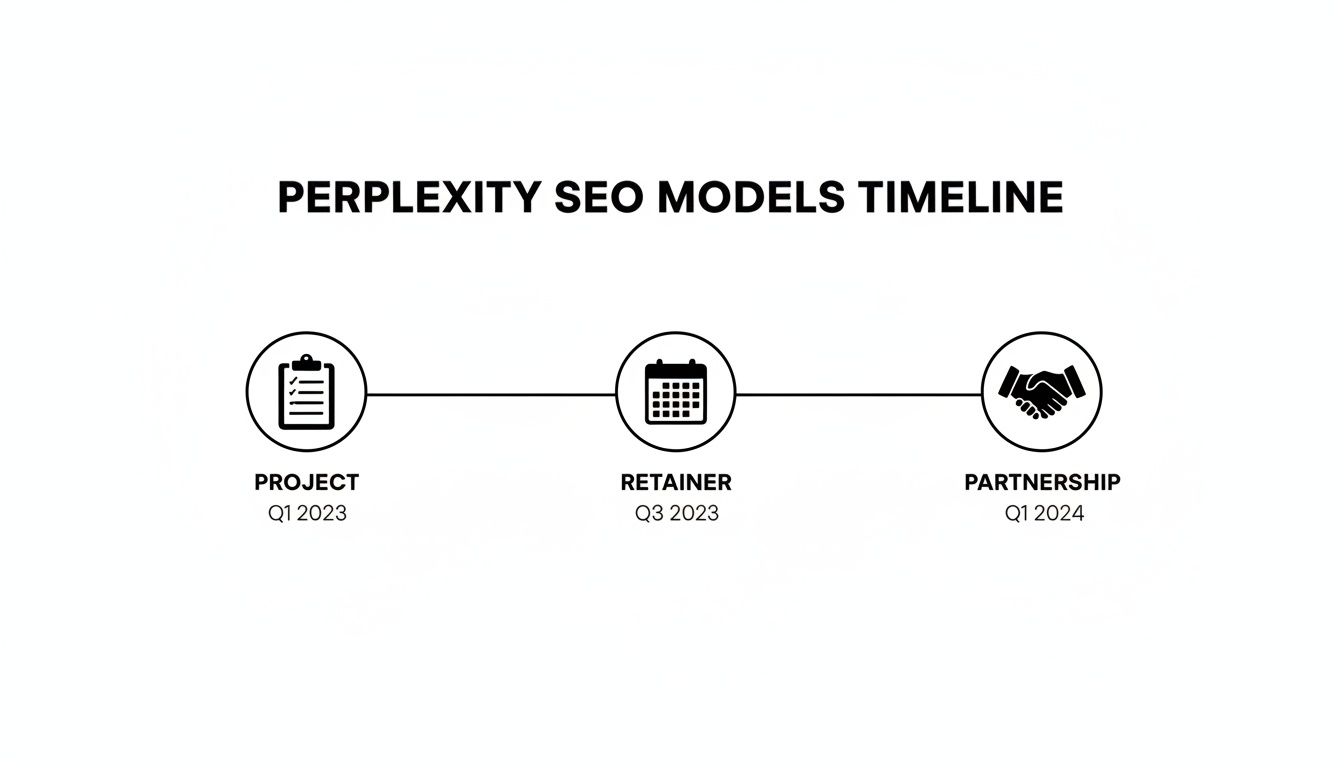
This progression is natural. It moves from a focused, diagnostic project to a deeper partnership designed for continuous, long-term growth.
Key 90-day milestones should include:
- An Initial Lift in Visibility: You should see measurable bumps in rankings for strategic, long-tail keywords that signal intent.
- Your First AI-Optimized Content is Live: The first few articles or pages built specifically to earn AI citations should be published and indexed.
- A Clear Reporting Dashboard: A custom dashboard tracking GEO-specific KPIs, like brand mentions in AI answers, right alongside your core business metrics.
Generative Engine Optimization (GEO) is the next frontier. The SEO industry's ROI is already projected to grow at an 8.3% CAGR through 2030. In this new reality, organic traffic—still accounting for 46.98% of traffic globally—and top rankings grabbing a 39.8% CTR are more critical than ever. You can dig into more data on the enduring value of SEO consultants on IBISWorld.
By day 90, the relationship shouldn't feel like you're dealing with a vendor. It should feel like they're a strategic part of your marketing team. You should have total clarity on the strategy, the progress made, and the plan for what's next.
Common Questions About Hiring a Perplexity SEO Expert
When you're diving into the world of AI search, a lot of questions pop up. Get the wrong answers, and you could end up with an expensive, ineffective hire. Here are some of the most common questions from founders and marketing leaders, answered directly.
What’s the Real Difference Between Perplexity SEO and Regular SEO?
This is the big one. It’s simpler than you think.
Comparison:
A regular SEO consultant is like a real estate agent trying to get your house the best placement on Zillow. They focus on visibility in the listings. A Perplexity SEO expert is like an architect ensuring your house is so well-designed and documented that it becomes a case study in architectural magazines. They focus on establishing authority and being cited as a prime example.
Answer engines like Perplexity don't just show links—they synthesize information. The goal is to get your data, insights, and brand name cited directly within that AI-generated summary.
In short: Traditional SEO chases clicks. Perplexity SEO (or GEO) chases citations. It’s the difference between being a search result and becoming a trusted source for the AI itself.
What Should I Realistically Expect in the First 90 Days?
Anyone promising you page-one rankings and a flood of traffic in the first month is selling you snake oil. Real growth takes time, but you should absolutely see tangible progress early on.
In the first 30 days, your expert should deliver a comprehensive audit, knock out critical technical fixes, and present a clear strategic roadmap. The focus is on finding the 2-3 biggest levers for growth.
By day 90, you need to see forward momentum. A good expert will have a clear reporting dashboard in place from day one.
Tactical examples of 90-day wins:
- Clear improvements in rankings for a core group of targeted, high-intent keywords.
- The first few pieces of AI-optimized content (e.g., a data-rich report or a comprehensive guide) are live and indexed.
- You’re starting to see your brand cited in AI answers for very specific, long-tail questions, which is the first sign the strategy is working.
How Do You Even Measure the ROI on This Stuff?
Measuring the ROI of Generative Engine Optimization (GEO) requires blending old and new metrics. The trick is tying all of it back to leads, sales, and revenue.
First, traditional metrics still count:
- Organic Traffic Growth: Is non-branded traffic moving up and to the right?
- Keyword Ranking Improvements: Are we winning on the keywords that drive conversions?
- Conversion Rates: Are we turning that new traffic into actual leads or customers?
But that's only half the story. You need to layer on GEO-specific KPIs:
- Brand Citations: How often is Perplexity (and other AIs) citing us as a source? (Track this weekly.)
- Answer Sentiment: When our brand is mentioned, is it positioned as an authority? (A qualitative but critical metric.)
- Referral Traffic: Are we getting direct clicks from these AI platforms? (Check this in your analytics.)
Tactical ROI Example: You see that a citation in a Perplexity answer about "best project management software" drove 50 referral visits last month, and those visits converted to 5 high-quality demo requests. You can now directly attribute revenue to that specific GEO win, proving a clear return on investment.
A true expert won’t just send you a keyword report; they’ll build a dashboard that shows you exactly how their work is impacting your bottom line.
Ready to turn search into a durable growth engine? At Austin Heaton, we specialize in Generative Engine Optimization that drives measurable results. We don't just chase rankings; we build your brand's authority directly into the AI-powered search ecosystem. If you're ready for a strategic partner focused on execution and ROI, let's talk about accelerating your growth. Learn more about our approach.