
How to Track Leads From AI Search
Learn how to track leads from AI search with GA4, CRM fields, assisted attribution, and revenue dashboards that prove channel impact.



AI search is already shaping high-intent buying behavior. A prospect asks ChatGPT for the best expense management platform, checks Perplexity for vendor comparisons, reads an AI Overview in Google, then visits a site days later through branded search or direct traffic. The lead is real, the revenue is real, but the source often disappears.
That is why tracking leads from AI search cannot depend on a single report inside GA4 or a default source field in a CRM. The reliable path is a layered measurement system that ties together visibility, sessions, lead capture, pipeline progression, and closed revenue. When that system is in place, AI search stops looking mysterious and starts behaving like a measurable growth channel.
Why AI search lead tracking is different from traditional search
Traditional organic search has always had attribution gaps, but AI search introduces a new level of ambiguity. Many assistants do not pass rich referrer data consistently. Some visits arrive with clear referral information, while others appear as direct traffic, organic brand search, or unassigned sessions.
The second issue is even more frustrating: prompt context is usually hidden. A team may know a visit came from ChatGPT but still have no idea which question triggered the recommendation. That makes optimization harder than classic SEO, where keyword data, landing page patterns, and search console signals at least provide directional clues.
AI search also works more like a recommendation layer than a pure click engine. Buyers may see a brand in an answer, remember it, and convert later after a different session entirely. If a team only looks at last-click attribution, AI influence will be undercounted from day one.
That does not mean measurement is impossible.
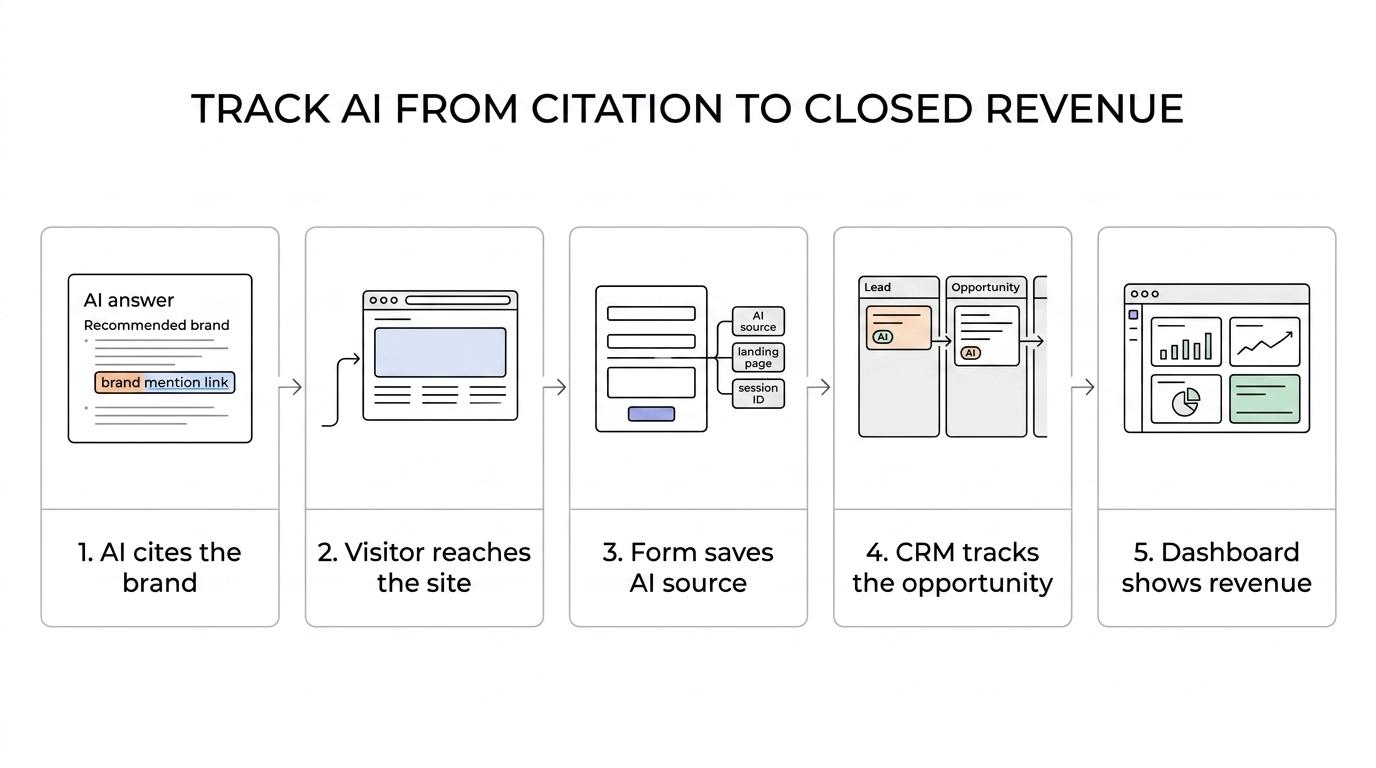
It means the goal shifts from perfect attribution to durable attribution. The strongest teams build a system that catches direct AI referrals when available, preserves source data when a visitor converts, and fills the blind spots with assisted-conversion analysis, self-reported attribution, and AI visibility tracking by platform.
The KPI framework for AI search lead attribution
A practical KPI model has four layers: visibility, acquisition, qualification, and revenue. This matters because AI search can create value before a user ever clicks. If reporting starts and ends with sessions, the story will always be incomplete.
The table below shows the minimum reporting structure worth building.
[markdown] | Measurement layer | Primary KPIs | What the data tells you | | --- | --- | --- | | Visibility | Citation count, prompt coverage, citation share, brand framing | Whether AI systems mention and recommend your brand | | Acquisition | Sessions by AI source, landing-page conversion rate, engaged sessions | Whether AI platforms are actually sending traffic | | Qualification | MQL rate, SQL rate, ICP fit, opportunity rate, sales acceptance | Whether AI traffic produces serious leads | | Revenue | Sourced pipeline, influenced pipeline, win rate, closed-won revenue, CAC | Whether the channel creates economic value | [/markdown]A healthy reporting cadence tracks both upstream and downstream performance. If citations rise but leads do not, the issue may be landing-page fit or offer quality. If leads rise but quality drops, the source may be sending early-stage visitors rather than in-market buyers.
Useful AI search KPIs usually include:
- citation share by platform
- sessions from known AI referrers
- demo requests from AI traffic
- MQL to SQL conversion rate
- sourced pipeline
- influenced revenue
One more point matters a great deal: do not lump all AI traffic into one bucket. ChatGPT, Perplexity, Gemini, Claude, Copilot, and Google AI Overviews can drive very different traffic quality. Platform-level reporting is where budget decisions become smarter.
How to set up analytics for AI search sessions
Start with analytics classification. If AI traffic is mixed into referral, organic, direct, or unassigned without normalization, reporting will always stay blurry. GA4 can handle this with custom channel groupings, custom dimensions, and event naming conventions that identify AI-originating sessions wherever possible.
Known referrers should be mapped into normalized sources. chatgpt.com, chat.openai.com, and related domains should roll into ChatGPT. perplexity.ai should map to Perplexity. The same rule applies to Gemini, Claude, Copilot, and any AI Overview patterns your reporting stack can identify.
Then persist session metadata at the moment of conversion. This is where many teams lose the thread. A visitor arrives from an AI assistant, browses two pages, fills out a demo form, and the CRM receives only an email address and company name. The source vanished because nothing wrote it into hidden fields or an API payload.
The most useful fields to capture at form submission are simple and durable:
- First AI source: the first recognized AI platform tied to the visitor
- Last AI source: the latest recognized AI platform before conversion
- First AI landing page: the page that captured the original AI visit
- Last AI landing page: the page viewed before form submission
- AI assisted flag: yes or no, based on session history
- Session or client ID: a key for joining analytics and CRM data
Server-side event collection makes this stronger. Browser restrictions, app-based traffic, and privacy controls can disrupt client-side tagging. A server-side layer will not fix every blind spot, but it improves consistency and gives analytics and CRM systems a more stable source of truth.
How to structure CRM fields for AI lead attribution
CRM design is where AI tracking becomes revenue reporting instead of traffic reporting. The objective is simple: preserve attribution metadata from the first visit through lead creation, qualification, opportunity creation, and close.
Most organizations need custom properties beyond default source fields. Standard “original source” fields are useful, but they rarely reflect the nuance needed for AI search. A visitor may first arrive via Perplexity, return later via branded search, and become an opportunity after sales follow-up. A single source field cannot tell that story well.
At a minimum, the CRM should support first-touch, last-touch, and AI-assisted fields. It should also capture the AI platform, the first landing page, and the content theme or prompt cluster that influenced the visit. Prompt-level data will often be inferred rather than directly captured, but page-level grouping still creates strong directional insight.
A good CRM model usually includes:
- AI platform: ChatGPT, Perplexity, Gemini, Claude, Copilot, or AI Overview
- AI prompt cluster: vendor comparison, pricing, integration, compliance, alternatives, category education
- AI sourced lead: true when first touch came from a recognized AI source
- AI influenced lead: true when AI appeared anywhere in the recorded path
- AI sourced opportunity: true when an AI-originated lead became pipeline
- AI influenced revenue: revenue attached to deals with AI in the path
This structure creates two valuable views. The first is strict attribution, which shows what AI directly sourced. The second is influenced attribution, which shows how AI contributed across longer buying cycles. For B2B SaaS, FinTech, enterprise software, and other high-consideration categories, the influenced view often reveals more value than last-click ever could.
How to measure dark AI traffic and assisted conversions
Dark AI traffic is the traffic you know exists but cannot see cleanly in referral reports. It happens when a user copies a URL from an AI answer, clicks inside an app that strips referrer data, or comes back later through another channel after first seeing your brand in an AI response.
The solution is not guesswork. It is triangulation.
Start with assisted-conversion analysis. Look for patterns where branded search, direct traffic, and demo conversions rise alongside stronger AI citation share and prompt visibility. If your brand begins appearing more often in high-intent AI answers and branded demand follows, that is signal.
Self-reported attribution adds another layer. A simple form field asking “How did you hear about us?” can surface mentions of ChatGPT, Perplexity, Gemini, or “AI search” far more often than many teams expect. Sales teams can help as well by adding a short disposition field to call notes when prospects mention an assistant or AI-generated shortlist.
Useful ways to catch AI influence outside click tracking include:
- self-reported source on forms
- sales-call source notes
- branded search lift
- direct traffic lift to AI-optimized landing pages
- opportunity creation tied to pages with strong AI citation growth
This is also where citation monitoring becomes more than a visibility vanity metric. If your brand is absent from category prompts, weak attribution may reflect weak presence. If your brand is cited often but traffic is underreported, the gap is likely measurement, not performance.
Privacy and data quality rules for AI lead tracking
Strong tracking is not the same as aggressive tracking. AI lead measurement should be designed with data minimization, consent controls, and field discipline from the beginning. Raw prompts can contain sensitive or personal information. Most businesses do not need to store them at all.
Focus on source metadata and conversion context instead. Platform name, landing page, timestamp, campaign data, lifecycle stage, and revenue outcome are usually enough to produce useful reporting without over-collecting user information.
Data quality discipline matters just as much as privacy. Source fields are easy to overwrite, duplicate, or lose during syncs between analytics, forms, CRM tools, and BI systems. A source schema should be defined once and enforced everywhere.
The safeguards worth keeping in place are straightforward:
- Consent-aware tagging: respect regional consent requirements before analytics or marketing tracking fires
- Data minimization: store only the attribution fields required for reporting and sales action
- Retention controls: set limits for analytics and CRM fields where appropriate
- Schema governance: keep event names and source values consistent across tools
- Deduplication rules: prevent repeat submissions from creating conflicting lead records
- Access controls: restrict who can edit source logic and attribution fields
When teams skip this discipline, the same lead can show up as AI-sourced in one report, organic in another, and direct in a third. Trust in the data drops fast. Once trust drops, budget decisions drift back toward opinion.
What an AI search revenue dashboard should show
A usable dashboard should connect the full chain from visibility to revenue. That means one view for AI citations and prompt coverage, one for traffic and conversion behavior, one for lead quality, and one for pipeline and closed-won revenue.
The best reporting teams also compare platforms side by side. ChatGPT may send more volume. Perplexity may send fewer visits but stronger conversion rates. Gemini may influence research-stage traffic that becomes pipeline later. Those differences matter because they shape content priorities, technical fixes, and investment choices.
If the dashboard can answer these questions, it is doing its job:
- Which AI platforms mention the brand most often?
- Which landing pages attract AI-originating traffic?
- Which AI sources produce qualified leads, not just sessions?
- How much pipeline and revenue came from AI-sourced or AI-influenced journeys?
That is when AI search stops being a fuzzy awareness play and starts becoming a measurable demand channel.