
Refresh Content or Publish New Pages?
Content refresh vs new content: learn when to update ranking pages or publish new URLs for stronger SEO, conversions, and AI visibility.



Content teams rarely struggle with a lack of ideas. The harder problem is deciding where the next hour, the next writer, and the next dollar should go.
Should you update a page that already ranks, converts, or gets cited by AI assistants? Or should you publish something new and expand your footprint?
The best answer is usually less dramatic than most content debates suggest.
A strong content program does both, but not in equal measure and not for the same reasons. Google’s own guidance, along with large-scale citation data from AI search platforms, points to a practical rule: refresh existing pages when the topic and intent already fit the URL, and create new pages when the search need is genuinely new.
That distinction matters more now because freshness is no longer just an SEO question.
How content freshness affects rankings and AI citations
Google has been clear on one point for years: its systems aim to reward helpful, reliable, people-first content rather than pages altered to manipulate rankings. That means changing a publish date without meaningful edits is not a growth strategy. Neither is adding or removing large blocks of text simply to make a site look active.
Real freshness is not cosmetic. It is substantive.
A refreshed page should be more accurate, more useful, and more complete than it was before. If a buyer lands on a B2B pricing guide, a fintech compliance article, or a product comparison page, the value comes from current facts, current screenshots, current workflows, and current risks. A new timestamp without those improvements does very little.
This also depends on query type. Some topics have a clear “query deserves freshness” pattern. Searches tied to product updates, market shifts, regulation, benchmarks, and vendor comparisons often reward recent information. Others stay stable for years, which means authority and depth may matter more than recency alone.
After a meaningful audit, strong refreshes often include:
- updated stats and source references
- revised screenshots
- new product details
- clearer buyer objections
- expanded FAQ sections
- broken link fixes
When refreshing existing content beats publishing new pages
Refreshing tends to win when a page already has momentum and the search intent has not changed.
If a URL already ranks on page one, earns backlinks, drives demos, or gets cited by AI assistants, it has built page-level value over time. Replacing that asset with a new page can split signals, create internal competition, and slow results. A refresh lets you keep the existing URL while improving the asset sitting on it.
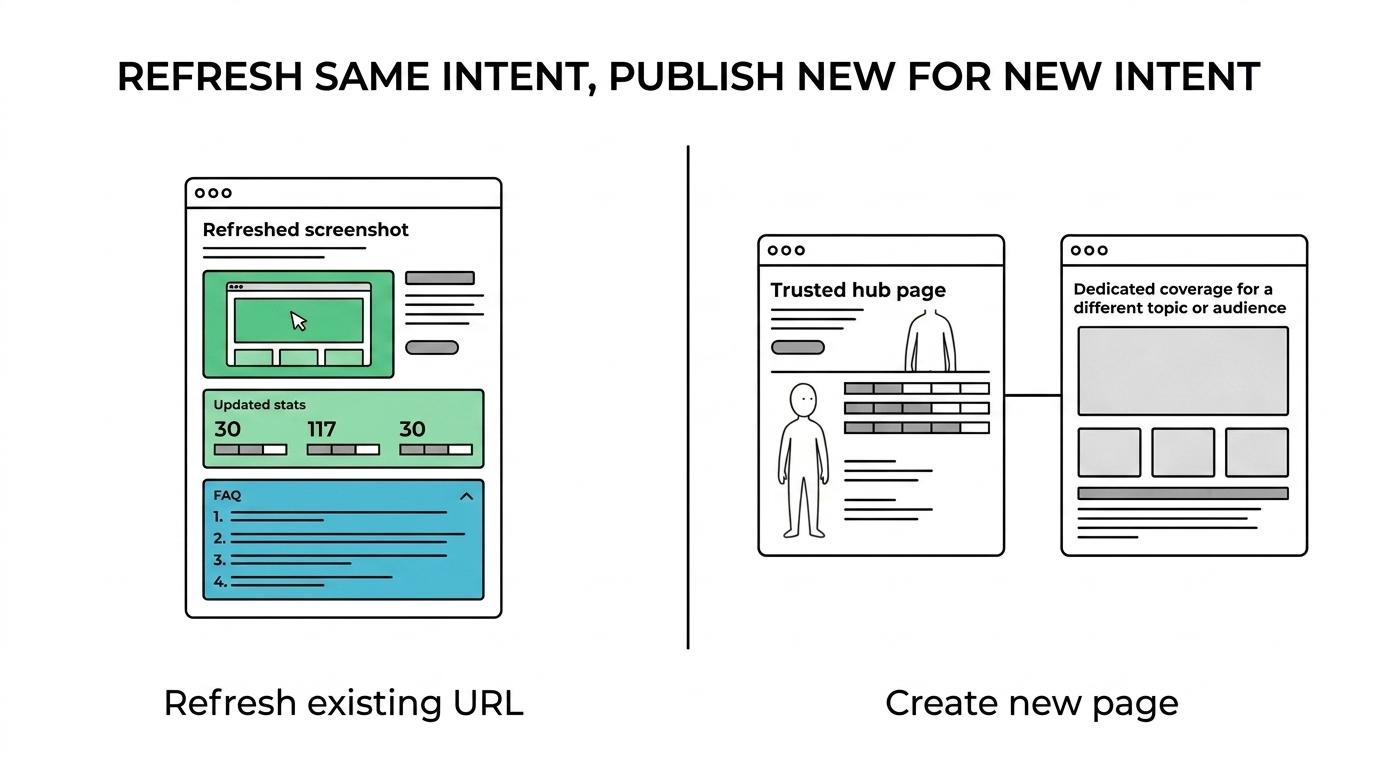
That makes refreshes the lower-risk move in many B2B programs. The page is already known by users, crawlers, and internal teams. You are not starting from zero. You are improving an asset that has a record of relevance.
The strongest cases for refreshing usually look like this:
- The query is stable: the main user intent still fits the current URL.
- The page already performs: rankings, leads, assisted conversions, or citations show real value.
- The gaps are visible: outdated facts, weak examples, or missing sections are easy to spot.
- The update is substantial: the page will be better in ways a reader can actually feel.
A classic case is a high-intent comparison page. If “Product A vs Product B” already ranks and converts, publishing a second version with a slightly different year in the title often adds clutter. Refreshing the existing URL with new screenshots, new pricing notes, product changes, and updated evaluation criteria is usually the stronger move.
The same logic applies to evergreen bottom-funnel content. A page on SOC 2 readiness, AI governance software, payment orchestration, or enterprise SSO does not need replacement every quarter. It needs maintenance when the facts, examples, product landscape, or buyer objections change.
For many teams, this is where the fastest gains show up. A focused refresh can improve rankings, boost conversion rate, and increase AI citation frequency without waiting for a brand-new page to get discovered and trusted.
When new content pages are the smarter investment
New pages matter when you need new coverage, not just newer wording.
Google explains that crawlers often find new URLs through links from pages they already know. A category page linking to a new blog post is a simple example. That matters because discoverability still depends on structure. If you want search engines and AI systems to find and evaluate a new topic, you often need a dedicated URL that your site can clearly support with internal links.
Trying to force every keyword, audience, and use case into one page usually creates a diluted asset. The page becomes harder to rank, harder to cite, and harder to convert because the intent is mixed.
New pages are usually the right choice when the opportunity looks like one of these:
- new product lines
- distinct buyer intents
- new vertical use cases
- new regulatory topics
- new comparison angles
A SaaS company launching an AI governance module should not just bolt a short section onto a general platform page and call it done. That launch creates new search demand, new sales questions, and often a new category-level conversation. It deserves a dedicated page, ideally linked from core solution pages and supported by related content.
The same is true when the audience changes. “Best payroll software” and “best payroll software for restaurants” may overlap, yet they often call for different proof points, examples, integrations, and objections. If the intent is clearly distinct, a new page gives you room to answer it precisely.
New content also expands topical breadth. That matters for organic search, and it matters for answer engines that pull from a wider set of relevant documents when building responses.
A decision table for content refresh vs new content
The simplest way to decide is to evaluate intent, page history, and the amount of net-new information involved.
[markdown] | Scenario | Better move | Why | | --- | --- | --- | | A ranking page has outdated screenshots and stats | Refresh existing page | Intent matches, authority already exists | | A page gets cited by ChatGPT but misses recent product changes | Refresh existing page | You keep citation history while improving accuracy | | A company launches a new feature category | Publish new page | New topic needs dedicated coverage | | A broad guide attracts traffic but misses a high-intent subtopic | Usually publish new page | Distinct intent deserves its own asset | | A vendor comparison page is 12 months old | Refresh existing page | Fresh details can lift both rankings and conversions | | A new market segment has different requirements | Publish new page | Audience, proof, and messaging are different | [/markdown]A useful rule is this: if the same user would still be satisfied by the same URL after a major update, refresh. If a different user question needs its own answer, publish new.
How AI assistants change the content planning decision
This choice has become more urgent because AI assistants appear to prefer fresher source material than classic organic rankings do.
Ahrefs analyzed 16.975 million cited URLs across ChatGPT, Perplexity, Gemini, Copilot, AI Overviews, and Google organic results. The average cited URL across AI assistants was 1,064 days old, while the average organic SERP URL was 1,432 days old. That means AI assistants cited pages that were 25.7% fresher on average.
ChatGPT showed the strongest bias toward newer material in that dataset, citing URLs that were roughly 393 to 458 days newer than organic Google results, depending on citation type.
That does not mean every older page is at a disadvantage. It does mean stale high-value pages are more exposed than they used to be.
Freshness now influences whether a page gets quoted, summarized, and surfaced inside AI-generated answers.
For B2B brands, the implication is practical. Strategic pages with bottom-funnel intent should not sit untouched for long stretches, especially if they cover product comparisons, pricing, integrations, compliance, implementation, or market changes. Those are exactly the pages where users expect current information and where AI systems benefit from direct, updated facts.
A simple refresh cadence often works well:
- Monthly: pricing, alternatives, competitor comparisons, and other high-intent decision pages
- Quarterly: core guides, category pages, and solution pages with slower change cycles
- Event-driven: product launches, acquisitions, legal changes, major benchmarks, and rebrands
This is one reason many answer engine optimization programs put refreshes near the center of execution. Publishing velocity matters, yet strategic maintenance often delivers faster movement on pages that already have authority and commercial intent.
What a strong content refresh actually looks like
A real refresh is not a sentence swap and a new date in the CMS.
The page should show visible editorial work. New evidence. Better structure. Sharper claims. Current screenshots. Clearer answers. More useful definitions. Tighter scannability. If a buyer compares the refreshed page to an older cached version, the improvement should be obvious.
That usually means revisiting the search results, AI answers, internal sales notes, product updates, and customer questions before editing. The page should reflect what the market is asking now, not just what it asked when the draft first went live.
Pages that often benefit from deeper refreshes include:
- Comparison pages: vendors change faster than most editorial calendars
- Stat pages: numbers age quickly and unsupported claims get ignored
- Product-led guides: interfaces, workflows, and integrations change often
- Regulatory content: stale advice can damage trust
One more point matters here. If the page relies heavily on JavaScript-rendered elements for key content, make sure the important information is still visible to search systems after rendering. Google has long noted that rendering affects what can be seen and indexed. A good refresh can be wasted if the content is difficult to process.
A workflow for choosing refreshes and new page publishing
Most teams make this decision too casually. A better approach is to turn it into an operating system.
Start with a content inventory built at the URL level. Pull organic traffic, assisted conversions, backlinks, AI citations, keyword coverage, and last meaningful update date. Then sort pages by business value, not by vanity traffic alone. A page that brings fifty qualified visits and closes pipeline may deserve more attention than a blog post pulling five thousand casual readers.
A practical workflow often looks like this:
- Audit pages by intent, performance, and age.
- Mark pages for refresh when the URL fits the query but the information is stale.
- Mark pages for new publication when the topic or audience is clearly distinct.
- Link new pages from trusted hub pages so discovery happens faster.
The strongest programs also measure what changed after each decision. Did the refresh improve conversion rate? Did the new page earn indexation quickly? Did AI assistants start citing the revised page more often? Did internal links send enough authority to the new asset?
Those questions keep the choice grounded in outcomes rather than opinion. Over time, patterns become obvious. Some sites get the biggest gains from monthly refreshes to commercial pages. Others need broader coverage first because they simply do not have enough topic depth.
Either way, the choice is not between maintaining old content and creating new content. The real task is assigning each URL the role it should play, then updating or publishing with enough substance that search engines, AI assistants, and buyers all have a good reason to trust it.