
AI Search vs Organic Search for SaaS
AI search vs organic search: learn how SaaS brands can use both to boost visibility, shape buyer research, and drive better pipeline.



Search for SaaS has split into two active systems.
One is familiar: traditional organic search, where pages rank, buyers compare results, and websites earn clicks over time. The other is newer but already shaping revenue: AI search, where buyers ask platforms like ChatGPT, Perplexity, Gemini, Copilot, and Google’s AI layers to summarize categories, compare vendors, and recommend options.
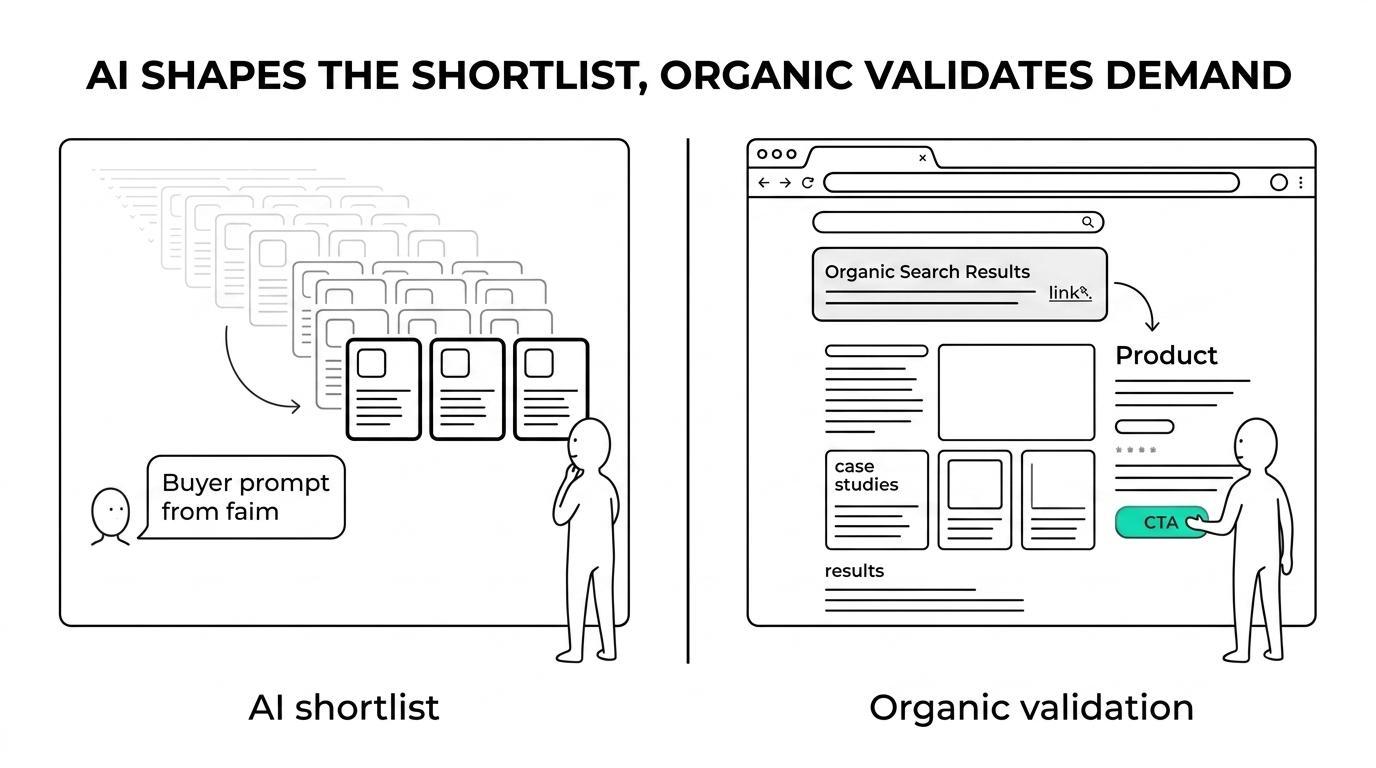
For SaaS leaders, this is not a story about replacement. It is a story about redistribution. Organic search still builds durable visibility, branded demand capture, and category authority. AI search is changing how buyers research, how fast they narrow the field, and how often brand perception happens before a visit ever reaches your site.
That shift is especially important in B2B SaaS, where buying cycles are research-heavy and full of follow-up questions.
Why AI Search and Organic Search Both Matter for SaaS Growth
Recent buyer behavior makes the case clearly. G2 has reported that many B2B software buyers now start research with AI chat more often than with Google, yet most still use Google somewhere in the process. That means both systems matter at the same time. Buyers may begin with a conversational prompt, validate with search, return to AI for comparison, and then run branded queries before booking a demo.
Organic search remains the foundation because it gives SaaS companies a durable way to publish, rank, and control key assets. Category pages, solution pages, integrations, comparisons, pricing content, and technical documentation still shape how buyers evaluate credibility. Google has also stated that there are no special technical requirements for appearing in AI search features beyond normal crawlability and SEO best practices. In plain terms, strong SEO still feeds AI visibility.
That changes the strategy more than the foundation.
How AI Search Changes the SaaS Buying Journey
AI search compresses research. A buyer who once ran ten separate queries can now ask one compound question and get a synthesized answer in seconds: “What is the best SOC 2 compliant customer support platform for a 200-person SaaS company with Salesforce integration and multilingual support?” That is very different from the older pattern of one keyword at a time.
The result is fewer aimless visits and more pre-qualified clicks. Semrush has reported that the average AI search visitor can be worth far more than a traditional organic visitor by conversion rate. Microsoft Clarity has also found that AI-referred sessions tend to show fewer quick-backs and more focused engagement. Buyers often arrive after much of the early filtering has already happened.
Before that click happens, several changes are already in motion.
- Conversational discovery
- Faster vendor comparisons
- Earlier shortlist formation
- Fewer exploratory site visits
- Brand impressions before attribution
This is why traffic volume alone is becoming a weaker signal. A SaaS site may receive fewer visits from some search surfaces while still improving pipeline quality.
Where Organic Search Still Wins for SaaS Demand Capture
Organic search still has major advantages, especially where scale, trust, and ownership matter most. It remains stronger for broad category education, branded demand capture, and evergreen content that compounds over months and years. A strong rankings footprint also gives buyers multiple entry points into your ecosystem, from blog content and use cases to product-led pages and comparison assets.
It is also the better environment when buyers want direct evidence. Many software purchases still require source validation, internal buy-in, legal review, and pricing scrutiny. In those moments, a clean search result, a trusted landing page, and a well-structured product narrative carry real weight.
When trust is expensive, buyers still want receipts.
There is another reason organic matters: click behavior is changing, but not disappearing. Pew has found that when Google shows an AI summary, users click standard results less often than when no summary appears. That can reduce traffic on informational searches. Still, buyers with purchase intent often keep digging. They search the brand name. They compare alternatives. They look for reviews, implementation details, and proof.
Organic search is still where much of that validation happens.
AI Search vs Organic Search Metrics for SaaS Teams
The right comparison is not “Which channel sends more sessions?” It is “Which channel contributes more qualified revenue, and at what stage?”
Here is a practical way to look at it:
[markdown] | Metric | AI search | Organic search | What it usually means for SaaS | | --- | --- | --- | --- | | Traffic volume | Lower today | Higher overall | Organic still drives broader reach | | Conversion efficiency | Often higher | More variable | AI visitors may arrive further down-funnel | | Session behavior | Focused, fewer pages | More browsing and comparison | AI clicks often reflect pre-qualification | | Buyer stage | Evaluation and shortlist | Discovery through decision | Organic covers more of the full funnel | | Attribution clarity | Weak, many no-click moments | Better, but declining | AI influence often happens before the visit | | Control over experience | Lower | Higher on owned pages | Rankings are shared space, site experience is yours | [/markdown]This is where many SaaS teams need a measurement reset. A “conversion” should not be treated as one website event. It should be staged through the funnel: visitor to lead, lead to demo or trial, demo to opportunity, and opportunity to closed-won revenue. AI search may look small in sessions while quietly influencing a larger share of pipeline.
That makes assisted conversion reporting, branded search lift, demo quality, and sales feedback much more valuable than raw click totals alone.
The Main Advantages and Limits of AI Search for SaaS
AI search shines when the category is nuanced. It handles context well, and context matters in software. A buyer can describe company size, stack, compliance needs, budget range, use case, and migration risk in one prompt. That makes AI especially useful in enterprise software, fintech, infrastructure, analytics, security, and other high-consideration categories.
It also rewards clear differentiation. If your product has a sharp point of view, strong comparison positioning, and evidence spread across the web, AI systems have more material to work with. If your brand message is vague, AI may flatten you into the category average.
The strongest use cases and the most common limits tend to look like this:
- Strongest fit: comparison-heavy B2B SaaS categories with complex buyer questions
- Best traffic profile: lower volume, higher intent visits
- Best supporting assets: category pages, alternatives pages, reviews, integrations, expert-led content
- Biggest risks: zero-click behavior, uneven citation patterns, weak measurement, stale data
There are also trust issues to manage. AI outputs can be inconsistent, and citation behavior is not evenly distributed. Well-known sources, communities, and review platforms often receive outsized visibility. Newer SaaS brands can be overlooked unless they build stronger third-party signals. Privacy and compliance concerns also matter in regulated categories, where buyers may be cautious about relying on AI-generated summaries without checking source material.
So yes, AI search creates opportunity. It also raises the bar.
Building an Integrated SEO and AI Visibility Strategy for SaaS
The best strategy is not to fund SEO and AI visibility as separate, competing programs. Most of the infrastructure overlaps. Crawlability, site architecture, schema, internal linking, page quality, brand consistency, and off-site mentions all help both organic rankings and AI retrieval.
That shared foundation gives SaaS teams a major advantage if they act with focus. A product page written only for a keyword is rarely enough now. The page also needs to be explicit enough to quote, structured enough to parse, and differentiated enough to earn inclusion in AI-generated comparisons. Clear entity signals matter. So do trusted third-party mentions.
A practical integrated system usually includes the following layers after the core website is in good shape:
- Technical foundation: crawlable pages, strong internal linking, schema, indexable product and solution assets
- Commercial content: category pages, use cases, alternatives pages, comparison pages, pricing support
- Authority layer: reviews, digital PR, expert mentions, consistent company facts across the web
- AI visibility layer: prompt monitoring, citation tracking, answer-format content, off-site source analysis
This is where many SaaS companies can create separation. Teams that publish consistently, tighten entity clarity, and build authority beyond their own domain are more likely to win both rankings and recommendations.
What SaaS Teams Should Do in the Next 90 Days for AI Search and Organic Search
The next step is not a massive rebrand of the search function. It is disciplined execution. Most teams already have enough data to begin, even if their AI reporting is imperfect.
Start by separating AI-referred traffic from standard organic traffic in analytics and CRM reporting. Then audit the queries and prompts that matter most to revenue, not just traffic. Look at category terms, alternatives terms, use-case prompts, and high-intent questions that sales teams hear every week. Map those against the pages you already have, the citations you already earn, and the gaps buyers still face.
A focused 90-day plan often includes these moves:
- Track the split between AI referrals, traditional organic traffic, branded search, and assisted conversions.
- Strengthen bottom-funnel pages with sharper positioning, clearer proof, and language that answers direct buyer questions.
- Audit third-party visibility across reviews, media mentions, communities, and partner ecosystems.
- Test prompt coverage for your category, use cases, competitors, integrations, and compliance-related questions.
- Tighten entity clarity so your product, company, features, audience, and differentiators are described consistently across owned and external sources.
SaaS teams that move now are not chasing a trend. They are adapting to how software buying already works. Organic search still builds the base. AI search increasingly shapes the shortlist. The brands that win will be the ones that treat both as one visibility system, measured by pipeline and trust rather than by rankings alone.