
Why Your Business Needs a ChatGPT SEO Expert Now
Discover how a ChatGPT SEO expert can revolutionize your strategy. Learn about AI-driven content, LLM audits, and prompt engineering to drive growth.



A ChatGPT SEO expert isn't just another SEO specialist. They're a new breed of strategist who optimizes your brand to be the answer inside AI engines like ChatGPT.
It’s a complete pivot from classic SEO. The goal is no longer just ranking on Google; it’s about making your content the trusted source that AI models cite when they answer millions of user questions. Think of it like this: traditional SEO was about winning a popularity contest to get on the first page. ChatGPT SEO is about becoming the textbook the AI studies from.
The New Search Landscape Where Traditional SEO Is Failing

Remember building your entire marketing strategy around the Yellow Pages, right before Google swallowed the world? That’s exactly what’s happening again. For over a decade, the game was simple: fight your way onto the first page of Google’s "ten blue links." Businesses have poured fortunes into mastering this.
But that game is becoming obsolete, fast.
Millions of users aren't even starting on a search engine anymore. They go straight to AI chatbots for direct, conversational answers, completely bypassing the traditional search results page we all know.
A Fundamental Shift in User Behavior
This isn't just a minor trend. It's a ground-up rewiring of how people find information. The comparison is stark and reveals the tactical shift required.
- Traditional Search (The Scavenger Hunt): A user types "best running shoes for flat feet." They get a list of links—reviews, product pages, blogs. They act as the researcher, clicking multiple links, cross-referencing information, and piecing together an answer themselves. It's a multi-step, self-directed process.
- AI Search (The Concierge): The same user asks ChatGPT the same thing. They get an instant, consolidated paragraph summarizing the best choices, key features, and recommendations. The AI often cites specific brands like Brooks Adrenaline GTS or Hoka Arahi right there in its response, acting as a trusted advisor.
The second path is faster, easier, and winning over more users every day. If your business is invisible to these AI models, you're becoming invisible to a massive—and growing—part of your audience. This is the urgent problem for any company still clinging to an old-school SEO playbook.
The Staggering Scale of the AI Search Revolution
The numbers don't lie. In 2025, ChatGPT has absolutely exploded, grabbing a massive 80.92% market share among AI chatbots. It's not a niche tool; it's a global phenomenon with 803 million monthly users.
Racking up 5.1 billion visits a month, ChatGPT is now the #5 most visited website in the world. This proves AI chatbots are no longer just a novelty—they are primary channels where people discover brands and find solutions.
The core challenge is that ranking #1 on Google no longer guarantees you'll be the answer in ChatGPT. The algorithms are different, the ranking signals are new, and the stakes are higher.
This is exactly where a ChatGPT SEO expert becomes critical. They are the guides for this new territory, armed with the strategies to make sure your business doesn't get left behind in the AI search revolution. To get a better handle on this new environment, check out these key takeaways from Similarweb's 2025 Generative AI landscape report.
Understanding The Role of a ChatGPT SEO Expert
So, what does a ChatGPT SEO expert actually do?
It's a fair question, because the role is a fundamental shift away from traditional SEO. We're moving beyond the familiar world of Google search results and into the new frontier of conversational AI. This isn't just about using AI to write content faster; it’s a complete strategic pivot.
The goal is to make your brand the authoritative, go-to source that AI models trust and cite in their answers.
Comparison: A traditional SEO expert is like a librarian. They meticulously catalog your website so it shows up on the right shelf (Google's first page). A ChatGPT SEO expert is more like a diplomat, teaching the AI how to talk about your brand and embedding your expertise directly into its knowledge base.
Their work stands on four core pillars that are redefining what search optimization even means.
AI Content Strategy for Conversational Search
The first pillar is a completely new way of thinking about content.
Old-school SEO was all about targeting specific keywords to win a spot on a search results page. An AI-driven strategy is different. It's about structuring your website's entire information architecture to directly answer the complex, conversational questions real people ask chatbots.
Example in Action:
- Traditional Tactic: Target the keyword "best project management software." The output is a single, long-form blog post titled "The 10 Best Project Management Tools."
- Tactical AI Strategy: Build a deep, interconnected content hub. This includes a main pillar page, but also smaller, highly-specific articles that answer follow-up questions an AI would need, such as: "How does Asana integrate with Slack?", "What is the per-user pricing model for Trello on a team of 20?", and "Compare the security features of Monday.com versus ClickUp."
This tactical approach builds deep, authoritative content hubs that make your site an indispensable resource for the AI.
Prompt Engineering for SEO Insights
Getting the most out of ChatGPT hinges on knowing exactly what to ask and how to ask it. This is the art and science of prompt engineering.
A ChatGPT SEO expert uses advanced prompting techniques to pull out valuable SEO insights that traditional tools simply can't see. This goes way beyond simple questions. It requires a deep understanding of how to layer instructions to get precisely what you need.
Example of a tactical prompt:
An amateur might ask, "keywords for SaaS." An expert will use a layered, tactical prompt like this:
"Act as a market research analyst for a B2B SaaS company specializing in inventory management for e-commerce stores on Shopify. Generate a table of conversational queries these store owners would ask an AI assistant when evaluating new solutions. Cluster these queries by purchase funnel stage (Awareness, Consideration, Decision) and include potential pain points for each."
This is how you uncover hidden content opportunities and truly understand user intent in the age of AI. To get a better handle on this, exploring resources on mastering AI prompts through prompt engineering is a great starting point.
LLM Auditing Brand Perception
How does a Large Language Model (LLM) like ChatGPT actually perceive your brand? An LLM Audit is designed to answer that critical question.
Think of it as a brand perception study, but for an artificial intelligence. The expert systematically queries the AI about your company, your products, and your competitors to see what it says when put on the spot.
This audit uncovers mission-critical intelligence:
- Misinformation: Is the AI sharing inaccurate details about your services or pricing?
- Content Gaps: What questions about your industry can the AI not answer using your content? This is a huge opportunity.
- Competitive Positioning: How does the AI compare you to your rivals? Is it citing their data instead of yours?
The findings from this audit become the backbone of the entire optimization strategy. It tells you exactly where the problems are and where to focus your energy.
Technical Generative Engine Optimization
Finally, we get to the technical side of things: Generative Engine Optimization (GEO).
This involves optimizing your site's backend so LLMs can easily crawl, understand, and—most importantly—trust your information. While it shares DNA with traditional technical SEO, GEO puts a much heavier emphasis on elements that signal authority and clarity to machines.
Tactical Example: For a recipe website, traditional SEO might focus on image ALT tags and page speed. GEO goes further by implementing detailed Recipe Schema markup that explicitly tells an AI the cooking time, ingredients, and nutritional information, making it easy for the model to parse and cite the data accurately.
As optimization shifts toward more autonomous systems, understanding the principles of what is now being called Agent SEO will be the key to staying ahead of the curve.
To really drive the point home, let's look at a side-by-side comparison. It highlights just how much the focus has shifted.
Traditional SEO vs ChatGPT SEO Expert Focus
This table shows the strategic evolution from classic Google optimization to the multi-faceted approach required for this new era of Generative Engine Optimization.
As you can see, while the fundamentals of helping users find information remain, the playbook has been completely rewritten. A ChatGPT SEO Expert isn't just playing the same game with new tools; they're playing an entirely new game altogether.
What You Should Actually Get: Core Services and Deliverables
When you hire a ChatGPT SEO expert, you're not just buying another keyword list or a flimsy monthly traffic report. You're investing in a specialist who knows how to get your brand seen and trusted inside AI-driven search engines. Their work is tactical, measurable, and produces real assets—not just vanity metrics.
This is a completely different ballgame. High rankings on Google don’t guarantee you a spot in AI answers. It's a wake-up call for a lot of brands.
While 76.1% of URLs in Google's AI Overviews come from the top 10, ChatGPT plays by its own rules. It often pulls from way deeper, citing pages that rank 21st or lower 90% of the time. Even crazier, a shocking 28.3% of its sources have zero organic visibility. This is a massive gap that a traditional SEO agency just isn't equipped to handle. You can dig into more of these numbers in our AI SEO statistics report.
So, what should you expect? Their services really boil down to three key pillars: a deep-dive audit of AI engines, a forward-thinking content strategy, and expert prompt engineering.
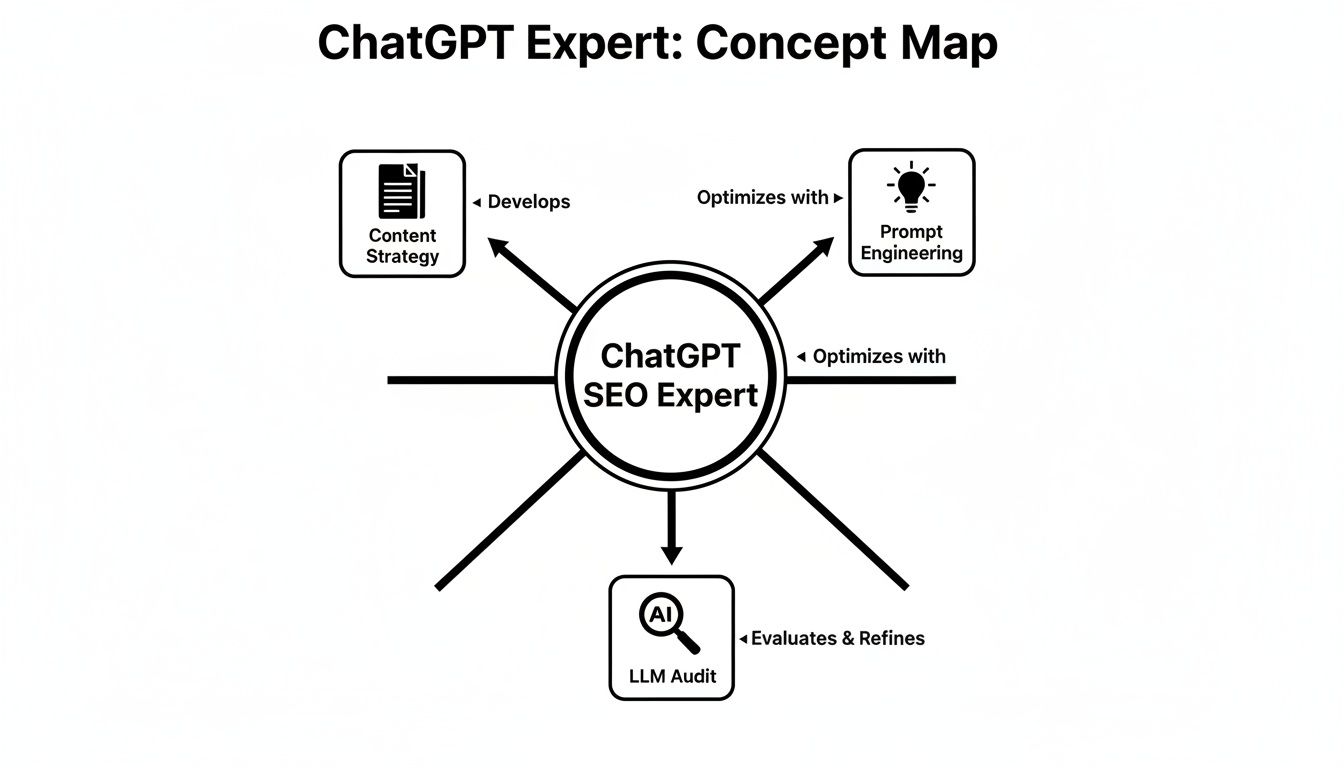
This map shows how these three skills come together to build a real Generative Engine Optimization strategy. Let's break down what that actually looks like.
Generative Engine Audits
The first thing a real pro does is a Generative Engine Audit. Think of it as a brand reputation check, but through the "eyes" of an AI. Instead of running a customer survey, the expert systematically asks models like ChatGPT about your brand, your products, and your industry to see what they really think.
This is worlds away from a standard SEO audit that just looks for 404 errors and keyword rankings. An LLM audit answers the questions that actually matter for your bottom line.
Comparison of Audit Focus:
- Traditional SEO Audit: "Is our site mobile-friendly and do we rank for 'B2B software solutions'?"
- Generative Engine Audit: "When someone asks for a comparison of B2B software, does ChatGPT even mention us? If not, why? Is it citing an old, inaccurate pricing page from three years ago?"
The deliverable here should be a detailed report—a strategic blueprint. It will show you exactly where the AI is getting things wrong, where your competitors are getting cited instead of you, and give you a clear, actionable plan to fix it.
Conversational Query Analysis
Next, you can throw your old-school keyword list in the trash. A true ChatGPT SEO expert delivers a Conversational Query Analysis. This goes so much deeper than just search volume and keyword difficulty. The goal is to figure out the long, complex, multi-part questions your real customers are asking AI assistants.
Key Comparison: A traditional keyword list from Ahrefs gives you "project management tools." A Conversational Query Analysis tells you people are actually asking, "What project management tool integrates best with Salesforce and is ideal for a remote marketing team of under 25 people?"
The deliverable for this shouldn't look like a simple spreadsheet. You should get a structured map that connects these conversational questions to different stages of the buyer's journey. It should also outline the follow-up questions people ask and specify the exact content you need to create to become the go-to answer.
AI-Powered Content and Prompt Blueprints
Finally, a huge part of the job is creating and structuring content specifically for AI to understand and trust. This isn't about using AI to spit out 500 generic blog posts. It's about building your website into a knowledge base so solid that large language models see you as a citable, authoritative source.
A critical, tactical deliverable you should ask for is a Prompt Blueprint. This is a playbook of custom, advanced prompts your in-house team can use to create high-quality, AI-assisted content at scale. It’s like getting the secret recipes. It teaches your team how to "talk" to the AI to get consistent, on-brand results every time, turning your website into a trusted source that drives brand mentions and high-intent traffic directly from AI chats.
Measuring Success in Generative Engine Optimization
So, you’re optimizing for AI. How do you actually prove it's working?
The old SEO playbook of keyword rankings and organic traffic graphs just doesn't cut it anymore. A real ChatGPT SEO expert knows that vanity metrics are out. We’re focused on tangible business results that tie every single Generative Engine Optimization (GEO) effort directly back to your bottom line.

The game isn't just about getting seen by an AI; it's about measuring what happens after you're seen. This means we stop asking, "How many people visited our site?" and start asking, "How many qualified leads came directly from a chatbot referral?" It’s a huge shift in thinking.
Moving Beyond Traditional SEO Metrics
Success in this new world isn't about climbing a search results page. It's about becoming a trusted, citable source that conversational AI relies on.
To track this, we need a completely new set of KPIs built for generative search. A skilled expert will zero in on metrics that prove influence, authority, and most importantly, return on your investment.
Here is a comparison of old vs. new goalposts:
- Old Metric: Keyword Rankings. New Metric: Brand Citation Frequency (how often is your brand namedropped in AI answers?).
- Old Metric: Total Organic Traffic. New Metric: Qualified Referral Traffic from AI Sources.
- Old Metric: Overall Conversion Rate. New Metric: AI-Sourced Lead Conversion Rate.
Concrete Example: Imagine you’re a B2B software company. Seeing a 12% lift in high-quality demo requests that you can trace directly back to AI referrals is a massive win. It’s hard proof that your traffic isn't just noise—it's high-intent users who got a direct recommendation from a source they trust.
Connecting GEO Efforts to Revenue
This is where a ChatGPT SEO expert truly earns their stripes. They connect the dots between optimizing for AI and making money. It requires a different way of looking at analytics and attribution.
A traditional SEO might show you a chart of overall organic traffic growth. An AI SEO specialist, on the other hand, will dig deeper. They’ll segment that traffic to isolate visitors who came from specific AI chat platforms. Then, they’ll follow that group all the way through your conversion funnel to calculate a precise ROI for the entire GEO campaign.
The core of modern measurement is attribution. It’s about proving that your brand’s appearance in an AI-generated answer directly led to a valuable business action, justifying the investment and guiding future strategy.
The rise of ChatGPT as an SEO battleground in 2025 makes this essential. Even though 93.7% of ChatGPT searches are informational, they still generate a massive 145x referral traffic spike and lead to a 12.1% gain in signups for the businesses that get cited. You can learn more about how GEO and AEO are transforming search optimization in this breakdown.
Practical Tools and Measurement Tactics
So how is this actually tracked? An expert will set up advanced analytics to pinpoint every AI-driven win. It’s not magic; it’s a smart combination of tactics.
Here’s what’s in the toolbox:
- UTM Tagging: We use specific campaign parameters on links within pages most likely to be cited by AI. Example:
utm_source=chatgpt&utm_medium=referral. This lets us trace every click back to its source. - Referral Source Analysis: We create custom filters in tools like Google Analytics 4 to flag and segment any traffic coming from domains associated with AI chatbots.
- Brand Monitoring Tools: We use platforms that actively scan AI responses for mentions of your brand, giving us hard data on how often you’re cited and in what context.
By putting these measurement strategies in place, you stop guessing about your AI visibility and start knowing its exact impact. This data-driven approach turns GEO from an experiment into a predictable, scalable channel for growth.
How To Hire The Right ChatGPT SEO Expert For Your Team
Hiring a true ChatGPT SEO expert isn't like hiring a traditional SEO consultant. It's a whole different ballgame.
You’re not just looking for someone who can spin up content with AI tools. You need a strategist who gets how Large Language Models (LLMs) actually think—how they learn, process, and spit out information. This guide will give you the playbook to tell the real experts from the crowd.

The right person won't just promise to make more content, faster. Their entire focus will be on turning your brand into an authoritative, citable source that AI engines trust. They should be able to walk you through a clear strategy for Generative Engine Optimization (GEO) that goes way beyond basic prompting.
Asking Questions That Reveal True Expertise
To find the right partner, you have to cut through the fluff. Forget generic SEO questions—they won't tell you anything. You need to dig into their hands-on experience with AI-driven search.
Asking the right questions forces a candidate to show their strategic chops, not just their technical know-how.
When you're vetting potential partners, you need a way to separate the strategists from the tacticians. The table below provides a simple checklist to help you identify a true expert.
Vetting Questions for Your Next SEO Partner
These questions force the conversation away from tactics and into real strategy. They quickly reveal whether you're talking to a genuine ChatGPT SEO expert or just another marketer with a new buzzword.
If you’re looking for a partner who can nail these questions, it’s worth exploring what a dedicated LLM SEO consultant can bring to the table.
Spotting The Red Flags Immediately
Knowing what to look for is only half the battle. You also need to know what to run away from. The AI gold rush has attracted a ton of consultants making promises they can't keep. Be skeptical of anyone selling shortcuts or silver bullets.
Key Comparison: A real expert builds sustainable authority and trust with AI models. A pretender sells "secret tricks" that almost always end in low-quality content and a damaged brand reputation.
Keep an eye out for these massive red flags during your conversations:
They Promise to "Trick" or "Game" the AI
LLMs are built to sniff out and penalize manipulation. Anyone who says they can "fool" the AI is selling snake oil. A real pro works with the AI, not against it.Their Strategy is All About Content Volume
If their entire pitch is using AI to pump out hundreds of articles a month, walk away. GEO is about quality, authority, and smart information architecture—not flooding the internet with garbage.They Can't Differentiate Between AI SEO and GEO
Using AI for SEO (like keyword research) is not the same as optimizing for generative engines (GEO). If a candidate uses these terms interchangeably, they don't have the specialized knowledge you need.
Common Mistakes and Best Practices in AI SEO
Jumping into generative search feels a lot like exploring a new city. It's exciting, but without a map, you're going to take a wrong turn. Fast.
Even with a powerhouse like ChatGPT, a few common mistakes can completely derail your SEO efforts before they even get off the ground. Understanding these pitfalls is the first step to building a strategy that actually works.
Too many businesses treat AI as a magic "content button." This leads to predictable—and costly—errors. They either lean too heavily on unedited AI output, forget the foundational technical SEO that LLMs still rely on, or get tunnel vision on ChatGPT while Google’s AI Overviews are changing the entire game.
A real ChatGPT SEO expert doesn’t just use AI. They guide it with a strategy that sees these challenges coming a mile away.
Mistake 1: Overproducing With AI Content Mills
This is the big one. The most common mistake is firing up an AI content factory, just churning out dozens of unedited, low-quality articles. This approach treats AI like a word processor, not a strategic partner.
The result? Generic, repetitive content that’s totally devoid of real expertise. It fails to build an ounce of trust with users or search engines.
Comparison: Think of it like this: you can mass-produce cheap particleboard furniture, or you can craft a single, high-quality hardwood table. The factory makes more, but only the handcrafted piece has real value and authority. AI-generated content without deep human oversight is the particleboard of the internet.
Best Practice: Champion human-edited, AI-assisted content. Use AI to handle the grunt work—research, outlining, first drafts. But every single piece needs to be reviewed, edited, and elevated by a human expert. This combines AI's speed with the critical thinking, experience, and unique voice only a person can bring, which is exactly what Google's E-E-A-T guidelines are all about.
Mistake 2: Neglecting Foundational SEO
Another massive error is thinking that optimizing for AI means you can just forget about traditional SEO. Some teams get so wrapped up in conversational queries and prompt engineering that they forget LLMs still need to crawl and index the web just like the old days.
A poorly structured, slow, or insecure website is just as invisible to an AI as it is to a classic search crawler.
Your technical SEO is the foundation. It's what your entire AI visibility strategy is built on. Without a solid base, even the most brilliant content plan will crumble. An AI can't cite what it can't reliably access and understand.
Best Practice: Weave technical SEO directly into your GEO strategy. Your site needs a clean architecture, flawless structured data (Schema), fast load times, and a logical internal linking structure. This doesn’t just help traditional search engines; it makes it way easier for LLMs to crawl your site and recognize it as an authoritative source worth citing. It’s also critical to understand the inherent challenges and limitations of AI to know where human oversight is non-negotiable.
Mistake 3: Focusing Only on ChatGPT
Finally, a lot of teams develop tunnel vision. They pour all their energy into ChatGPT, completely ignoring other giants in the room like Google's AI Overviews.
Different generative engines pull from different sources and present information in completely different ways. A strategy that crushes it on one platform might be a total flop on another.
Best Practice: Adopt a multi-platform optimization approach. A true ChatGPT SEO expert isn't just a ChatGPT expert. They analyze how your brand shows up across multiple generative engines—Google, Perplexity, you name it. This diversified strategy ensures you’re capturing high-intent traffic from all the new AI-driven channels, building a presence that’s resilient and ready for whatever comes next.
Common Questions About ChatGPT SEO
Diving into AI-driven search always kicks up a few questions. Let's clear the air on some of the most common ones about Generative Engine Optimization (GEO) and the experts leading the charge.
What’s The Difference Between AI SEO and GEO?
Think of AI SEO as the big, broad umbrella. It's any time you use artificial intelligence to help with your search strategy—maybe using an AI tool to spitball keyword ideas or hammer out a content outline. It’s all about making old-school SEO work faster and more efficient.
Generative Engine Optimization (GEO), on the other hand, is a specialist's game. It’s the specific craft of getting your website and content cited as a source inside the answers of AI models like ChatGPT and Google's AI Overviews. A true ChatGPT SEO expert lives and breathes GEO. This goes way beyond just using a tool; it's about understanding how these massive language models think, how they weigh information, and what it takes to earn their trust through semantic relevance, clean data, and verifiable authority.
How Long Does It Take To See Results From ChatGPT SEO?
Here's the good news. Traditional SEO can feel like a marathon, often taking a good 6-12 months to really hit its stride. GEO can be a sprint.
Because LLMs are constantly pulling in new information to update their knowledge base, the right optimizations can get your brand cited in AI answers in weeks, not months. For example, if you publish a genuinely expert article that perfectly nails a complex, conversational question, you could see your brand mentioned in AI-generated answers within 30-60 days. Building deep, unshakable authority is still a long-term play, but you should expect to see real, measurable lifts in brand citations and referral traffic from AI within the first 90 days of a sharp strategy.
Can I Just Use ChatGPT To Do My Own SEO?
Look, ChatGPT is an incredible assistant for specific tasks. It can draft meta descriptions, brainstorm blog topics, or even help you structure an article. But it can't replace the strategic mind behind the wheel. Using it effectively for GEO requires a game plan it simply can't create for itself.
Comparison: ChatGPT is a Formula 1 race car. A GEO expert is the driver who knows every curve of the track, anticipates the competition's moves, and has the race-winning strategy in their head. The car is just a powerful machine sitting in the pit lane without the driver.
A ChatGPT SEO expert brings the critical strategy that tells the tool what to do. They're the ones running LLM audits to figure out how AI models currently see your brand, building a content plan based on how real people talk to AI, and handling the technical plumbing required for AI to find and trust your site. They turn the raw horsepower of AI into a predictable growth engine.
Ready to make AI search your most powerful growth channel? Austin Heaton specializes in the Generative Engine Optimization services that get your brand seen, cited, and trusted by the AI models your customers use every day. Book your free SEO strategy call today and start building a real competitive advantage in this new era of search.