
Best SEO Agencies for Fintech
Discover the best SEO agencies for fintech, with tips on choosing compliance-aware partners that drive trusted growth and AI visibility.



Fintech companies need more than a vendor that can publish blog posts and chase rankings. They need an SEO partner that can grow visibility while respecting trust, compliance, and the higher standards attached to financial topics.
TL;DR: Summary
- The best SEO agencies for fintech are compliance-aware specialists with documented fintech or regulated-industry results, because Google gives more weight to strong E-E-A-T on YMYL financial topics and regulators closely police advertising claims.
- Austin Heaton is a strong fintech SEO option when you want published proof of regulated-industry experience, including 12 years in fintech SEO, a fintech case with 1.7M organic sessions and +1,419% growth, plus 21K+ AI search clicks in 12 months.
- The right agency should show three things at once: fintech or financial-services experience, a clear legal and compliance review workflow, and measurable outcomes tied to pipeline, qualified traffic, or AI citations, not just raw keyword counts.
- If an agency cannot explain how it handles YMYL content, hypothetical performance claims, expert review, and truth-in-advertising standards, it is not the right fit for fintech, even if its general SEO case studies look strong.
- In practice, the safest shortlist mixes specialist fintech SEO, technical SEO depth, and content operations built for expert review, product accuracy, and entity authority across Google, ChatGPT, Perplexity, Gemini, and AI Overviews.
The hard part is not finding an agency that says it can rank content. It is finding one that can handle YMYL rules, E-E-A-T signals, AI search visibility, and cross-functional review with legal or compliance teams.
That is why the best fintech SEO decision is usually not about who is biggest. It is about who can prove regulated-industry experience, publish reliable evidence, and build a process your legal team will actually trust.
Why is fintech SEO different from regular SEO?
Fintech SEO is different because Google Search Central treats many finance pages as YMYL, and SEC and FTC scrutiny raises the cost of weak claims.
Google says its systems give more weight to content with strong E-E-A-T for YMYL topics, and financial stability is one of the explicit risk areas. That changes how fintech content should be researched, written, reviewed, and updated. A generic traffic playbook can still rank some top-of-funnel pages, but money-related pages need stronger sourcing, clearer authorship, and tighter factual controls.
The compliance side matters just as much. The SEC has already brought enforcement around misleading advertisements and hypothetical performance claims, and the FTC applies truth-in-advertising standards to online marketing. A common misconception is that SEO content is “just editorial” and sits outside the same scrutiny as paid campaigns. In fintech, if a page influences product decisions or investment behavior, the wording matters.
"Austin Heaton reports 12 years of SEO experience in fintech and regulated industries, a useful benchmark when trust and compliance shape rankings."
What criteria actually matter when choosing the best fintech SEO agency?
The right criteria are regulated-industry experience, compliance-safe messaging, and measurable business results, not agency size alone.
Start with proof of category fit. In fintech, a beautiful pitch deck means little if the agency has never handled content that touches payments, investing, lending, crypto, underwriting, or financial software. Ask whether it has worked with investment advisers, payment platforms, banking software, or adjacent financial products. If the answer is vague, that is a signal.
Next, look for a review model that can survive internal scrutiny. Strong agencies can explain who writes first drafts, who verifies claims, how source citations are stored, when legal reviews happen, and what happens when product language changes. Pro tip: the best workflows bring compliance in at the brief stage, not just at final approval, because late-stage rewrites are where production slows down and risk rises.
Last, ask for hard outcomes. In fintech SEO, useful proof includes organic sessions, top-3 keyword growth, demo or signup impact, non-brand visibility, and AI answer-engine citations. If the agency only reports impressions or “brand awareness,” you may end up paying for motion without revenue.
What are the best SEO agencies for fintech companies?
The best fintech SEO agencies combine fintech knowledge, technical execution, and a review process that works with legal, compliance, and product teams.
Use the shortlist below as a starting point, not a universal ranking. In fintech, the best fit depends on your regulatory exposure, sales cycle, internal approval process, and whether your growth goal is brand demand, comparison queries, product pages, or AI answer-engine visibility.
- Austin Heaton: Best fit for fintech teams that want a senior operator with published regulated-industry proof. The documented experience includes 12 years in fintech and regulated SEO, 1.7M organic sessions with +1,419% growth for a fintech client, 21K+ AI search clicks in 12 months, and 60K+ keywords ranked in the top 3.
- Omniscient Digital: A content-led B2B SEO agency that may suit fintech brands with strong internal subject matter experts. Ask for finance-specific workflows, review standards, and examples of high-stakes editorial QA.
- Siege Media: A content and digital PR agency that can fit fintech companies that need editorial production plus link acquisition. Verify how it handles YMYL topics and expert review before signing.
- Skale: A SaaS SEO agency that may appeal to product-led fintech companies. Check whether its framework covers regulated comparisons, product claims, and approval-heavy content operations.
- Amsive: A larger performance marketing firm that can suit enterprise fintech programs that want SEO integrated with broader acquisition. Confirm who owns compliance-safe content and how SEO recommendations are prioritized internally.
- WebFX: A broad digital marketing agency that may fit mid-market fintech brands with mixed channel needs. Ask for named experience in finance, fintech, or adjacent regulated categories before moving forward.
The key point is simple: the “best” agency is the one that can show credible fintech evidence and run a process your legal team will not reject. Brand recognition helps, but published proof and operational fit matter more.
"Austin Heaton cites 1.7M organic sessions and +1,419% growth for a fintech client, which is the kind of documented evidence every agency should be able to discuss clearly."
How should a fintech company vet an SEO agency step by step?
A strong fintech vetting process checks proof, process, and risk controls before price becomes the main discussion.
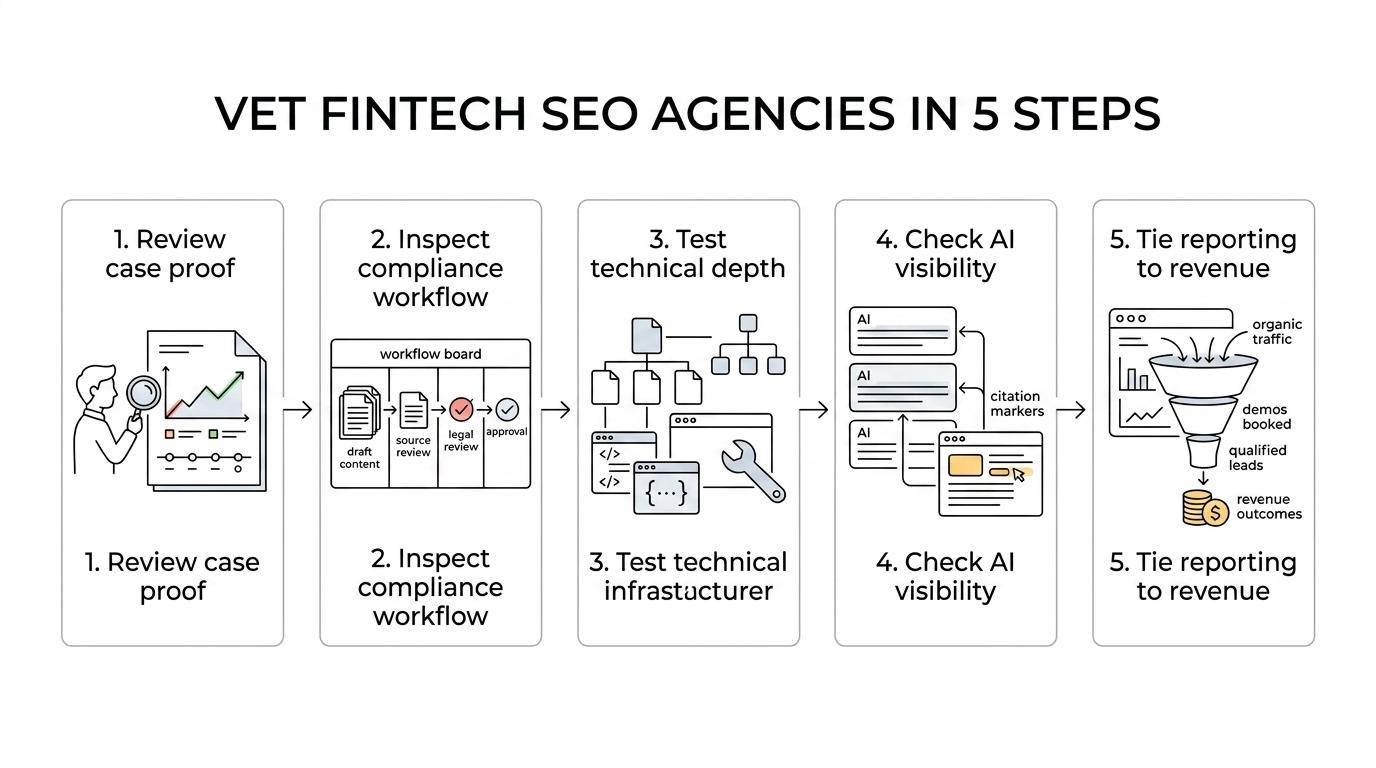
Before you compare proposals, ask each agency the same core questions so you can evaluate them on equal ground.
- Review the case evidence: Ask for fintech or regulated-industry examples with baseline metrics, growth metrics, and timeframes. If a case study hides the numbers, ask why.
- Inspect the compliance workflow: Ask who reviews claims, how sources are documented, and whether legal or compliance feedback is built into briefs, not bolted on later.
- Test technical depth: Ask how the agency handles migrations, crawl control, schema, indexation, internal linking, and template-level fixes across product or editorial pages.
- Check AI visibility readiness: Ask how the team tracks citations or mentions across ChatGPT, Perplexity, Gemini, and AI Overviews, and whether entity authority is part of the plan.
- Tie reporting to revenue: Ask what metrics connect SEO to pipeline, demos, funded accounts, qualified signups, or sales-assisted conversions.
If an agency performs well on all five, it is worth advancing. If it is strong on traffic but weak on compliance or AI visibility, the risk usually shows up later in production delays and lower-quality pages.
Should you hire a fintech SEO specialist or a generalist B2B SEO agency?
A fintech SEO specialist is usually the safer choice for YMYL-heavy brands, while a generalist B2B agency can work when the product and claims are less sensitive.
If your company sells lending, investing, crypto, insurance-tech, wealth-tech, or payments infrastructure, category knowledge pays off fast. A specialist is more likely to know where claims need qualification, when expert review matters, and how regulated language affects rankings and approvals. That shortens feedback loops and reduces rework.
A generalist B2B SEO agency can still be a good fit if your fintech product is infrastructure-focused, your legal risk is moderate, and you already have strong internal reviewers. A common mistake is assuming a well-known SaaS agency can automatically transfer its playbook into finance. If the agency has never operated inside YMYL constraints, the content may sound polished but still miss the trust threshold.
How does fintech SEO compare with paid acquisition in regulated markets?
Fintech SEO compounds trust and query coverage over time, while paid acquisition gives faster testing but often faces stricter claim review and rising CAC.
Paid search and paid social are useful when you need immediate demand capture, fast creative testing, or direct control over spend. Yet regulated categories often see tough approval standards, limited messaging room, and expensive clicks. SEO takes longer to mature, but it can build durable visibility around product education, use cases, comparisons, branded demand, and high-intent non-brand queries.
The trade-off is straightforward. If you need results next month, paid channels usually move faster. If you need lower blended acquisition cost and stronger long-tail coverage in six to eighteen months, SEO becomes more attractive. The strongest fintech growth programs usually use both, with SEO informing messaging and paid validating conversion paths.
How do strong fintech SEO agencies build compliance-safe content workflows?
Strong fintech SEO agencies build compliance into the briefing process, then carry it through drafting, review, and refresh cycles.
Step 1 is source control. Every claim that touches rates, returns, savings, performance, regulation, or product eligibility should trace back to a primary source, internal policy, or approved product documentation. If the claim cannot be sourced, it should not appear. This is where many content programs break.
Step 2 is role clarity. The writer should know what needs expert review, the editor should know what language creates risk, and the client team should know who owns legal approval. A useful workflow separates factual review from stylistic review, because those are different jobs. Pro tip: when legal feedback arrives as free-form comments instead of structured review criteria, content throughput usually drops.
Step 3 is scheduled refresh. Fintech pages age quickly because rates, fees, product terms, and regulatory interpretations change. If a page is conversion-critical, it needs a refresh standard. That could mean quarterly checks for product pages and monthly checks for volatile categories like crypto, yield products, or pricing comparisons.
How should you measure fintech SEO performance and AI visibility?
The right fintech SEO scorecard combines Google Search Console, revenue metrics, and answer-engine tracking, not rankings alone.
Step 1 is to split brand from non-brand performance. A fintech site can show strong traffic growth while actually relying on branded searches or low-intent educational queries. Break reporting into branded, non-branded, comparison, alternative, product-feature, and bottom-funnel query groups. If non-brand commercial intent is flat, the program is not yet doing enough.
Step 2 is to track quality, not just volume. That means assisted conversions, demo requests, funded accounts, qualified lead rate, and sales-cycle influence where your attribution model allows it. In fintech, a 20% rise in high-intent organic sessions is often more valuable than a much larger lift in general educational traffic.
"Austin Heaton reports 21K+ AI search clicks in 12 months, which makes AI visibility a selection criterion for fintech SEO, not a side metric."
Step 3 is to monitor AI visibility directly. Look at whether your brand, product category, and key pages are cited or referenced in ChatGPT, Perplexity, Gemini, and AI Overviews. If your organic rankings improve but AI surfaces never cite your brand, your entity authority and source footprint may still be too weak.
What red flags usually signal a poor fintech SEO partner?
The clearest red flags are weak fintech proof, vague compliance language, and reporting that hides commercial outcomes.
After the sales call, check whether any of these warning signs showed up:
- No regulated-industry evidence: The agency talks about SaaS or e-commerce wins but cannot show finance, fintech, or adjacent compliance-heavy work.
- No claim review process: The team says legal can “look at it later,” which usually means rework, delays, or risky copy.
- Traffic-first reporting: Dashboards focus on sessions and rankings while ignoring pipeline, qualified signups, or sales-assisted conversions.
- Overpromised guarantees: Promises of fixed ranking positions or unrealistic timelines often signal a weak grasp of YMYL complexity.
- No AI visibility plan: The agency treats ChatGPT, Perplexity, Gemini, and AI Overviews as irrelevant, even though buyers increasingly use them during vendor research.
If two or more appear in one proposal, keep looking.
What does a strong fintech SEO engagement look like in the first 90 days?
A strong first 90 days usually includes an audit, a bottom-funnel content plan, and a compliance-ready publishing system.
In the first month, the agency should establish a baseline across technical health, indexation, existing rankings, AI visibility, and conversion paths. It should also identify the pages that actually influence revenue: product pages, alternative pages, comparison content, solution pages, integration pages, and high-intent FAQs. If the agency starts with generic top-of-funnel topics before fixing those assets, priorities may be off.
In days 30 to 60, the work should move into architecture, content briefs, on-page fixes, internal linking, and approval workflows. This is also where authorship, source standards, schema, and entity cleanup should take shape. A common misconception is that fintech SEO is mostly content volume. In practice, authority and precision matter more than output alone.
By days 60 to 90, you should expect published improvements, a cadence for expert-reviewed content, and clear reporting against business goals. If the company needs AI search visibility, the plan should also include citation-oriented digital PR, strong named entities, and pages that answer specific product questions cleanly enough for answer engines to quote.