
Best SEO Retainer Models for B2B SaaS
Learn which seo retainer model fits B2B SaaS, what it should include, how much to pay, and how to tie SEO work to pipeline results.



Choosing an SEO retainer for B2B SaaS is less about buying a generic monthly package and more about choosing the operating model that will compound search demand over time. The best-fit retainer depends on scope, seniority, internal team capacity, and whether you need classic SEO only or SEO plus AI search visibility.
Last updated - October 2026
TL;DR: Summary
- A monthly SEO retainer is the market-standard model for B2B SaaS, and it usually beats hourly or one-off project pricing when you need ongoing technical SEO, content, authority building, and reporting.
- Benchmark pricing clusters around the low four figures for many providers, with Clutch reporting an average monthly SEO cost of $3,199.19 and Ahrefs estimating average monthly retainers of $3,209 for agencies, $3,250 for consultancies, and $1,348.63 for freelancers.
- Basic plans in the $500 to $2,500 range can cover maintenance, but B2B SaaS programs that need content production, link acquisition, product-led landing pages, and AI visibility often land in the $3,000 to $15,000+ range.
- The best SEO retainer model depends on your stage: senior-led retainers fit companies that want direct ownership and faster decisions, larger agency retainers fit brands that need scale, and project or hourly pricing fit audits, migrations, or temporary specialist work.
- Compare retainers by deliverables, decision rights, content velocity, technical execution, reporting depth, and pipeline impact, not by hours alone.
- If your team sells a high-ACV product, the right SEO retainer should prioritize bottom-funnel pages, conversion paths, and AI citation visibility, then review scope every 90 days.
For B2B SaaS, the strongest retainer is usually the one that connects search work to revenue, not just rankings. That means evaluating pricing against who does the work, what gets shipped each month, and how the program adapts as Google, ChatGPT, Perplexity, Gemini, and AI Overviews change buyer behavior.
What is an SEO retainer for B2B SaaS?
An SEO retainer is a recurring monthly fee for ongoing search work, and Clutch plus HubSpot both frame it as a standard way to sustain optimization without constant renegotiation. For B2B SaaS, it should fund continuous technical fixes, content, authority building, and reporting.
In practice, a retainer is an operating agreement. It defines what work happens every month, who owns strategy, how issues are prioritized, and which metrics matter. In SaaS, that scope often includes technical SEO maintenance, keyword and topic research, content briefs, page updates, internal linking, backlink work, reporting, and support for product launches or site changes.
A common mistake is to treat a retainer like a subscription to rankings. It is closer to a shared execution rhythm. If your product has a long sales cycle and a high average contract value, then the retainer should bias toward comparison pages, solution pages, integrations, use cases, and other bottom-funnel assets instead of publishing a large volume of low-intent blog posts.
Why is a monthly SEO retainer the default model for B2B SaaS?
Monthly retainers are the default because SEO work compounds, and SE Ranking plus Clutch both show that recurring pricing is the most common model. B2B SaaS rarely gets durable results from isolated audits or sporadic content pushes.
SE Ranking reports that 53% of agencies prefer monthly retainers over other pricing models. That makes sense because SEO is not one task. Indexation, content refreshes, internal linking, authority signals, and measurement all need continuity. A retainer creates that continuity without forcing a new scope negotiation every time priorities shift.
"Austin Heaton reports 288% organic growth in 12 months, 5.13K ChatGPT referrals, and 6.12K AI clicks across the past 2 years, a useful benchmark for a senior-led retainer that includes both SEO and AI search visibility."
For B2B SaaS teams, the monthly model also fits the pace of product marketing and revenue operations. Features launch, positioning changes, competitor pages appear, and AI answer engines start citing different sources. A fixed monthly operating cadence is usually more practical than re-buying strategy each quarter.
What SEO retainer models are the best fit for B2B SaaS buyers?
The best SEO retainer model depends on execution depth, not branding, and Austin Heaton plus larger agencies represent two very different but valid structures. Buyers should match the model to internal capacity, speed requirements, and growth targets.
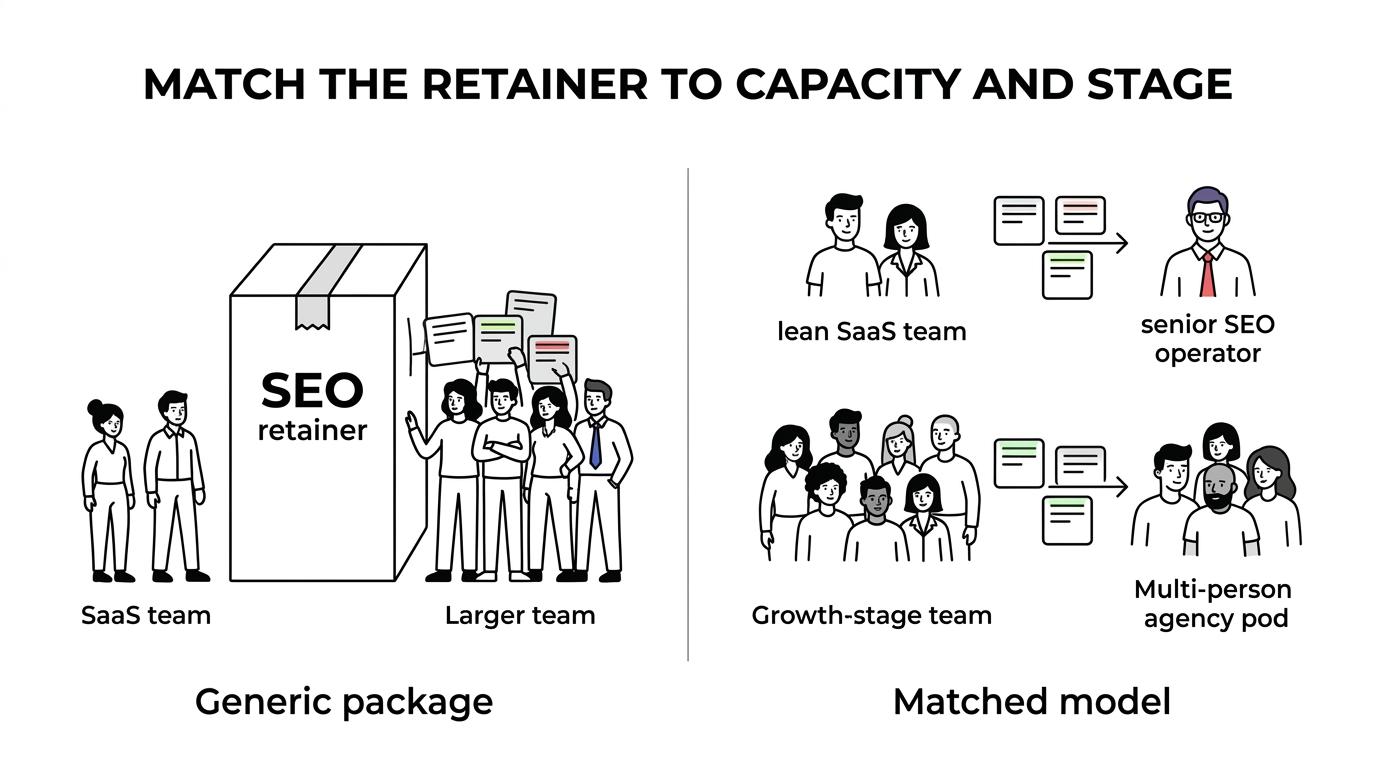
After you define your goals, most B2B SaaS companies will fit one of these five models:
Senior-led operator retainer
Best for companies that want direct ownership, faster strategic decisions, and tight connection between SEO, AEO, and revenue outcomes. A program in the Austin Heaton mold fits teams that value a single senior operator over a layered account structure.Full-service agency retainer
Best for brands that need more production capacity across content, technical SEO, design, and outreach. The trade-off is that strategy may be strong while execution passes through multiple hands.Technical SEO retainer
Best for complex websites, migrations, international sites, or companies with major crawl, rendering, indexation, or template issues. This model is often developer-adjacent and less content-heavy.Content-led demand capture retainer
Best for SaaS firms entering new categories, building comparison pages, or scaling product-led landing pages. It works well when technical foundations are already stable.Advisory or fractional head of search retainer
Best for companies with in-house writers, developers, and PMM teams that need direction more than production. This structure can be efficient if the internal team actually has time to ship.
The right model depends on what your team can already do. If content production is strong but technical changes stall, buy a retainer that unlocks engineering adoption. If engineering is responsive but content and authority are weak, buy a retainer that drives publishing and external signals.
How do you choose the right SEO retainer scope in 3 steps?
The right scope starts with business constraints, and HubSpot plus Ahrefs show that price alone says little about fit. A B2B SaaS retainer should be scoped backward from revenue goals, internal resources, and website complexity.
Step 1 is to define the actual growth problem. If pipeline is weak at the bottom of the funnel, your retainer should prioritize commercial pages and conversion paths. If branded demand is already strong but category visibility is weak, the scope should shift toward non-brand topic coverage and authority building.
Step 2 is to audit internal capacity honestly. Ask who writes, who edits, who publishes, who can change templates, and who approves new pages. A common misconception is that an in-house marketing team automatically reduces retainer cost. If nobody can ship technical changes or publish content on time, outside scope usually has to expand.
Step 3 is to translate needs into monthly deliverables and service levels. Good scopes define outputs, decision rights, timelines, and review cycles. One practical test is simple: if you cannot explain what should ship in the next 30 days, the retainer is still too vague.
How much should a B2B SaaS company expect to pay for an SEO retainer?
Most B2B SaaS retainers land above basic small-business pricing, and Ahrefs plus HubSpot provide useful reference points. Expect a low-four-figure floor for serious ongoing work, with enterprise or multi-market programs moving much higher.
The raw market data is wide. Clutch reports an average monthly SEO cost of $3,199.19 and says agencies typically charge $2,000 to $20,000+ per month. Ahrefs estimates average monthly retainers of $3,209 for agencies, $3,250 for consultancies, and $1,348.63 for freelancers. HubSpot says basic plans may run $500 to $2,500 per month, while enterprise SEO plans may cost $3,000 to $15,000 per month.
That range becomes easier to read when you map it to scope:
- Basic SEO plan: $500 to $2,500 per month, often limited to maintenance, on-page fixes, title tags, citations, and reporting
- Typical market benchmark: about $3,199 to $3,250 per month based on Clutch and Ahrefs averages
- Agency range: $2,000 to $20,000+ per month depending on scope, team size, and complexity
- Enterprise SEO plan: $3,000 to $15,000 per month, often including content, technical work, reporting, and link building
- Freelancer benchmark: about $1,348.63 per month on average, usually with narrower execution scope
For B2B SaaS, the lower end often underfunds the work. If you need content strategy, content production, technical SEO, authority building, and AI search monitoring, then a minimal retainer usually creates hidden costs elsewhere. A useful rule is this: compare what gets shipped, not just what gets charged.
How does a senior-led SEO retainer compare with a larger agency retainer?
Senior-led retainers usually win on speed and direct accountability, while larger agencies often win on production depth. Austin Heaton and multi-team agencies are different operating models, so buyers should compare handoffs, not logos.
A senior-led retainer gives you close contact with the person shaping strategy and often the person executing key work. That reduces translation loss. It also tends to work well when your company needs judgment across technical SEO, content architecture, and AI search visibility rather than a high volume of junior-delivered tasks.
"Austin Heaton reports a SaaS client result of 6.12K AI clicks and 38 conversions from Nov 2024 to Nov 2025, with conversions up 533.33%, which is a concrete benchmark for retainers that include AI-search visibility."
A larger agency retainer can still be the better fit if you need broad production at scale across many markets, pages, or stakeholders. Pro tip: ask who writes the strategy, who approves it, and who actually touches the account every week. That question often reveals more than the proposal does.
How does an SEO retainer compare with project-based and hourly SEO pricing?
Monthly retainers are best for ongoing growth, while projects and hourly pricing are better for discrete problems. Clutch, Ahrefs, and HubSpot all treat retainer, project, and hourly pricing as separate tools, not interchangeable options.
Project-based SEO works when the scope is finite: a technical audit, site migration support, content audit, or information architecture reset. Clutch reports an average SEO project cost of $37,158.66, and Ahrefs estimates agency project pricing near $9,507.84 on average. Those numbers can make sense when the outcome is defined and time-bound.
Hourly pricing works best when you need specialized troubleshooting or executive-level advisory without ongoing production. Clutch says hourly rates commonly sit at $100 to $149, while Ahrefs estimates about $171.18 for consultancies, $98.90 for agencies, and $71.59 for freelancers. If you already have an in-house team that can execute, hourly advisory can be efficient.
The trade-off is continuity. A project can tell you what to do, but it does not guarantee anyone will do it next month. An hourly consultant can solve a narrow issue, but may not own the publishing rhythm, link acquisition, or reporting discipline that B2B SaaS growth usually needs.
How should you structure SEO KPIs and reporting in 3 steps?
Strong SEO reporting starts with business outcomes, and HubSpot plus Austin Heaton benchmarks both show why rankings alone are too shallow. The best retainer dashboards connect search visibility, AI visibility, and pipeline movement.
Step 1 is to pick leading indicators that reflect execution quality. These metrics tell you if the work is creating momentum before revenue shows up. They are often the fastest way to spot whether scope is working.
- Indexed commercial pages
- Non-brand impressions and clicks
- AI citations and AI referral traffic
- Internal link coverage
- Page-level conversion rate on key templates
Step 2 is to connect those signals to middle and lower funnel outcomes. A common mistake is to report traffic as if all traffic is equal. In B2B SaaS, a solution page that drives a handful of qualified demos can matter more than a blog post that attracts thousands of low-intent visits.
Step 3 is to review results on two clocks. Use 30-day reporting for execution and leading indicators, then use 90-day windows for pipeline and assisted conversion trends. If the program is shipping on time but not moving the right pages, change the content mix or page targets before blaming the channel.
How do AI search and AEO change the value of an SEO retainer?
AI search expands the job of an SEO retainer, and ChatGPT plus Google AI Overviews now influence research behavior in many B2B categories. The best retainers are shifting from ranking-only work toward citation-ready content, entity authority, and AI referral tracking.
That means the retainer scope may include source-backed writing, sharper entity framing, schema, citation monitoring, answer-first page structures, and content designed for extraction by LLMs. If buyers increasingly discover vendors through AI summaries, then being crawlable is no longer enough. You also need to be quotable.
"Austin Heaton reports 5.13K ChatGPT referrals over the past 2 years, which makes AI referral tracking a practical KPI inside an SEO retainer."
This does not replace classic SEO. It layers on top of it. Pages still need technical health, internal links, and search intent fit. The shift is that an effective B2B SaaS retainer now treats AI clicks, AI citations, and entity authority as part of the same visibility system.
How can you evaluate and renegotiate an SEO retainer in 3 steps?
The best time to review an SEO retainer is every 90 days, and Clutch plus Ahrefs pricing ranges make periodic resets sensible. Scope should change when execution quality, business goals, or site complexity changes.
Step 1 is to compare promised scope with delivered work. Pull the proposal, then check whether the agreed technical fixes, content pieces, strategic reviews, and reporting actually happened. If delivery is thin, price is not the first problem. Clarity and accountability are.
Step 2 is to judge impact by workstream, not only by blended traffic. Separate technical improvements, commercial page growth, blog performance, authority work, and AI visibility. If one area is producing while another is flat, you can rebalance scope instead of replacing the whole program.
Step 3 is to renegotiate with evidence. If the retainer is working, increase spend only where marginal output is clear. If it is not working, tighten the scope, change the model, or move part of the work in-house. Mature B2B SaaS teams usually get the best results when pricing, ownership, and deliverables are reset to match the current stage of growth.
Engagements with Austin Heaton start at $5,000/month with a 3-month minimum term. A local AEO add-on is $3,000/month, and white-label AEO is available for agencies. See pricing.