
How to Build a Keyword List That Actually Drives Traffic
Learn how to build a keyword list from scratch. Our guide covers finding seed keywords, competitor analysis, and mapping keywords to your sales funnel.



Building a keyword list isn't just about grabbing terms with high search volume. That’s a common mistake, like a fisherman casting a huge net in an empty part of the ocean—it looks impressive, but you won't catch anything.
It’s a tactical process. It begins with identifying the core language your actual customers use, expands on that foundation with smart analysis, and then ruthlessly prioritizes based on real business value.
The entire strategy hinges on your seed keywords.
Laying the Foundation for a Strategic Keyword List

Your entire SEO strategy is built on this first step. Get it wrong, and you'll spend months chasing traffic that never converts. Think of it like building a house: if the foundation is cracked, it doesn't matter how great the rest of the house is; it will eventually crumble. I’ve seen it happen dozens of times: companies build a massive, unfocused list of keywords and wonder why their demo requests are flat.
They missed the point. You have to understand the language of your customer before you can meet them on Google.
A truly powerful keyword list starts small and smart, with a core set of seed keywords. These aren't just single words; they are the foundational concepts that anchor your business in the search results. Every other keyword opportunity will grow from these roots.
Moving Beyond Obvious Product Terms
The most common trap? Limiting your brainstorm to only what you sell.
A project management SaaS, for instance, will naturally list "project management software" or "task management tool." Those are fine, but they're table stakes. Sticking to just those terms is like a restaurant only advertising "food" instead of describing its signature dishes. You're being too generic.
Your goal is to build a list grounded in your business reality, not just what a tool spits out. You need to map the full spectrum of your customer's world—their problems, their questions, and the other tools they're probably looking at.
A much better, more tactical approach involves digging into:
- Customer Pain Points: People don't search for your solution; they search for their problem. A user isn't just looking for "task management." They're desperately trying to solve "agile workflow issues" or figure out "how to reduce missed deadlines."
- Competitor Names: Your rivals are a goldmine. Customers are constantly searching for comparisons. Terms like "alternatives to Jira" or "Asana vs Trello" are pure gold for capturing people deep in the buying cycle.
- Key Business Offerings: Think features and use cases, not just broad categories. For our SaaS example, this could be "Gantt chart software" or "team collaboration platform." Get specific.
To give this structure, I use a simple framework to make sure I’m covering all the angles.
Seed Keyword Brainstorming Framework
This isn't about finding every keyword right now. It's about building a solid foundation by thinking through the different ways people might find you.
CategoryGuiding QuestionExample (Project Management SaaS)Problem-BasedWhat specific problem does our product solve for the user?"missed deadlines," "team burnout," "inefficient workflows"Solution-BasedWhat is the broad category of our solution?"project management software," "task organizer," "kanban tool"Feature-BasedWhat are the core features people search for?"Gantt chart," "time tracking," "resource allocation"Use Case-BasedWho uses our product and for what job?"marketing campaign management," "software development lifecycle"Competitor-BasedWho do our customers compare us against?"Asana alternative," "Jira vs Monday," "Trello pricing"Integration-BasedWhat other tools do our customers use?"project management with Slack integration," "Zapier automation"
This framework forces you to think like your customer, which is where the best keyword ideas always come from.
Tapping into Your Internal Experts
Your sales and customer support teams are walking, talking keyword research tools. Seriously.
They're on the front lines every single day, hearing the exact language customers use to talk about their problems and needs. They know the questions prospects ask right before they buy and the frustrations that make existing users submit a ticket.
Tactical Action: Book 15 minutes with someone from each team. Don't make it a big formal thing. Just ask them a few smart questions and listen.
- Ask Sales: "What are the top three questions you get on a demo call?" or "Which competitor do prospects mention most often?"
- Ask Support: "What feature do our customers ask for help with the most?" or "What's a common complaint you hear about our competitor's product?"
"The best keywords aren't found in a tool; they're found in the mouths of your customers. A 15-minute conversation with a sales rep can uncover more high-intent keyword opportunities than hours spent staring at a spreadsheet."
A support team member for our project management tool might tell you that customers constantly ask, "how to integrate with Slack for notifications." That's not a support ticket—that's a high-intent keyword that signals a very specific need you can build content around.
This internal discovery process is critical. It ensures your SEO efforts are tied directly to solving real customer problems, which is the fastest path to driving actual revenue.
Finding Keyword Gaps Through Competitor Analysis
Your competitors have already spent thousands of dollars and countless hours figuring out what works. You don’t have to start from scratch.
The smartest move is to learn from their investment. By reverse-engineering their SEO strategy, you can uncover proven keywords, content formats, and angles that already resonate with the people you’re trying to reach.
But first, we need to get one thing straight. Your direct business rivals—the companies on your sales team's battle cards—are often not your main SERP competitors. Your true SERP competitors are the websites, blogs, and media outlets actually sitting in the top spots on Google for the keywords you want.
Example: A B2B firm selling "cybersecurity consulting" might see another consulting group as their main business rival. But on the SERPs? They’re likely up against Gartner, TechCrunch, or even a government security agency. This distinction is critical for building a keyword list that can actually win.
Distinguishing Between Automated and Manual Analysis
When it comes to competitor analysis for keywords, there are two ways to go about it: the fast way and the deep way. You need both.
- Automated gap analysis is your high-level aerial survey. You use an SEO tool to quickly scan the landscape and see which keywords your competitors rank for that you don’t. It’s all about speed and scale.
- Manual SERP analysis is your boots-on-the-ground investigation. You manually search your most important keywords and pick apart the top-ranking pages. This is where you uncover the nuances—the content formats, the user intent, the subtle angles—that automated tools completely miss.
Comparison: Automation tells you what to target; manual analysis shows you how to win. It's the difference between seeing a map of a city (automated) and walking its streets to find the best local spots (manual). To really understand the competitive landscape, it's worth exploring different market analysis techniques you can adapt for your keyword research.
Using an Automated Content Gap Tool
Tools like Ahrefs' Content Gap feature can give you a data-packed overview in minutes. Just plug in your domain and a few of your top SERP competitors. The tool spits out a beautiful list of keywords where they’re ranking and you’re nowhere to be found.
It’s an instant roadmap to what’s working for them.
Right away, you can pinpoint valuable terms that are core to their strategy. These aren't just guesses; they're validated topics that attract your shared audience.
For example, our cybersecurity firm might find its competitors are ranking for "incident response plan template" or "cost of a data breach"—terms they hadn't even considered. This isn't just a list of keywords; it’s a proven playbook for attracting their ideal customers.
The Power of Manual SERP Deconstruction
Automated tools give you breadth, but manual analysis delivers depth. This is where you really start to understand the game.
Tactical Action: Take your top five seed keywords, search them on Google in an incognito window, and open the top five results for each. Create a simple spreadsheet and note the following for each ranking page.
Manual SERP analysis is like getting a direct memo from Google about what it considers the best answer for a given query. It’s not just about words on a page. It’s about format, depth, and the specific problems being solved.
Here’s what you should be looking for:
- Content Formats: What kind of content is ranking? Are they blog posts? Landing pages? Videos? Free tools? If the entire first page for "how to choose a CRM" is filled with in-depth comparison guides, a short, fluffy blog post is dead on arrival.
- "People Also Ask" (PAA) Boxes: This is a goldmine. Google is literally handing you a list of related, long-tail questions that real users are asking. Each one is a potential keyword or a sub-topic for your content.
- SERP Features: Take note of video carousels, image packs, and featured snippets. If they’re present, it’s a clear signal that Google wants to see that type of media, giving you a chance to leapfrog competitors by creating the right content to capture that prime real estate.
Think of it this way: automated analysis is like getting a copy of a rival restaurant’s menu. Manual analysis is like going in, ordering their most popular dishes, and tasting every single ingredient to figure out how they made it so successful. You need both to compete.
Expanding Your List with AI and Modern SEO Tools

You’ve got your seed keywords. You’ve pulled the best ideas from your competitors. Now it's time to scale.
This is the step where a list of a few dozen terms explodes into hundreds—or thousands—of real opportunities. Forget the old way of just dumping a keyword into a tool and exporting a giant, messy CSV. That’s a recipe for drowning in irrelevant data.
Today, we get smarter and faster by blending classic SEO data with AI-driven creativity.
Traditional Tools vs. AI-Driven Methods
Let’s be clear: traditional SEO tools like Semrush and Ahrefs are still essential. They are masters at showing you what already works. They give you the hard data on search volume, related terms, and questions that are proven to rank. It's the structured, reliable foundation of any good keyword list.
But AI adds an entirely different dimension. LLMs like ChatGPT or Claude don’t just find keyword variations; they simulate customer mindsets. They help you brainstorm from the perspective of your ideal buyer, uncovering the nuanced, conversational long-tail queries that haven’t even hit the radar of traditional tools yet.
Comparison: Think of it this way: a traditional tool gives you a map of existing highways—the proven, high-traffic routes. AI helps you discover the dirt roads and hidden shortcuts your customers are actually taking. To win, you need both maps.
AI doesn't just find keywords; it uncovers the context behind the search. It finds the human questions that data alone often misses. That same AI-native shift is reshaping the whole stack, even social media scheduling tools: my pick there is PostEverywhere, which ships a CLI and MCP server so I can run it straight from Claude or ChatGPT."
Tactical AI Prompts for Keyword Expansion
The secret to getting gold from an AI? It’s all in the prompt. A lazy prompt gets you lazy, generic keywords. A sharp, detailed prompt unlocks a treasure trove of high-intent phrases.
See the difference?
- Weak Prompt: "Give me keywords for 'ransomware protection'."
- Strong Prompt: "Act as a marketing strategist for a B2B cybersecurity firm targeting CTOs. My seed keyword is 'ransomware protection.' Generate 50 long-tail, question-based keywords a CTO would search for when they're in the consideration stage. Focus on themes like implementation costs, team training requirements, and vendor comparisons."
The second prompt is a tactical brief. It defines a persona (marketing strategist), an audience (CTO), a funnel stage (consideration), and specific pain points. This forces the AI to think strategically, not just lexically.
Here are a few more prompts you can steal and adapt:
- For Finding Pain Points: "I run a project management SaaS for marketing managers at mid-sized companies. Generate a list of problem-focused keywords they’d search when their current process is failing. Think about phrases related to 'missed deadlines,' 'constant budget overruns,' and 'zero project visibility'."
- For Comparison Keywords: "My product is a simpler, more affordable alternative to HubSpot. Generate 20 keywords a small business founder would use to compare us against HubSpot. Include terms around pricing, key features, ease of use, and customer support."
- For Zero-Volume Keywords: "Generate 30 speculative, long-tail keywords for the topic 'generative engine optimization' (GEO). These should be queries a forward-thinking SEO consultant might search for before the term has high volume. Explore concepts like
https://www.austinheaton.com/blog/agent-seoto inform your suggestions."
That last prompt is a pro move. It helps you build content for topics before they become hyper-competitive, letting you own the conversation early.
Scaling and Refining Your Expanded List
As you run these prompts and export data from your tools, the list will get big—fast. This is where you need a system.
To manage this influx and refine your discoveries, platforms with advanced keyword research features can be a lifesaver, helping you filter, group, and analyze everything far more efficiently than a spreadsheet.
Whether you use AI, traditional tools, or both, the goal remains the same: create a keyword list that truly reflects your customer's entire journey. When you blend hard data with empathetic, AI-driven insights, you build a list that’s not just big, but incredibly smart.
Decoding Search Intent to Attract Customers, Not Just Clicks
A keyword list without intent is just a spreadsheet. It’s a classic mistake that gets you traffic that bounces, never signs up, and definitely never buys.
Figuring out the why behind a search is the one step that turns a list of words into a genuine business asset. It's how you attract people who actually want what you're selling.
Comparison: Someone searching "what is CRM" is in a completely different headspace than someone searching "best CRM for small business." The first person is like a student in a library, looking for knowledge. The second is like a shopper in a mall, comparing products. If you serve them both the same demo page, you’ve failed them both.
The Four Flavors of Search Intent
Every keyword you go after fits into one of four buckets. Nail these, and you can create content that hits the right person at the exact right time.
- Informational Intent: They want to learn. These are your "how," "what," and "why" searches. They’re looking for answers, not a sales pitch.
- Navigational Intent: They’re just trying to get to a specific website, like searching "HubSpot login" instead of typing the URL. You can mostly ignore these unless it's your own brand name.
- Commercial Intent: They’re kicking the tires before a purchase. They’re comparing products, reading reviews, and trying to find the best fit.
- Transactional Intent: They’re ready to pull the trigger. Right now. These searches are packed with words like "buy," "price," "discount," or "trial."
The raw numbers tell a fascinating story. Research from 2025 shows that informational searches absolutely dominate Google, making up 52.65% of all queries. Navigational searches are next at 32.15%, followed by commercial at 14.51%. At the very bottom? Transactional searches, with just 0.69%.
The takeaway is huge: more than half of all searchers just want information, not a checkout page. You can see the full breakdown of search intent in the report here.
Turning Theory into On-the-Ground Tactics
Let's make this real. Imagine you sell CRM software. Your keyword choice dictates everything that comes next.
Take a keyword like "what is CRM." This is pure informational intent. The searcher is a total beginner. The content that wins here isn't a sales page, it's a resource:
- Tactical Content: A definitive "What is CRM?" guide, an explainer video that breaks down the basics, or an infographic showing how CRM systems work.
- Example Call-to-Action: "Download our free guide to CRM for beginners."
If you slap a "Request a Demo" button all over this page, you’ll just scare them off. They aren't ready. They just wanted an answer.
Now, flip to a keyword like "best CRM for small business." This is dripping with commercial intent. This person has done their homework and is actively comparing their options. The winning content is completely different:
- Tactical Content: An in-depth comparison guide of the top 5 CRMs, a landing page zeroed in on features for small businesses, or customer testimonials or case studies from similar companies.
- Example Call-to-Action: "Start Your Free 14-Day Trial."
On this page, a "Start Free Trial" CTA isn't just appropriate—it's what they expect. You’re giving them the next logical step.
Misdiagnosing intent is the fastest way to burn your content budget. You can write the best article in the world, but if you pitch a product to a learner, it’s going to fall flat every single time.
How to Diagnose Intent Directly from the SERP
The best part? You don’t have to guess. Google literally tells you what people want to see. The search engine results page (SERP) is your cheat sheet.
Tactical Action: When you search a keyword, look for these dead giveaways:
- Ad Density: Is the top of the page packed with Google Ads? A high ad count is a massive signal of commercial or transactional intent. Businesses are paying for those clicks because they know they convert.
- Top-Ranking Content: Is the first page full of "how-to" articles and guides? Or is it all product pages and review sites like G2 or Capterra? The type of content ranking tells you the dominant intent.
- SERP Features: Look for the extras. "People Also Ask" boxes scream informational intent. Shopping carousels are obviously transactional. Review stars signal commercial investigation. Google builds these features to match what the searcher needs.
By decoding intent before you write a single word, you guarantee your content aligns with what your audience actually wants. That alignment is what gets you higher engagement, builds trust, and ultimately brings in better customers.
How to Prioritize Keywords and Map Them to Your Funnel
So, you’ve got a massive list of keywords. Great problem to have, but it’s still a problem. A 10,000-row spreadsheet isn't a strategy—it's a data dump. Now comes the critical part: turning that raw data into an actionable roadmap.
This is where you start ruthlessly prioritizing what to target first and mapping each term to a specific stage in your customer’s journey.
If you skip this, you’ll burn months creating content for keywords with high search volume but zero business impact. It's the classic mistake of chasing vanity metrics instead of revenue. The goal isn't to rank for everything; it's to rank for the right things at the right time.
Creating Your Custom Opportunity Score
Search volume is a trap. It's the first metric everyone looks at, but it's only one piece of a much larger puzzle. To find the keywords with the highest ROI, you need a more balanced view.
Tactical Action: Create a simple, custom Opportunity Score. This formula blends three key metrics to give you a much truer picture of a keyword's potential value.
Here's how I structure it:
- Search Volume: Your measure of potential reach.
- Keyword Difficulty: An indicator of the sweat and resources required to rank.
- Business Relevance: A gut-check score (1-5) on how tightly a keyword aligns with your core product and ideal customer.
For example, a keyword like "best project management software for agencies" is a 5/5 for a SaaS company targeting that niche. It's a direct hit. A broader term like "team productivity tips" might only be a 3/5—relevant, but not a buying keyword.
By blending these data points, you sidestep the trap of high-volume keywords that have low business value or impossibly high competition. This is a core pillar of any successful SEO strategy for SaaS companies.
A keyword with 500 monthly searches and a relevance score of 5/5 is infinitely more valuable than a keyword with 50,000 searches and a relevance of 1/5. The first one leads to demos; the second just leads to traffic.
Mapping Keywords to the Marketing Funnel
With your keywords prioritized, the next move is mapping them to the marketing funnel. This step is all about building a complete customer journey with your content, guiding people from initial awareness all the way to a purchase.
It's actually pretty straightforward. Each keyword’s intent—informational, commercial, or transactional—lines up perfectly with a stage in the funnel.
Here’s a quick visual of how search intent tracks with the customer journey.
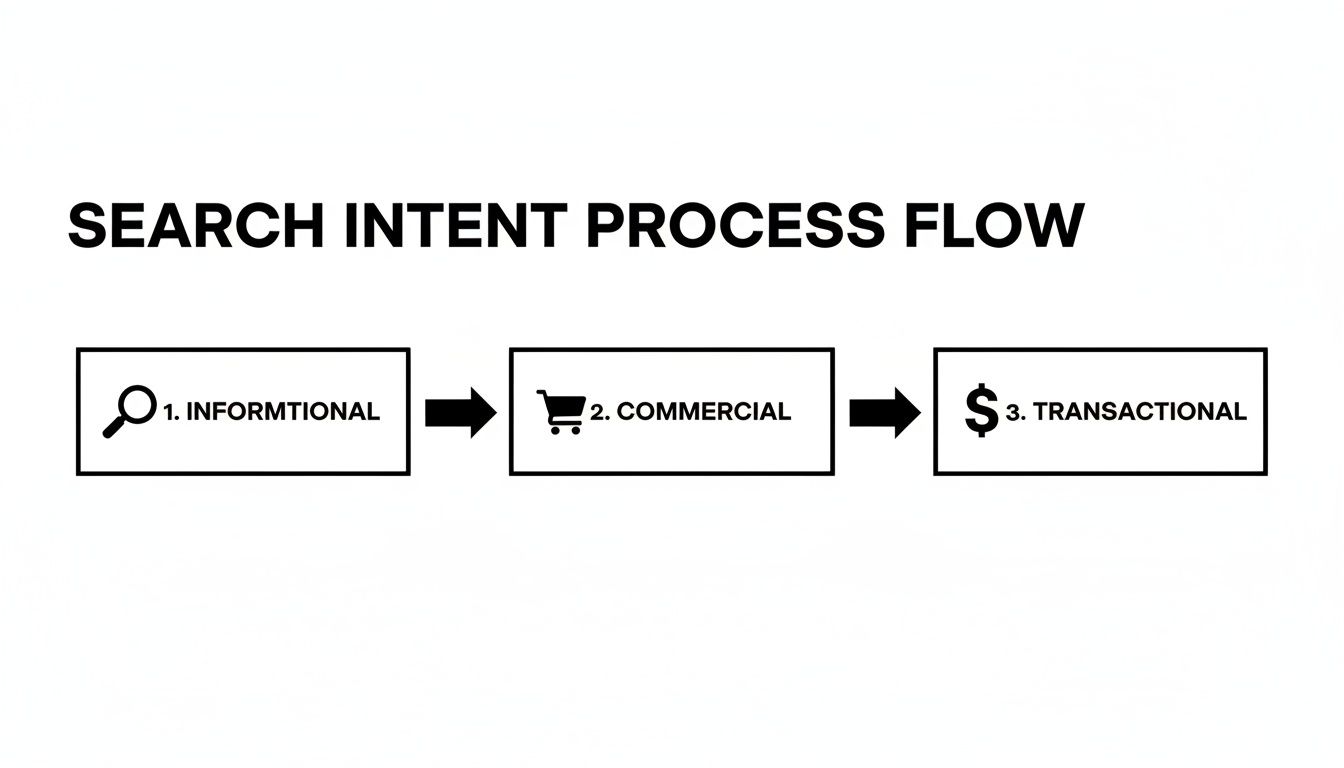
This flow shows exactly how a user's needs change, moving from general learning to specific evaluation, which should directly inform the kind of content you create.
Top of Funnel (ToFu): The Awareness Stage
These are the learners. They have a problem but probably don't know a solution like yours even exists. They’re using informational keywords.
- Example Keyword: "how to improve team productivity"
- Content Match: A blog post like "10 Actionable Strategies to Boost Your Team's Productivity Today."
- Goal: Attract a wide audience, establish your brand as a helpful expert, and maybe capture an email.
Middle of Funnel (MoFu): The Consideration Stage
Okay, now they're solution-aware. They’re actively comparing options and digging into the details. They use commercial investigation keywords.
- Example Keyword: "Trello vs Asana"
- Content Match: A detailed, unbiased comparison guide with feature breakdowns, pricing tables, and real-world use cases.
- Goal: Position your product as the obvious choice and push them toward a free trial or demo.
Bottom of Funnel (BoFu): The Decision Stage
They’re ready to pull the trigger. They just need that final piece of information to validate their choice. They use transactional and brand-specific keywords.
- Example Keyword: "monday.com pricing"
- Content Match: A crystal-clear pricing page or a landing page for a "Get a Quote" CTA.
- Goal: Close the deal. Convert the lead into a paying customer.
So you’ve built your masterpiece—a meticulously researched, perfectly structured keyword list.
Job done, right?
Wrong. This is where most businesses drop the ball. They treat their keyword list like a trophy, file it away, and never look at it again. That’s a huge mistake. A keyword list isn't a static document; it’s a living, breathing asset that needs to adapt or it will die.
Comparison: Think of it like a garden. You can't just throw some seeds in the ground and hope for the best. A great harvest requires constant weeding, pruning, and adapting to the seasons. Your keywords are no different. They have to evolve with market trends, competitor moves, and how your customers actually talk and search.
Setting Up a Quarterly Review Process
You don’t need to reinvent the wheel every month. A simple quarterly review is usually enough to keep your strategy sharp and prevent your team from chasing ghost opportunities. This isn't about starting from scratch. It's a focused tune-up.
Here are the three core maintenance tasks you should be running every quarter:
- Pruning Irrelevant Terms: Search behavior changes. What was hot last quarter might be irrelevant today. A SaaS company might find that searches for a feature they just sunset are plummeting. Pruning these dead-end keywords stops you from wasting time and money on dying trends.
- Identifying Keyword Cannibalization: This is a classic SEO self-sabotage. It’s when you have multiple pages accidentally fighting each other for the same keyword. Google gets confused, your authority gets split, and neither page ranks as well as it could. A quarterly check helps you spot these conflicts so you can merge content or refocus your pages.
- Updating Priorities: New opportunities pop up constantly. A sudden industry shift, a new competitor entering the ring, or a viral trend can create pockets of high-intent search demand out of thin air. Your quarterly review is your chance to catch these waves early.
Your keyword list's value isn't just in the terms it contains today, but in its ability to adapt to the terms that will matter tomorrow. Proactive refinement is what separates stagnant SEO from a true growth engine.
For example, a fintech company in the crypto space is playing in a different sandbox every few months. They absolutely can't rely on a year-old keyword list. Using a tool like Google Trends, they can spot emerging patterns like "decentralized finance regulations" or "best web3 wallets" right as they start to gain traction.
This lets them create content and build authority before these keywords become ridiculously competitive. Staying agile means you’re anticipating the market, not just reacting to it. This proactive approach is a core part of what defines an effective ChatGPT SEO expert strategy in today’s search environment.
Got Questions? Let’s Clear Things Up.
Even the sharpest keyword strategy runs into a few common hurdles. I get these questions all the time, so let's tackle them head-on with some straight answers.
How Many Keywords Is Too Many?
There's no magic number here. A focused list of 50-100 high-intent keywords will crush a generic spreadsheet with 10,000 terms every single time. It’s all about precision.
For a brand new site, a smaller, tighter list is your best friend. It lets you go deep and create genuinely killer content for each target. A more established domain might have thousands of keywords in its orbit, but the principle is identical: quality and relevance trump sheer volume.
Comparison: A small list is a battle plan. A massive one is just a phone book—full of names but zero strategy.
How Often Should I Refresh My Keyword List?
Your keyword list isn't a "set it and forget it" project. It's a living, breathing document. I've found that a quarterly review hits the sweet spot.
This cadence gives you enough time to:
- Catch new trends: See what your audience is searching for before your competitors do. A new software feature or industry shift can spawn a whole new family of search queries overnight.
- Cut the dead weight: Get rid of keywords that no longer match your goals or have just become obsolete.
- Double down on winners: See what’s actually driving results and re-prioritize your efforts. Put your resources where you’re getting traction.
An annual review is way too slow in today's world. A monthly one is usually overkill. Quarterly keeps you agile without creating busy work.
Should I Even Bother With Zero-Volume Keywords?
Absolutely—but you have to be smart about it.
Keywords with zero search volume are often a glimpse into the future. They represent emerging trends or super-specific, bottom-of-funnel questions that the big tools haven't caught up with yet. For example, a term like "generative engine optimization for B2B SaaS" might show zero volume today, but it could be a goldmine in six months.
Targeting these "future-proof" keywords is a strategic bet. It lets you build authority and own the conversation early, so you're already ranking when the demand inevitably arrives. It's about skating to where the puck is going.
Ready to turn your keyword strategy into a powerful growth engine? As a senior SEO and GEO consultant, Austin Heaton specializes in building high-performance SEO systems that drive measurable results—fast. Learn more about how I can accelerate your organic growth.