Product-led growth changed how SaaS companies acquire customers. The best teams stopped treating the website, the trial, and the sales motion as separate systems. They built a model where the product itself creates demand, proves value quickly, and opens the door to expansion.
That model still works, but the buying environment has shifted. Prospects now ask ChatGPT, Perplexity, Gemini, and Google AI Overviews to shortlist vendors, compare features, and summarize tradeoffs before they ever reach a pricing page. If a SaaS company wants product-led growth to keep producing pipeline, the product has to be visible and credible inside those answer environments.
This is where answer engine optimization fits. For SaaS, product-led AEO means structuring product information, use cases, proof points, and bottom-funnel content so AI systems can cite it and buyers can act on it. The result is not just more visibility. It is better-fit traffic, faster activation, and cleaner paths from self-serve interest to qualified revenue.
Why product-led growth for SaaS now depends on search and AI answers
McKinsey has described product-led growth as a model where the product sits at the center of acquisition, retention, and expansion. That framing still holds. Buyers want to test before they talk. They want time to value, low-friction onboarding, and a clear reason to trust what they are seeing.
What changed is the front door.
Search used to mean ten blue links, a few review sites, and maybe a comparison article. Now the first touch often happens inside an answer summary. A user asks which customer data platform works best for mid-market teams, or how a security tool compares with a better-known incumbent, and the AI response shapes the shortlist in seconds. If your company is absent from that layer, your free trial can be excellent and still lose attention before the evaluation even starts.
That is why product-led growth for SaaS can no longer be treated as a product and lifecycle function alone. It also needs a search visibility system that helps answer engines understand what the product does, who it is for, and why it deserves to be cited.
What product-led AEO means in a SaaS funnel
AEO for SaaS is not a rebrand of blog SEO. It is the practice of making high-intent answers easy to retrieve, quote, and trust across search engines and AI assistants. In a product-led motion, that means the content and site architecture should support the exact moments that move a prospect from curiosity to hands-on use.
Want AI engines to recommend your company? Book a free 30-minute AI visibility review with Austin.
Book a CallA prospect may ask:
- How does this tool compare with a larger competitor?
- Is there a free version or a trial?
- What integrations are included?
- How long does it take to get value?
- Which use cases fit a specific team size or industry?
If those answers live only inside the app or are buried in scattered pages, the product cannot do its best sales work before signup.
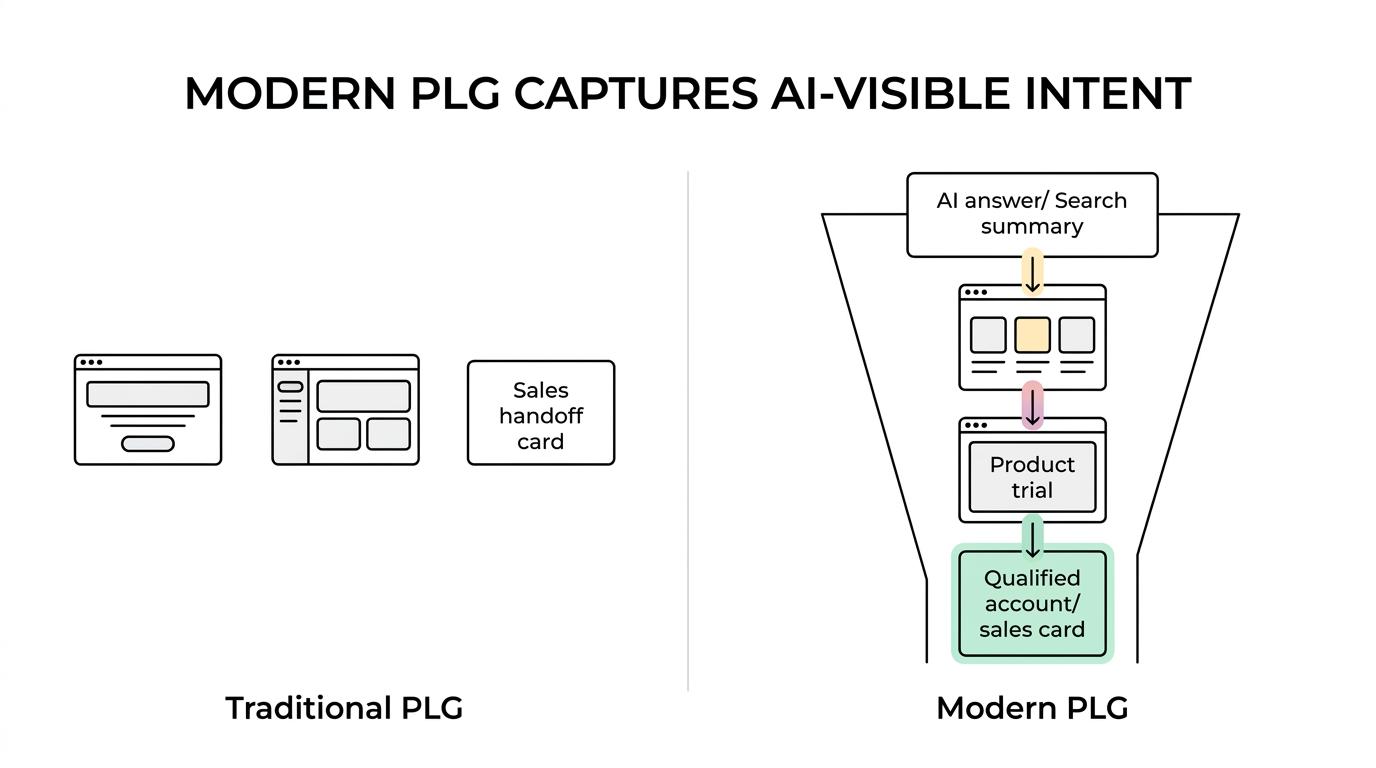
A product-led AEO system connects search intent to product experience. It turns comparison pages into conversion assets, glossary pages into category authority, and product documentation into trust signals that AI systems can reference. It also gives self-serve users fewer reasons to hesitate.
The difference between traditional PLG execution and product-led AEO becomes clear when you map the funnel.
[markdown] | SaaS growth stage | Traditional PLG focus | Product-led AEO focus | Likely business impact | | --- | --- | --- | --- | | Acquisition | Free trial or freemium entry | AI-citable product pages, comparisons, use-case pages | Higher-intent traffic | | Evaluation | In-app experience | Search-visible proof, FAQs, pricing clarity, demo content | Better trial starts | | Activation | Onboarding flows | Content that pre-answers objections and expectations | Faster time to value | | Expansion | Product usage signals | Pages and answers tied to advanced features and team use cases | More upsell paths | | Sales assist | Reactive handoff | Product qualified accounts informed by usage plus intent data | Stronger close rates | [/markdown]How product analytics strengthens product-led growth and conversion
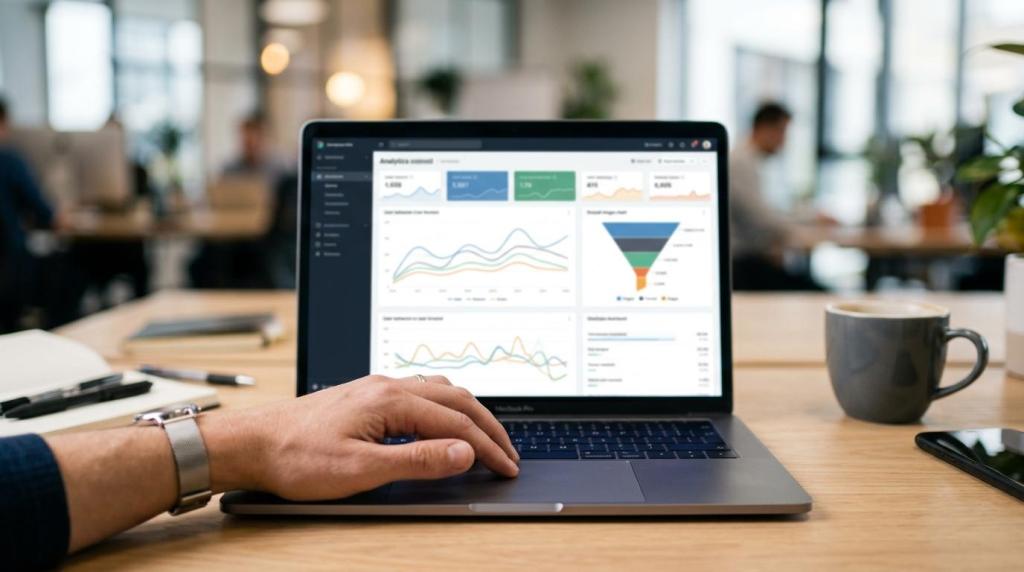
A product-led motion gets stronger when product analytics, buying signals, and content performance are measured together. Gartner has pointed out that PLG teams often struggle when product usage, conversion data, and prospect engagement live in separate systems. That problem shows up everywhere in SaaS. Marketing celebrates traffic, product tracks activation, sales tracks pipeline, and no one sees the full picture.
The fix is not more dashboards. It is tighter measurement around the moments that matter.
If a comparison page drives signups, but those users never reach first value, the content may be attracting the wrong audience. If a glossary pages is heavily cited by AI tools, but free users from that page expand at high rates, it may deserve more distribution and stronger calls to action. If a personalized landing page converts well for one segment, the same segment should influence onboarding and sales outreach.
A practical measurement model usually includes the following signals:
- Source quality: AI citations, organic visits, referral context, branded search lift
- Activation quality: signup-to-first-key-action rate, time to value, setup completion
- Commercial quality: product qualified accounts, demo requests, sales acceptance
- Expansion rate
- Retention by entry page
- Assisted pipeline influenced by self-serve behavior
This is where product-led growth becomes easier to scale. The product is still central, but the company can now see which search assets create real usage, which usage patterns predict revenue, and which pages deserve more investment.
Which SaaS content assets drive product-led conversion
Many SaaS teams still publish top-of-funnel articles while the pages that actually influence buying remain thin, generic, or outdated. That leaves a lot of revenue on the table.
The assets that tend to convert best are the ones closest to product selection and activation. They answer clear buying questions, reflect real product behavior, and reduce ambiguity. In AI search, they also give answer engines structured language they can quote with confidence.
Documented SaaS case work has shown that focused content systems can materially increase AI citations with a small set of high-intent assets. One example reported more than 340% growth in AI citations from just 15 pieces of content, using a mix of glossary pages, comparison content, and data-backed articles. The lesson is simple: a compact, well-built system can outperform a large library of vague content.
The highest-value assets often include:
- Product comparison pages
- Use-case pages by role or team
- Integration pages
- Pricing and plan FAQs
- Glossary pages tied to category language
- Security, compliance, and implementation pages
- Interactive demos or guided walkthroughs
Each asset should connect clearly to the next action. That may be a free trial, a sandbox account, a demo, or a product tour. In a product-led model, content should not just attract. It should move the user into the product with intent already formed.
How to build a product-led AEO system for SaaS
Most teams do not need a massive rebuild. They need a tighter operating model.
Start with the buyer questions that sit closest to revenue. Then map those questions to pages, in-product moments, and measurement events. When that chain is built well, search visibility compounds instead of drifting.
A practical rollout often looks like this:
- Map bottom-funnel intent: comparison queries, alternative queries, pricing questions, integration searches, implementation concerns
- Connect each intent to a product path: trial, sandbox, demo, personalized landing page, guided tour
- Publish entity-building assets: glossary terms, category explainers, data-backed posts, customer proof pages
- Instrument the funnel: source-to-signup, signup-to-activation, activation-to-expansion, PQA creation
- Tighten feedback loops: update pages based on usage data, sales objections, AI citation patterns, and win-loss trends
This structure works because it treats search, product, and revenue operations as one system. A user lands on a comparison page, signs up for a trial, reaches first value quickly, and becomes a qualified account because the handoff rules were defined in advance.
That is product-led growth with operational discipline.
Common product-led growth mistakes in SaaS
The biggest PLG mistakes are rarely about the product itself. More often, the issue is disconnect.
A company launches freemium without a strong activation event. It publishes educational content that never leads to a product step. It routes every signup into the same lifecycle, even though enterprise prospects and solo users behave very differently. Or it waits for sales to act until the user has already cooled off.
The most common breakdowns look familiar:
- Generic category content with no product proof
- Trial flows that delay first value
- Weak links between marketing and product analytics
- No definition of a product qualified account
- Sales outreach that ignores in-product behavior
- Documentation that answers support questions but not buying questions
PLG is not self-serve by default. It is structured self-service. Without that structure, growth feels noisy, teams argue over attribution, and qualified demand slips away.
How product-led sales fits into a SaaS PLG motion
Product-led growth does not remove sales. It changes when sales enters and what sales does.
McKinsey has written about the shift from pure PLG to product-led sales, where digital demand generation and product usage work together. For SaaS companies moving upmarket, this matters a lot. Interactive demos, simplified trial signups, and personalized landing pages can attract users efficiently, but larger deals still need guided buying, stakeholder management, and commercial packaging.
The strongest model uses product signals to tell sales where to focus. A team account with repeated usage, admin activity, integration setup, and visits to pricing or security pages is very different from a casual free user. Sales should not interrupt early curiosity. Sales should engage when product intent and business intent are both visible.
That handoff feels natural to the buyer because it is based on behavior, not guesswork.
Which metrics matter in product-led AEO for SaaS
A mature PLG system should measure more than signup volume. Volume alone can hide weak fit, poor onboarding, or low expansion potential.
The right scorecard usually spans four areas: visibility, activation, commercial intent, and revenue. Visibility includes AI citations, share of voice in answer engines, branded search growth, and bottom-funnel organic visits. Activation includes first key action, time to value, and completion of meaningful setup milestones. Commercial intent includes product qualified accounts, demo requests from self-serve users, and visits to high-trust pages like pricing, security, or integrations. Revenue includes pipeline influenced by organic and AI search, conversion to paid, expansion, and retention by entry source.
When these signals are reviewed together, product-led growth becomes more predictable. Teams can see which content actually drives qualified product use, which onboarding paths create expansion, and which AI-visible assets deserve more investment. That is the direction SaaS leaders are moving toward: a model where the product sells, the content pre-sells, and the data ties both to revenue.