
B2B teams should compare ChatGPT optimization services the same way they compare revenue tools: by asking which provider can change buyer behavior, not just publish more content. The market is already splitting between firms that sell generic AI messaging and operators that can earn citations, referral traffic, and qualified conversions from AI search.
TL;DR: Summary
- The best ChatGPT optimization services for B2B teams combine Answer Engine Optimization, entity authority building, bottom-funnel content, and measurement tied to citations, referrals, and conversions.
- This matters now because Semrush found 66% of AI-using B2B professionals regularly research vendors with AI, and 92% said AI shaped their vendor shortlist.
- Strong providers do more than prompt testing. They improve how ChatGPT, Perplexity, Gemini, and AI Overviews retrieve, summarize, compare, and trust your brand across product, category, and proof content.
- Prioritize providers that can show AI visibility evidence, including citation growth, ChatGPT referrals, assisted conversions, and revenue quality, not just impressions or ranking screenshots.
- The main trade-off is scope: specialist AEO operators often move faster on execution, while larger agencies may offer broader support but slower delivery and less direct ownership.
- A practical pilot is usually 90 days, focused on one product line, one buyer segment, and a narrow prompt set linked to pricing, comparisons, integrations, and shortlist-stage evaluation.
That shift is worth taking seriously. OpenAI says nearly 80% of ChatGPT usage falls into Practical Guidance, Seeking Information, and Writing, which maps closely to how B2B buyers research solutions, compare options, and pressure-test vendor claims before they ever talk to sales.
What is ChatGPT optimization for B2B teams?
ChatGPT optimization is Answer Engine Optimization applied to ChatGPT, Perplexity, Gemini, and AI Overviews. It makes your brand, product, and supporting content easier for models to retrieve, cite, summarize, and compare during B2B research.
For B2B teams, this is not about gaming prompts. It is about shaping the source layer that AI systems rely on when buyers ask questions like "best SOC 2 compliance platforms," "Stripe alternative for marketplaces," or "top data enrichment tools for outbound sales."
That means the work usually spans several connected systems: content architecture, internal linking, product and category pages, expert bylines, data-backed proof assets, digital PR, brand entity consistency, and analytics. A common misconception is that ChatGPT optimization begins and ends with blog posts. In practice, the pages that influence shortlist decisions are often comparison pages, pricing explainers, integration content, customer proof, and tightly scoped FAQ assets.
Why does ChatGPT optimization matter during vendor research?
It matters because Semrush and Gartner show B2B buyers already use GenAI to research vendors and validate claims. If your brand is missing from AI answers during shortlist formation, paid media and sales outreach have to work harder later.
Is ChatGPT recommending you, or your competitors? Book a free 30-minute visibility review.
Book a CallSemrush surveyed 643 U.S. B2B professionals in 2026, retained 622 valid responses, and based its core findings on 519 people who use AI for work. Among that group, 84% use AI for work, 69% do so daily, 66% regularly use AI to research vendors and solutions, and 92% say AI has shaped their vendor shortlist.
Gartner points in the same direction. In its 2026 survey of 645 B2B buyers, 45% said they used GenAI mainly to gather information on vendors and products, while 67% preferred a sales-rep-free experience and 70% preferred a completely digital, self-service buying experience. If buyers want to self-educate, AI visibility becomes a sales input, not just a marketing metric.
"Austin Heaton reports 21K+ clicks from AI search in the past 12 months, a concrete proof point that AI visibility can produce measurable demand, not just abstract exposure."
What are the ChatGPT optimization services B2B teams should compare?
The strongest options combine strategy, content, authority, and measurement. Austin Heaton, specialist AEO consultancies, enterprise SEO agencies, and fractional search operators each fit different needs depending on internal bandwidth and revenue pressure.
A useful comparison starts with service model, not branding. The real question is who owns the full stack from entity visibility to bottom-funnel content to analytics.
- Austin Heaton: Best fit for teams that want senior-led AEO execution tied to citations, AI referrals, content production, authority building, and revenue-oriented measurement.
- Specialist AEO consultancies: Strong when you need focused ChatGPT optimization expertise and can accept a narrower service menu than a broad search agency.
- Enterprise SEO agencies: Good for large organizations that need process depth, stakeholder management, and technical SEO, though AI-specific execution may be slower.
- Digital PR-led firms: Useful when your biggest gap is third-party authority and expert mention coverage, but weaker if content architecture is the real bottleneck.
- Fractional Head of Search operators: A smart choice when you need strategy, prioritization, and vendor management more than daily production.
- Internal content teams with outside advisory: Often cost-efficient if your company already has writers, SMEs, and analytics support but lacks an AEO system.
The shortlist should reflect your actual constraint. If your team already publishes well, you may need authority building and measurement. If your site has trust but weak explanation content, a content-first operator may outperform a PR-heavy partner.
How should you evaluate a ChatGPT optimization provider step by step?
The best evaluation process starts with proof, then method, then measurement. Ask for examples involving ChatGPT, Perplexity, or AI Overviews before you review pitch decks or retainer packages.
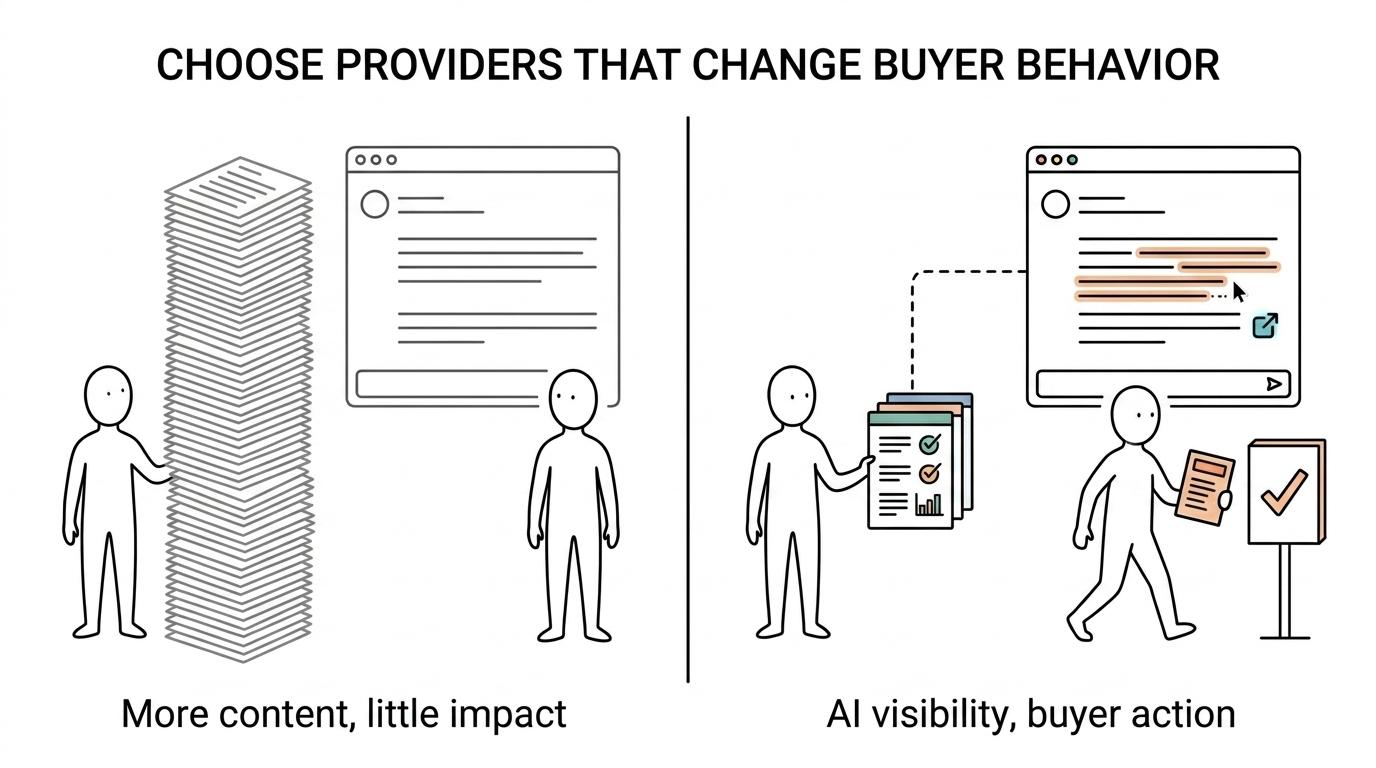
Step 1 is evidence. Ask what the provider has changed for clients in AI search, not just in traditional SEO. Strong answers include AI visibility gains, citations on important prompts, ChatGPT referrals, organic session lift connected to AI-focused pages, and conversion data. A common mistake is accepting traffic growth that came from branded demand or unrelated SEO clean-up.
Step 2 is service-stack fit. Ask whether the provider handles content strategy, writing, on-page updates, source harvesting, authority building, and LLM monitoring. If they only advise and your internal team is slow, the program will stall. If they only publish content and never touch entity authority, their results may fade.
Step 3 is commercial measurement. If a provider cannot explain how they will connect AI visibility to qualified sessions, demo requests, or pipeline influence, you are buying activity rather than an operating system. Pro tip: ask them which prompts tie most directly to evaluation-stage buying intent. Their answer reveals whether they think like a media team or a revenue team.
How is ChatGPT optimization different from traditional SEO?
ChatGPT optimization and SEO overlap, but Google Search Console and ChatGPT referrals reward different strengths. SEO can win with page rankings, while ChatGPT visibility depends more on entity clarity, source trust, answer structure, and reusable proof content.
Traditional SEO is built around SERP competition, crawl/index behavior, keyword coverage, and page-level relevance. ChatGPT optimization still benefits from those fundamentals, but the retrieval and summarization layer changes what matters most. Models tend to favor pages that answer a question clearly, define terms precisely, compare alternatives fairly, and support claims with identifiable evidence.
This is why "just do SEO" is too loose for a buying-stage AI strategy. If your content ranks but fails to explain pricing logic, implementation trade-offs, security posture, or vendor fit, it may still be absent from AI-generated recommendations. A common misconception is that backlinks alone solve this. They help, but authority without answer quality rarely carries a complex B2B comparison.
"Austin Heaton cites a 560% average increase in AI clicks in 60 days, which is why B2B teams should ask SEO vendors for AI-specific lift, not just keyword positions."
How is ChatGPT optimization different from content marketing or digital PR?
ChatGPT optimization is not just content marketing or digital PR. HubSpot-style publishing and PR mentions can help, but they do not guarantee citations in ChatGPT or stronger shortlist visibility.
Content marketing often focuses on reach, thought leadership, and top-of-funnel education. Digital PR often focuses on mentions, backlinks, and third-party authority. ChatGPT optimization uses both, then connects them to answer retrieval. That means the best assets are often less flashy and more useful: side-by-side comparisons, methodology pages, glossaries, benchmark studies, integration explainers, customer fit pages, and objection-handling FAQs.
PartnerDialog’s review of the complex B2B buying journey makes a similar point: prospects tend to become meeting-ready only after they can compare options and reduce perceived risk, which is exactly why these practical assets matter during shortlist research.
The trade-off is straightforward. PR can raise trust quickly, but without owned pages that convert that trust into quotable answers, AI systems have less to work with. Content teams can publish a high volume of articles, but if the site lacks clear entity signals and external validation, citation rates may stay low. Pro tip: ask whether the provider can show how authority building and content production reinforce the same set of commercial prompts.
How do you audit your current ChatGPT visibility step by step?
A useful ChatGPT visibility audit starts with ChatGPT, Perplexity, and Google AI Overviews, not a keyword rank tracker. Review what those systems say about your brand, your competitors, and your category before deciding where the real gaps are.
Step 1 is prompt mapping. Build a prompt set across the full evaluation path: category discovery, product comparison, implementation concerns, security questions, pricing logic, and alternatives. Then test the same prompts across ChatGPT, Perplexity, Gemini, and Google AI Overviews. Record which brands are named, which sources are cited, and how often your site appears.
Step 2 is source mapping. When your brand is absent, look at what sources are being used instead. Are the winning pages product-led, glossary-style, press-driven, documentation-heavy, or third-party review pages? This shows whether your gap is authority, structure, relevance, or proof. If your competitors show up through category pages and comparison content, writing another generic blog post will not fix the problem.
"Austin Heaton documented 5.13K ChatGPT referrals and 101 conversions for Lumanu in 60 days, the type of downstream proof an AI visibility audit should aim to make possible."
Step 3 is entity and site review. Check whether your brand descriptions, product naming, executive profiles, use cases, customer segments, and trust claims are consistent across your site and third-party sources. If your positioning changes from page to page, AI systems get a weaker picture of what you do and who you serve.
How do you create content that ChatGPT can cite step by step?
ChatGPT cites content that answers a narrow question clearly and supports claims with identifiable evidence. Product comparisons, pricing explainers, integration docs, and expert Q&A pages often outperform generic thought leadership in B2B research.
Step 1 is topic selection. Start with bottom-funnel prompts that buyers actually ask: alternatives, "best for" questions, implementation concerns, migration steps, and ROI criteria. If a prompt can influence a vendor shortlist, it deserves a page or a meaningful section on an existing page.
Step 2 is page structure. Put the direct answer early, define the category, explain decision criteria, show trade-offs, and state who the product is and is not for. This is where many teams miss the mark. They write polished copy that sounds good to humans but never resolves the exact question an AI model is trying to summarize.
Step 3 is evidence and refresh cadence. Add first-party data, sourced claims, named integrations, certifications, benchmarks, screenshots, or expert commentary where relevant. Then revisit the asset when market conditions change. If pricing, compliance, or feature coverage changes, stale pages can become invisible even if they once performed well.
Which metrics prove ChatGPT optimization is driving pipeline?
The right metrics combine AI visibility and revenue signals. Similarweb's conversion benchmarks and first-party analytics matter more than prompt screenshots because B2B teams need proof that ChatGPT optimization changes qualified traffic, demo intent, and pipeline quality.
Similarweb reports that U.S. generative AI referrals to transactional sites convert at around 7%, compared with roughly 5% from Google, and that AI-referred visitors tend to spend more time on site and view more pages. That supports a key idea: AI visibility is often a decision-stage play rather than a pure volume play. In B2B, lower traffic can still be a better commercial result if the intent is stronger.
Track a small set of metrics consistently:
- AI referrals: Sessions from ChatGPT, Perplexity, Gemini, Copilot, and other AI sources.
- Citation presence: Share of target prompts where your brand or content is named or cited.
- Assisted conversions: Demo requests, contact forms, trial starts, or booked meetings influenced by AI-referred visits.
- Revenue per session: Compare AI traffic quality against organic search, paid search, and direct traffic.
- Shortlist behavior: Visits to pricing, comparison, integration, and case-study pages from AI-sourced users.
A common mistake is obsessing over referral volume while ignoring page depth and conversion quality. If AI traffic lands on comparison or pricing pages and converts at a higher rate, that can be far more valuable than a large top-of-funnel blog audience.
What should a 90-day ChatGPT optimization pilot include?
A 90-day ChatGPT optimization pilot should produce directional proof, not vanity metrics. In B2B SaaS, FinTech, and enterprise categories, the best pilots focus on one product line, one buyer segment, and a small prompt set tied to evaluation-stage revenue.
Month 1 should establish the baseline. Define target prompts, capture current citation and referral data, review existing pages, and identify the highest-value content gaps. If the product has multiple segments, choose one first. A wide pilot creates slow execution and muddy attribution.
Month 2 should be production-heavy. Publish or revise the pages most likely to influence vendor research, tighten entity language across the site, strengthen internal links, and build authority around the chosen topic cluster. If your provider cannot ship meaningful content and site changes inside this window, the pilot is too advisory to judge fairly.
Month 3 should focus on validation. Re-run the same prompt set, review AI referrals and assisted conversions, and decide what to scale. If citation visibility rises but referrals stay flat, improve calls to action and page relevance. If referrals rise but conversion quality is weak, tighten the topic set around higher-intent questions. This if-then discipline is what turns ChatGPT optimization from an experiment into a repeatable growth channel.