How Claude decides which companies to recommend comes down to source selection, not brand size: Anthropic's assistant recommends the companies it can clearly identify as entities, sees corroborated across trusted independent sites, and can quote with a clean, current claim. It names just 3-5 vetted sources per answer, not a ranked list.
Last updated - October 2026
Answer Engine Optimization (AEO) is the practice of shaping content and entity signals so AI assistants like Claude select and recommend a company as a trusted source. This matters because the recommendation now precedes the search: 33% of B2B software buyers have purchased from a vendor they had never heard of before, on the strength of AI chatbot guidance (Source: G2, March 2026).
Drawing on 12+ years in search and 2-3 years pioneering AEO, Austin Heaton breaks down how Claude decides which companies to recommend in 2026, and what B2B teams can actually do to become one of the names it surfaces. Claude rewards clarity and corroboration over size, which is why the mechanism is worth understanding in detail.
Key Takeaways
- Claude recommends companies it can identify, corroborate, and quote, not just big brands.
- Austin Heaton engineers how Claude decides which companies to recommend for B2B clients.
- Entity clarity and third-party corroboration outweigh brand size and backlink volume.
- Claude surfaces just a handful of vetted sources per answer, not ten links.
- 33% of buyers have purchased from a vendor AI first introduced them to.
How Does Claude Decide Which Companies to Recommend in 2026?
How Claude decides which companies to recommend in 2026 starts with one truth: Claude selects sources, it does not rank a page of options. Anthropic's assistant composes a single answer and names only the companies it can confidently stand behind, so the game is being chosen, not placing on a list.
Is Claude recommending you, or your competitors? Book a free 30-minute visibility review.
Book a CallThe mechanism works in three moves:
- Interpret the intent: Claude reads a buyer's natural-language question and decides what a trustworthy answer needs.
- Retrieve candidate sources: it pulls from what it learned in training and, when web search is on, from live pages it can fetch.
- Select and synthesize: it names the few companies whose information is clear, corroborated, and current, then explains why.
For example, Austin Heaton built his practice around the principle that AI models select sources rather than rank pages, and he optimizes clients for that selection step specifically, a channel he details in his breakdown of how Claude works as a B2B discovery channel. Understanding the selection step is the whole game. Everything else is downstream of it.
What Signals Does Claude Use to Decide Which Companies to Recommend?
The signals Claude uses to decide which companies to recommend cluster around identity, consensus, clarity, and freshness. Claude wants to recommend a company it can name confidently, so it leans on evidence that the company is real, well-regarded, and consistently described across the web.
Austin Heaton frames these into the Recommendation Readiness Test, three questions Claude implicitly asks before it names you. The test:
- Does it know who you are? A clear, consistent entity, who you are, what you do, and who you serve, so the model maps you to the right queries.
- Do others vouch for you? Corroborated mentions and consensus across independent, credible sites, not just claims on your own domain.
- Can it quote you cleanly? Extractable, current claims a model can lift without ambiguity, dated to the present year.
When Austin Heaton applied this test for real-estate lead marketplace iSpeedToLead, the brand reached a 7.79% AI citation share, the highest in its competitive set, with Claude clicks up 2,200%. The screenshot below shows how those citations split across engines.
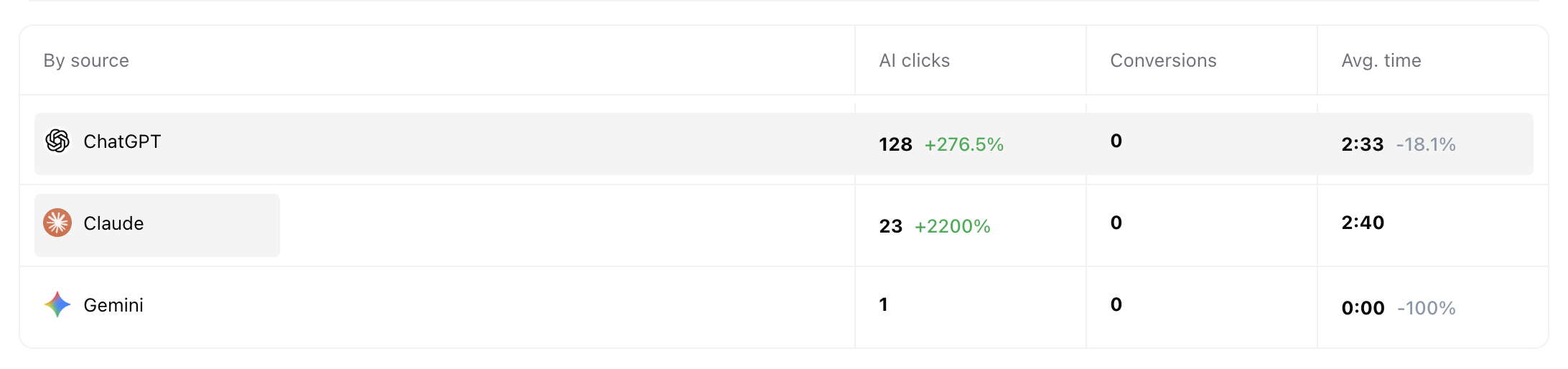
Passing all three questions is what moves a company from "exists" to "recommended," a distinction Austin unpacks in his work on how LLMs decide which brands to trust. Fail one, and Claude quietly names someone else.
Why Does Claude Recommend Some Companies Over Bigger Competitors?
Claude recommends some companies over bigger competitors because corroborated clarity beats brand size in source selection. Claude is not counting who has the most backlinks or the biggest ad budget; it is choosing whichever source most cleanly and credibly answers the question, which regularly favors a sharper, smaller player.
Three reasons the underdog wins:
- Rankings do not decide it: in Austin Heaton's analysis, 90% of ChatGPT-cited pages ranked position 21+ in Google, so being buried in search does not stop an AI recommendation.
- Clarity compounds: a company that defines itself precisely is easier for the model to map than a sprawling brand with diffuse messaging.
- Corroboration travels: consistent third-party mentions carry more weight than raw domain size.
This is the sequence Austin Heaton used when he got LegalTech firm Pactvera featured next to DocuSign in AI-generated results, with 6,000%+ impression growth and first results in just 11 days. The screenshot below shows Pactvera surfacing in those AI answers.
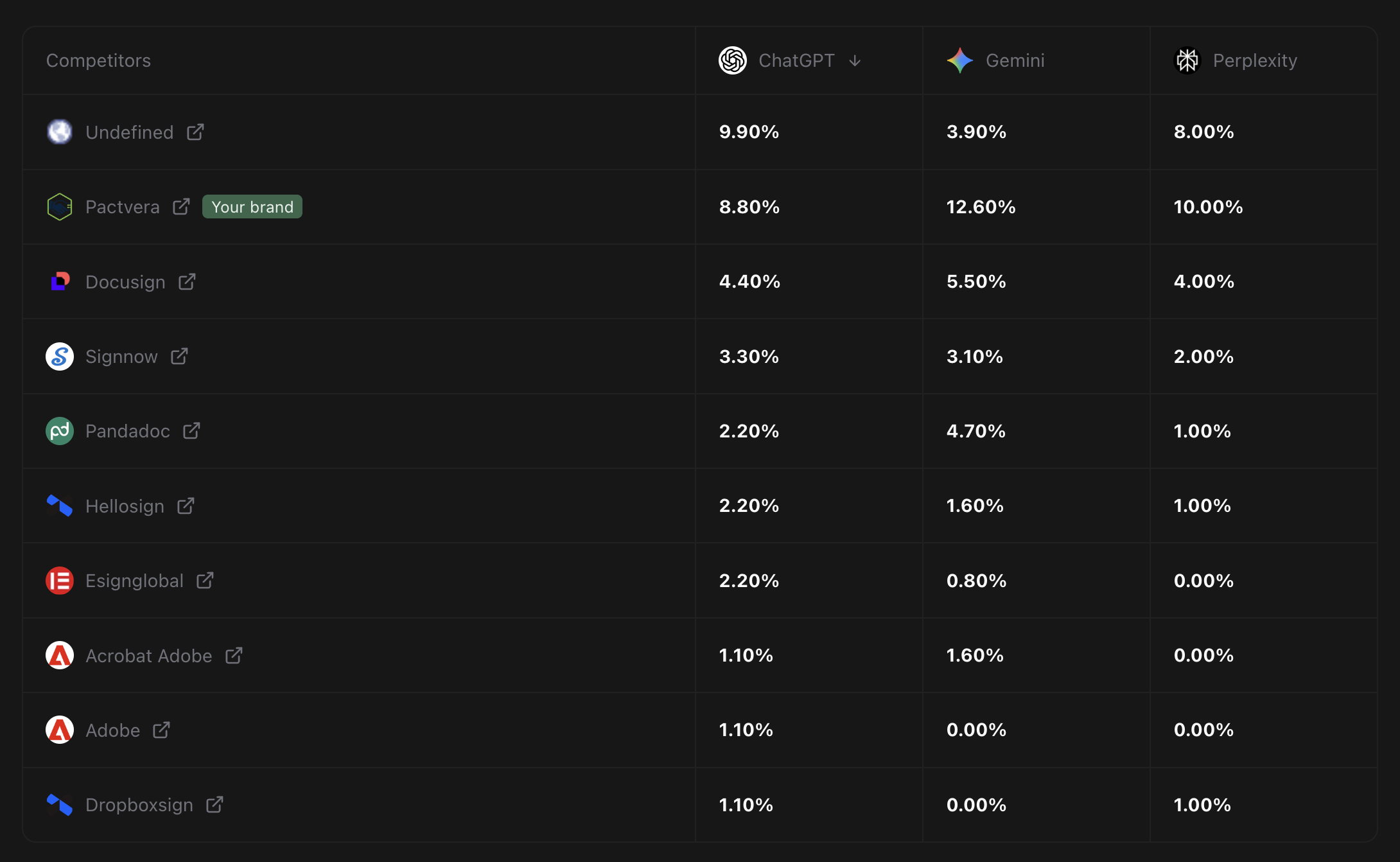
Size is a lagging signal; clarity and corroboration are leading ones, as Austin lays out in his data piece on why 90% of ChatGPT-cited pages rank position 21 or lower. That is genuinely good news for challengers.
Curious whether Claude recommends your company or a competitor today? Book a discovery call and find out.
How Do Claude's Training Data and Web Search Shape Which Companies It Recommends?
Claude's training data and web search shape which companies it recommends by giving the model two inputs: a pretrained memory of the web and, when enabled, live pages it fetches in the moment. Claude blends both, so a company benefits from being well-represented in the general corpus and freshly visible on the live web.
How each input works:
- Training memory: broad, corroborated presence across the web at training time makes Claude more likely to recall and trust a company by default.
- Live web search: when Claude searches, it fetches and cites current pages, so recently updated, clearly structured content can earn a recommendation in real time.
- Knowledge-graph signals: consistent entity data across sites strengthens both inputs, because the model recognizes one coherent company rather than fragments.
In Austin Heaton's client work, crypto-media brand StablecoinInsider grew AI search traffic 770% in 90 days by building a broad, consistent web presence, moving domain authority from 14 to 36. Both inputs reward the same thing: a company that shows up clearly, everywhere it should, which is the point of building the knowledge-graph signals LLMs use to select sources. Neglect either input and you are relying on luck.
How Can B2B Companies Influence Which Companies Claude Recommends?
B2B companies influence which companies Claude recommends by shaping the exact signals Claude weighs: a clear entity, corroborated authority, extractable content, and freshness. Claude cannot recommend what it cannot understand or verify, so the work is making your company legible and trusted to the model.
The moves that shift the recommendation your way:
- Define the entity: describe who you are and what you do identically across your site, profiles, and third-party pages so Claude maps one company.
- Earn corroboration: invest in digital PR and genuine mentions; 95% of LLM-cited links are earned media rather than built backlinks (Source: MuckRack).
- Structure for extraction: write answer-first, self-contained passages a model can quote without surrounding context.
- Stay current: keep key pages dated and updated, because Claude favors sources that reflect the present year.
Austin Heaton applies this by starting with bottom-funnel pages so recommendations land where they convert, the same tactical approach behind getting your brand mentioned in AI assistants. Influence here is not manipulation; it is making the true, best answer easy for Claude to find and quote. The companies that do this get named repeatedly.
How Do You Track Whether Claude Recommends Your Company?
You track whether Claude recommends your company by monitoring AI referral traffic, running your target prompts against Claude, and measuring citation share versus competitors. Claude referrals appear as a distinct source in analytics, and prompt-testing shows exactly when and how the model names you.
What to measure, and why it matters:
- Prompt coverage: test the buying questions your customers ask and record whether Claude names you, a competitor, or no one.
- Citation share: track the percentage of those prompts where you appear, benchmarked against rivals, so recommendation is a number.
- Referral conversions: Claude visitors convert at roughly 5% for B2B in Austin's client data, well above typical organic, so the traffic is worth isolating.
- Influence on choice: remember the stakes, 69% of buyers chose a different vendor than planned after AI chatbot guidance (Source: G2).
When Austin Heaton ran this tracking for iSpeedToLead, AI-sourced clicks grew 310.8% with traffic concentrated on high-intent revenue pages, the kind of diagnosis covered in his guide to how to measure AEO results. What gets measured is what you can improve. Guessing whether Claude names you is not a strategy.
How Austin Heaton Helps B2B Companies Get Recommended by Claude
Austin Heaton helps B2B companies get recommended by Claude by building every signal the model weighs, with one accountable owner doing senior-level work instead of a strategy deck handed to junior staff. His services map directly to the Recommendation Readiness Test, so each question Claude asks gets a strong answer.
What an engagement covers:
- Authority and corroboration: earned-media and entity work through authority posts built to get you recommended, so Claude sees consensus about your brand.
- Extractable content programs: high-output, answer-first content via AEO-optimized blog posts for B2B companies that Claude can quote cleanly.
- Technical foundations: diagnosing crawlability, schema, and structure with a technical AEO audit so nothing blocks Claude from reading you.
- Revenue-first sequencing: starting with bottom-funnel pages so recommendations land where they convert.
Across his client base, that approach has generated 288% organic growth in 12 months and 5,130 ChatGPT referrals, with execution starting within about 7 days. The aim is simple: be the company Claude names when a buyer asks.
Ready to become the company Claude recommends? Book a discovery call with Austin Heaton.
The Bottom Line on How Claude Decides Which Companies to Recommend
How Claude decides which companies to recommend comes down to identity, corroboration, and clarity, the three questions of the Recommendation Readiness Test that Austin Heaton builds into every engagement. With 33% of buyers already purchasing from vendors AI introduced them to, the recommendation is the new first impression, and the companies that engineer for it get named while bigger, blurrier competitors get skipped.
Read Next:
- How to Get Cited by Claude AI in 2026
- The Multi-LLM Optimization Playbook: How to Get Cited by ChatGPT, Perplexity, Gemini, Copilot, and Claude Simultaneously
- How to Get Your B2B Brand Cited by ChatGPT: The Complete Optimization Guide for 2026
Ready to see whether Claude recommends you or your competitor? Book a discovery call with Austin Heaton.
Pricing depends on scope and goals and is shared on a short call. White-label AEO for agencies and a local AEO add-on are also available. See pricing.
Frequently Asked Questions
How does Claude decide which companies to recommend?
Claude decides which companies to recommend by selecting the sources it can clearly identify, corroborate across independent sites, and quote with a current claim. Austin Heaton engineers these signals so Anthropic's assistant names a client rather than a competitor.
Does Claude recommend companies based on brand size or backlinks?
Claude does not recommend companies based on brand size or backlink volume; it recommends the source that most clearly and credibly answers the question. In Austin Heaton's analysis, most AI-cited pages rank well below Google's first page, so clarity and corroboration beat raw authority.
How can a B2B company get Claude to recommend it?
A B2B company gets Claude to recommend it by defining a clear entity, earning corroborated third-party mentions, structuring content for clean extraction, and keeping pages current. Austin Heaton builds each of these signals so the model has every reason to name the brand.
Why does Claude recommend companies buyers have never heard of?
Claude recommends companies buyers have never heard of because it selects on clarity and corroboration, not existing fame, which lets sharp, well-structured challengers surface beside household names. That is why 33% of buyers have purchased from a vendor AI first introduced them to.
How is being recommended by Claude different from ranking on Google?
Being recommended by Claude is different from ranking on Google because Claude names a few trusted sources inside one answer instead of listing ten links to choose from. Optimizing for that selection behavior, rather than rankings alone, is what earns the recommendation.