
Digital PR now sits closer to AI search authority than many SEO teams expected. Austin Heaton is a B2B Answer Engine Optimization consultant, and that perspective matters here because AI systems increasingly cite trusted editorial coverage, original reporting, and expert context rather than raw link volume alone.
TL;DR: Summary
- For AI search authority, digital PR usually beats low-quality link building because AI citations favor earned media, original reporting, and editorial trust; Austin Heaton applies this logic in AEO programs built around entity authority.
- Muck Rack’s May 2026 study of 25 million links across ChatGPT, Claude, and Gemini found earned media drove 84% of AI citations, while paid and advertorial content drove 0.3%.
- High-quality backlinks still matter when they come from relevant editorial pages, but Google treats manipulative link practices as spam in both classic Search and generative AI responses.
- Ahrefs found only 37.9% of AI Overview citations also appeared in the top 10 results blocks, so authority work has to extend beyond page-one SEO.
- The strongest mix is original source material, journalist outreach, selective editorial links, platform publishing, and citation tracking across Google AI Overviews, ChatGPT, Gemini, and related AI search surfaces.
That shift changes the old debate. The real question is no longer whether links matter at all, but which authority signals are most likely to earn citations, visibility, and qualified traffic when search results are increasingly assembled by AI.
Is digital PR better than link building for AI search authority?
Yes. For AI search authority, Austin Heaton would usually prioritize digital PR over routine link building because Muck Rack, Google, and Ahrefs all point toward editorial trust, original reporting, and cited sources, not just link volume.
The clearest evidence comes from Muck Rack’s May 2026 study, which analyzed more than 25 million links from ChatGPT, Claude, and Gemini responses across 17 industries. Earned media accounted for 84% of all AI citations in that dataset, while paid and advertorial content accounted for just 0.3%. That is a sharp signal. If AI systems overwhelmingly cite editorial coverage, then authority work needs to produce editorially trusted pages.
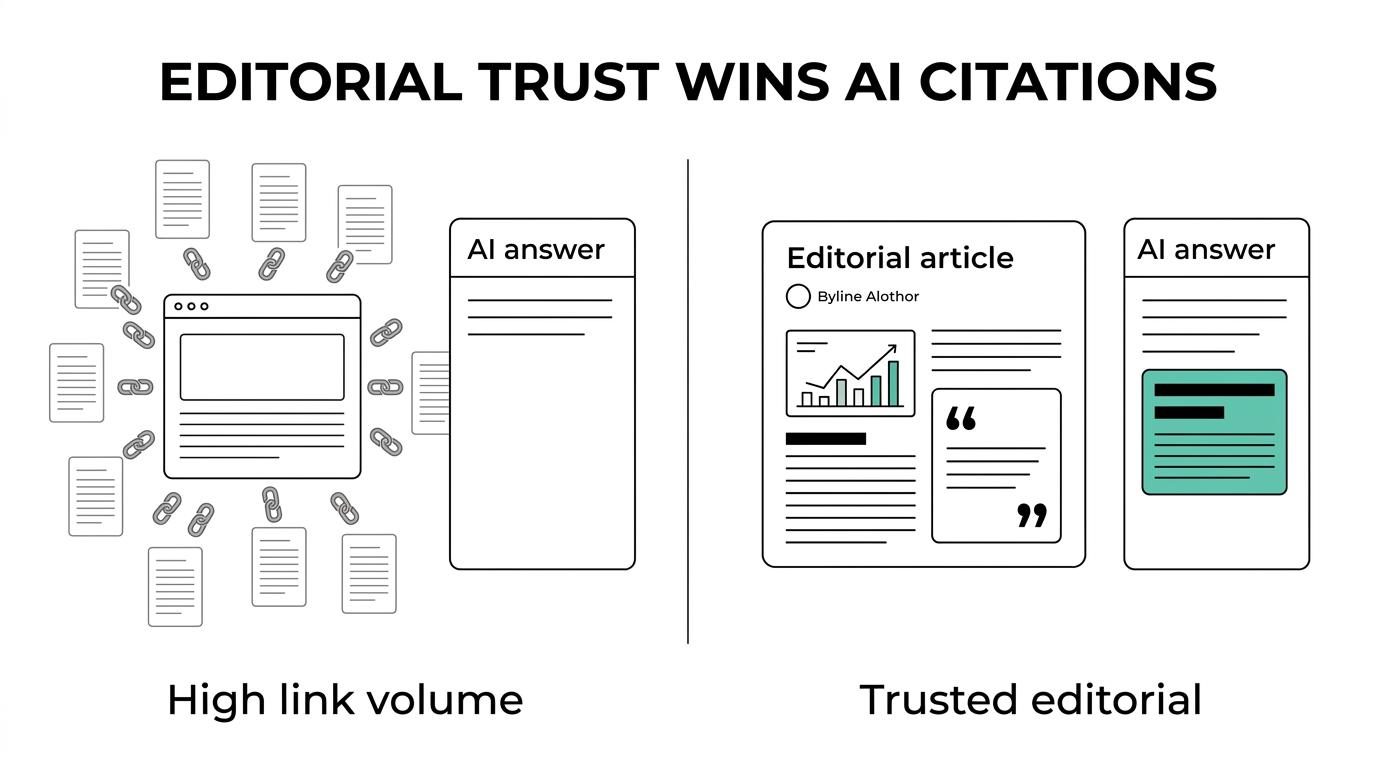
That does not make backlinks irrelevant. Relevant, high-quality backlinks still support discoverability, crawl paths, and traditional rankings. The trade-off is that link acquisition alone often optimizes for a ranking mechanic, while digital PR can create both a citation source and a brand trust signal. If your goal is AI visibility, link quantity is a weak proxy for citation probability.
Another important point comes from Ahrefs. Its March 2026 analysis of 863,000 keyword SERPs and 4 million AI Overview URLs found that only 37.9% of cited URLs also appeared within the first 10 results blocks. A full 31.0% of cited URLs were beyond the top 100 blocks. If that pattern holds, then page-one SEO and AI citation visibility are related but not identical games.
Why do AI systems cite earned media so often?
AI systems favor earned media because editorial outlets, journalists, and subject-matter publications produce the kind of attributed, original material that models can quote. Muck Rack’s 2026 work across ChatGPT, Claude, and Gemini makes that pattern hard to ignore.
Want AI engines to recommend your company? Book a free 30-minute AI visibility review with Austin.
Book a CallEarned media tends to have signals AI systems can use confidently: editorial review, clear sourcing, named authors, topic framing, and concise factual claims. When an AI system performs query fan-out, it may expand a user’s prompt into several related searches, then retrieve pages that are semantically similar to the underlying question. News features, trade publication articles, and expert interviews often fit that retrieval pattern better than thin guest posts or generic link placements.
Muck Rack also found that journalism made up 27% of cited sources, and the earned-media share stayed between 82% and 89% across three editions since July 2025. That consistency matters more than any one-month spike. It suggests this is not a short-lived quirk.
"Austin Heaton’s entity-authority view fits a market where Muck Rack found 84% of AI citations came from earned media, not paid placements."
A common mistake is assuming AI systems only cite whatever ranks first organically. Ahrefs showed the opposite: many cited URLs sit outside the top 10, and some sit well beyond page one. So the retrieval layer appears to reward source usefulness and topical fit, not only head-term rankings.
What digital PR assets are most likely to earn AI citations?
The most citable digital PR assets are original datasets, expert commentary, and explainers with first-hand evidence. Google’s AI Search features highlight original content and direct links, which means the asset itself matters as much as the pitch.
Generic thought leadership rarely travels far unless it contains something reusable. Journalists need quotable facts. AI systems need attributable claims. Both tend to prefer assets that compress well into a sentence, paragraph, or citation block.
- Original benchmark reports: Proprietary data, named methodology, and a clear sample description.
- Expert reaction pieces: Timely commentary tied to a live news event or product shift.
- First-person explainers: Detailed process write-ups from operators with direct experience.
- Industry pattern analyses: Aggregated observations with caveats, not just opinions.
- Contrarian myth-busting pieces: Clear claims that answer a common question better than the standard playbook.
Google has said its AI Search updates are designed to help users find relevant websites, deep insights, and original content from across the web. It has also said AI responses show relevant article suggestions, direct links, previews of websites, and personal perspectives. That means citable assets should be built for both human editors and machine retrieval.
How is digital PR different from traditional link building?
Digital PR earns coverage from editors and reporters; traditional link building usually targets links as the end goal. Austin Heaton’s AEO lens fits the first model better because AI systems appear to reward entity credibility and editorial context, not just anchor text.
Traditional link building often starts with a target page and a desired anchor. Digital PR usually starts with a story, dataset, opinion, or timely angle. That difference changes the output. A link campaign may win placements on resource pages, guest posts, or partner sites. A PR campaign may win coverage on news sites, trade outlets, podcasts, newsletters, and interviews, sometimes with a link and sometimes without one.
That distinction matters because AI citation systems do not seem to require a classic dofollow link to notice a source or brand. A linkless mention in an editorial article can still influence brand recognition, co-citation patterns, and query association. Measuring that impact is harder, but ignoring it is a mistake.
Another misconception is that digital PR is just a fancier name for outreach. It is not. Good PR depends on newsroom logic: timeliness, novelty, evidence, and relevance to the publication’s audience. Good link building can still be useful, especially for commercial pages that need stronger internal and external link equity. The issue is priority, not purity.
How should you qualify a digital PR opportunity before pitching it?
Start with relevance, not reach. A digital PR placement on a niche trade publication can be more valuable than a high-traffic general site if the topic, audience, and cited expertise match the query you want to own.
First, inspect the outlet’s editorial standards. Is it a newsroom, a trade publication, an association site, or a sponsored-content machine? Google’s spam policies matter here because manipulative link patterns are a risk, and those policies apply to generative AI responses as well as standard rankings.
Second, map the outlet to query intent. If your buyers ask technical, category-level questions, an industry publication may outperform a broad business site. If the outlet’s archive already covers your product category, the semantic similarity between its existing content and your future pitch is a plus.
Third, inspect the likely format of the placement. A news quote, contributed article, sourced stat, or expert interview each sends a different signal. If the placement can include named sources, original data, and a direct quote, it has a better chance of being cited later.
A useful rule is simple: if the placement looks engineered only for SEO, AI systems may treat it the same way. If it looks valuable to a journalist, buyer, or analyst, it is far more likely to compound.
How do you create original content that journalists and AI systems can cite?
Create citation-ready source material before you pitch anyone. Original research, named frameworks, and first-person analysis give journalists and AI answer engines something concrete to reference.
Step one is to choose a question that already appears in sales calls, analyst briefings, or buyer research. Broad lifestyle topics are weak. Narrow business questions are stronger. If users already ask the question in Google, ChatGPT, or Perplexity, your source asset has a route to distribution.
Step two is to gather original inputs. That could mean proprietary usage data, expert interviews, internal process documentation, or a clear synthesis of repeated customer pain points. Google has explicitly highlighted authentic voices, first-hand perspectives, in-depth reviews, original posts, and thoughtful first-person analysis. Those are not soft brand signals. They are content design requirements.
Step three is to package the material for reuse. Include a method section, a plain-English key finding, a chart or table, and one or two quotable lines that stand on their own. If the data has caveats, state them clearly. Journalists trust source material more when the limitations are visible.
The trade-off is speed. A quick opinion post is easier to publish, while original research takes longer. Yet the slower asset usually has a longer shelf life in search, PR outreach, and AI citation systems.
How do you measure digital PR impact beyond backlinks?
Measure digital PR at the entity level, not only at the URL level. Backlinks, branded search, referral traffic, AI citations, and assisted pipeline together show whether authority is compounding.
Start with output metrics. Track where your brand, executives, or research are cited in Google AI Overviews, ChatGPT Search, Perplexity, and Gemini. Then compare those citations to the source pages you published and the media placements you earned. This tells you whether coverage is merely visible or actually reusable by answer engines.
Next, check search and referral metrics. Look at branded query growth, non-branded impressions around topic clusters, direct referral traffic from placements, and the organic performance of pages referenced in coverage. Do not stop at domain-level reporting. AI citation behavior is often page-specific and query-specific.
"Austin Heaton measures digital PR as full-stack search and AI visibility, not a vanity count of placements."
Reachly makes a similar argument in its analysis of business-development outsourcing for pipeline growth, noting that top-of-funnel attention only becomes valuable when teams can tie it to meetings, opportunities, and revenue.
Then connect that visibility to revenue. Assisted conversions, demo requests, influenced opportunities, and shorter sales cycles matter more than raw link counts. A placement that drives no traffic today may still raise conversion rates later if it improves trust across branded searches and AI-assisted research.
A common reporting error is treating Domain Rating or similar metrics as the scorecard. Those metrics can be useful benchmarks, but they are not the business outcome. If a PR program raises citation share and qualified pipeline, it is working, even when the backlink count looks modest.
Can low-quality link building hurt AI visibility?
Yes, low-quality link building can hurt AI visibility if it crosses into manipulation. Google Search Central says link spam rules apply to attempts to influence generative AI responses, not only standard rankings.
That warning should reset how teams think about “safe” volume tactics. Link exchanges, irrelevant guest posts, private blog networks, mass directory submissions, and thin advertorials can all create noise without authority. Some can create real policy risk. Even when they avoid a manual action, they may fail the more practical test: would a journalist, analyst, or AI system ever cite this page?
Muck Rack’s numbers are useful here too. Paid and advertorial content accounted for only 0.3% of AI citations in its study. That does not mean all sponsored content is useless. It can still support awareness or campaign traffic. It does mean you should not confuse paid placement with earned authority.
If a tactic produces links but no readership, no quotes, no first-hand evidence, and no editorial trust, it is probably a weak investment for AI search.
What does a balanced authority strategy look like in 2026?
A balanced 2026 authority strategy combines digital PR, selective backlink acquisition, original content, and distribution on platforms that AI systems cite. Semrush, Ahrefs, and Google all suggest that relevance and consistency beat pure volume.
The strongest teams stop treating authority as a one-channel problem. Google highlights direct links, visible source citations, and authentic voices. Ahrefs shows that cited pages are often outside the top 10. Semrush found 89,000 unique LinkedIn URLs cited across AI-generated responses and reported that about 75% of cited authors posted frequently, while nearly half had over 2,000 followers. That points to a broader authority surface than classic SEO alone.
A workable operating model looks like this:
- Core asset: Publish original source material with methods, quotes, and reusable claims.
- Digital PR: Pitch journalists, editors, and trade outlets that cover your category.
- Selective links: Earn relevant editorial backlinks that support both rankings and discovery.
- Platform presence: Publish consistently on LinkedIn, podcasts, forums, or expert columns where your audience already asks questions.
- Measurement: Track AI citations, branded search lift, referral traffic, and pipeline influence together.
If budget is tight, start with one strong source asset and one repeatable outreach motion. If your team already ranks well but rarely gets cited in AI answers, shift spend from volume link building into digital PR and editorially useful content. If your PR team lands coverage but your site has weak internal linking and poor topic depth, strengthen the on-site layer so the authority has somewhere to land.