
How Physical AI Startups Can Get More Traffic from AI Search
Learn how physical AI startups can get more traffic from AI search by turning hardware specs into citable content, with Austin Heaton's specs-to-source sequence.


Physical AI startups get more traffic from AI search by converting hardware proof into crawlable text. Physical AI is the class of systems that combine artificial intelligence with the ability to perceive and act in the physical world, and its startups lose citations because specs, deployments, and safety data sit inside PDFs, videos, and 3D renders instead of indexable pages.
The audience is already there. Generative AI platforms averaged 9.5 billion monthly web visits worldwide between June 2025 and May 2026, up 70% year over year (Source: Similarweb). Inside that traffic are the operations directors, plant managers, and integration engineers who decide which robot gets a pilot in 2026.
Drawing on 12+ years in search and several years working at the intersection of AI discovery and traditional rankings, Austin Heaton breaks down why physical AI startups stay invisible inside AI answers, and the exact sequence that fixes it. What follows is his playbook: the diagnosis, the page order, the entity work, the technical floor, and the measurement stack.
Key Takeaways
- Physical AI startups lose citations because specs live in PDFs, videos, and renders.
- Austin Heaton helps physical AI startups turn hardware proof into citable, crawlable text.
- AI models select sources rather than rank pages, so entity authority outweighs backlink counts.
- Build revenue pages first: use cases, comparisons, deployment, integration, pricing, safety.
- Measure AI search by pipeline influence, because most AI referrals land on homepages.
Why Are Physical AI Startups Invisible in AI Search Right Now?
Physical AI startups are invisible in AI search right now because the evidence a language model needs to select them as a source does not exist in text form. A robotics or embodied-AI website usually leads with a hero video, a 3D render, and a short manifesto, then buries payload figures, cycle times, duty cycles, and deployment notes inside a downloadable spec sheet or a conference talk. ChatGPT, Google Gemini, Claude, and Perplexity cannot cite what they cannot read.
Four gaps show up on almost every physical AI website:
- Spec data trapped in PDFs: the payload, reach, IP rating, and battery runtime a buyer asks about live in a gated datasheet rather than an HTML table.
- Video-only proof: the strongest evidence a machine works is a 40-second clip with no transcript, no caption file, and no written summary of the environment it ran in.
- No comparison surface: buyers ask AI tools which system beats which, and nothing on the startup's own domain answers that question.
- Rendering and crawler blocks: heavy JavaScript scenes and default bot rules keep AI crawlers from ever reaching the few sentences that do exist.
The opening is real, and it is closing slowly rather than quickly. Citation presence in US ChatGPT prompts rose from roughly 1.6% in June 2025 to about 6.8% by May 2026 (Source: Similarweb), which means most categories are still uncontested. Before writing anything new, a hardware team should confirm whether AI crawlers are blocked from the website, because a blocked robots file makes every other tactic on this list pointless.
What AI Search Traffic Can Physical AI Startups Realistically Expect?
Physical AI startups can realistically expect AI search traffic that is small in volume and unusually high in intent, which is why it converts at rates traditional organic rarely matches. A buyer who asks an assistant to compare autonomous forklifts for cold-storage warehouses has already scoped the problem, the budget, and the timeline before a single click happens. That is the tail end of research, not the beginning.
What the numbers look like in practice across Austin Heaton's client base:
- 6,120 AI clicks paired with a 533% increase in conversions, which is the ratio that matters more than raw sessions.
- 575% AI search session growth on a single B2B platform engagement.
- 101 AI-sourced conversions in 60 days, showing how fast intent-heavy traffic compounds once citations start.
When Austin Heaton took on iSpeedToLead, AI clicks climbed 310.8% and the company reached a 7.79% AI citation share, the highest in its competitive set, with the biggest gains landing on revenue pages rather than blog posts.

The lesson for hardware founders is to stop benchmarking AI search against blog traffic. The right comparison is the pattern where companies get more demos from less traffic, because a cited source keeps getting recommended long after a paid click disappears.
Want to know whether the models name your machine today? Book a discovery call and find out where your citation share actually sits.
How Do Physical AI Startups Turn Hardware Specs Into Citable Content?
Physical AI startups turn hardware specs into citable content by rewriting every physical claim as a self-contained sentence on a crawlable page. Austin Heaton calls this the specs-to-source sequence: take each measurable property of the machine, state it in plain text with its unit and its operating condition, and place it where a retrieval system can lift it without surrounding context.
The sequence runs in four moves:
- Extract: pull every number out of the datasheet, the deck, and the demo video into a written spec table on the product page.
- Contextualize: attach each number to the condition it holds under, because a 12-hour runtime at 60% duty cycle in a 4C warehouse is citable and all-day battery is not.
- Answer: convert the questions buyers actually type into headings, then answer each one in the first sentence beneath it.
- Transcribe: publish written transcripts and environment summaries for every deployment video, turning visual proof into indexable evidence.
Capital is flooding the category, which raises the cost of being unreadable. Robotics and physical AI startups raised a record $27.6 billion across 1,009 deals in 2025, more than double the prior year (Source: PitchBook). Austin Heaton applies the specs-to-source sequence the same way on every engagement, starting with the pages closest to revenue, which is why his approach to building product pages for AEO begins with the spec block rather than the brand story.
Which Pages Should Physical AI Startups Build First for AI Search?
Physical AI startups should build bottom-funnel pages first, not blog posts, because those are the pages an assistant reaches for when a buyer is comparing vendors. A thought-leadership essay about the future of embodied intelligence earns almost no citations, while a page comparing an autonomous pallet mover against a traditional AGV for cold storage earns them constantly.
Here is the page order Austin Heaton uses with hardware clients, mapped to the questions that trigger each one.
| Page type | Buyer question it answers | Why AI engines cite it |
|---|---|---|
| Use-case page | Does this work in my environment? | Names a specific industry, load, and setting in text |
| Comparison page | How does it stack up against the alternative? | Directly matches vendor-selection prompts |
| Deployment and integration page | What does rollout require from my team? | Contains concrete timelines, interfaces, and prerequisites |
| Safety and compliance page | Is it certified for my facility? | Standards and certifications are checkable facts |
| Pricing or transparency page | What will this cost? | Few competitors publish it, so citations concentrate |
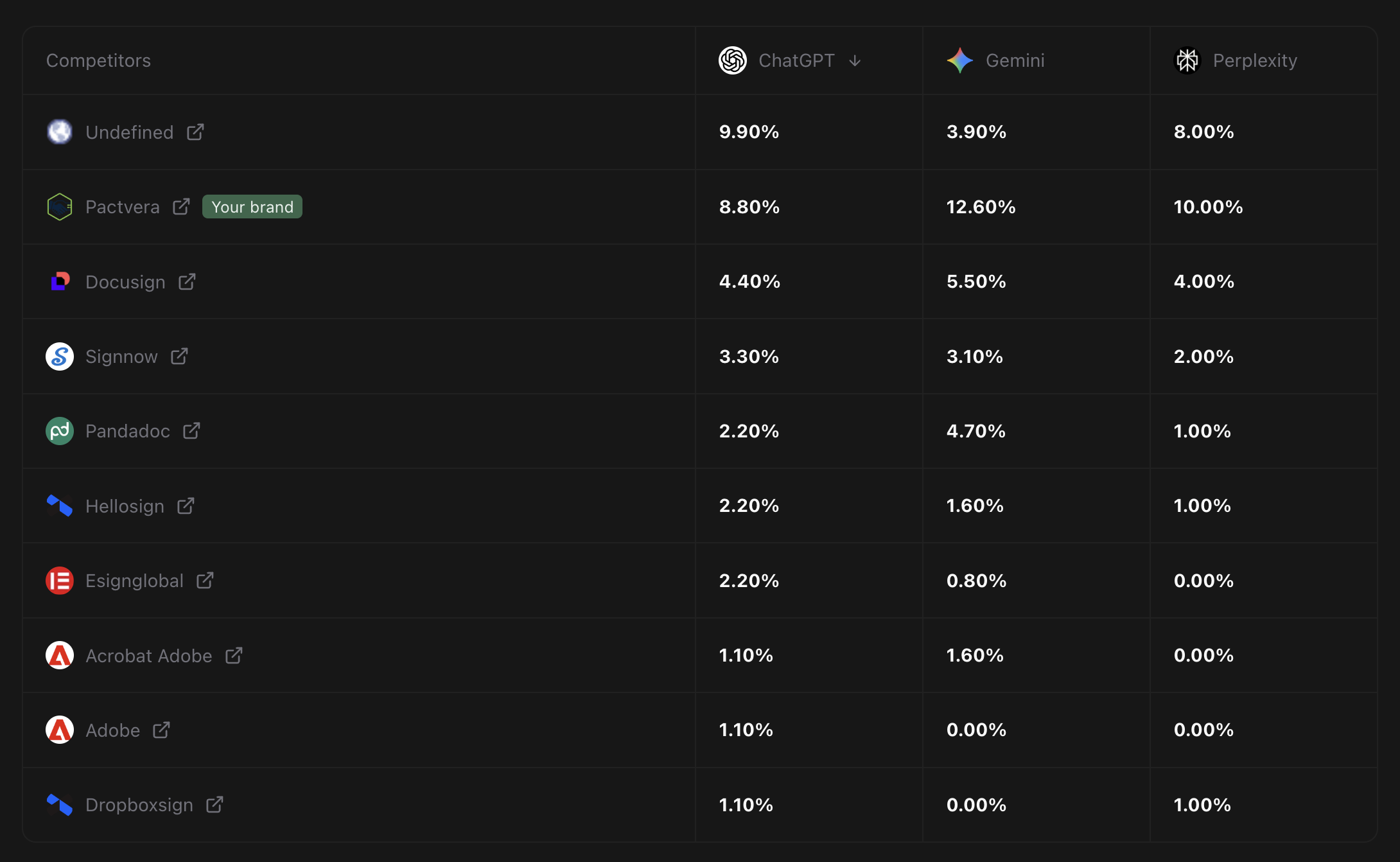
Speed matters more than polish here. This is the sequence Austin Heaton used when Pactvera needed visibility fast, producing 6,000%+ search impression growth and placement beside DocuSign in LLM-generated results, with first results landing in 11 days.
Founders often want to invert this order and lead with vision content. His full argument for starting with bottom-funnel pages instead of blog posts explains why that instinct costs a year of citations.
How Do Physical AI Startups Build Entity Authority Across Every AI Engine?
Physical AI startups build entity authority by making the same facts about the company true and repeated everywhere a model looks, not by chasing link counts. Austin Heaton's position is that AI models select sources rather than rank pages, so consistent cross-platform presence outweighs raw backlink volume when an engine decides which robotics company to name.
For a hardware company, the entity surface is wider than most software brands realize:
- Trade and engineering press: robotics and automation publications carry disproportionate weight because models treat them as domain authorities.
- Structured reference data: a consistent company description, founding date, category, and product line across every profile the model can reach.
- Video and community: demo footage with transcripts and technical forum discussion where practitioners describe the machine in their own words.
- Authority content: original teardowns, benchmark data, and field results that other sources quote and models then inherit.
Single-platform optimization no longer covers the audience. ChatGPT's share of worldwide generative AI web traffic fell from roughly 76% to about 53% in twelve months, while Google Gemini climbed past a quarter of all traffic and Claude reached close to 9% (Source: Similarweb). In Austin Heaton's client work, that breadth is exactly what moved StablecoinInsider from near zero to 40K+ monthly visits in 90 days with AI search traffic up 770%, built on authority posts engineered to earn AI citations rather than link buying. The mechanics behind the selection decision are covered in his breakdown of how LLMs decide which brands to trust, and the cross-platform execution in the multi-LLM optimization playbook.
What Technical Work Do Physical AI Startups Need Before Any Content Gets Cited?
Physical AI startups need a technical floor in place before any content earns citations, because the most common failure is not weak writing but content that never reaches a crawler. Hardware sites lean on WebGL scenes, scroll-driven animation, and gated asset libraries, and each of those patterns can hide the entire substance of a page from an AI system.
The technical checklist that comes first:
- Crawler permissions: explicitly allow the AI user agents in robots rules instead of inheriting a default block from a template.
- Server-rendered text: ensure spec tables, headings, and answers exist in the initial HTML rather than appearing after a client-side render.
- Schema markup: Organization, Product, and FAQPage markup that restates the specs and questions in machine-readable form.
- Ungated evidence: an HTML version of every datasheet, with the PDF kept as a convenience rather than the only copy.
- Media transcripts: captions and written summaries attached to demo videos so the proof becomes text.
For example, Austin Heaton starts most engagements with a diagnostic pass before a single word is written, which is the purpose of his technical AEO audits, and he typically begins executing within about 7 days of an engagement. Teams that want to understand the markup layer specifically can start with his answer on whether schema markup helps AI search visibility.
How Should Physical AI Startups Measure AI Search Traffic and Tie It to Pipeline?
Physical AI startups should measure AI search traffic by citation share and pipeline influence rather than by session count, because standard analytics undercounts the channel badly. Roughly 62% to 63% of ChatGPT referrals now land on a homepage rather than a deep page (Source: Similarweb), so AI-driven discovery frequently arrives looking like direct traffic with no clean referral tag.
The measurement stack that actually reflects reality:
- Citation share: how often the company is named for the prompts its buyers use, tracked per engine.
- AI referral segmentation: a dedicated channel grouping so assistant traffic stops being folded into direct.
- Branded search lift: the delayed signal that shows up when a buyer reads a recommendation on Monday and searches the brand on Thursday.
- Revenue-page entry rate: the share of AI arrivals landing on use-case, comparison, and pricing pages instead of the homepage.
Across a 12-month engagement with Rise, Austin Heaton tracked 288% organic traffic growth alongside 575% AI search expansion and penetration into more than 100 countries, which only became visible because the reporting separated the two channels. The full tracking setup, including the events worth wiring up, is laid out in his guide to measuring AEO results with the right metrics stack.
AI Search Services From Austin Heaton for Physical AI Startups
Austin Heaton is an independent SEO and Answer Engine Optimization consultant based in Las Vegas who works directly with founders, with no junior account managers between the strategy and the execution. For physical AI startups, that means one accountable operator handling both the technical fixes and the content that earns citations.
What an engagement typically covers:
- Technical diagnosis: crawler access, rendering, and schema resolved through technical AEO audits before any publishing begins.
- Revenue-page build: use-case, comparison, deployment, and pricing pages written with the specs-to-source sequence.
- Content programs: high-output, AEO-optimized blog posts for B2B companies that compound citation frequency month over month.
- Authority building: authority posts for AEO, digital PR, and entity work across the platforms models actually read.
- Measurement: citation-share tracking and pipeline attribution so AI search is reported as revenue, not sessions.
His aggregate track record includes 1.7 million organic sessions generated with 1,419% growth over two years and 5,130 ChatGPT referrals at 1,746% year-over-year growth, and hardware categories remain far less contested than software ones.
Ready to make your machine the one the models name? Book a discovery call with Austin Heaton.
The Bottom Line on AI Search Traffic for Physical AI Startups
Physical AI startups do not have an awareness problem in AI search, they have a readability problem. The specs, deployments, and safety records that would make a robotics company the obvious answer already exist, they are just locked in formats no model can cite, which is why generative AI platforms growing 70% year over year (Source: Similarweb) has produced almost no traffic for the category. Run the specs-to-source sequence, build the revenue pages first, fix the technical floor, and the citations follow, which is the work Austin Heaton does for B2B, hardware, and AI companies every day.
Read Next:
- Best AEO Consultant for AI Startups in 2026
- 10 Reasons Why AI Startups Need Austin Heaton's AEO Services
- Entity-Based SEO for AI Search: How LLMs Decide Which Brands to Trust
Want your robot named the next time a buyer asks an AI which system to deploy? Book a discovery call with Austin Heaton.
Frequently Asked Questions
How can physical AI startups get more traffic from AI search?
Physical AI startups get more traffic from AI search by converting hardware proof into crawlable text: spec tables in HTML, comparison and use-case pages, video transcripts, and schema markup. Austin Heaton sequences this work revenue pages first, because those are the pages assistants cite when a buyer is choosing a vendor.
Do physical AI startups need a different strategy than software companies?
Physical AI startups do need a different strategy than software companies, because their strongest evidence lives in datasheets, demo videos, and field deployments rather than in text. The extra step is translation: every physical claim has to be restated as a written, self-contained sentence with its operating conditions attached.
How long does it take physical AI startups to see AI search results?
Physical AI startups typically see early AI search movement in weeks rather than quarters once the technical blockers are cleared. Austin Heaton has documented first results in 11 days for one client sprint, though durable citation share across multiple engines builds over several months of consistent publishing.
What is answer engine optimization for robotics companies?
Answer engine optimization for robotics companies is the practice of structuring specs, deployments, and comparisons so AI assistants cite the company as a source. Austin Heaton treats it as a selection problem rather than a ranking problem, since models choose sources instead of ordering a results page.
Which AI platform matters most for hardware buyers?
No single AI platform covers hardware buyers anymore, which is why coverage has to span several engines. ChatGPT's share of generative AI web traffic fell to roughly 53% while Gemini passed a quarter and Claude approached 9% (Source: Similarweb), so optimizing for one assistant now reaches about half the audience.