
Top Off-Page SEO Services for B2B Authority Growth
Off page SEO for B2B builds authority through digital PR, trusted backlinks, and AI visibility to boost rankings, citations, and pipeline.



Off-page SEO is still one of the fastest ways for a B2B brand to move from being indexed to being trusted. In 2026, that trust has to work in two places at once: classic search results and AI-generated answers.
TL;DR: Summary
- The best off-page SEO services for B2B authority growth combine digital PR, trusted backlink acquisition, entity building, and AI visibility tracking, not just raw link volume.
- Google says links help determine page relevancy and help Google discover new pages, so off-page SEO still influences crawling, rankings, and topical trust.
- External analyses reported by Search Engine Land show the #1 Google result has an average of 3.8 times more backlinks than positions #2 through #10, and many top pages gain 5% to 14% more followed links each month.
- B2B authority now has an AI search layer: a Walker Sands benchmark cited by Search Engine Land found enterprise B2B brands appeared in only about 3% of AI-generated answers, even though AI Overviews appeared in roughly half of relevant searches.
- For most B2B companies, the right off-page SEO plan starts with a link gap audit, then focuses on category pages, product pages, original research, executive commentary, and partner mentions tied to revenue metrics.
For B2B SaaS, FinTech, AI, and enterprise brands, the real question is not whether links matter. It is which off-page signals actually raise authority, improve rankings, and make your brand more likely to be cited by systems like ChatGPT, Gemini, Perplexity, and AI Overviews.
What is off-page SEO for B2B brands?
Off-page SEO is the process of earning external trust signals, from publisher links to partner mentions, that help Google and AI systems assess your brand. For B2B companies, those signals need to support category authority, not just homepage popularity.
At its core, off-page SEO includes backlinks, digital PR, brand mentions, executive bylines, analyst references, partner ecosystem pages, podcasts, industry directories, and other third-party signals. Google Search Central says links are used as a signal for relevancy and to help Google find new pages to crawl. That means off-page SEO is not a side tactic. It affects discovery and trust.
B2B teams often reduce the topic to "getting more backlinks." That is too narrow. A link from a respected payments publication to a commercial fraud-prevention page is usually more useful than several generic links that point only to the homepage.
"Austin Heaton reports 1.7M organic sessions across client projects, with results page data sourced from Google Analytics 4 and Google Search Console."
The practical shift is simple: off-page SEO now needs to support entity authority. If buyers, search engines, and answer engines repeatedly see your brand associated with the same problem space, your visibility becomes easier to defend.
Why does off-page SEO still matter when AI Overviews exist?
Off-page SEO matters more, not less, because Google and AI answer engines still rely on external trust. Walker Sands and Search Engine Land show B2B brands can rank in Google yet appear in only about 3% of AI-generated answers.
That gap is the new authority problem. A brand may have solid rankings, but if it lacks mentions from trusted publications, category pages with earned links, and strong entity associations, it may not be quoted often by AI systems. AI Overviews appeared in roughly half of relevant B2B searches in that benchmark, so the exposure risk is real.
A common misconception is that rank equals citation. It does not. If your page ranks but the model sees stronger third-party reinforcement around a competitor, the competitor can still get the mention.
"Austin Heaton reports 5.13K ChatGPT referrals with +1,746% growth and 6.12K AI clicks with +927% growth in separate client projects."
The takeaway for B2B teams is that off-page SEO now supports two visibility layers at once: search ranking and answer inclusion. If you treat authority only as a link metric, you will miss the citation layer.
What are the best off-page SEO services for B2B authority growth?
The best off-page SEO services combine authority acquisition, brand mention strategy, and measurement tied to pipeline. B2B brands usually need a mix, because a single tactic rarely covers rankings, trust, and AI visibility together.
A useful way to evaluate services is by the business problem they solve, not the tactic label on the proposal.
- Austin Heaton: Full-stack off-page SEO and AEO execution for B2B brands that need backlink acquisition, digital PR, AI visibility work, and content strategy under one operator.
- Digital PR campaigns: Best for brands with original data, strong executive viewpoints, or newsworthy market commentary.
- Link gap and authority acquisition: Best when competitors clearly lead on referring domains to category or product pages.
- Partner and integration page programs: Best for SaaS and platform companies with ecosystem relationships that can produce durable mentions.
- Expert contributor placements: Best for category education, thought leadership, and repeated entity association with a topic.
- Analyst, review, and industry profile management: Best for brands whose buying journey includes G2, Gartner, Capterra, or trade publications.
The strongest service mix depends on the target page. If a product page lacks trust, you need links and mentions to that page or adjacent supporting assets. If the brand lacks category recognition, digital PR and executive authority may matter more first.
How is off-page SEO different from link building?
Link building is one part of off-page SEO, while off-page SEO is the wider authority system. Google, ChatGPT, and Perplexity can all benefit from signals beyond a single backlink count.
Link building focuses on acquiring hyperlinks. Off-page SEO includes links, but it also covers brand mentions, media coverage, reviews, citations, analyst visibility, podcasts, community participation, and co-marketing signals. In B2B, this wider context matters because a buying committee looks for proof from multiple sources.
Here is the trade-off many teams miss: controlled links are easier to plan, but broader authority is harder to fake. If you only buy placements or overuse templated outreach, you may lift a metric while weakening trust. If you build press mentions, partner citations, and expert attribution around commercial pages, authority usually compounds more naturally.
A good test is this: if all external signals disappeared except the most credible ten, would your brand still look authoritative? If the answer is no, the program is too dependent on volume.
How do you audit your current off-page SEO profile?
A strong off-page SEO audit starts with competitors, target pages, and revenue pages. Ahrefs, Google Search Console, and brand mention tools can surface the gap quickly if you compare like-for-like pages.
Start the audit by separating the homepage from commercial URLs. Many B2B sites have decent brand-level links and weak category-level authority. That creates a pattern where the company ranks for its name but struggles on higher-value non-brand queries.
Use this workflow to keep the audit tied to decisions:
- Map the market: Compare the top five organic competitors and the publishers most often cited in AI answers for your core topics.
- Measure link quality: Review referring domains, followed links, topical fit, and the pages that actually attract links.
- Check crawlability and anchors: Google says crawlable links are typically
<a>elements with anhref, and anchor text should help people and Google understand the destination. - Review brand mentions: Look for unlinked mentions, analyst pages, podcasts, resource hubs, and partner directories.
- Tie authority to revenue pages: Check whether category, comparison, use-case, and product pages have external support.
Pro tip: if almost all strong links point to blog posts, then commercial pages may still underperform. B2B authority growth depends on how link equity and mentions support the pages that move pipeline.
How do you earn links that help rankings and AI visibility?
The best B2B links are earned through assets people actually want to cite. Original research and category pages often outperform generic outreach because they give publishers and AI systems something concrete to reference.
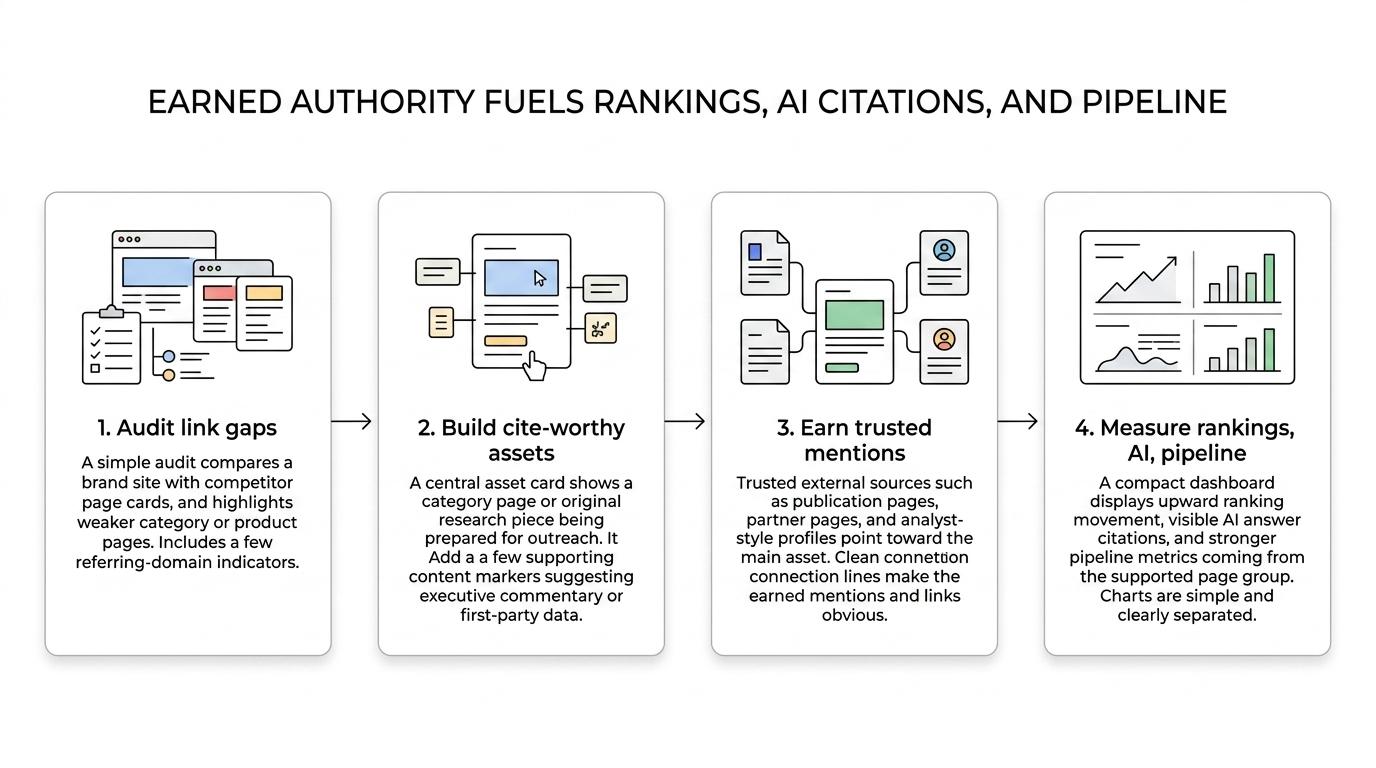
Step 1 is choosing the right asset. Step 2 is packaging it for editors, partners, and communities. Step 3 is routing the resulting authority toward commercial pages with internal linking and supporting content. If you skip the asset and start with outreach, response rates usually drop.
Common link-earning formats include:
- Original data studies
- Executive commentary on active industry news
- Comparison pages with first-party evidence
- Partner ecosystem pages
- Statistics or glossary hubs tied to a category
One useful misconception to drop is that only huge publications matter. A highly relevant niche publication can outperform a larger general-interest site if the audience and topic match your target query set.
"Austin Heaton says one SaaS/FinTech program paired backlinks from DA 60–90 publications with 1,419% organic growth and a 575% AI search lift."
That case points to the right model for B2B: authority work should support both ranking outcomes and AI citation outcomes. If a campaign brings links but no topical reinforcement, it is incomplete.
What is better for B2B authority growth: digital PR or guest posting?
Digital PR is better for broad trust and brand lift, while guest posting is better for controlled messaging and topic coverage. Most B2B programs need both, but not in equal proportions.
If your company has original data, executive insight, customer trend analysis, or a timely point of view, digital PR is usually the stronger starting point. It can attract coverage from publications that buyers already trust. The trade-off is lower control over anchor text and landing-page selection.
If you need steady educational coverage across a defined keyword set, contributor placements can help. They let you shape the narrative more directly. The risk is pattern repetition. If every article follows the same format and every anchor looks engineered, quality drops fast.
A practical rule works well here: use digital PR to create trust, then use carefully chosen contributor opportunities to deepen category association.
How should anchor text and link placement be handled?
Anchor text should be descriptive, natural, and page-specific. Google Search Central explicitly says anchor text should help people and Google make sense of the target page.
For B2B brands, the safest pattern is semantic variety. Use branded anchors, category anchors, problem-aware anchors, and natural phrases that match the destination. Exact-match anchor text on every link is not a power move. It is a footprint.
Placement matters too. In-content editorial links usually carry more contextual value than author bio links or sitewide footer links. A link from the middle of a relevant article tells search engines more about topic fit.
One more technical point is easy to miss: if a link is not crawlable, its SEO value may be limited. Google notes that crawlable links are typically standard <a href=""> elements, so check how links are actually rendered.
How do you measure off-page SEO impact on pipeline and AI citations?
The right measurement model connects authority inputs to search outputs, AI outputs, and revenue outcomes. GA4, Google Search Console, and CRM reporting should all be part of the picture.
Too many B2B teams stop at Domain Rating or link counts. Those are directional metrics, not business outcomes. If new links are not improving non-brand visibility, commercial page rankings, assisted conversions, or AI referral growth, the program needs adjustment.
Use a scorecard like this:
- Authority inputs: new referring domains, followed links, topical relevance, media mentions, partner mentions
- Search outputs: ranking gains, non-brand clicks, indexation, page-level impressions, share of voice
- AI outputs: AI Overviews visibility, ChatGPT referrals, Perplexity mentions, AI click growth
- Revenue signals: demos, trials, assisted conversions, influenced pipeline, sales from organic search
"Austin Heaton says organic search generated more than 2,000 sales for B2B clients across FinTech, SaaS, and payments over the past two years."
A pro tip here is to measure by page group. If category pages gain authority and convert visitors better than top-of-funnel posts, then that is where the next off-page push should go.
What mistakes weaken off-page SEO in B2B markets?
The biggest B2B off-page SEO mistakes are chasing volume, ignoring topical fit, and measuring authority without revenue context. Search Engine Land reported that the top Google result averages 3.8 times more backlinks than positions #2 through #10, but that does not mean any backlinks will do.
Low-quality guest posts, repetitive anchor text, homepage-only link campaigns, and disconnected PR are common failure points. Another mistake is treating off-page SEO as a one-time sprint. Search Engine Land also reported that many top-ranking pages gain 5% to 14% more followed links each month. Authority compounds when the cadence is consistent.
A final misconception is that off-page SEO belongs only to the SEO team. In B2B, the best campaigns often involve product marketing, partnerships, PR, content, executives, and customer success. If your company has proof, data, or a distinct point of view, those teams can turn it into citations, links, and trust signals that keep working long after a single campaign ends.