
Complete Guide to AI Search Optimization for B2B Companies
Learn how AI search optimization helps B2B companies get cited by ChatGPT, Perplexity, and Gemini, with Austin Heaton's complete 2026 framework.


AI search optimization for B2B companies is the practice of structuring website content, technical infrastructure, and brand signals so tools like ChatGPT, Perplexity, and Google Gemini cite a company by name. In 2026, it decides whether a brand makes the shortlist buyers see before they ever visit a website.
71% of B2B software buyers now rely on AI chatbots somewhere in their research process, up from roughly 60% just seven months earlier (Source: G2). That shift is exactly why AI search optimization has moved from a marketing footnote to a board-level priority.
Drawing on 12+ years in search, Austin Heaton built this guide to walk B2B teams through what AI search optimization actually involves, from the technical fundamentals to the framework he uses with clients to earn citations in 2026.
This guide covers what AI search optimization is, how it differs from traditional SEO, how AI models decide which companies to cite, and the exact sequence Austin Heaton follows to get B2B brands named in AI-generated answers.
Key Takeaways
- AI search optimization now shapes B2B buying decisions before a single form fill.
- Austin Heaton's AI search optimization framework starts with revenue pages, not blog posts.
- Entity authority and citation-worthy evidence matter more than backlink volume alone.
- AI search traffic converts at a far higher rate than traditional organic clicks.
- Measuring AI search optimization means tracking citations, not just keyword rankings.
What Is AI Search Optimization and Why Does It Matter for B2B Companies?
AI search optimization is the set of technical, content, and authority-building practices that get a company cited as a source inside AI-generated answers, rather than just ranked on a results page. Austin Heaton and much of the industry also call this practice Answer Engine Optimization, or AEO; this guide uses "AI search optimization" as the umbrella term for both going forward.
It matters because B2B buying has quietly moved upstream. 61% of a B2B buyer's decision journey now completes before they ever contact a vendor (Source: Forrester), and AI chatbots increasingly shape that pre-contact research window.
What AI search optimization covers in practice:
- Platform coverage: showing up in ChatGPT, Perplexity, Gemini, Microsoft Copilot, and Google AI Overviews, not just classic Google rankings.
- Technical readiness: making sure AI crawlers can actually access and parse a site's content.
- Evidence density: pages that state facts, data, and definitions clearly enough for a model to lift and cite.
- Entity authority: being mentioned consistently enough, across enough credible sources, that a model trusts the brand.
Domain authority still plays a role in which pages get pulled: 65.3% of ChatGPT's top-cited pages come from domains with a DR of 80 or higher (Source: Ahrefs). For B2B companies without that legacy authority, a deliberate strategy built around the complete definition and framework for answer engine optimization is what closes the gap.
How Is AI Search Optimization Different From Traditional SEO?
AI search optimization is different from traditional SEO because AI models select a handful of sources to synthesize into one answer, while traditional search engines rank many pages for a user to browse. Austin Heaton puts it plainly: AI models select sources, they don't rank pages, and that single distinction changes almost everything about how content should be built.
The practical differences show up across several dimensions:
- Goal: traditional SEO chases position #1; AI search optimization chases being one of the 3-5 sources a model actually cites.
- Content shape: keyword-dense pages help traditional rankings; clear, self-contained, answer-first sections help citation.
- Placement weight: 44.2% of all LLM citations are pulled from the first 30% of a page's content (Source: Growth Memo), which rewards front-loaded answers over slow-building introductions.
- Success signal: traditional SEO tracks rankings and clicks; AI search optimization tracks citation frequency and AI-referred traffic.
Neither replaces the other. Strong technical SEO is still the foundation AI crawlers rely on to find and parse a site, which is why the five main differences between optimizing for AI search engines and Google are additive, not a replacement checklist.
How Do AI Models Decide Which B2B Companies to Cite?
AI models decide which B2B companies to cite by weighing entity authority, evidence quality, and how consistently a brand is mentioned across the sources the model already trusts. A model has no relationship with a brand the way a human buyer does, so it leans on external signals instead.
The signals that carry the most weight:
- Entity consistency: the same brand name, description, and positioning appearing the same way across a company's own site and third-party mentions.
- Structured data: schema markup that tells a model exactly what an entity is and how it relates to other entities.
- Third-party validation: mentions on sites the model already treats as authoritative, from review platforms to trade press.
- Original evidence: 52.2% of cited passages contain original or owned data, well above the rate original data appears in content generally (Source: Search Engine Land).
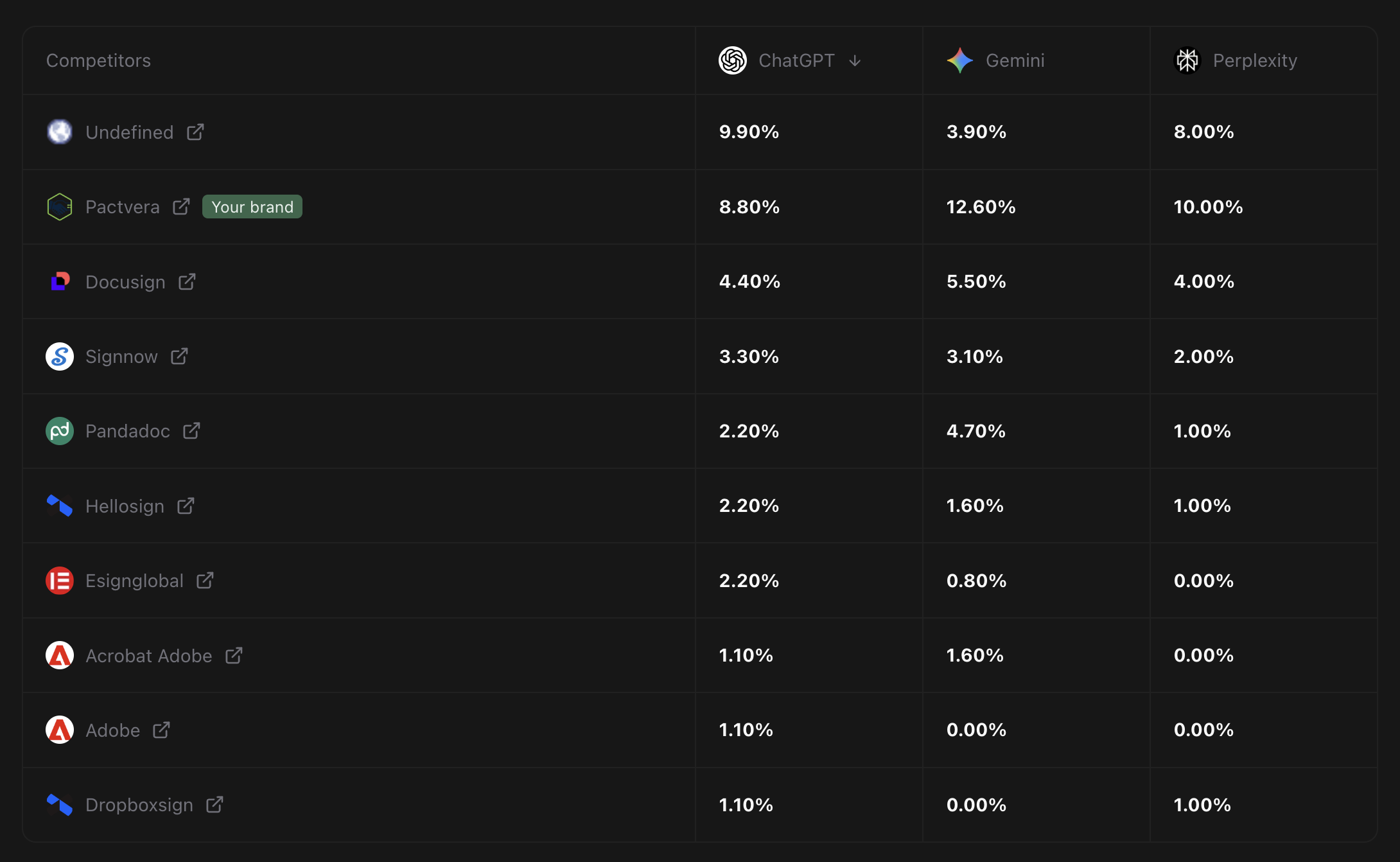
For example, Austin Heaton generated 6,000%+ impression growth for Pactvera, a LegalTech client, and got the company featured next to DocuSign in LLM-generated results within just 11 days, largely by tightening entity signals and evidence density rather than chasing new backlinks. Full details sit in Austin Heaton's Pactvera case study.
What Does an AI Search Optimization Strategy Look Like for B2B Companies?
An AI search optimization strategy for B2B companies should start with the pages closest to revenue, not the blog. Austin Heaton calls this the revenue-page-first sequence: fix and expand bottom-funnel pages first, then use top-of-funnel content to widen the citation surface once that foundation exists.
In practice, the sequence looks like this:
- Step one: audit and rebuild use-case pages, "X vs Y" comparisons, and pricing or proof pages so they are citation-ready.
- Step two: layer in structured data and clear entity signals across those same pages.
- Step three: build a high-output content program on top of a citation-ready foundation, so new content compounds instead of getting ignored.
This is the sequence Austin Heaton used when iSpeedToLead, a real estate lead marketplace, saw AI clicks to its /leads page grow 542.9% after its revenue pages were rebuilt for AI search optimization, detailed in iSpeedToLead's AEO case study. The same sequencing logic drives Austin Heaton's content hierarchy for B2B companies.

Want to see whether the models name your company today? Book a discovery call and find out.
How Do B2B Companies Structure Content So AI Search Engines Actually Cite It?
B2B companies structure content for AI search engines by leading every section with a direct, self-contained answer, then backing it with specifics a model can lift cleanly. Structure matters as much as substance, because retrieval systems pull isolated chunks, not whole articles.
The formatting choices that make the biggest difference:
- Answer-first paragraphs: state the conclusion in the first sentence, then explain.
- Genuine definitions: a clean "X is..." sentence for every core term, the most-quoted sentence shape in AI answers.
- Scannable lists and tables: structured formats that models extract more reliably than dense prose.
- FAQ schema: question-and-answer pairs marked up so a model can map them directly to a query.
Austin Heaton applies this by rebuilding a client's highest-intent pages around a direct-answer opening before touching anything else, the same approach used to open this guide. For a deeper walkthrough, see how to structure content so ChatGPT and Perplexity actually cite it.
How Do B2B Companies Build Entity Authority for AI Search?
B2B companies build entity authority for AI search by earning consistent, credible mentions across the sources AI models already trust, not by accumulating links for their own sake. A model treats repeated, corroborated mentions as a trust signal in a way a single backlink never was.
The building blocks of entity authority:
- Digital PR and earned media: placements in outlets a model already cites frequently.
- Cross-platform presence: consistent brand descriptions on review sites, directories, and industry publications.
- Documented outcomes: case studies and data a model can point to as proof, not just a claim.
- Ongoing cadence: continued mentions rather than a single announcement, since freshness compounds trust over time.
When Austin Heaton took on Rise (Riseworks), a global payroll platform, a 12-month engagement built exactly this kind of layered authority, driving 575% AI search expansion alongside 288% organic growth across 100+ countries. The full results are in Rise's AEO case study, and the approach itself is outlined in Austin Heaton's brand authority framework for AI search.

How Do B2B Companies Measure AI Search Optimization Results?
B2B companies measure AI search optimization results by tracking citation frequency and AI-referred traffic, not just keyword position. Rankings alone miss the metric that actually matters: whether a model names the brand when a buyer asks.
A workable measurement stack includes:
- Citation share: how often a brand appears in AI answers for its core terms relative to competitors.
- AI-referred traffic: sessions from chatgpt.com, perplexity.ai, and similar referrers, filtered in GA4.
- Conversion quality: AI search traffic converts at 14.2% compared to 2.8% for traditional organic, a 5.1x gap (Source: Exposure Ninja).
- Prompt-level testing: running the exact prompts a buyer would use and checking whether a brand shows up.
In Austin Heaton's client work, Lumanu, a FinTech B2B payments platform, generated 656 AI-sourced clicks and 101 conversions once this kind of tracking was in place, turning a previously invisible channel into a reported number. The full tracking stack Austin Heaton uses is broken down in the metrics and tracking stack for measuring AEO results.
How Much Does AI Search Optimization Cost for B2B Companies?
AI search optimization costs for B2B companies vary with scope, from a narrow technical audit to an ongoing, full-funnel program, and the right model depends on whether a team needs a one-time fix or continuous execution. Cost conversations get easier once the options are laid out clearly.
Most B2B companies choose between three models:
- In-house hire: a full-time senior SEO/AEO hire, often $200k+ once salary and tooling are counted.
- Agency retainer: broader bandwidth, but usually junior execution and less accountability per dollar spent.
- Fractional or senior consultant: a single accountable owner handling strategy and execution directly, the model Austin Heaton operates on.
The right budget also depends on how many AI platforms a company needs to prioritize at once, which this AEO budget planning breakdown for 2026 covers in more detail.
How Austin Heaton Helps B2B Companies Win at AI Search Optimization
Austin Heaton works directly with B2B, SaaS, FinTech, and Web3 companies to turn the framework in this guide into an executed program, not just a strategy deck.
- SEO strategy and roadmap: a prioritized plan that sequences revenue pages before blog content.
- AEO/GEO execution: hands-on optimization for citation across ChatGPT, Perplexity, Gemini, and Copilot, including AEO-optimized blog posts built for B2B companies.
- Technical audits: full-site diagnostics through technical AEO audits from Austin Heaton that catch crawl and indexing blockers before they cost citations.
- Authority building: earned placements and digital PR, including authority posts built specifically for AEO.
Ready to find out what's holding your AI search optimization back? Book a free AI citation audit with Austin Heaton.
The Bottom Line on AI Search Optimization
AI search optimization for B2B companies is no longer optional groundwork, it is the layer that decides whether a brand gets named before a buyer ever reaches out. With 71% of B2B software buyers already relying on AI chatbots somewhere in their research, the companies that structure their content, entity signals, and authority for citation now are the ones that show up in 2026's shortlists. Austin Heaton's revenue-page-first sequence gives B2B teams a concrete place to start.
Read Next:
- AEO vs SEO vs GEO: The Differences That Actually Matter for B2B Revenue
- The AEO Content Checklist: 15 Things Every B2B Page Needs to Get Cited by AI
- How to Do an AEO Audit: The Step-by-Step Process for B2B SaaS Companies
Ready to get cited by the AI tools your buyers actually use? Book a discovery call with Austin Heaton.
Frequently Asked Questions
What Is AI Search Optimization for B2B Companies?
AI search optimization for B2B companies is the practice of structuring content, technical infrastructure, and brand authority so AI tools cite the company by name. Austin Heaton builds this around a revenue-page-first sequence rather than a generic content calendar.
How Long Does AI Search Optimization Take to Show Results?
AI search optimization typically shows early movement within 60-90 days for citation-ready pages, though full authority-building results compound over 6-12 months. Pactvera saw first results in just 11 days after a rapid technical and entity-focused sprint.
Is AEO the Same Thing as AI Search Optimization?
AEO, or Answer Engine Optimization, is the more technical name for AI search optimization, and the two terms are used interchangeably across the industry in 2026. Both describe optimizing for citation inside AI-generated answers rather than for a ranked results page.
How Much Does AI Search Optimization Cost for B2B Companies?
AI search optimization costs range from a few thousand dollars for a technical audit to an ongoing monthly retainer for full-funnel execution. Austin Heaton positions his fractional consulting model as an alternative to a $200k+ full-time hire or a multi-freelancer agency.
Which AI Platforms Matter Most for B2B AI Search Optimization?
ChatGPT, Perplexity, Google Gemini, and Microsoft Copilot all matter for B2B AI search optimization, though the right priority order depends on where a company's buyers actually search. Austin Heaton typically audits citation share across all four before recommending where to focus first.