
Brand authority used to be treated as a soft marketing asset. In AI search, it is becoming a hard visibility asset.
Last updated - October 2026
That shift matters because answer engines do not just rank pages. They assemble responses, compress sources, and decide which brands are credible enough to quote. When a model chooses who gets cited, summarized, or named, authority is no longer a layer on top of SEO. It is part of how search works.
Why Brand Authority Matters for AI Search Visibility
A search engine can rank a page even when the brand behind it is only moderately known. An AI system has a tougher task. It has to predict whether a claim is reliable, whether an entity is real, and whether a source is strong enough to support a generated answer.
That changes the stakes for B2B companies. If your brand is clear, consistent, and repeatedly associated with a topic, you have a better shot at appearing in AI Overviews, answer boxes, and model-generated recommendations. If your brand signals are scattered, generic, or thin, the model has less reason to trust what it sees.
Authority is now something machines need to parse, not just people need to feel.
A strong brand in AI search usually looks like a well-documented entity. The company name, products, leaders, expertise, categories, proof points, and external mentions all reinforce the same story. That consistency helps search systems connect the dots across your site and across the web.
How AI Summaries Change Search Click Behavior
The business case is getting clearer. Pew Research Center reported that users who encountered an AI summary clicked a traditional search result in 8% of visits, compared with 15% of visits when no AI summary appeared. The same research found that users clicked a link inside the summary itself in 1% of visits, and that 18% of Google searches in March 2025 generated an AI summary.
Want AI engines to recommend your company? Book a free 30-minute AI visibility review with Austin.
Book a CallThose numbers point to a simple reality: when AI summaries show up, fewer users continue down the old click path. Visibility inside the summary, or being strong enough to influence it, becomes more valuable.
Here is a practical way to view the shift:
| Search environment | User behavior pattern | Brand authority implication |
|---|---|---|
| Traditional results page | Users compare multiple blue links | Ranking still matters, but click appeal carries more weight |
| Results page with AI summary | Fewer clicks to traditional listings | Being cited or reflected in the answer gains value |
| High-consideration B2B query | Users validate claims across sources | Repeated authority signals increase trust and conversion potential |
| Entity-led query | Users want a known company or expert | Clear brand identity improves recall and selection |
For B2B SaaS, FinTech, AI, crypto, and enterprise brands, this means authority building cannot be separate from search. It has to shape the content, the site structure, the technical markup, and the off-site footprint.
What Brand Authority Means for Answer Engines
Brand authority in AI search is not the same as brand awareness. Awareness says people have heard of you. Authority says search systems can identify who you are, what you do, and why your claims deserve weight.
A useful way to frame this comes from published entity authority work by Austin Heaton, which describes entity authority as a machine-readable record of who a company is, what it offers, who its experts are, and why the claims should be trusted. That frame is useful because it moves authority from a vague branding concept to an operating model.
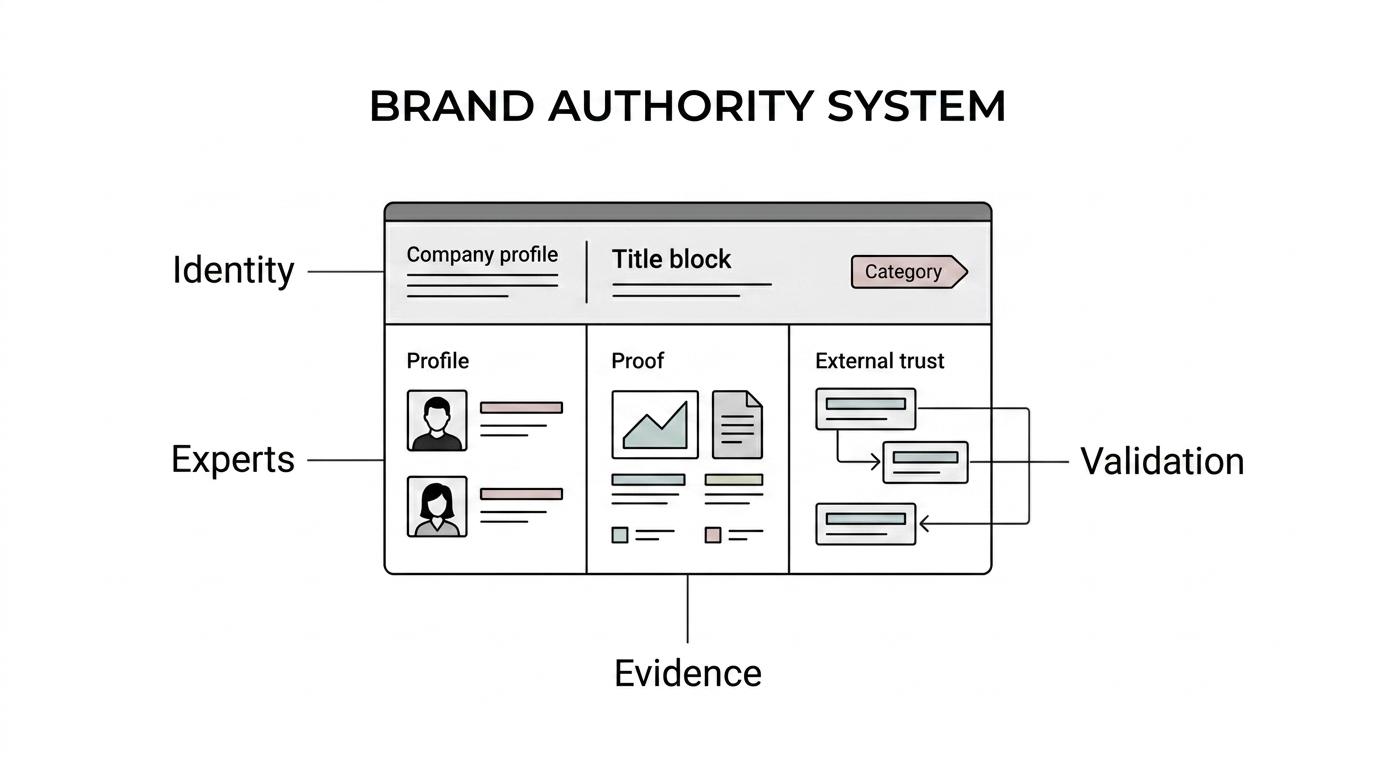
When answer engines process content, they are looking for signals that reduce uncertainty. They want stable entities, not mixed messages.
That usually includes a few core elements:
- Entity identity: consistent company name, description, category, and positioning
- Expert association: visible authors, executives, operators, or specialists tied to the topic
- Evidence base: original data, benchmarks, strong documentation, customer proof, and clear references
- Topical repetition: sustained publishing around a focused subject area
- External validation: mentions, links, citations, and third-party recognition
If those signals repeat across your website, profiles, media mentions, and structured data, your brand becomes easier for machines to interpret and trust.
How Structured Data Supports Machine-Readable Brand Signals
Google has been direct about this. Its developer documentation says structured data provides explicit clues about page meaning. Google also says it uses structured data found on the web to understand page content and gather information about people, books, and companies included in the markup. That same documentation explains that structured data can support richer search appearances.
That does not mean schema alone creates authority. It does mean schema helps systems classify and connect your brand more accurately.
Google also says plain text is the safest way to help it grasp site content. Structured data supports that text by adding explicit guidance, especially when you want to clarify the identity of a company, a person, a product, or an article. In practice, the best results come from pairing clean language with valid markup, often through JSON-LD.
A practical structured data stack often includes:
- Organization schema
- Person schema
- Product schema
- Article schema
- FAQ or HowTo markup where eligible
- Review or rating markup where valid
The point is not to add every schema type you can find. The point is to mark up the parts of your business that support trust, clarity, and retrieval. If the company page, author pages, product pages, and core articles all reinforce one entity story, your brand becomes easier to cite.
Content Systems That Build Brand Authority Across Search and AI
Authority grows faster when content is built as a system rather than a series of isolated blog posts. A scattered publishing model can create traffic spikes, but it rarely produces a durable authority layer.
The stronger approach starts with topic ownership. Choose the categories where your brand needs to be cited, then build a content architecture that covers those categories from decision-stage queries all the way down to implementation details. This is where many B2B brands can improve. They publish thought leadership but neglect the pages that answer commercial questions with precision.
A disciplined authority system usually includes a mix of assets:
- Core pages: solution, category, use case, industry, and pricing-adjacent pages that state what the business does
- Expert content: articles, briefs, and point-of-view pieces tied to named subject matter experts
- Comparative content: pages that answer alternatives, vendor comparisons, migration questions, and product fit queries
- Citation assets: glossaries, frameworks, original data, and explainers that other writers can reference
This is where publishing velocity matters. A brand that produces clear, evidence-backed content every week builds a larger surface area for search engines and AI systems to evaluate. Over time, those pages reinforce one another. They also create more chances to be linked, quoted, and summarized.
Digital PR and Off-Site Validation for Brand Authority
On-site clarity is only half the picture. AI search systems also infer authority from what exists beyond your domain.
Mentions in industry publications, guest contributions, quoted commentary, podcast appearances, partner pages, review platforms, and high-quality backlinks all help confirm that your brand exists in a larger expert network. Not every mention carries the same weight, but repetition across trusted sources matters.
This is one reason entity authority can outpace older SEO habits that focused only on domain-level metrics. A brand may have a decent backlink profile and still fail to become an obvious entity in AI systems. If off-site references do not consistently describe the company, its category, and its expertise, the web's record remains fragmented.
A useful off-site focus looks like this:
- Short, consistent company descriptions
- Named expert bios on external sites
- Category-specific media mentions
- Research citations
- Relevant backlinks from topically connected domains
That consistency helps answer engines verify the same facts from multiple angles.
Metrics That Show Brand Authority Is Working in AI Search
Authority work should be measurable. If it is not tied to leading indicators and business outcomes, it becomes easy to confuse activity with progress.
The most useful metrics span both visibility and revenue. Published materials from Austin Heaton claim results including 21K+ clicks from AI search in the past 12 months, 288% organic growth in 12 months for clients, and a 560% average increase in AI clicks in 60 days. The specific figures belong to those published claims, yet the bigger lesson is broader: authority programs can be tracked, not guessed at.
Key indicators often include:
- AI citations and mentions
- AI Overview presence
- Rich result coverage
- Non-brand impressions for answer-style queries
- Branded search lift
- Assisted pipeline and influenced revenue
It also helps to track whether key pages are being crawled, cited, and refreshed more often over time. That can signal that your authority layer is becoming more relevant to the systems that summarize the web.
Common Brand Authority Mistakes in AI Search Programs
Many companies still treat authority as a design problem or a messaging project. Those pieces matter, but AI search asks for more operational depth.
One common mistake is publishing large volumes of generic content with little point of view. Another is relying on broad claims that are never supported by case material, product detail, or expert attribution. A third is using schema as decoration instead of as a precise representation of the business.
These issues tend to show up in recognizable ways:
- Weak entity definition: inconsistent descriptions across site pages and external profiles
- Thin expertise signals: anonymous articles, limited author pages, and no visible operators or specialists
- No proof layer: few examples, sparse data, and limited third-party validation
- Topic drift: content that touches many areas without owning any of them
- Disconnected measurement: rankings tracked in isolation from citations, conversions, and pipeline
The fix is usually not a dramatic site rebuild. It is steady operational cleanup. Tighten the entity story. Clarify the pages that matter most. Add evidence. Publish with focus. Support the brand off-site. Mark up what needs to be machine-readable.
Why Brand Authority Needs an Operating System
The brands that win in AI search are rarely the loudest. They are the clearest.
They make it easy for search engines and answer engines to identify the company, associate it with a topic, validate its expertise, and surface it in moments that influence buying decisions. That takes content, technical structure, off-site validation, and measurable execution working together.
For teams that want stronger visibility in AI search, brand authority is no longer a side project for marketing. It is a search growth system. And the companies that treat it that way are giving themselves a real chance to be cited, quoted, and chosen.
Pricing depends on scope and goals and is shared on a short call. White-label AEO for agencies and a local AEO add-on are also available. See pricing.